Passenger Drones Market Size, Share & Demand Report By Propulsion Type (Electric, Hybrid, Hydrogen Fuel Cell), By Application (Urban Transportation, Emergency Medical Transportation, Tourism and Leisure, Airport Shuttle Services, Corporate Mobility), By Capacity (One Passenger, Two Passengers, Four Passengers, More Than Four Passengers), By Region & Segment Forecasts, 2026–2034
USD 3950
Market Overview
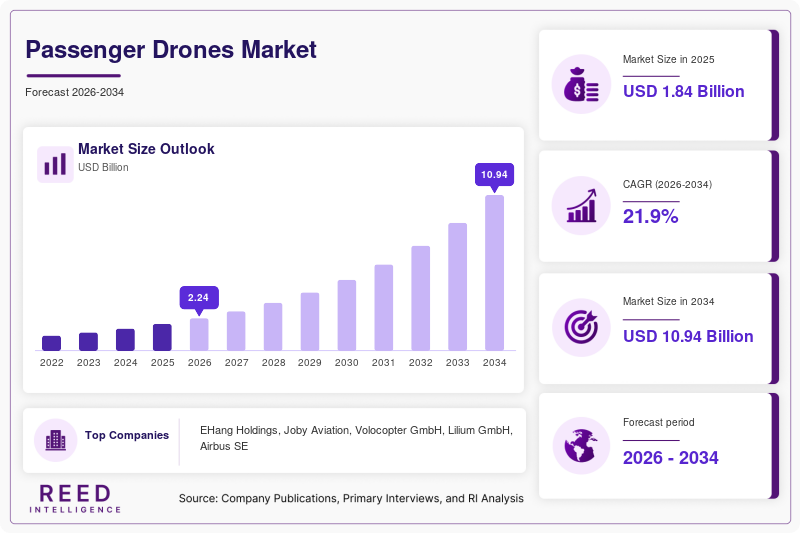
The global Passenger Drones Market size was valued at USD 1.84 billion in 2026 and is projected to reach USD 8.96 billion by 2034, expanding at a CAGR of 21.9% during the forecast period from 2026 to 2034. The market is gaining momentum due to increasing investments in urban air mobility infrastructure, rising demand for sustainable transportation systems, and rapid advancements in electric propulsion technology. Passenger drones, also referred to as autonomous aerial mobility vehicles, are being developed for short-distance urban transportation, emergency mobility services, and premium tourism applications. Growing congestion in metropolitan cities has accelerated interest in aerial mobility solutions that can reduce travel time and support efficient transportation systems.
Government initiatives supporting smart city development and low-emission transportation networks have also strengthened market growth. Several aviation authorities are collaborating with private manufacturers to establish safety regulations and certification frameworks for electric vertical take-off and landing aircraft. Improvements in lightweight battery systems, autonomous navigation software, and artificial intelligence-based traffic management platforms are further supporting commercial deployment. The increasing involvement of aerospace companies, mobility startups, and defense contractors is creating a competitive ecosystem focused on commercialization and operational efficiency.
Key Highlights
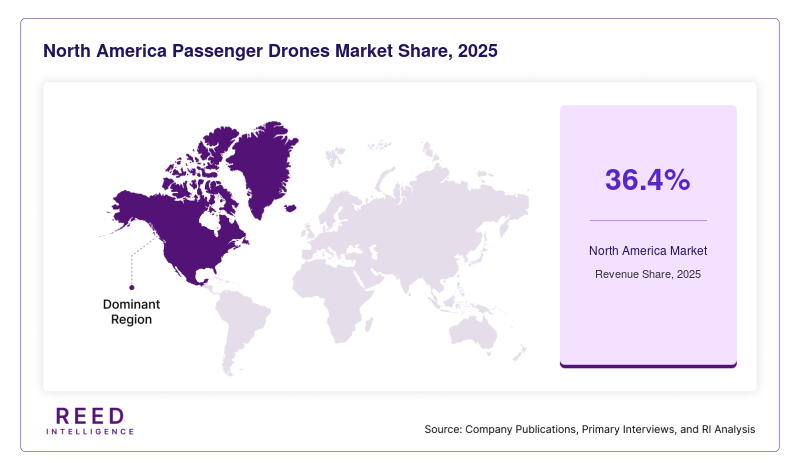
- North America dominated the Passenger Drones Market with a 36.4% share in 2025, while Asia Pacific is expected to grow at the fastest CAGR of 24.1% during 2026–2034.
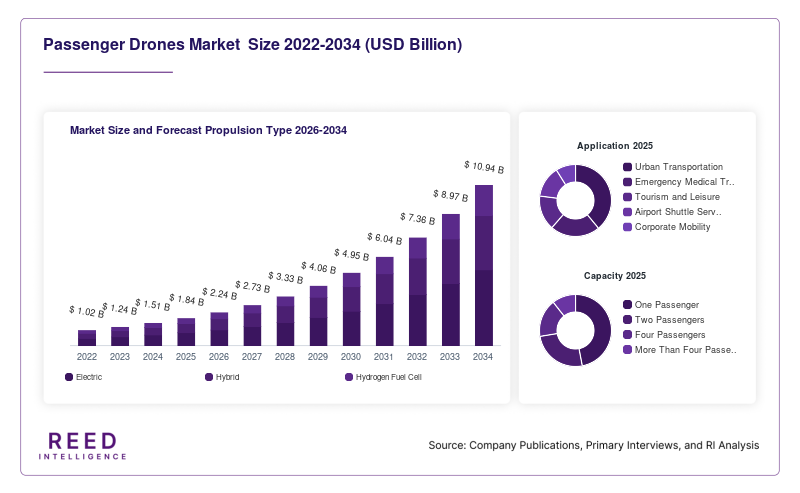
- By propulsion type, electric passenger drones accounted for the largest share of 61.8% in 2025, while hybrid propulsion systems are projected to grow at a CAGR of 23.6% during the forecast period.
- By application, urban transportation held the leading share of 44.2%, whereas emergency medical transportation is anticipated to expand at a CAGR of 24.8% through 2034.
- By capacity, two-passenger drones captured the largest market share of 47.5% in 2025, while four-passenger drones are expected to grow at a CAGR of 22.9%.
- The United States remained the dominant country, with market values of USD 620 million in 2024 and USD 760 million in 2025.
Market Trends
Expansion of Urban Air Mobility Infrastructure
Urban air mobility projects are becoming a central trend in the Passenger Drones Market as governments and private firms increase investments in aerial transportation infrastructure. Major metropolitan cities are developing vertiports, charging hubs, and digital traffic management systems to support commercial passenger drone operations. Airports and transportation authorities are integrating drone mobility corridors into existing transit networks to improve short-distance travel efficiency. The growing emphasis on reducing road congestion and carbon emissions is encouraging municipalities to support pilot projects and commercial demonstrations. In addition, technology firms are introducing AI-powered flight coordination systems that improve safety and route optimization. This trend is creating favorable conditions for commercial deployment and accelerating partnerships between aerospace manufacturers and smart city developers across developed and emerging economies.
Integration of Autonomous Flight Technologies
The increasing adoption of autonomous navigation systems is reshaping the Passenger Drones Market by improving operational efficiency and reducing dependency on manual piloting. Companies are integrating machine learning algorithms, real-time obstacle detection systems, and sensor fusion technologies into passenger drones to enhance safety standards. Autonomous operation enables drones to optimize routes, reduce fuel consumption, and improve passenger convenience. Several manufacturers are also investing in cloud-based monitoring platforms that provide predictive maintenance and remote fleet management capabilities. As regulatory authorities continue to test autonomous air traffic management systems, confidence in self-operated aerial vehicles is improving. This trend is expected to support large-scale commercialization, particularly in urban transportation and emergency response services where rapid mobility and operational precision are critical factors.
Market Drivers
Rising Demand for Sustainable Transportation Solutions
The increasing focus on reducing greenhouse gas emissions is driving demand for electric aerial transportation systems across urban regions. Passenger drones provide an alternative mobility solution that can reduce dependence on fuel-powered road transportation and support cleaner urban mobility networks. Governments are implementing policies that encourage low-emission transportation technologies, creating favorable conditions for electric passenger drone development. The integration of battery-powered propulsion systems and lightweight composite materials is helping manufacturers improve energy efficiency and operational range. In addition, consumers are showing growing interest in advanced mobility solutions that offer reduced travel time and lower environmental impact. The transition toward sustainable transportation ecosystems is therefore accelerating investment in research, certification programs, and commercial pilot projects within the Passenger Drones Market.
Increasing Investments from Aerospace and Technology Companies
The Passenger Drones Market is experiencing strong growth due to rising investments from aerospace manufacturers, technology firms, and mobility startups. Companies are allocating substantial resources toward autonomous flight systems, advanced battery technologies, and vertical take-off capabilities to strengthen commercial readiness. Venture capital funding and strategic partnerships are supporting rapid innovation and product testing activities across multiple regions. Aerospace firms are collaborating with software companies to improve navigation systems, communication infrastructure, and cybersecurity capabilities. The growing presence of established aviation companies is also increasing market credibility and encouraging regulatory development. In addition, defense agencies and public transportation authorities are investing in drone mobility programs to evaluate passenger transport efficiency, further strengthening market expansion and technological advancement.
Market Restraint
Regulatory and Safety Challenges Limiting Commercial Deployment
Regulatory uncertainty and safety concerns remain significant barriers to large-scale commercialization in the Passenger Drones Market. Aviation authorities across different countries continue to develop operational standards, certification procedures, and air traffic management regulations for autonomous aerial vehicles. The absence of globally standardized frameworks creates delays in product approvals and commercial launch timelines. Passenger drones must comply with strict safety requirements related to navigation systems, battery performance, cybersecurity, emergency landing procedures, and passenger protection. These compliance requirements increase development costs and extend testing periods for manufacturers.
Public perception regarding aerial safety also affects adoption rates, particularly in densely populated urban areas where operational risks are closely monitored. Noise pollution concerns and limited infrastructure availability create additional operational challenges for commercial operators. For example, several pilot programs in urban regions have faced delays due to restrictions on low-altitude autonomous flights and unresolved insurance policies. Smaller startups often struggle to manage the high costs associated with regulatory testing and certification processes. These factors may limit short-term commercialization opportunities and slow market penetration despite strong technological advancements and growing investment activity.
Market Opportunities
Growth Potential in Emergency Medical Transportation
Emergency medical transportation is emerging as a significant opportunity in the Passenger Drones Market due to increasing demand for rapid healthcare access in urban and remote areas. Passenger drones can reduce emergency response times by bypassing traffic congestion and reaching difficult locations more efficiently than conventional ground transportation. Healthcare providers and government agencies are evaluating aerial mobility solutions for medical evacuations, organ transport, and urgent patient transfers. The integration of autonomous navigation systems and real-time monitoring technologies is improving operational reliability in emergency applications. In addition, investments in smart healthcare infrastructure and connected mobility networks are supporting adoption across developed economies. As healthcare systems focus on improving patient outcomes and emergency accessibility, passenger drone manufacturers are expected to expand their presence in specialized medical transportation services.
Rising Adoption in Tourism and Luxury Mobility Services
The tourism and premium mobility sectors are creating new growth opportunities for passenger drone operators worldwide. Luxury travel providers are introducing aerial sightseeing services and premium urban mobility experiences to attract high-income consumers seeking advanced transportation options. Passenger drones can provide faster travel routes to tourist destinations, resorts, and entertainment hubs while offering panoramic aerial experiences. The increasing popularity of smart tourism infrastructure and digitally connected travel services is supporting the integration of drone mobility into tourism ecosystems. Several hospitality groups are partnering with drone manufacturers to evaluate commercial tourism applications in coastal cities and island destinations. In addition, rising disposable income and growing interest in futuristic transportation experiences are expected to encourage demand for short-distance aerial tourism services during the forecast period.
Segmental Analysis
By Propulsion Type
Electric passenger drones accounted for the largest market share of 61.8% in 2024 due to their lower emissions, reduced operational costs, and growing compatibility with sustainability goals. Manufacturers are increasingly focusing on fully electric propulsion systems to support environmentally friendly transportation networks and comply with regulatory emission standards. The adoption of lightweight lithium-based battery systems and efficient energy management software has improved operational performance and reduced maintenance requirements. Electric propulsion systems are also gaining acceptance because they generate lower noise levels compared to conventional fuel-powered systems, making them suitable for urban mobility applications. Several commercial pilot programs in metropolitan areas are using electric passenger drones to evaluate urban transportation efficiency and passenger convenience. These advantages continue to strengthen the dominant position of electric propulsion technologies in the Passenger Drones Market.
Hybrid propulsion systems are projected to register the fastest CAGR of 23.6% during the forecast period due to their ability to combine electric efficiency with extended operational range. Hybrid systems utilize fuel-assisted power generation to improve endurance and support longer travel distances without requiring frequent charging infrastructure. Manufacturers are investing in hybrid technologies to address operational limitations associated with battery capacity and range constraints. The growing demand for intercity aerial mobility and emergency transportation applications is increasing interest in hybrid-powered passenger drones. In addition, hybrid propulsion systems provide improved reliability for operations in regions with limited charging infrastructure. Technological advancements in lightweight engines and fuel optimization systems are further supporting the commercial development of hybrid passenger drone platforms across multiple transportation and logistics applications.
By Application
Urban transportation represented the leading application segment with a market share of 44.2% in 2024 due to increasing traffic congestion and rising demand for time-efficient mobility solutions. Passenger drones are being evaluated as alternative transportation systems capable of reducing travel time in densely populated metropolitan regions. Governments and urban planners are investing in smart transportation infrastructure to integrate aerial mobility corridors into existing transit networks. The development of vertiports and autonomous traffic management systems is supporting commercial pilot operations across major cities. Consumers are also showing increasing interest in premium mobility services that offer convenience and faster connectivity. The integration of artificial intelligence, real-time navigation systems, and electric propulsion technologies is improving the commercial feasibility of urban transportation applications within the Passenger Drones Market.
Emergency medical transportation is anticipated to expand at the fastest CAGR of 24.8% during the forecast period due to increasing demand for rapid healthcare access and efficient emergency response systems. Passenger drones are being tested for patient transfers, disaster response operations, and medical supply transportation in congested or remote locations. Healthcare providers are exploring aerial mobility systems to reduce delays associated with traditional road transportation. Autonomous navigation capabilities and remote monitoring systems are improving operational reliability and safety in emergency applications. Governments are also supporting pilot projects focused on healthcare mobility modernization and rapid evacuation services. The ability of passenger drones to reach difficult locations quickly makes them valuable for emergency medical logistics, particularly during natural disasters and urban traffic disruptions, thereby supporting strong segment growth.
By Capacity
Two-passenger drones held the dominant share of 47.5% in 2024 due to their lower manufacturing costs, compact design, and suitability for urban mobility operations. These drones are widely used in pilot testing programs and commercial demonstrations because they require less battery capacity and simpler infrastructure support compared to larger passenger drone systems. Manufacturers prefer two-passenger models during early commercialization phases as they provide operational flexibility and lower certification complexity. The compact structure also allows easier integration into urban environments where landing space and vertiport capacity may be limited. In addition, two-passenger drones are gaining popularity in tourism, executive transportation, and short-distance travel services where efficiency and convenience remain important operational factors. These advantages continue to support their leading market position.
Four-passenger drones are expected to witness the fastest CAGR of 22.9% during the forecast period owing to increasing demand for higher passenger capacity and improved operational economics. Larger passenger drones can support commercial air taxi services and shared mobility models that improve revenue generation for operators. Technological improvements in battery density, lightweight materials, and autonomous flight systems are enabling manufacturers to develop larger aerial mobility platforms with enhanced performance capabilities. Governments and transportation authorities are also exploring multi-passenger aerial transport systems to reduce urban traffic pressure and improve public transportation efficiency. In addition, commercial operators are investing in larger drone fleets to support tourism services and airport connectivity solutions. These factors are expected to strengthen the adoption of four-passenger drone systems across global urban mobility networks.
Regional Analysis
North America
North America accounted for 36.4% of the global Passenger Drones Market share in 2025 and is expected to maintain a steady CAGR of 20.8% during the forecast period. The region benefits from strong investment in urban air mobility programs, advanced aerospace infrastructure, and supportive government funding initiatives. The presence of established aviation manufacturers and technology companies has accelerated innovation in autonomous flight systems and electric propulsion technologies. In addition, growing collaboration between regulatory agencies and private firms is improving commercial testing and certification activities across the region.
The United States remained the dominant country in North America due to rising investments in smart transportation systems and advanced aerospace research programs. Several urban mobility pilot projects are being conducted in major cities to evaluate commercial passenger drone operations. A unique growth factor supporting the U.S. market is the increasing involvement of defense and public safety agencies in aerial mobility development. These agencies are investing in autonomous mobility technologies for emergency response and urban transportation efficiency, creating favorable conditions for long-term market growth.
Europe
Europe represented 27.1% of the Passenger Drones Market in 2025 and is projected to grow at a CAGR of 21.4% through 2034. The region is witnessing increasing adoption of sustainable transportation technologies supported by strict environmental regulations and carbon reduction targets. European governments are investing in electric aviation projects and autonomous mobility infrastructure to improve urban transportation efficiency. Growing partnerships between aerospace manufacturers and mobility service providers are further supporting technological advancement and operational testing within the region.
Germany dominated the European market due to its strong automotive engineering ecosystem and increasing investments in electric aviation technologies. The country is focusing on integrating passenger drones into urban transportation networks through public-private partnerships and smart city initiatives. A unique growth factor in Germany is the presence of advanced battery manufacturing capabilities that support efficient electric propulsion systems. This advantage is helping regional manufacturers improve drone performance, operational range, and commercial feasibility across urban mobility applications.
Asia Pacific
Asia Pacific is expected to record the fastest CAGR of 24.1% during the forecast period due to rapid urbanization and increasing transportation congestion in major metropolitan areas. The region is witnessing substantial investments in smart city infrastructure and electric mobility systems, creating favorable conditions for passenger drone deployment. Governments across several countries are supporting aerial mobility pilot programs and infrastructure development initiatives. Rising consumer interest in advanced transportation technologies and improving digital connectivity are also contributing to regional market growth.
China emerged as the leading country in Asia Pacific because of strong manufacturing capabilities and large-scale investments in drone technology development. Domestic companies are actively expanding research activities related to autonomous flight systems, lightweight materials, and battery innovation. A unique growth factor supporting the Chinese market is the government’s focus on integrating aerial mobility into urban planning frameworks. This strategic approach is encouraging infrastructure development and accelerating the commercialization of passenger drone transportation services across major cities.
Middle East & Africa
The Middle East & Africa accounted for a moderate share of the Passenger Drones Market in 2025 and is forecast to expand at a CAGR of 19.7% through 2034. The region is gradually adopting urban air mobility solutions as governments diversify transportation infrastructure and invest in advanced smart city projects. Several countries are exploring electric aviation technologies to improve tourism mobility and premium transportation services. Increasing investment in digital infrastructure and renewable energy systems is also supporting the long-term adoption of passenger drones.
The United Arab Emirates dominated the regional market due to its strong focus on futuristic transportation technologies and innovation-driven urban development. Authorities in the country are conducting commercial trials and developing regulatory frameworks for autonomous aerial transportation services. A unique growth factor in the UAE is the integration of passenger drone mobility into tourism and luxury transportation ecosystems. This strategy is helping attract international technology partnerships and creating commercial opportunities for drone operators and mobility service providers.
Latin America
Latin America held a developing share of the Passenger Drones Market in 2025 and is projected to grow at a CAGR of 18.9% during the forecast period. Regional growth is supported by increasing interest in smart mobility solutions and improving digital infrastructure investments. Urban congestion in major cities is encouraging transportation authorities to evaluate alternative aerial mobility systems. In addition, regional governments are gradually introducing innovation policies that support autonomous transportation research and sustainable urban development initiatives.
Brazil remained the dominant country in Latin America due to growing investment in aerospace innovation and urban transportation modernization programs. The country is witnessing increasing collaboration between mobility startups and aviation research institutions focused on electric drone technologies. A unique growth factor supporting the Brazilian market is the rising demand for aerial transportation solutions in densely populated urban areas with traffic management challenges. This factor is expected to encourage pilot testing and infrastructure expansion across the country.
Competitive Landscape
The Passenger Drones Market is characterized by increasing competition among aerospace companies, mobility startups, and technology providers focused on autonomous aerial transportation solutions. Leading companies are investing heavily in battery innovation, flight automation systems, and lightweight aircraft structures to strengthen commercial readiness. Strategic partnerships with urban mobility developers, software firms, and transportation authorities are becoming common as companies seek to expand operational capabilities and regulatory compliance.
EHang Holdings emerged as one of the leading participants in the market due to its active commercialization strategy and autonomous aerial vehicle development programs. The company recently expanded its urban air mobility testing operations through partnerships with regional transportation authorities and tourism operators. Other major companies including Joby Aviation, Volocopter, Lilium, and Airbus are focusing on electric propulsion systems, advanced air traffic management solutions, and infrastructure integration projects. Several firms are also pursuing acquisitions and collaborative agreements to accelerate certification processes and strengthen their technological portfolios. Competitive differentiation is increasingly based on operational range, passenger safety, autonomous capabilities, and energy efficiency, which are expected to remain key factors influencing market competition during the forecast period.
Key Players
- EHang Holdings
- Joby Aviation
- Volocopter GmbH
- Lilium GmbH
- Airbus SE
- Boeing Company
- Archer Aviation
- Vertical Aerospace
- Hyundai Motor Group
- AeroMobil
- Kitty Hawk Corporation
- Embraer Eve Air Mobility
- Bell Textron Inc.
- Xpeng AeroHT
- Jaunt Air Mobility
Recent Developments
- In February 2026, EHang Holdings expanded its autonomous passenger drone testing program in Asia to strengthen urban air mobility operations and commercial route validation.
- In October 2025, Joby Aviation partnered with regional transportation authorities in the United States to support the development of electric air taxi infrastructure and vertiport networks.
- In January 2026, Volocopter GmbH introduced an upgraded electric passenger drone platform with enhanced battery efficiency and extended operational flight range.
- In August 2025, Airbus SE accelerated its urban air mobility initiative by expanding research activities focused on autonomous navigation and advanced aerial traffic management systems.
Passenger Drones Market Segments
Propulsion Type
- Electric
- Hybrid
- Hydrogen Fuel Cell
Application
- Urban Transportation
- Emergency Medical Transportation
- Tourism and Leisure
- Airport Shuttle Services
- Corporate Mobility
Capacity
- One Passenger
- Two Passengers
- Four Passengers
- More Than Four Passengers
By Region
- North America
- Europe
- APAC
- Middle East and Africa
- LATAM