Passenger Emergency Oxygen Deployment System Market Size, Share, Growth & Forecast Report By System Type (Chemical Oxygen Generators, Compressed Oxygen Systems, Hybrid Oxygen Systems), By Application (Commercial Aviation, Business Jets, Military Aircraft), By End Use (OEM Installations, Aftermarket Retrofit, MRO Services), By Region & Segment Forecasts, 2026–2034
USD 3950
Market Overview
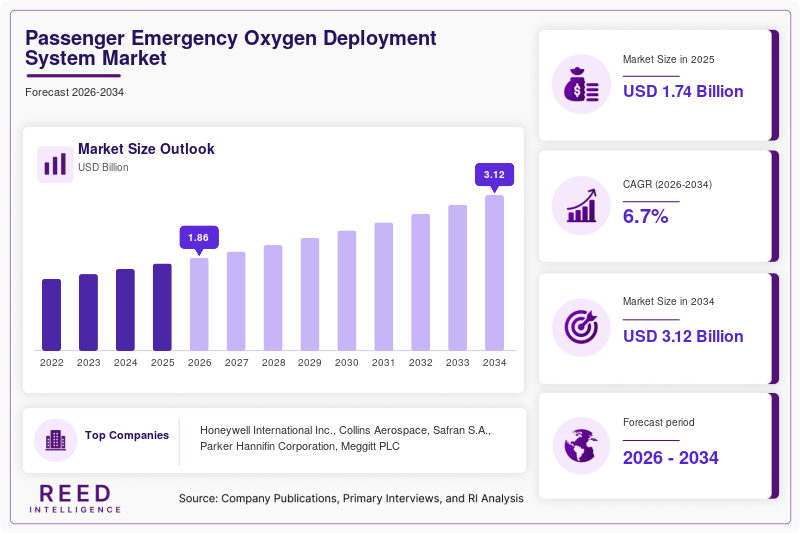
The Passenger Emergency Oxygen Deployment System Market is projected to reach approximately USD 1.86 billion in 2026 and is expected to expand to around USD 3.12 billion by 2034, registering a CAGR of 6.7% during 2026–2034. Growth in the market is primarily driven by increasing global air passenger traffic, strict aviation safety regulations, and rising aircraft production rates across commercial and regional aviation segments. Emergency oxygen systems are critical safety components in aircraft, designed to ensure passenger survivability during cabin depressurization events, thereby maintaining compliance with international aviation safety standards.
A key global factor supporting market expansion is the continuous modernization of commercial aircraft fleets. Airlines are increasingly investing in next-generation aircraft equipped with lightweight, high-efficiency oxygen generation systems, replacing conventional chemical oxygen generators. This transition is improving system reliability, reducing maintenance costs, and enhancing passenger safety performance.
Key Highlights
- North America holds approximately 34.2% market share, driven by strong aircraft manufacturing and retrofit activities across commercial fleets.
- Asia Pacific is projected to grow at a CAGR of 8.3% due to rapid aviation expansion, rising middle-class air travel demand, and new aircraft deliveries.
- Chemical Oxygen Generators dominate the system type segment with widespread OEM integration, while Compressed Oxygen Systems are the fastest-growing subsegment at a CAGR of 7.6% due to improved storage efficiency.
- Commercial aviation remains the dominant application area, whereas business jets represent the fastest-growing application segment supported by premium air travel demand.
Market Trends
Transition toward lightweight oxygen generation technologies
The Passenger Emergency Oxygen Deployment System Market is witnessing a significant shift from traditional chemical oxygen generators toward lightweight and more efficient systems. Aircraft manufacturers are focusing on reducing overall aircraft weight to improve fuel efficiency and operational performance. As a result, compact oxygen generation technologies, including advanced chemical oxygen cartridges and hybrid compressed oxygen systems, are gaining adoption. These systems provide stable oxygen supply while minimizing space requirements in overhead passenger compartments. Additionally, airlines are prioritizing systems that offer longer service life and reduced maintenance frequency. The trend is further supported by the integration of smart monitoring systems that track oxygen cylinder status and predict maintenance needs, improving overall operational safety and reliability across commercial fleets.
Increasing adoption of retrofit and aftermarket upgrades
Another prominent trend in the Passenger Emergency Oxygen Deployment System Market is the rising demand for retrofit installations in aging aircraft fleets. Many airlines are extending aircraft lifecycles beyond initial design expectations, leading to increased focus on upgrading emergency oxygen systems to comply with updated aviation safety standards. Retrofit programs are particularly strong in North America and Europe, where large fleets of mid-life aircraft require modernization. Airlines are investing in modular oxygen systems that can be integrated without major structural modifications, reducing downtime and operational disruptions. Additionally, regulatory authorities are mandating periodic upgrades of safety systems, further driving aftermarket demand. This trend is expected to continue as airlines balance cost efficiency with regulatory compliance.
Market Drivers
Rising global air passenger traffic and fleet expansion
One of the primary drivers of the Passenger Emergency Oxygen Deployment System Market is the continuous growth in global air passenger traffic. Increasing urbanization, rising disposable income, and expanding tourism activities are contributing to higher demand for commercial air travel. Airlines are responding by expanding their fleets and introducing new aircraft on both long-haul and regional routes. Each new aircraft requires certified emergency oxygen systems, directly increasing market demand. Additionally, emerging economies in Asia Pacific and the Middle East are investing heavily in aviation infrastructure, further accelerating aircraft procurement. This expansion is creating sustained demand for both OEM-installed and aftermarket oxygen deployment systems across commercial and business aviation segments.
Strict aviation safety regulations and compliance requirements
The market is also strongly driven by stringent aviation safety regulations imposed by authorities such as FAA and EASA. These regulations mandate the installation of reliable emergency oxygen systems capable of supporting passengers and crew during cabin depressurization events. Compliance requirements are regularly updated, prompting airlines and manufacturers to adopt advanced systems with improved performance standards. Aircraft certification processes require rigorous testing of oxygen deployment mechanisms, ensuring high reliability under extreme conditions. This regulatory environment not only drives initial installations but also supports continuous upgrades and replacements. As aviation safety standards become more stringent globally, demand for technologically advanced oxygen systems continues to rise.
Market Restraint
High maintenance complexity and cost constraints in oxygen system integration
A significant restraint in the Passenger Emergency Oxygen Deployment System Market is the complexity and cost associated with system maintenance and integration. Emergency oxygen systems require precise engineering, periodic inspections, and strict compliance with aviation safety standards, which increases operational costs for airlines. Chemical oxygen generators, in particular, involve replacement cycles after activation or expiration, contributing to recurring maintenance expenses. Additionally, integration of advanced oxygen systems into existing aircraft structures often requires specialized engineering modifications, increasing installation complexity and downtime. Smaller airlines and budget carriers may delay upgrades due to financial constraints, opting to extend the lifecycle of existing systems instead of investing in new technologies. This cost sensitivity can slow adoption rates, especially in emerging markets where aviation budgets are limited. Furthermore, supply chain dependencies for certified oxygen system components can create procurement delays, impacting fleet modernization schedules and overall market growth momentum.
Market Opportunities
Growth in next-generation aircraft manufacturing programs
The expansion of next-generation aircraft manufacturing programs presents a significant opportunity for the Passenger Emergency Oxygen Deployment System Market. Leading aircraft manufacturers are developing fuel-efficient, lightweight aircraft models that incorporate advanced safety systems, including next-generation oxygen deployment technologies. These aircraft are designed with improved cabin pressurization systems, which require more efficient and compact oxygen solutions. As global airlines place large aircraft orders to meet rising travel demand, OEM suppliers of oxygen systems are positioned to benefit from long-term supply contracts. Additionally, the increasing focus on sustainable aviation practices encourages the development of eco-efficient oxygen systems that minimize waste and enhance lifecycle performance.
Expansion of aviation infrastructure in emerging economies
Emerging economies in Asia Pacific, Latin America, and the Middle East are investing heavily in aviation infrastructure development, creating strong growth opportunities for emergency oxygen system manufacturers. Rising air travel penetration in countries such as India, China, Brazil, and the UAE is driving demand for new aircraft deliveries and fleet expansion. This expansion requires large-scale deployment of certified oxygen systems across commercial and regional aircraft. Additionally, government initiatives supporting domestic airline growth and airport modernization are encouraging increased aircraft procurement. These factors collectively create a favorable environment for both OEM and aftermarket suppliers in the Passenger Emergency Oxygen Deployment System Market.
Segmental Analysis
System Type Segment
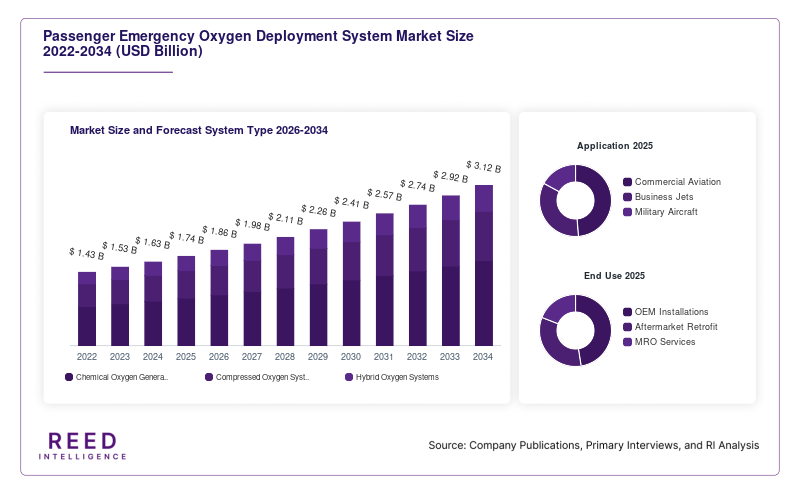
Chemical Oxygen Generators dominate the system type segment with approximately 48.6% market share in 2024. These systems are widely used in commercial aircraft due to their reliability, compact design, and compliance with aviation safety standards. They remain the preferred choice for OEM installations across major aircraft programs.
Compressed Oxygen Systems are the fastest-growing subsegment with a CAGR of 7.6%, driven by their improved storage efficiency and longer operational lifecycle. Airlines are increasingly adopting these systems for premium aircraft categories due to reduced maintenance requirements and enhanced performance stability under variable cabin pressure conditions.
Application Segment
Commercial Aviation holds the dominant share of approximately 62.3% in 2024. The segment benefits from high aircraft production rates and continuous fleet expansion by major airlines worldwide. Emergency oxygen systems are mandatory across all commercial aircraft, ensuring steady demand.
Business Jets represent the fastest-growing subsegment with a CAGR of 7.8%, supported by rising demand for private aviation and corporate travel. Growth is driven by increasing high-net-worth individuals and time-sensitive travel requirements.
End-Use Segment
OEM Installations dominate the segment with a 55.4% share in 2024, as oxygen systems are integrated during aircraft manufacturing. Strong partnerships between aircraft manufacturers and system suppliers support this dominance.
Aftermarket Retrofit is the fastest-growing subsegment with a CAGR of 7.2%, driven by fleet modernization programs and regulatory upgrades. Airlines are increasingly upgrading older aircraft to meet updated safety compliance standards.
Regional Analysis
North America
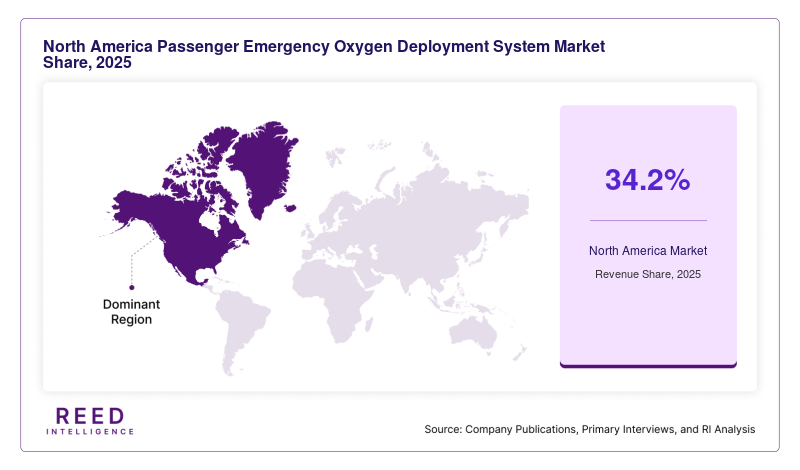
North America accounted for approximately 34.2% market share in 2025, supported by a mature aerospace manufacturing ecosystem and strong demand for aircraft retrofit programs. The region is expected to expand at a steady CAGR of around 6.2% during 2026–2034, driven by continuous fleet modernization and strict aviation safety compliance requirements. The presence of major aircraft OEMs and long-term defense aviation spending further strengthens regional dominance in the Passenger Emergency Oxygen Deployment System Market.
The United States leads the regional market due to its advanced aviation infrastructure and high aircraft production capacity. A key growth factor is the increasing adoption of FAA-mandated safety upgrades, which is accelerating replacement and modernization of oxygen deployment systems across commercial aircraft fleets, particularly in mid-life aircraft undergoing extended service cycles.
Europe
Europe held nearly 27.5% market share in 2025 and is projected to grow at a CAGR of approximately 6.5% through 2034, supported by strong regulatory oversight from EASA and a well-established commercial aviation network. The region benefits from consistent aircraft deliveries, modernization of aging fleets, and rising demand for fuel-efficient aircraft equipped with advanced safety systems. Increasing focus on sustainability is also encouraging the adoption of lightweight oxygen deployment technologies.
Germany dominates the European market due to its strong aerospace engineering base and collaboration with major aircraft manufacturers. A major growth factor is the region’s emphasis on next-generation aircraft safety integration, where airlines are actively upgrading oxygen systems to comply with evolving European aviation safety directives and environmental efficiency targets.
Asia Pacific
Asia Pacific accounts for approximately 23.8% market share in 2025 and is projected to register the fastest growth with a CAGR of around 8.3% during 2026–2034. Rapid expansion of low-cost carriers, increasing passenger traffic, and large-scale aircraft procurement programs are key drivers. Countries such as China, India, and Southeast Asian nations are significantly increasing their aviation infrastructure investments, supporting strong OEM demand.
China leads the regional market due to large aircraft orders and domestic airline expansion programs. A key growth factor is rising air travel penetration supported by expanding middle-class income levels, which is accelerating demand for new aircraft equipped with modern emergency oxygen deployment systems across both domestic and international routes.
Middle East & Africa
The Middle East & Africa region held around 8.1% market share in 2025 and is expected to grow at a CAGR of approximately 6.9% during 2026–2034. Growth is driven by expanding aviation hubs, increasing long-haul connectivity, and rising investments in premium airline fleets. Major airlines in the region are focusing on enhancing passenger safety standards in line with global aviation norms.
The United Arab Emirates dominates the regional market due to its strong aviation infrastructure and globally connected airline network. A key growth factor is the development of major international transit hubs such as Dubai and Doha, which require advanced aircraft fleets equipped with high-reliability oxygen deployment systems for long-haul operations.
Latin America
Latin America accounted for approximately 6.4% market share in 2025 and is projected to grow at a CAGR of around 6.1% during 2026–2034, supported by gradual fleet expansion and increasing regional air connectivity. Economic recovery and tourism growth are also contributing to rising aircraft utilization and modernization efforts across commercial airlines.
Brazil leads the regional market due to its large domestic aviation network and growing airline investments. A key growth factor is the increasing demand for regional connectivity and low-cost air travel, which is encouraging airlines to upgrade aircraft safety systems, including emergency oxygen deployment technologies, to meet international aviation standards.
Competitive Landscape
The Passenger Emergency Oxygen Deployment System Market is moderately consolidated, with key players focusing on innovation, strategic contracts, and global expansion. Leading companies include Honeywell International Inc., Collins Aerospace, Safran S.A., Cobham Limited, and B/E Aerospace. These companies dominate due to strong OEM partnerships with aircraft manufacturers and extensive product portfolios.
Honeywell International Inc. is considered a leading market participant due to its advanced oxygen generation technologies and integration capabilities across multiple aircraft platforms. The company continues to strengthen its position through long-term supply agreements with major aerospace manufacturers.
Recent development includes expanded production capacity for advanced chemical oxygen systems to support next-generation aircraft programs, improving supply chain efficiency and reducing lead times for OEM customers.
Key Players
- Honeywell International Inc.
- Collins Aerospace
- Safran S.A.
- Cobham Limited
- Parker Hannifin Corporation
- Meggitt PLC
- B/E Aerospace
- Diehl Aviation
- Ventura Aerospace
- Zodiac Aerospace
- Aerox Aviation Oxygen Systems
- Precise Flight Inc.
- Technodinamika
- Air Liquide Aviation
- AMETEK Inc.
Recent Developments
- Honeywell expanded its aerospace oxygen systems production facility in 2025 to meet rising OEM demand.
- Collins Aerospace announced integration of smart monitoring capabilities into next-generation oxygen deployment systems.
- Safran entered a strategic collaboration with a major aircraft OEM to co-develop lightweight oxygen generation units for future aircraft platforms.
Passenger Emergency Oxygen Deployment System Market Segments
System Type
- Chemical Oxygen Generators
- Compressed Oxygen Systems
- Hybrid Oxygen Systems
Application
- Commercial Aviation
- Business Jets
- Military Aircraft
End Use
- OEM Installations
- Aftermarket Retrofit
- MRO Services
By Region
- North America
- Europe
- APAC
- Middle East and Africa
- LATAM