Passenger Service System (PSS) Market Size, Share & Demand Report By Component (Software Solutions, Services, Cloud-Based Platforms), By Deployment Mode (Cloud, On-Premise, Hybrid), By Airline Type (Full-Service Carriers, Low-Cost Carriers, Regional Airlines, Charter Airlines), By Region & Segment Forecasts, 2026–2034
USD 3950
Market Overview
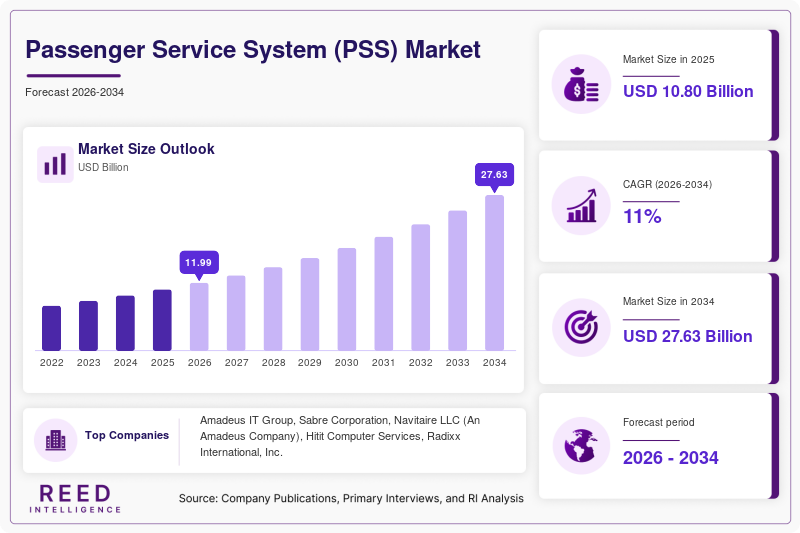
The global Passenger Service System (PSS) Market size was valued at approximately USD 10.8 billion in 2026 and is projected to reach USD 24.9 billion by 2034, expanding at a CAGR of 11.0% during 2026–2034. Passenger service systems have become a critical component of airline digital infrastructure, enabling carriers to manage reservations, inventory, ticketing, departure control, loyalty programs, and ancillary services through integrated platforms. As airlines continue to modernize their operations, the demand for scalable and cloud-based PSS solutions is increasing across both established and emerging aviation markets.
A major factor supporting market growth is the steady recovery and expansion of global air travel. Rising passenger volumes, increasing airline fleet capacity, and growing demand for personalized travel experiences are encouraging carriers to invest in advanced passenger management technologies. Airlines are seeking systems capable of improving operational efficiency while enhancing customer engagement across multiple touchpoints. Modern PSS platforms support real-time data exchange, mobile integration, dynamic pricing, and automated customer service functions, making them essential tools in the evolving aviation ecosystem.
Key Highlights
- North America dominated the market with a 36.4% share in 2025, while Asia Pacific is expected to grow at the fastest CAGR of 12.8% during 2026–2034.
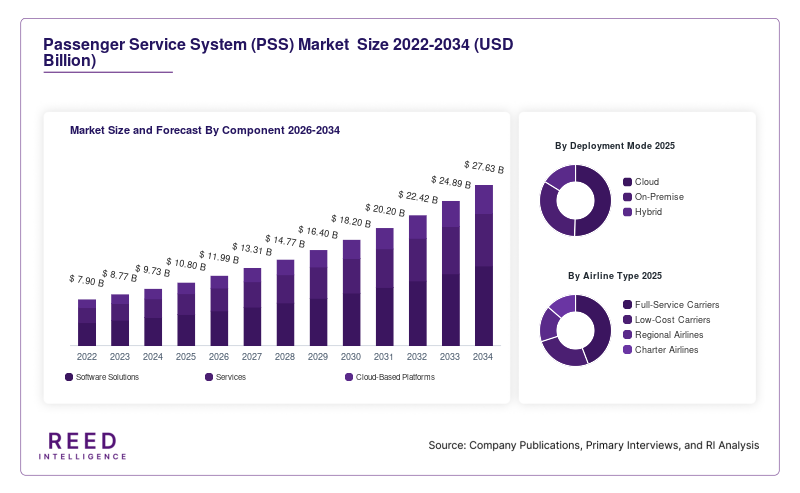
- By component, software solutions accounted for the largest share of 67.8%, while cloud-based platforms are projected to grow at a CAGR of 13.5%.
- By deployment mode, cloud deployment led with a 61.3% share, whereas hybrid deployment is expected to expand at a CAGR of 12.9%.
- By airline type, full-service carriers held a 58.7% share, while low-cost carriers are projected to grow at a CAGR of 13.2%.
- The United States remained the dominant country, with market values of USD 2.98 billion in 2024 and USD 3.25 billion in 2025.
Market Trends
Expansion of Cloud-Native Passenger Platforms
The Passenger Service System (PSS) Market is witnessing a strong shift toward cloud-native architectures. Airlines are increasingly replacing legacy reservation and inventory systems with flexible cloud environments that provide scalability, lower infrastructure costs, and improved system reliability. Cloud-native platforms allow carriers to deploy updates faster, integrate third-party applications efficiently, and support growing passenger volumes without extensive hardware investments. This transition is particularly important for airlines operating across multiple regions where operational flexibility is essential. Vendors are responding by developing modular solutions that enable airlines to customize functions according to operational requirements. As digital transformation remains a priority, cloud-native passenger service platforms are expected to become the standard operating model across the aviation industry.
Growing Adoption of Personalized Passenger Experiences
Airlines are increasingly using passenger data to deliver personalized services throughout the travel journey. Modern PSS solutions integrate customer profiles, loyalty information, booking history, and travel preferences to create tailored offers and recommendations. These capabilities enable airlines to increase ancillary revenue through personalized upgrades, baggage services, seat selection, and onboard offerings. The trend is further supported by advances in analytics and artificial intelligence that allow carriers to predict customer behavior more accurately. Personalized experiences are becoming a key competitive differentiator, particularly as travelers expect seamless interactions across mobile applications, websites, and airport touchpoints. This growing focus on customer-centric services continues to influence investment decisions across the Passenger Service System (PSS) Market.
Market Drivers
Rising Global Air Passenger Traffic
The continuous increase in global air passenger traffic remains a primary growth driver for the Passenger Service System (PSS) Market. Airlines are handling larger passenger volumes than ever before, creating demand for robust systems capable of managing reservations, ticketing, departure control, and customer communications efficiently. Expanding middle-class populations, growing tourism activities, and improved air connectivity are contributing to higher passenger numbers across both domestic and international routes. As airline operations become more complex, carriers require integrated digital platforms that support scalability and real-time data processing. Passenger service systems help airlines maintain operational efficiency while ensuring smooth customer experiences. Consequently, increasing passenger traffic directly translates into stronger demand for advanced PSS solutions worldwide.
Digital Transformation Across Airlines
Airline operators are accelerating digital transformation initiatives to improve profitability and operational performance. Passenger service systems play a central role in these modernization strategies by connecting multiple operational functions through a unified technology platform. Airlines are investing in automation tools that reduce manual processes, enhance customer service, and improve decision-making through data-driven insights. Integration with mobile applications, self-service kiosks, and digital payment systems further strengthens the value proposition of modern PSS platforms. In addition, regulatory compliance requirements and cybersecurity considerations encourage airlines to adopt advanced solutions from established technology providers. As digital transformation remains a long-term industry priority, demand for innovative passenger service technologies is expected to increase steadily throughout the forecast period.
Market Restraint
High Implementation and Migration Complexity
Despite strong growth prospects, the Passenger Service System (PSS) Market faces challenges related to implementation complexity and migration costs. Many airlines continue to operate legacy systems that have been customized over several decades. Transitioning from these environments to modern passenger service platforms often requires substantial investment, extensive testing, employee training, and operational restructuring. The migration process can create temporary disruptions if not executed carefully, making some airlines cautious about large-scale upgrades. Smaller carriers with limited technology budgets may find implementation expenses difficult to justify despite potential long-term benefits. Additionally, integrating passenger service systems with existing airport infrastructure, loyalty programs, and external travel platforms can increase project complexity. These factors may delay adoption decisions and slow deployment timelines, particularly among regional operators and airlines operating in cost-sensitive markets.
Market Opportunities
Growth of Low-Cost and Regional Airlines
The rapid expansion of low-cost and regional carriers presents a significant opportunity for the Passenger Service System (PSS) Market. Many emerging airlines require affordable, scalable, and cloud-based platforms that can support rapid growth without substantial capital expenditure. Passenger service system vendors are developing subscription-based solutions specifically designed for smaller operators seeking efficient reservation, ticketing, and customer management capabilities. Emerging aviation markets in Asia Pacific, Africa, and Latin America continue to witness the launch of new carriers and route expansions. These developments create a favorable environment for technology adoption. As competition intensifies among airlines, digital platforms that improve operational efficiency and customer engagement are expected to experience strong demand from both new and expanding carriers.
Integration of Artificial Intelligence and Advanced Analytics
Artificial intelligence and advanced analytics create considerable opportunities for innovation within the Passenger Service System (PSS) Market. Airlines are increasingly seeking solutions capable of generating actionable insights from passenger data. AI-powered systems can optimize pricing strategies, predict travel demand, personalize customer interactions, and automate service processes. These capabilities support revenue growth while improving operational efficiency. Advanced analytics also enable airlines to identify customer preferences and deliver targeted offerings that enhance traveler satisfaction. As airlines continue investing in data-driven business models, vendors that integrate sophisticated analytical capabilities into passenger service platforms are likely to gain competitive advantages. This opportunity is expected to drive product development and market expansion over the forecast period.
Segmental Analysis
By Component
Software solutions represented the dominant subsegment within the component category and accounted for approximately 67.8% of market revenue in 2024. Airlines increasingly prioritize integrated software platforms that combine reservations, inventory management, ticketing, departure control, and loyalty functions within a single ecosystem. These solutions enable carriers to improve operational efficiency while reducing system fragmentation. The growing need for real-time passenger information and seamless digital interactions further supports software adoption. Airlines benefit from centralized data management capabilities that improve decision-making and customer service performance. As passenger expectations continue evolving, software solutions remain the foundation of modern passenger service system deployments and maintain a leading position across the global market.
Cloud-based platforms represent the fastest-growing subsegment and are expected to register a CAGR of 13.5% during the forecast period. Airlines are increasingly migrating from traditional infrastructure to cloud environments that offer scalability, flexibility, and lower maintenance requirements. Cloud-based solutions support rapid deployment, continuous updates, and efficient integration with external applications. These advantages are particularly attractive for carriers seeking to modernize operations without significant capital expenditure. Vendors are expanding cloud offerings with advanced analytics, artificial intelligence, and cybersecurity capabilities that further enhance value. The ability to adapt quickly to changing passenger volumes and market conditions remains a major factor driving accelerated adoption of cloud-based passenger service technologies.
By Deployment Mode
Cloud deployment emerged as the dominant subsegment within the deployment category, capturing approximately 61.3% of market revenue in 2024. Airlines increasingly prefer cloud environments because they provide centralized management, reduced infrastructure costs, and enhanced accessibility. Cloud deployment enables carriers to manage operations across multiple locations while maintaining consistent service quality. The model also supports faster software updates and improved disaster recovery capabilities. As airlines seek greater operational agility, cloud deployment has become an attractive option for both large international carriers and emerging regional operators. Growing confidence in cloud security frameworks and regulatory compliance measures continues to support widespread adoption throughout the aviation industry.
Hybrid deployment is expected to be the fastest-growing subsegment, expanding at a CAGR of 12.9% through 2034. Many airlines prefer hybrid environments because they combine the flexibility of cloud infrastructure with the control offered by on-premise systems. This approach enables carriers to migrate gradually from legacy platforms while minimizing operational disruption. Hybrid deployment is particularly beneficial for airlines managing sensitive data or operating under strict regulatory requirements. The ability to balance scalability, security, and performance creates strong demand for hybrid solutions. As carriers pursue digital transformation strategies while preserving existing investments, hybrid deployment models are expected to gain substantial traction across the Passenger Service System (PSS) Market.
By Airline Type
Full-service carriers held the largest share within the airline type segment, accounting for approximately 58.7% of market revenue in 2024. These airlines manage extensive route networks, complex passenger operations, and sophisticated loyalty programs, creating strong demand for advanced passenger service platforms. Full-service carriers rely on integrated systems to coordinate reservations, customer engagement, ancillary services, and departure control activities. Their focus on premium passenger experiences further increases investment in digital technologies that support personalization and operational excellence. Large international airlines often act as early adopters of advanced features, helping drive innovation across the broader market. As a result, full-service carriers continue to represent the largest revenue-generating customer group.
Low-cost carriers are projected to register the fastest CAGR of 13.2% during the forecast period. The rapid expansion of budget airlines across emerging markets is creating significant demand for scalable and cost-efficient passenger service technologies. Low-cost operators prioritize solutions that streamline booking processes, automate customer interactions, and maximize ancillary revenue opportunities. Cloud-based deployment models align particularly well with the operational requirements of these carriers because they reduce infrastructure expenses while supporting rapid growth. Increasing competition among low-cost airlines is encouraging greater investment in customer experience technologies and digital engagement platforms. These factors position the low-cost carrier segment as a major contributor to future market expansion.
Regional Analysis
North America
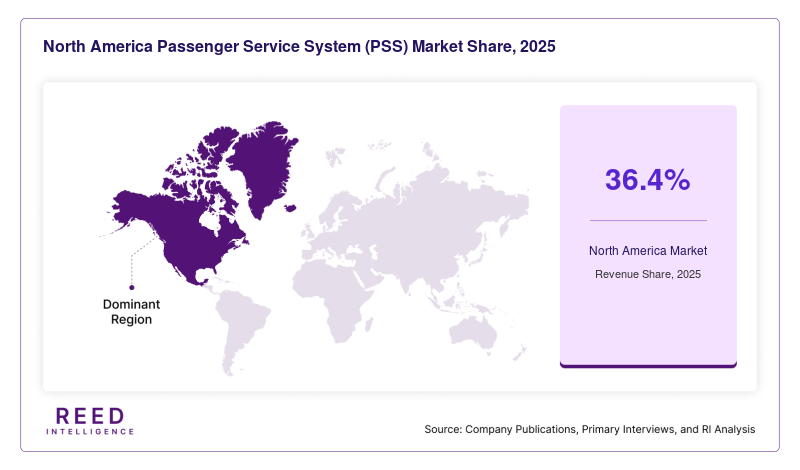
North America accounted for approximately 36.4% of the Passenger Service System (PSS) Market in 2025, making it the largest regional market. The region benefits from the presence of major airlines, advanced aviation infrastructure, and strong technology adoption rates. Airlines across the United States and Canada continue investing in digital transformation initiatives that enhance operational efficiency and passenger experiences. The regional market is expected to register a CAGR of 9.8% through 2034 as carriers modernize existing systems and expand cloud-based deployments.
The United States remains the dominant country within the region due to its extensive airline network and high passenger traffic volumes. A unique growth factor is the strong focus on ancillary revenue optimization. Airlines increasingly use advanced passenger service systems to manage dynamic pricing, personalized offers, and loyalty programs. These capabilities support revenue diversification while strengthening customer engagement across digital channels.
Europe
Europe represented nearly 27.1% of the global Passenger Service System (PSS) Market in 2025. The region benefits from a highly connected aviation ecosystem and a significant concentration of international carriers. European airlines are actively upgrading legacy technology infrastructure to support operational resilience and regulatory compliance. The market is forecast to expand at a CAGR of 10.1% during the study period as carriers pursue digital modernization and customer-centric service strategies.
Germany remains the leading country in the European market due to its strong aviation sector and technological capabilities. A distinctive growth factor is the region's emphasis on sustainability and operational efficiency. Airlines increasingly deploy digital passenger management platforms to optimize resource utilization, reduce administrative burdens, and improve passenger flow management while supporting broader environmental objectives.
Asia Pacific
Asia Pacific held approximately 22.6% of the Passenger Service System (PSS) Market in 2025 and is expected to record the fastest CAGR of 12.8% through 2034. The region benefits from rapid urbanization, rising disposable incomes, expanding tourism activities, and increasing airline fleet investments. Both established and emerging carriers are implementing advanced passenger service technologies to manage growing traveler volumes and improve customer satisfaction.
China remains the dominant country in Asia Pacific owing to its large domestic aviation market and substantial airline investments. A unique growth factor is the rapid expansion of low-cost carriers across the region. These airlines increasingly rely on cloud-based passenger service systems that offer cost efficiency, scalability, and streamlined operational management, supporting continued market growth.
Middle East & Africa
The Middle East & Africa accounted for around 7.1% of the Passenger Service System (PSS) Market in 2025. Aviation hubs across the Gulf region continue investing heavily in digital infrastructure to support international passenger traffic. Airlines are adopting modern passenger management systems to enhance service quality and maintain operational excellence. The regional market is projected to grow at a CAGR of 10.7% during the forecast period.
Saudi Arabia represents a leading country within the region due to ongoing aviation expansion and tourism development initiatives. A notable growth factor is the increasing investment in airport modernization projects. Airlines and airport operators are adopting integrated passenger service technologies to support seamless travel experiences and accommodate rising visitor numbers linked to economic diversification programs.
Latin America
Latin America captured approximately 6.8% of the Passenger Service System (PSS) Market in 2025. The region is gradually strengthening its aviation infrastructure while airlines continue modernizing customer service capabilities. Passenger service platforms are increasingly viewed as essential tools for improving operational performance and managing growing travel demand. The market is anticipated to expand at a CAGR of 10.3% through 2034.
Brazil remains the dominant country in the region due to its large aviation network and expanding domestic travel sector. A unique growth factor is the increasing penetration of digital booking channels. Airlines are investing in passenger service systems that support mobile applications, online reservations, and self-service technologies, helping improve customer convenience and operational efficiency.
Competitive Landscape
The Passenger Service System (PSS) Market is characterized by the presence of established technology providers and specialized aviation software companies. Competition focuses on cloud innovation, system integration capabilities, cybersecurity enhancements, and customer experience functionality. Vendors continue investing in artificial intelligence, advanced analytics, and mobile technologies to strengthen their market positions.
Amadeus remains a leading participant due to its extensive global customer base and comprehensive portfolio of airline technology solutions. The company recently expanded its cloud-based passenger service capabilities to support improved scalability and operational efficiency for airline customers. Other prominent competitors continue pursuing strategic partnerships, acquisitions, and product upgrades to enhance market reach.
Key Players
- Amadeus IT Group
- Sabre Corporation
- Navitaire LLC
- Hitit Computer Services
- Radixx International
- SITA
- IBM Corporation
- Oracle Corporation
- TravelSky Technology Limited
- Accelya Group
- Bravo Passenger Solutions
- IBS Software
- Hexaware Technologies
- Unisys Corporation
- InteliSys Aviation Systems
Recent Developments
- In 2025, a leading passenger service system provider expanded its cloud-based platform capabilities to help airlines improve reservation management, ancillary revenue generation, and customer experience across digital channels.
- In 2025, several airline technology companies introduced artificial intelligence-enabled passenger service solutions designed to enhance personalized booking experiences, dynamic pricing, and automated customer support functions.
- In 2024, a major aviation software vendor launched an advanced passenger service platform integrating reservations, inventory management, and departure control functions within a unified cloud-native architecture.
- In 2024, passenger service system providers increased investments in cybersecurity and data protection initiatives to strengthen platform resilience and comply with evolving aviation regulatory requirements.
- In 2025, strategic partnerships between airlines and technology vendors accelerated the deployment of next-generation passenger service systems focused on seamless omnichannel engagement, self-service capabilities, and operational efficiency improvements.
Passenger Service System (PSS) Market Segments
By Component
- Software Solutions
- Services
- Cloud-Based Platforms
By Deployment Mode
- Cloud
- On-Premise
- Hybrid
By Airline Type
- Full-Service Carriers
- Low-Cost Carriers
- Regional Airlines
- Charter Airlines
By Functionality
- Reservation Systems
- Inventory Management
- Departure Control Systems
- Loyalty Program Management
- Ancillary Revenue Management
By End User
- Commercial Airlines
- Cargo Airlines
- Airport Operators
- Travel Service Providers
By Region
- North America
- Europe
- APAC
- Middle East and Africa
- LATAM