Passion Fruit Market Size, Share & Demand Report By Product Type (Fresh Passion Fruit, Frozen Passion Fruit, Passion Fruit Puree, Passion Fruit Juice Concentrate, Dried Passion Fruit Products), By Application (Beverages, Bakery and Confectionery, Dairy Products, Nutraceutical and Wellness Products, Foodservice Applications), By Distribution Channel (Supermarkets and Hypermarkets, Convenience Stores, Specialty Food Stores, Online Retail, Wholesale Distribution) By Region & Segment Forecasts, 2026
USD 3950
Market Overview
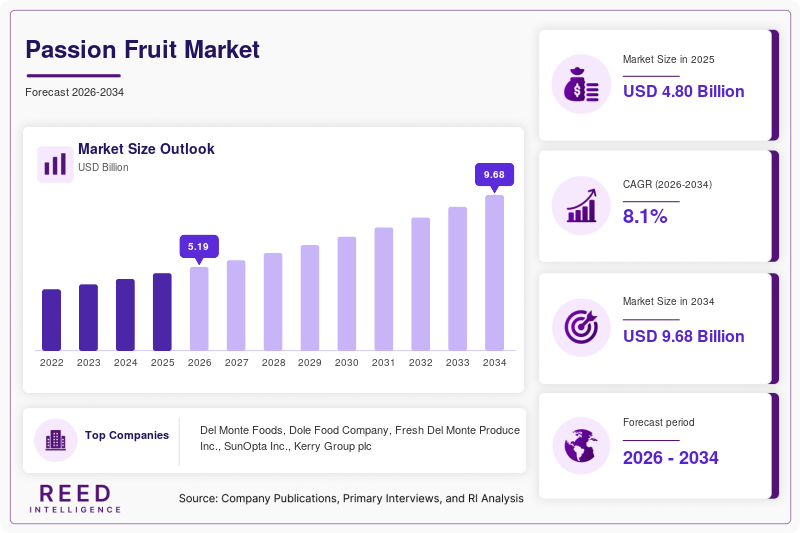
The global Passion Fruit Market size was valued at approximately USD 4.8 billion in 2026 and is projected to reach nearly USD 8.9 billion by 2034, expanding at a CAGR of 8.1% during the forecast period from 2026 to 2034. The market continues to experience stable expansion due to increasing consumer demand for tropical fruits, rising awareness regarding nutritional beverages, and the growing popularity of exotic fruit flavors across food processing industries. Passion fruit has gained considerable commercial importance in juice concentrates, flavored dairy products, desserts, alcoholic beverages, and natural wellness products. Manufacturers are increasingly incorporating passion fruit extracts into premium food and beverage formulations because of their vitamin-rich composition, aromatic profile, and antioxidant content.
One of the major global factors supporting market growth is the increasing consumer preference for natural and plant-based food ingredients. Consumers across developed and emerging economies are actively seeking fruit-based products with clean-label positioning and reduced artificial additives. Passion fruit has become a preferred ingredient in smoothies, functional drinks, frozen desserts, and organic food categories. The expansion of international fruit trade networks and advancements in cold-chain logistics have further enabled year-round availability of fresh passion fruit in global retail markets. In addition, the hospitality sector and quick-service restaurant industry are introducing tropical fruit menus to attract younger consumers seeking new taste experiences.
Key Highlights
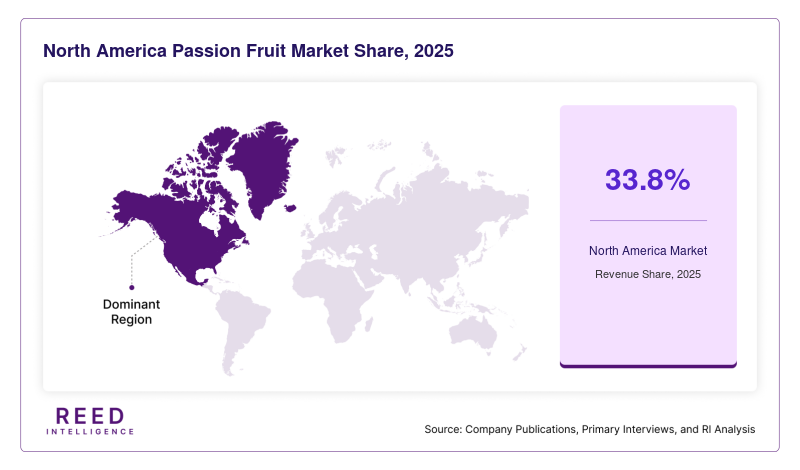
- North America dominated the market with a 33.8% share in 2025, while Asia Pacific is expected to grow at the fastest CAGR of 10.9% during 2026–2034.
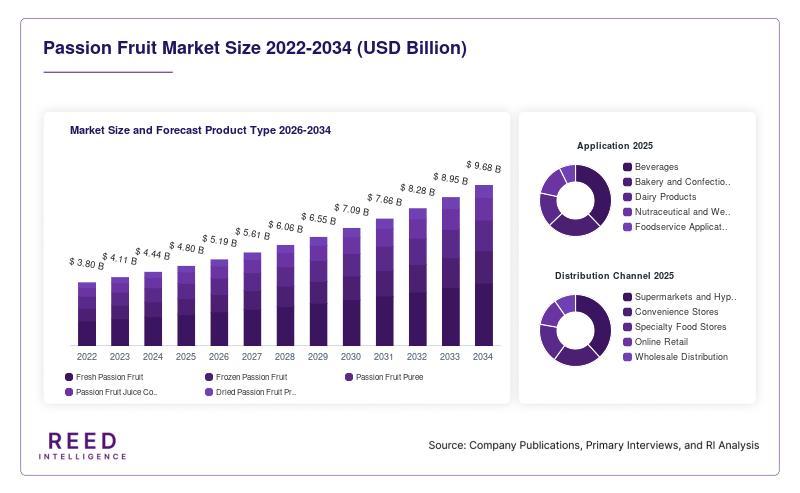
- By product type, fresh passion fruit accounted for the largest share of 46.5%, while frozen passion fruit products are projected to grow at a CAGR of 11.4%.
- By application, beverages led with a 39.7% share, whereas nutraceutical and wellness products are expected to expand at a CAGR of 10.8%.
- By distribution channel, supermarkets and hypermarkets dominated with a 42.1% share, while online retail is anticipated to grow at a CAGR of 12.2%.
- Brazil remained the dominant country, with market values of USD 640 million in 2024 and USD 705 million in 2025.
Market Trends
Expansion of Functional Beverage Consumption
The increasing consumption of functional beverages has emerged as a significant trend influencing the Passion Fruit Market. Beverage manufacturers are launching tropical fruit drinks fortified with vitamins, antioxidants, probiotics, and plant-based ingredients to cater to changing consumer preferences. Passion fruit is increasingly used in sparkling beverages, kombucha products, sports hydration drinks, flavored waters, and juice blends due to its refreshing flavor and nutritional profile. The fruit contains vitamin C, dietary fiber, and antioxidant compounds that align with wellness-focused purchasing behavior. Consumers in urban regions are particularly attracted to beverages with exotic flavors and natural ingredients, encouraging beverage producers to diversify their product portfolios.
Foodservice operators and premium café chains are also introducing passion fruit-based beverages to strengthen menu differentiation. Seasonal fruit beverages featuring passion fruit have gained popularity among younger consumers seeking visually appealing and healthier alternatives to carbonated drinks. Manufacturers are investing in advanced fruit processing technologies to preserve flavor intensity and nutritional content during beverage production. The trend is expected to accelerate further as health-conscious consumers continue to replace sugary soft drinks with fruit-based hydration products.
Growing Demand for Organic and Sustainable Tropical Fruits
The growing preference for organic and sustainably sourced fruits is shaping purchasing patterns within the Passion Fruit Market. Consumers are increasingly evaluating food products based on farming practices, traceability, and environmental impact. Organic passion fruit cultivation has gained attention in regions where consumers prioritize pesticide-free produce and eco-friendly agricultural systems. Retailers and food brands are responding by expanding certified organic tropical fruit offerings across supermarkets and premium grocery stores.
Sustainable farming initiatives are also improving the market image of passion fruit producers. Agricultural cooperatives are adopting water-efficient irrigation systems, regenerative farming methods, and biodegradable packaging solutions to attract environmentally conscious consumers. In addition, export-oriented producers are obtaining international certifications to strengthen trade opportunities across Europe and North America. The trend has encouraged long-term investments in sustainable fruit supply chains, especially in Latin America and Asia Pacific. As climate-conscious purchasing decisions continue to influence retail demand, sustainable passion fruit production is expected to become a competitive differentiator for major market participants.
Market Drivers
Rising Popularity of Tropical Fruit Ingredients in Processed Foods
The increasing use of tropical fruit ingredients in processed food applications is a major growth driver for the Passion Fruit Market. Food manufacturers are incorporating passion fruit pulp, concentrates, purees, and flavors into yogurt products, bakery items, confectionery products, jams, sauces, and frozen desserts. The fruit’s distinctive aroma and tart-sweet taste profile make it highly suitable for premium and innovative food formulations. Consumers are demonstrating growing interest in globally inspired flavors, encouraging food companies to experiment with tropical fruit combinations.
The rapid expansion of convenience food consumption has further strengthened demand for processed passion fruit ingredients. Ready-to-drink smoothies, fruit cups, and packaged snacks increasingly contain tropical fruit blends to enhance flavor appeal and nutritional value. Food processors are also using passion fruit in low-sugar and clean-label products to align with healthier eating trends. The increasing availability of advanced fruit preservation technologies, including freeze-drying and aseptic processing, has improved the commercial viability of passion fruit products in international markets.
Increasing Retail Availability Through Organized Distribution Networks
The expansion of organized retail infrastructure and e-commerce platforms has significantly supported the growth of the Passion Fruit Market. Supermarkets, hypermarkets, specialty fruit stores, and online grocery platforms are increasing the visibility and accessibility of exotic fruits among mainstream consumers. Improved cold-chain logistics and refrigerated transportation systems have enabled retailers to maintain product freshness and reduce spoilage rates during distribution.
Online retail platforms are playing a particularly important role in emerging markets where consumers are increasingly purchasing fresh produce through digital grocery applications. Subscription fruit boxes and direct-to-consumer delivery services are introducing passion fruit to households that previously had limited access to tropical fruits. Retailers are also investing in premium fruit sections and imported produce categories to capture higher-income consumers interested in specialty fruits. In addition, private-label food brands are launching passion fruit-flavored products to capitalize on growing consumer awareness regarding tropical fruit nutrition and taste diversity.
Market Restraint
Supply Chain Volatility and Climate-Related Agricultural Risks
The Passion Fruit Market faces considerable challenges associated with agricultural dependency, climate variability, and supply chain instability. Passion fruit cultivation is highly sensitive to environmental conditions such as excessive rainfall, droughts, temperature fluctuations, and pest infestations. Unpredictable weather events in major producing countries frequently affect crop yields, resulting in inconsistent product availability and price volatility. Farmers in tropical regions often experience production losses due to fungal diseases and inadequate irrigation infrastructure, which can reduce overall profitability.
Supply chain disruptions also impact exporters and food processors that rely on continuous fruit availability for manufacturing operations. Fresh passion fruit has a relatively short shelf life, making transportation and storage management critical for maintaining quality standards. Inadequate cold-chain infrastructure in developing agricultural regions can increase spoilage rates and operational costs. In addition, fluctuations in freight costs and international trade regulations may affect export competitiveness for passion fruit producers. Small-scale farmers often face financial limitations that restrict investments in modern agricultural technologies, disease-resistant crop varieties, and efficient post-harvest handling systems. These operational risks continue to create challenges for consistent market expansion and long-term supply stability.
Market Opportunities
Expansion of Nutraceutical and Wellness Product Applications
The increasing integration of fruit-based ingredients into wellness and nutraceutical products presents substantial growth opportunities for the Passion Fruit Market. Passion fruit extracts are gaining popularity in dietary supplements, herbal beverages, functional powders, and natural skincare products due to their antioxidant and vitamin-rich composition. Consumers are increasingly purchasing wellness products that contain naturally derived ingredients associated with immune support, digestive health, and stress reduction.
Manufacturers are investing in research related to passion fruit seed oil, peel extracts, and concentrated nutrients to develop value-added products with broader commercial applications. The wellness industry is also promoting tropical fruit ingredients as alternatives to synthetic additives in personal care and nutritional formulations. Demand for plant-based supplements and botanical ingredients is expected to increase significantly in developed economies, creating long-term opportunities for suppliers of processed passion fruit ingredients. Companies capable of offering standardized and traceable fruit extracts are likely to gain competitive advantages in the expanding nutraceutical sector.
Rising Export Potential in Emerging Consumer Markets
The growing consumption of imported tropical fruits across emerging economies offers favorable expansion opportunities for the Passion Fruit Market. Urbanization, rising disposable incomes, and changing dietary preferences are encouraging consumers in Asia Pacific, the Middle East, and Eastern Europe to explore exotic fruit varieties. International retailers and foodservice chains are expanding tropical fruit offerings to meet evolving consumer demand for premium and healthy food experiences.
Export-oriented producers are increasingly targeting high-growth markets through strategic partnerships, trade agreements, and diversified distribution channels. Governments in agricultural economies are also supporting tropical fruit exports through farming subsidies, export promotion initiatives, and infrastructure development programs. The expansion of refrigerated shipping technologies and digital trade platforms has further improved cross-border fruit distribution efficiency. As consumer awareness regarding passion fruit nutrition and culinary versatility increases globally, exporters are expected to benefit from stronger international demand and broader retail penetration.
Segmental Analysis
By Product Type
Fresh passion fruit accounted for the largest share of the Passion Fruit Market in 2024, representing approximately 46.5% of total revenue. The dominance of this subsegment is primarily linked to increasing consumer preference for minimally processed and naturally sourced fruits. Fresh passion fruit is widely consumed in households, cafés, hotels, and juice bars due to its versatility and strong nutritional profile. Retailers are increasingly offering premium fresh tropical fruit assortments to cater to health-conscious consumers seeking vitamin-rich dietary options. The expansion of refrigerated transportation systems and improved packaging technologies has further supported the availability of fresh passion fruit across international markets. In addition, restaurants and foodservice operators frequently use fresh passion fruit in desserts, cocktails, smoothies, and gourmet culinary applications, contributing to stable commercial demand.
Frozen passion fruit products are projected to witness the fastest CAGR of 11.4% during the forecast period. Growth within this subsegment is driven by increasing demand for convenience-oriented fruit products with longer shelf life and consistent quality. Frozen passion fruit pulp and concentrates are extensively utilized by beverage manufacturers, bakeries, dairy companies, and smoothie chains because they simplify storage and processing operations. Consumers are also purchasing frozen tropical fruits for home-based smoothies and healthy snack preparations. The rapid expansion of cold-chain logistics and modern food preservation technologies has improved the accessibility of frozen fruit products across emerging markets. Manufacturers are increasingly introducing frozen organic passion fruit products and portion-controlled packaging formats to address evolving consumer preferences for convenience and reduced food waste.
By Application
Beverages represented the dominant application segment in the Passion Fruit Market during 2024, accounting for nearly 39.7% of global revenue. Passion fruit is extensively used in juices, sparkling drinks, flavored waters, alcoholic beverages, smoothies, and fruit concentrates due to its strong aroma and refreshing flavor profile. Beverage companies are actively introducing tropical fruit blends to differentiate products in highly competitive retail environments. Consumer demand for natural hydration products and reduced-sugar beverages has encouraged manufacturers to utilize fruit-based ingredients instead of synthetic flavoring agents. In addition, café chains and foodservice outlets are expanding passion fruit beverage offerings to attract younger consumers interested in premium and visually appealing drinks. The increasing popularity of wellness beverages containing vitamins and antioxidants has also contributed to the strong performance of this segment.
Nutraceutical and wellness products are anticipated to register the fastest CAGR of 10.8% over the forecast period. The rapid growth of this subsegment is associated with rising consumer awareness regarding preventive healthcare and plant-based nutritional supplements. Passion fruit extracts, seed oils, and concentrates are increasingly incorporated into dietary supplements, herbal formulations, wellness drinks, and natural skincare products. Manufacturers are investing in research activities to explore the antioxidant, anti-inflammatory, and nutritional properties of passion fruit derivatives. The wellness industry’s transition toward naturally sourced ingredients has further strengthened demand for fruit-based functional products. In developed economies, consumers are actively seeking botanical ingredients with clean-label positioning, encouraging suppliers to expand premium passion fruit ingredient portfolios across health and wellness applications.
By Distribution Channel
Supermarkets and hypermarkets held the largest share of the Passion Fruit Market in 2024, contributing approximately 42.1% of total revenue. These retail formats remain dominant because they provide consumers with broad product availability, organized product displays, and convenient purchasing experiences. Major retail chains are increasingly expanding exotic fruit sections and premium imported produce categories to capture consumer interest in tropical fruits. Supermarkets also offer fresh, frozen, and processed passion fruit products under both branded and private-label categories, increasing market visibility. Promotional campaigns, seasonal discounts, and in-store sampling activities have further supported consumer awareness regarding passion fruit products. In addition, large retail outlets possess advanced refrigeration and inventory management capabilities that help maintain product freshness and quality.
Online retail is expected to emerge as the fastest-growing distribution channel, recording a CAGR of 12.2% during the forecast period. The increasing adoption of digital grocery shopping platforms and direct-to-consumer delivery services is significantly transforming fruit purchasing behavior. Consumers increasingly prefer online platforms because they offer convenience, product variety, subscription services, and home delivery options. E-commerce companies are collaborating with fruit suppliers and importers to provide premium tropical fruits in urban markets where demand for healthy food products continues to rise. Digital platforms also allow consumers to access product information, nutritional details, and organic certifications more easily. The expansion of cold-delivery logistics and mobile payment infrastructure is expected to further accelerate online sales of fresh and processed passion fruit products worldwide.
Regional Analysis
North America
North America accounted for approximately 33.8% of the global Passion Fruit Market share in 2025, maintaining its position as the largest regional market. The region is projected to expand at a CAGR of 7.4% during the forecast period due to growing demand for premium fruit beverages, healthy snacks, and natural flavor ingredients. Consumers in the United States and Canada increasingly prefer tropical fruit products with clean-label positioning and reduced artificial sweeteners. Major beverage manufacturers and dairy brands are integrating passion fruit into flavored yogurt, sparkling drinks, smoothies, and frozen desserts to attract wellness-oriented consumers.
The United States remained the dominant country within the regional market because of its highly developed retail sector and strong demand for imported tropical fruits. One unique growth factor supporting the country’s expansion is the rapid adoption of functional beverages containing exotic fruit ingredients. Health-focused café chains and premium juice brands are introducing passion fruit-based drinks targeted at younger urban consumers. In addition, rising Hispanic and multicultural populations are increasing familiarity with tropical fruit flavors, contributing to broader product acceptance across mainstream retail channels.
Europe
Europe represented nearly 24.6% of the global Passion Fruit Market in 2025 and is expected to witness a CAGR of 7.8% through 2034. The regional market is benefiting from increasing consumer demand for organic fruit products, premium desserts, and natural fruit concentrates. European consumers are highly responsive to sustainability claims and ethically sourced produce, encouraging retailers to expand organic passion fruit imports from Latin America and Africa. Food manufacturers across Germany, France, and the United Kingdom are incorporating passion fruit into confectionery products, bakery fillings, and flavored dairy applications.
Germany emerged as the dominant country in the European market due to its strong organic food industry and advanced retail distribution network. A unique factor supporting market growth in Germany is the increasing popularity of plant-based desserts and vegan beverages containing tropical fruit ingredients. Consumers are actively seeking innovative fruit flavors in non-dairy yogurt, oat-based smoothies, and fruit-infused sparkling beverages. The country’s extensive supermarket chains and specialty organic retailers continue to support the availability of fresh and processed passion fruit products across urban and suburban markets.
Asia Pacific
Asia Pacific held approximately 21.9% of the global Passion Fruit Market share in 2025 and is projected to register the fastest CAGR of 10.9% during the forecast period. Rising urbanization, expanding middle-class populations, and increasing awareness regarding nutritional fruits are contributing to strong regional demand. Consumers in China, India, Japan, and Southeast Asia are increasingly purchasing tropical fruit beverages, fruit snacks, and premium desserts. The rapid expansion of organized retail and digital grocery delivery platforms has improved consumer access to imported and domestically cultivated passion fruit products.
China remained the leading country within the regional market owing to strong consumer demand for functional beverages and premium fruit-based snacks. One distinctive growth factor supporting the Chinese market is the increasing popularity of fruit tea chains and café culture among younger consumers. Beverage outlets are frequently introducing passion fruit-infused teas, smoothies, and sparkling fruit drinks to attract urban customers seeking refreshing and visually appealing beverages. Domestic cultivation initiatives and investments in greenhouse agriculture are also helping improve local supply capabilities.
Middle East & Africa
The Middle East & Africa accounted for nearly 9.8% of the global Passion Fruit Market in 2025 and is expected to grow at a CAGR of 8.2% between 2026 and 2034. The market is witnessing gradual expansion due to increasing tourism activity, rising premium food consumption, and growing demand for imported tropical fruits across metropolitan areas. Hotels, restaurants, and luxury cafés are incorporating passion fruit into desserts, mocktails, and gourmet dishes to cater to international travelers and affluent consumers.
The United Arab Emirates emerged as the dominant country in the regional market because of its strong hospitality sector and premium retail infrastructure. A unique factor driving growth in the country is the increasing demand for exotic fruit beverages within luxury hotels and international restaurant chains. Imported passion fruit products are widely utilized in upscale culinary applications and specialty beverage menus. The expansion of high-end supermarkets and health-focused retail stores has further increased consumer access to fresh passion fruit and processed tropical fruit products.
Latin America
Latin America captured around 9.9% of the global Passion Fruit Market share in 2025 and is anticipated to expand at a CAGR of 8.6% through 2034. The region remains one of the most important production hubs for passion fruit cultivation due to favorable climatic conditions and established agricultural expertise. Countries across the region are increasing exports of fresh passion fruit, pulp, and juice concentrates to North America and Europe. Growing investments in agricultural modernization and export infrastructure are also strengthening regional competitiveness.
Brazil continued to dominate the Latin American market because of its large-scale cultivation capacity and strong domestic consumption of fruit beverages. One major factor supporting the country’s market growth is the widespread use of passion fruit in traditional juices, desserts, and processed food products. Brazilian beverage manufacturers are expanding product portfolios featuring tropical fruit flavors to meet rising domestic and international demand. Government-backed agricultural development programs and export initiatives are also encouraging farmers to improve productivity and product quality.
Competitive Landscape
The Passion Fruit Market is moderately fragmented, with regional producers, international fruit exporters, beverage ingredient suppliers, and processed food companies competing across multiple distribution channels. Market participants are increasingly focusing on sustainable farming practices, product innovation, and export expansion strategies to strengthen their competitive positions. Companies are also investing in advanced fruit processing technologies to improve shelf life, flavor retention, and product consistency for global food and beverage applications.
Del Monte Foods remained one of the leading companies in the market due to its extensive fruit distribution network and diversified tropical fruit portfolio. The company recently expanded its frozen tropical fruit product line to address growing demand for convenience-based healthy food options. Other major companies are strengthening partnerships with agricultural cooperatives to secure long-term raw material supply and improve traceability standards.
Key Players
- Del Monte Foods
- Dole Food Company
- Fresh Del Monte Produce Inc.
- SunOpta Inc.
- Kerry Group plc
- Symrise AG
- Döhler GmbH
- AGRANA Beteiligungs-AG
- Kanegrade Ltd.
- iTi Tropicals Inc.
- SVZ International B.V.
- Givaudan SA
- Ingredion Incorporated
- Nestlé S.A.
- PepsiCo Inc.
Recent Developments
- In February 2026, a leading tropical fruit exporter in Brazil announced the expansion of its passion fruit processing facility to increase frozen pulp production capacity for North American markets.
- In August 2025, a global beverage manufacturer introduced a new range of passion fruit-infused functional hydration drinks across major retail chains in the United States and Europe.
- In November 2025, an Asian online grocery platform partnered with regional fruit suppliers to launch premium imported passion fruit subscription boxes targeting urban consumers.
- In March 2026, a European food ingredient company introduced organic passion fruit concentrate solutions designed for clean-label dairy and bakery applications.
- In January 2026, a Middle Eastern hospitality distributor expanded its tropical fruit sourcing agreements to support increasing demand for premium passion fruit beverages in luxury hotels and restaurants.
Passion Fruit Market Segments
Product Type
- Fresh Passion Fruit
- Frozen Passion Fruit
- Passion Fruit Puree
- Passion Fruit Juice Concentrate
- Dried Passion Fruit Products
Application
- Beverages
- Bakery and Confectionery
- Dairy Products
- Nutraceutical and Wellness Products
- Foodservice Applications
Distribution Channel
- Supermarkets and Hypermarkets
- Convenience Stores
- Specialty Food Stores
- Online Retail
- Wholesale Distribution
By Region
- North America
- Europe
- APAC
- Middle East and Africa
- LATAM