PC-Based Concrete Superplasticizer Market Size, Share & Demand Report By Product Type (Slump Retention Superplasticizers, High-Range Water Reducers), By Form (Liquid Superplasticizers, Powder Superplasticizers), By Application (Ready-Mix Concrete, Precast Concrete), By End Use (Infrastructure Construction, Residential Construction) By Region & Segment Forecasts, 2026–2034
USD 3950
Market Overview
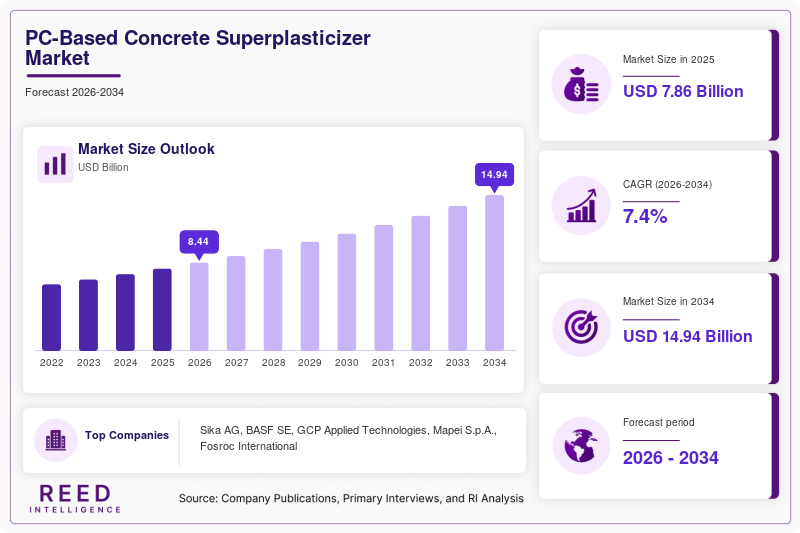
The PC-Based Concrete Superplasticizer Market size was valued at USD 7.86 billion in 2026 and is projected to reach USD 13.94 billion by 2034, expanding at a CAGR of 7.4% during the forecast period of 2026–2034. The market growth has been supported by the increasing number of infrastructure development projects across transportation, commercial construction, residential housing, and industrial facilities. Governments worldwide have accelerated investments in smart cities, highways, bridges, tunnels, airports, and energy infrastructure, which has strengthened demand for advanced concrete admixtures with enhanced performance characteristics.
PC-based concrete superplasticizers are widely used in modern construction applications due to their superior water-reduction capability, improved workability, and enhanced concrete strength. These polycarboxylate ether-based admixtures help manufacturers produce high-performance concrete while maintaining lower water-to-cement ratios. The increasing preference for durable and sustainable construction materials has contributed significantly to the expansion of the PC-Based Concrete Superplasticizer Market.
Key Highlights
- Asia Pacific accounted for 46.3% of the global PC-Based Concrete Superplasticizer Market share in 2025, while Middle East & Africa is projected to witness the fastest CAGR of 8.2% during 2026–2034.
- By product type, slump retention superplasticizers held the dominant share of 42.7% in 2025, whereas high-range water reducers are anticipated to grow at the fastest CAGR of 8.0%.
- By form, liquid superplasticizers represented the leading segment with 71.4% market share in 2025, while powder-based superplasticizers are projected to expand at a CAGR of 7.6%.
- By application, ready-mix concrete accounted for 38.5% of the market share in 2025, whereas precast concrete applications are expected to register a CAGR of 7.9%.
- By end use, infrastructure construction dominated with 41.2% share in 2025, while commercial construction is forecast to grow at a CAGR of 7.8%.
- China remained the dominant country market and was valued at USD 1.52 billion in 2024 and USD 1.64 billion in 2025.
Market Trends
Growing Adoption of High-Performance Concrete Solutions
The increasing demand for high-performance concrete has emerged as a major trend influencing the PC-Based Concrete Superplasticizer Market. Construction companies are focusing on concrete formulations that offer enhanced durability, reduced permeability, and improved compressive strength for large-scale infrastructure projects.
PC-based superplasticizers are increasingly utilized in high-rise buildings, bridges, tunnels, and marine structures where structural stability and long service life are essential. The trend has encouraged manufacturers to develop advanced admixture formulations compatible with modern cement systems and supplementary cementitious materials.
Rising Focus on Sustainable Construction Practices
Sustainability initiatives in the construction sector are reshaping the demand for environmentally efficient concrete admixtures. Builders and contractors are increasingly adopting low-water concrete mixtures to reduce material consumption and improve energy efficiency during construction.
PC-based concrete superplasticizers support sustainable construction by minimizing water usage and enabling lower cement content without compromising concrete performance. The growing adoption of green building certifications and carbon reduction strategies is expected to strengthen market demand for advanced admixture technologies.
Market Drivers
Expanding Infrastructure Development Activities
The rapid expansion of infrastructure construction projects has significantly driven the PC-Based Concrete Superplasticizer Market. Governments across emerging and developed economies are investing heavily in transportation networks, smart city initiatives, and public infrastructure modernization.
Large-scale projects involving highways, metro rail systems, airports, and industrial complexes require high-strength and flowable concrete mixtures. PC-based superplasticizers help contractors achieve superior workability and efficient placement in complex construction environments, supporting widespread adoption.
Increasing Demand for Ready-Mix Concrete
The growing use of ready-mix concrete in urban construction projects has accelerated demand for advanced concrete admixtures. Ready-mix producers increasingly rely on PC-based superplasticizers to maintain concrete consistency and extend workability during transportation and placement.
The expansion of urban housing developments and commercial real estate projects has strengthened the requirement for reliable admixture technologies capable of improving concrete performance under varying climatic conditions.
Market Restraint
Volatility in Raw Material Prices
Fluctuating prices of petrochemical-based raw materials remain a significant restraint for the PC-Based Concrete Superplasticizer Market. Variations in raw material costs directly impact manufacturing expenses and profit margins for admixture producers.
Supply chain disruptions and changes in global chemical pricing can also create pricing instability for end users. Smaller manufacturers often face operational challenges in maintaining competitive pricing during periods of raw material cost fluctuations.
Market Opportunities
Growth of Smart City Construction Projects
The increasing number of smart city projects worldwide presents substantial opportunities for the PC-Based Concrete Superplasticizer Market. Smart urban infrastructure projects require durable, high-performance concrete capable of supporting long-term structural integrity and sustainability goals.
Governments are allocating significant budgets toward intelligent transportation systems, energy-efficient buildings, and modern urban infrastructure. These developments are expected to increase the utilization of advanced concrete admixtures across large construction projects.
Technological Advancements in Low-Carbon Concrete
Technological innovation in low-carbon concrete solutions is creating new growth opportunities for market participants. Manufacturers are developing next-generation superplasticizers compatible with recycled aggregates, fly ash, slag cement, and low-clinker cement systems.
These advancements help reduce carbon emissions associated with cement production while maintaining concrete quality and performance. Growing environmental awareness within the construction industry is expected to strengthen adoption of sustainable admixture technologies.
Segmental Analysis
By Product Type
Based on product type, the PC-Based Concrete Superplasticizer Market is segmented into slump retention superplasticizers, high-range water reducers, self-compacting concrete admixtures, and specialty performance admixtures.
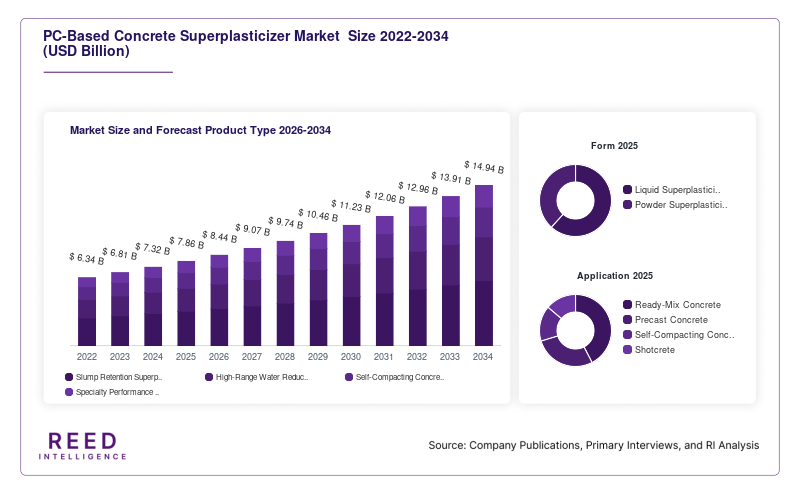
Slump retention superplasticizers dominated the market with a 42.7% share in 2025 due to their ability to maintain concrete workability during long transportation and placement durations. These products were widely utilized in large infrastructure projects and ready-mix concrete applications.
High-range water reducers are expected to witness the fastest CAGR of 8.0% during the forecast period. Their superior water reduction capability and enhanced strength performance will support growing adoption in high-performance construction applications. Increasing demand for low-water concrete mixtures is expected to strengthen segment growth.
By Form
Based on form, the market is categorized into liquid superplasticizers and powder superplasticizers.
Liquid superplasticizers accounted for the largest market share of 71.4% in 2025 owing to ease of mixing, improved dispersion properties, and compatibility with automated batching systems. Construction companies increasingly preferred liquid formulations for large-scale concrete production.
Powder-based superplasticizers are anticipated to grow at a CAGR of 7.6% during 2026–2034. Their extended shelf life and suitability for remote construction sites will support growing demand across infrastructure and precast applications.
By Application
Based on application, the PC-Based Concrete Superplasticizer Market is segmented into ready-mix concrete, precast concrete, self-compacting concrete, and shotcrete.
Ready-mix concrete held the dominant share of 38.5% in 2025 due to increasing urban construction activities and widespread adoption of centralized concrete production systems. Ready-mix manufacturers relied heavily on PC-based admixtures to improve concrete consistency and workability.
Precast concrete applications are expected to register the fastest CAGR of 7.9% through 2034. Rising demand for modular construction techniques and rapid infrastructure development will support segment expansion. Precast manufacturers are increasingly utilizing high-performance admixtures to improve production efficiency and structural durability.
By End Use
Based on end use, the market is divided into infrastructure construction, residential construction, commercial construction, and industrial construction.
Infrastructure construction dominated the market with a 41.2% share in 2025 due to increasing investments in highways, bridges, tunnels, and transportation networks. Governments across multiple regions continued prioritizing public infrastructure expansion and modernization projects.
Commercial construction is projected to witness the fastest CAGR of 7.8% during the forecast period. Rising development of office buildings, shopping complexes, data centers, and hospitality facilities will strengthen demand for advanced concrete solutions. The need for efficient and durable construction materials is expected to accelerate segment growth.
Regional Analysis
Asia Pacific
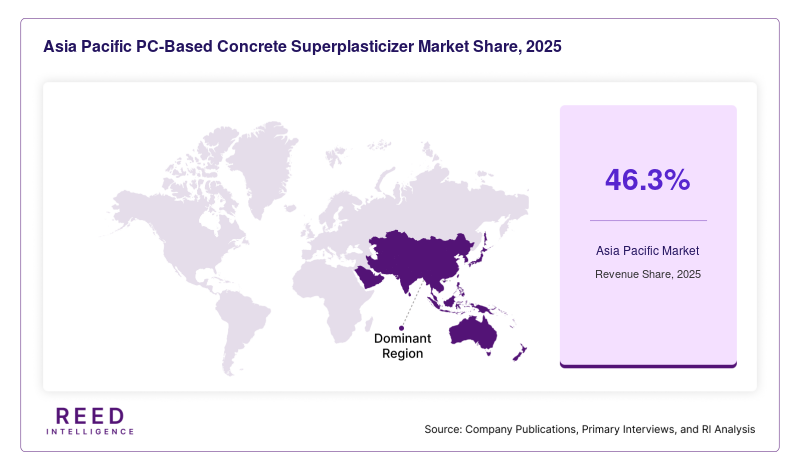
Asia Pacific accounted for 46.3% of the global PC-Based Concrete Superplasticizer Market share in 2025 and is projected to grow at a CAGR of 7.8% during 2026–2034. The region maintained a dominant position due to rapid urbanization and extensive infrastructure development activities.
China remained the leading country market because of expanding transportation infrastructure, high-rise residential construction, and industrial development projects. The country’s large-scale investments in smart cities and public infrastructure further supported market demand.
North America
North America represented 22.1% of the global PC-Based Concrete Superplasticizer Market share in 2025 and is anticipated to expand at a CAGR of 6.7% during the forecast period. The region benefited from increasing renovation projects and modernization of aging infrastructure.
The United States dominated the regional market owing to rising commercial construction activities and growing demand for durable concrete solutions in transportation projects. Investments in energy infrastructure and industrial facilities also contributed to market growth.
Europe
Europe captured 18.4% of the global PC-Based Concrete Superplasticizer Market share in 2025 and is expected to grow at a CAGR of 6.5% through 2034. The region experienced stable demand due to increasing emphasis on sustainable building materials and energy-efficient construction practices.
Germany led the European market because of strong adoption of green construction technologies and advanced engineering standards in commercial and industrial projects. The country’s focus on environmentally compliant infrastructure development supported product utilization.
Middle East & Africa
Middle East & Africa accounted for 7.3% of the global PC-Based Concrete Superplasticizer Market share in 2025 and is forecast to witness the fastest CAGR of 8.2% during 2026–2034. Rapid urban development and large-scale infrastructure investments contributed to regional growth.
Saudi Arabia emerged as the dominant country market due to ongoing megaproject developments, including transportation corridors, tourism infrastructure, and smart city initiatives. Expanding construction activities supported higher consumption of advanced concrete admixtures.
Latin America
Latin America held 5.9% of the global PC-Based Concrete Superplasticizer Market share in 2025 and is projected to expand at a CAGR of 6.3% during the study period. The region benefited from increasing residential and commercial construction projects.
Brazil remained the leading country market owing to growing investments in urban housing and industrial infrastructure. Expansion of ready-mix concrete production facilities further supported market penetration.
Competitive Landscape
The PC-Based Concrete Superplasticizer Market remains moderately consolidated with major chemical and construction material companies competing through product innovation, sustainability initiatives, and regional expansion strategies. Market participants are focusing on improving admixture efficiency and compatibility with environmentally friendly concrete systems.
Sika AG remained a leading market participant due to its broad admixture portfolio and extensive global construction chemicals network. The company recently introduced advanced PC-based superplasticizer formulations designed for low-carbon concrete applications and high-performance infrastructure projects.
BASF SE continued expanding its sustainable construction chemicals business through research investments and advanced admixture technologies. GCP Applied Technologies emphasized digital concrete optimization solutions, while Mapei S.p.A. strengthened its regional distribution network for specialty construction chemicals. Fosroc International focused on infrastructure-focused admixture innovations tailored for challenging environmental conditions.
Key Players List
- Sika AG
- BASF SE
- GCP Applied Technologies
- Mapei S.p.A.
- Fosroc International
- Arkema Group
- Saint-Gobain
- RPM International Inc.
- Kao Corporation
- Sobute New Materials
- CHRYSO SAS
- CICO Technologies Limited
- MC-Bauchemie
- Ha-Be Betonchemie GmbH & Co. KG
- Pidilite Industries Limited
Recent Developments
- In 2025, Sika AG introduced advanced PC-based admixtures designed for low-carbon and high-strength concrete applications.
- In 2024, BASF SE expanded its sustainable construction chemicals portfolio with enhanced water-reduction technologies.
- In 2025, Mapei S.p.A. invested in regional production expansion for advanced concrete admixture manufacturing.
- In 2024, Fosroc International launched new superplasticizer formulations tailored for infrastructure megaprojects.
- In 2025, CHRYSO SAS strengthened research initiatives focused on environmentally efficient concrete admixture solutions.
PC-Based Concrete Superplasticizer Market Segments
Product Type
- Slump Retention Superplasticizers
- High-Range Water Reducers
- Self-Compacting Concrete Admixtures
- Specialty Performance Admixtures
Form
- Liquid Superplasticizers
- Powder Superplasticizers
Application
- Ready-Mix Concrete
- Precast Concrete
- Self-Compacting Concrete
- Shotcrete
End Use
- Infrastructure Construction
- Residential Construction
- Commercial Construction
- Industrial Construction
By Region
- North America
- Europe
- APAC
- Middle East and Africa
- LATAM