Pearlescent Pigment Market Size, Share & Demand Report By Type (Iron Oxide Pearlescent Pigments, Silica-Based Pearlescent Pigments, Aluminum Oxide Pearlescent Pigments, Other Specialty Pearlescent Pigments), By Application (Automotive Coatings, Cosmetics and Personal Care, Plastics, Printing Inks, Packaging), By End Use (Industrial Manufacturing, Consumer Goods, Automotive Industry, Packaging Industry), By Region & Segment Forecasts, 2026–2034
USD 3950
Market Overview
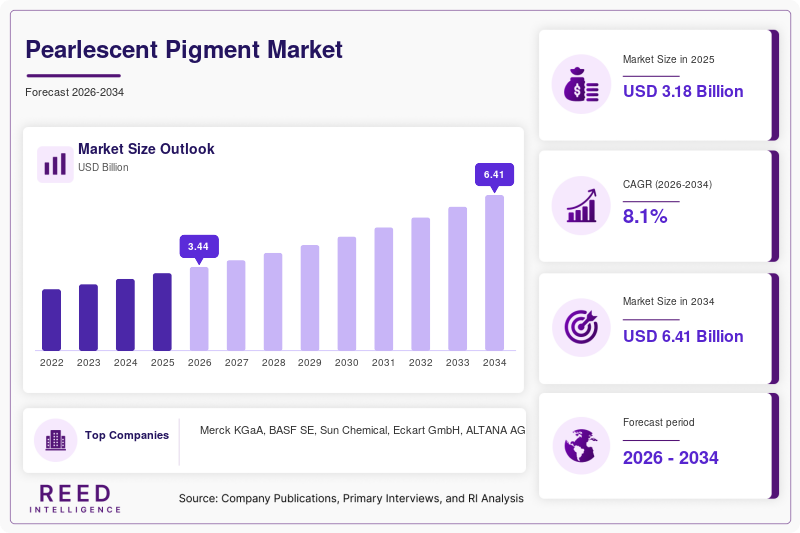
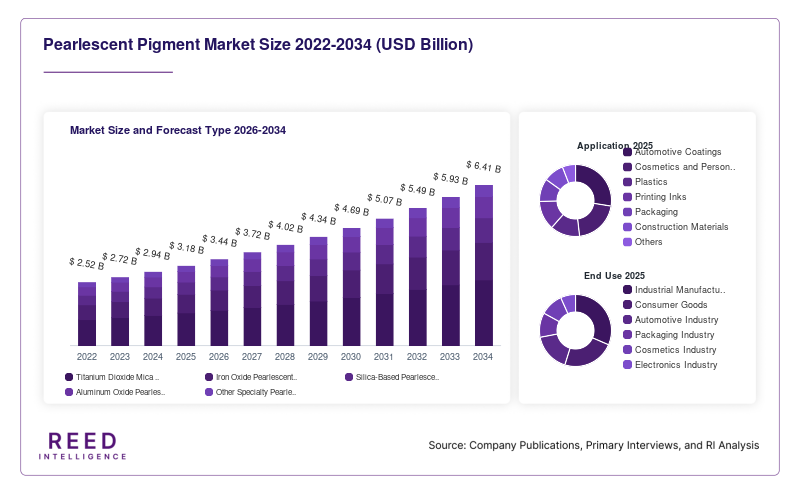
The global Pearlescent Pigment Market size was valued at USD 3.18 billion in 2026 and is projected to reach USD 5.94 billion by 2034, expanding at a CAGR of 8.1% during the forecast period from 2026 to 2034. The market continues to witness steady expansion due to rising demand for premium visual effects across automotive coatings, cosmetics, plastics, printing inks, and packaging applications. Pearlescent pigments are widely used to create reflective and shimmering finishes that improve product appearance and support brand differentiation in competitive consumer markets. Manufacturers are increasingly investing in advanced multilayer pigments and eco-friendly mineral-based formulations to meet changing industry requirements.
A major global factor supporting market growth is the increasing demand for sustainable and visually attractive materials in consumer goods and industrial applications. Companies in cosmetics, automotive, and luxury packaging are shifting toward non-toxic and low-VOC pigments that comply with environmental standards while maintaining strong optical performance. Growth in electric vehicle production and premium cosmetic launches has further accelerated the use of pearlescent pigments in coatings and decorative finishes. In addition, digital printing advancements and expanding urban infrastructure projects are increasing the consumption of specialty pigments in architectural coatings and decorative applications.
Key Highlights
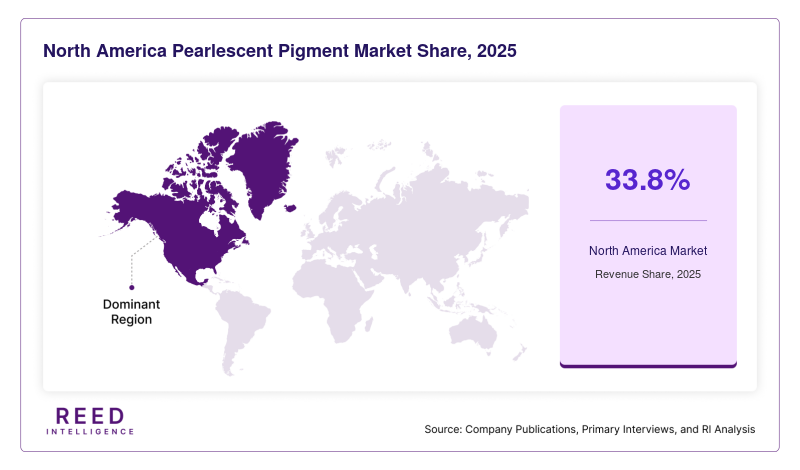
- North America dominated the market with a 33.8% share in 2025.
- Asia Pacific is expected to grow at the fastest CAGR of 9.6% during 2026–2034.
- By type, titanium dioxide mica pigments accounted for the largest share of 42.6%.
- while silica-based pearlescent pigments are projected to grow at a CAGR of 10.3%.
- By application, automotive coatings led with a 37.4% share.
- whereas cosmetics and personal care are expected to expand at a CAGR of 9.9%.
- By end use, industrial manufacturing held the dominant share of 39.1%.
- while consumer goods are anticipated to grow at a CAGR of 10.1%.
- The United States remained the dominant country, with market values of USD 620 million in 2024 and USD 675 million in 2025.
Market Trends
Growing Adoption of Eco-Friendly and Mineral-Based Pigments
The Pearlescent Pigment Market is experiencing strong momentum from the growing preference for sustainable and environmentally compatible pigment solutions. Manufacturers are focusing on mineral-based and biodegradable raw materials to align with changing environmental regulations and consumer preferences. Regulatory agencies across North America and Europe are encouraging the replacement of heavy metal-based pigments with safer alternatives, leading companies to increase investments in titanium dioxide mica and silica-coated pigments. Cosmetic and packaging industries are especially adopting eco-friendly pearlescent pigments to support sustainable branding strategies. Many personal care brands now market products using clean-label ingredients and recyclable packaging, increasing the use of natural-effect pigments. This trend is also influencing industrial coatings, where manufacturers are seeking low-emission materials with improved durability and aesthetic performance.
Expansion of Premium Automotive and Luxury Packaging Applications
Another important trend shaping the Pearlescent Pigment Market is the increasing use of premium visual finishes in automotive coatings and luxury packaging. Automotive manufacturers are integrating advanced pearlescent pigments into exterior paints to create color-shifting and reflective effects that improve vehicle appearance. Electric vehicle brands are particularly emphasizing premium coatings to differentiate products in highly competitive markets. Luxury packaging companies are also using pearlescent pigments in labels, cartons, and decorative films to improve shelf visibility and brand identity. The growing popularity of high-end consumer electronics and premium beverage packaging has increased demand for customized pigments with improved optical properties. Furthermore, digital printing technologies are enabling efficient integration of pearlescent finishes into packaging materials, supporting broader adoption across commercial printing applications.
Market Drivers
Rising Demand from Cosmetics and Personal Care Industries
The rapid expansion of the cosmetics and personal care sector is a major factor driving growth in the Pearlescent Pigment Market. Beauty and skincare brands are increasingly using pearlescent pigments in foundations, lipsticks, eye shadows, nail coatings, and body lotions to create glossy and reflective textures. Consumers are showing strong interest in premium cosmetic products with advanced visual appeal, encouraging companies to launch innovative formulations. The influence of social media marketing and beauty influencers has accelerated product innovation in shimmer-based cosmetics. Emerging economies in Asia Pacific and Latin America are witnessing rising disposable income and growing beauty awareness, contributing to higher consumption of specialty pigments. In addition, demand for skin-safe and hypoallergenic pigments is encouraging manufacturers to develop advanced cosmetic-grade formulations with improved stability and color consistency.
Increasing Use in Automotive and Industrial Coatings
The growing automotive and industrial coatings sectors are significantly supporting the expansion of the Pearlescent Pigment Market. Automotive manufacturers are incorporating pearlescent coatings into passenger vehicles, luxury cars, and electric vehicles to improve product differentiation and visual appeal. Industrial equipment producers are also adopting these pigments in machinery coatings, appliances, and construction materials to create durable decorative finishes. Infrastructure development projects across developing regions are increasing demand for high-performance architectural coatings containing pearlescent pigments. The market is also benefiting from advancements in multilayer pigment technology, which improves color depth and resistance to weather exposure. As manufacturers focus on high-quality surface finishing and corrosion resistance, the integration of specialty pigments in industrial coatings is expected to continue increasing during the forecast period.
Market Restraint
Fluctuating Raw Material Prices and Complex Manufacturing Processes
The Pearlescent Pigment Market faces challenges related to fluctuating raw material costs and technically complex manufacturing processes. Key raw materials such as titanium dioxide, mica, silica, and aluminum oxide are subject to price volatility due to mining restrictions, supply chain disruptions, and changing trade policies. Variations in raw material availability directly influence production costs and reduce profit margins for manufacturers. In addition, the manufacturing process for pearlescent pigments requires precision coating technologies and advanced quality control systems to achieve consistent optical effects. Smaller manufacturers often face difficulties in maintaining large-scale production efficiency while meeting regulatory standards. The market also experiences pressure from low-cost substitute pigments used in price-sensitive industries. For example, some packaging and decorative coating manufacturers continue to rely on conventional metallic pigments due to lower initial costs, limiting the adoption of premium pearlescent formulations in cost-sensitive applications.
Market Opportunities
Rising Demand for Advanced Printing Inks and Digital Printing Solutions
The increasing adoption of advanced printing technologies is creating significant opportunities for the Pearlescent Pigment Market. Printing companies are integrating pearlescent pigments into digital inks, flexible packaging, advertising materials, and decorative printing applications to improve visual effects and product differentiation. Growth in e-commerce packaging and customized branding strategies has accelerated demand for premium printing finishes. Consumer goods companies are investing in eye-catching packaging designs to attract customer attention in retail environments. Pearlescent pigments offer reflective properties and color depth that support these branding objectives. In addition, technological improvements in UV-curable inks and high-speed printing equipment are enabling efficient use of specialty pigments in commercial printing operations. The expanding adoption of smart packaging and anti-counterfeit labeling solutions is also expected to increase demand for advanced pearlescent pigment formulations.
Expanding Applications in Consumer Electronics and Decorative Plastics
The growing production of consumer electronics and decorative plastic products presents another strong growth opportunity for the Pearlescent Pigment Market. Smartphone manufacturers, wearable device companies, and appliance producers are increasingly using pearlescent finishes to improve product appearance and enhance consumer appeal. Decorative plastics containing pearlescent pigments are widely used in household appliances, interior furnishings, and fashion accessories. The shift toward premium product aesthetics is encouraging manufacturers to integrate specialty pigments into molded plastic components. Rapid urbanization and rising household spending in emerging economies are supporting growth in consumer electronics and home décor industries. Furthermore, advancements in heat-resistant and UV-stable pigments are improving their compatibility with engineering plastics and high-performance polymers, enabling broader adoption across industrial and consumer applications.
Segmental Analysis
By Type
Titanium dioxide mica pigments accounted for the largest share of the Pearlescent Pigment Market in 2024, representing 42.6% of global revenue. These pigments are widely used because of their excellent brightness, durability, and compatibility with coatings, plastics, cosmetics, and printing inks. Manufacturers prefer titanium dioxide mica pigments due to their ability to create reflective and color-shifting effects while maintaining strong chemical stability. Automotive coatings and industrial paints remain the largest application areas for this segment. In addition, cosmetic companies continue to adopt titanium dioxide mica pigments in foundations, eye shadows, and lip products because of their smooth texture and skin-safe properties. The segment also benefits from rising demand for premium decorative finishes in consumer goods and luxury packaging applications.
Silica-based pearlescent pigments are expected to register the fastest CAGR of 10.3% during the forecast period. The increasing focus on lightweight and environmentally sustainable materials is a key factor supporting growth in this segment. Silica-based pigments provide improved transparency, soft luster, and enhanced optical effects compared to traditional formulations. These pigments are increasingly used in premium cosmetics, digital printing inks, and high-end packaging applications where subtle visual finishes are preferred. Technological advancements in multilayer coating processes are improving the performance and durability of silica-based pigments in industrial applications. In addition, manufacturers are investing in low-VOC and recyclable pigment solutions to comply with environmental regulations, further accelerating demand for silica-based formulations across developed and emerging markets.
By Application
Automotive coatings represented the dominant application segment in the Pearlescent Pigment Market in 2024, accounting for 37.4% of total revenue. The automotive industry extensively uses pearlescent pigments to create premium visual effects and enhance vehicle aesthetics. Luxury vehicle manufacturers and electric vehicle brands are increasingly integrating reflective coatings to strengthen product differentiation in competitive markets. Pearlescent pigments are also valued for their weather resistance, color stability, and ability to improve surface appearance under varying lighting conditions. Rising consumer preference for customized vehicle finishes has further increased demand for specialty pigments in automotive refinishing and aftermarket applications. In addition, expanding vehicle production across Asia Pacific and North America continues to support the long-term growth of this segment.
Cosmetics and personal care applications are anticipated to witness the fastest CAGR of 9.9% from 2026 to 2034. Consumers are increasingly demanding shimmer-based beauty products with advanced visual appeal, encouraging cosmetic manufacturers to expand their use of pearlescent pigments. Products such as foundations, highlighters, nail coatings, and skincare creams commonly incorporate specialty pigments to create glowing and reflective textures. The growth of online beauty retail platforms and influencer-driven marketing campaigns is accelerating the launch of innovative cosmetic products globally. In addition, rising disposable income in emerging economies is increasing spending on premium personal care products. Manufacturers are also developing skin-safe and hypoallergenic pigment formulations to meet consumer demand for clean-label and dermatologically tested cosmetics.
By End Use
Industrial manufacturing emerged as the largest end-use segment in the Pearlescent Pigment Market in 2024, holding a 39.1% revenue share. Industrial manufacturers utilize pearlescent pigments in coatings, plastics, construction materials, and machinery components to improve product aesthetics and surface durability. Demand from architectural coatings and decorative construction materials has increased significantly due to ongoing infrastructure development projects worldwide. Industrial users also value these pigments for their resistance to heat, moisture, and corrosion in demanding operational environments. Furthermore, manufacturers of appliances and engineered plastics are incorporating pearlescent finishes into products to improve visual quality and consumer appeal. The expansion of industrial automation and smart manufacturing technologies is further encouraging investments in advanced coating materials.
Consumer goods are projected to register the fastest CAGR of 10.1% during the forecast period. The increasing popularity of visually attractive household products, electronics, fashion accessories, and packaging materials is driving growth in this segment. Brands are investing in decorative finishes and premium product presentation to strengthen customer engagement and improve retail visibility. Pearlescent pigments are increasingly used in smartphone casings, wearable devices, kitchen appliances, and luxury packaging to create reflective and metallic effects. Rising middle-class populations and improving purchasing power in developing economies are contributing to stronger demand for premium consumer products. In addition, technological improvements in pigment dispersion and compatibility with engineering plastics are enabling wider use across consumer electronics and decorative product manufacturing.
Regional Analysis
North America
North America accounted for 33.8% of the global Pearlescent Pigment Market share in 2025 and continues to maintain a leading position due to strong demand from automotive coatings, cosmetics, and industrial manufacturing sectors. The region is projected to expand at a CAGR of 7.4% during the forecast period. Increasing investments in premium coatings and specialty materials are supporting regional market growth. Manufacturers in the United States and Canada are focusing on sustainable pigment technologies and advanced multilayer formulations to meet environmental standards and improve product efficiency.
The United States remains the dominant country in North America due to its strong industrial base and advanced cosmetic manufacturing industry. Demand for pearlescent pigments is increasing in automotive refinishing applications and premium beauty products. The country is also witnessing rising investments in electric vehicle manufacturing, which is driving consumption of specialty coatings with reflective finishes. In addition, the expansion of luxury packaging and decorative printing industries is creating additional opportunities for pigment suppliers operating across the region.
Europe
Europe represented 27.1% of the global Pearlescent Pigment Market in 2025 and is expected to register a CAGR of 7.1% between 2026 and 2034. The region benefits from strict environmental regulations that encourage the use of eco-friendly pigments in coatings, cosmetics, and packaging applications. Germany, France, Italy, and the United Kingdom are major contributors to market demand. European manufacturers are increasingly focusing on recyclable materials and low-emission production methods to support sustainability targets across industrial sectors.
Germany continues to dominate the European market due to its strong automotive and industrial coatings industries. The country is a major producer of luxury vehicles that utilize advanced pearlescent coatings for premium visual effects. German cosmetic manufacturers are also increasing the use of specialty pigments in skincare and makeup products. In addition, the country’s emphasis on research and development has encouraged innovation in high-performance pigments with improved durability, heat resistance, and weather stability for industrial applications.
Asia Pacific
Asia Pacific held 24.9% of the global Pearlescent Pigment Market share in 2025 and is projected to witness the fastest CAGR of 9.6% during the forecast period. Rapid industrialization, urbanization, and expanding manufacturing activities are major factors supporting regional market growth. Countries such as China, India, Japan, and South Korea are increasing consumption of specialty pigments across plastics, cosmetics, automotive coatings, and packaging industries. Rising disposable income and changing consumer preferences toward premium products are also contributing to higher demand for decorative pigments.
China remains the dominant country in the Asia Pacific market due to its large-scale manufacturing capabilities and strong export-oriented production base. The country has experienced rising demand for pearlescent pigments in consumer electronics, automotive coatings, and decorative plastics. Government investments in industrial modernization and infrastructure development are also supporting growth in architectural coatings applications. Additionally, expanding domestic cosmetic brands and online retail channels are encouraging higher adoption of specialty pigments in personal care products.
Middle East & Africa
The Middle East & Africa region accounted for 7.3% of the global Pearlescent Pigment Market in 2025 and is anticipated to grow at a CAGR of 6.8% through 2034. The market is gradually expanding due to increasing investments in construction, decorative coatings, and luxury consumer goods. Countries in the Gulf region are witnessing rising demand for premium interior coatings and customized packaging materials. Growing tourism and hospitality infrastructure development are also supporting consumption of decorative paints and specialty pigments across commercial projects.
Saudi Arabia is the dominant country in the Middle East & Africa market because of large-scale construction projects and expanding industrial diversification initiatives. The country is increasing investments in decorative architecture and premium infrastructure developments that require advanced coating materials. Demand for pearlescent pigments is also rising in luxury packaging and cosmetic products targeting high-income consumers. Furthermore, government initiatives aimed at strengthening domestic manufacturing capabilities are encouraging regional production of specialty chemicals and pigments.
Latin America
Latin America captured 6.9% of the global Pearlescent Pigment Market share in 2025 and is forecast to expand at a CAGR of 6.9% during the assessment period. Market growth is supported by increasing demand for decorative plastics, automotive coatings, and personal care products across Brazil, Mexico, and Argentina. Rising urban populations and improving retail infrastructure are encouraging higher consumption of premium consumer goods. Regional manufacturers are also adopting advanced pigments to improve packaging quality and product presentation in competitive retail environments.
Brazil remains the leading market in Latin America due to its strong cosmetics and automotive sectors. The country is among the largest beauty and personal care markets in the region, creating substantial demand for shimmer-based pigments in makeup and skincare formulations. In addition, automotive manufacturing activities and aftermarket refinishing applications continue to support pigment consumption. The expansion of domestic packaging and printing industries is further increasing the use of pearlescent pigments in branding and decorative applications.
Competitive Landscape
The Pearlescent Pigment Market is moderately consolidated, with global and regional manufacturers competing through product innovation, sustainability initiatives, and strategic partnerships. Leading companies are investing in research and development to improve pigment durability, optical performance, and environmental compliance. Many market participants are expanding production capacity to address growing demand from automotive coatings, cosmetics, and packaging industries. Competitive strategies also include acquisitions, product portfolio diversification, and collaborations with coating and cosmetic manufacturers.
Merck KGaA remains a leading company in the global market due to its extensive specialty pigment portfolio and strong global distribution network. The company continues to focus on advanced effect pigments for automotive and cosmetic applications. BASF SE, Sun Chemical, Eckart GmbH, and ALTANA AG are also prominent market participants with significant investments in sustainable pigment technologies. In 2025, Sun Chemical introduced a new range of high-durability pearlescent pigments designed for digital printing and flexible packaging applications. Similarly, BASF SE expanded its production capabilities for eco-friendly effect pigments to strengthen its position in premium coatings and cosmetics markets.
Key Players
- Merck KGaA
- BASF SE
- Sun Chemical
- Eckart GmbH
- ALTANA AG
- Nihon Koken Kogyo Co., Ltd.
- Geotech International B.V.
- CQV Co., Ltd.
- DIC Corporation
- Sudarshan Chemical Industries Limited
- Kolortek Co., Ltd.
- Oxen Special Chemicals Co., Ltd.
- RIKA Technology Co., Ltd.
- Zhejiang Ruicheng Effect Pigment Co., Ltd.
- Fujian Kuncai Material Technology Co., Ltd.
Recent Developments
- In February 2025, Merck KGaA launched a new line of sustainable pearlescent pigments developed for low-emission automotive coating applications.
- In July 2025, BASF SE expanded its specialty pigment production facility in Germany to address rising demand from cosmetic and packaging manufacturers.
- In November 2025, CQV Co., Ltd. introduced advanced silica-based pearlescent pigments designed for digital printing and decorative plastic applications.
- In January 2026, Sun Chemical announced a strategic partnership with a packaging solutions provider to develop premium pearlescent ink technologies for luxury branding.
Pearlescent Pigment Market Segments
Type
- Titanium Dioxide Mica Pigments
- Iron Oxide Pearlescent Pigments
- Silica-Based Pearlescent Pigments
- Aluminum Oxide Pearlescent Pigments
- Other Specialty Pearlescent Pigments
Application
- Automotive Coatings
- Cosmetics and Personal Care
- Plastics
- Printing Inks
- Packaging
- Construction Materials
- Others
End Use
- Industrial Manufacturing
- Consumer Goods
- Automotive Industry
- Packaging Industry
- Cosmetics Industry
- Electronics Industry
By Region
- North America
- Europe
- APAC
- Middle East and Africa
- LATAM