Pedestrian Entrance Control Equipment Market Size, Share & Demand Report By Product Type (Speed Gates, Turnstiles, Swing Gates), By Technology (RFID-Based Access Control, Biometric Authentication), By End User (Commercial Buildings, Transportation Infrastructure), By Installation Type (New Installations, Retrofit Installations), By Distribution Channel (Direct Sales, System Integrators, Security Solution Providers), By Region & Segment Forecasts, 2026–2034
USD 3950
Market Overview
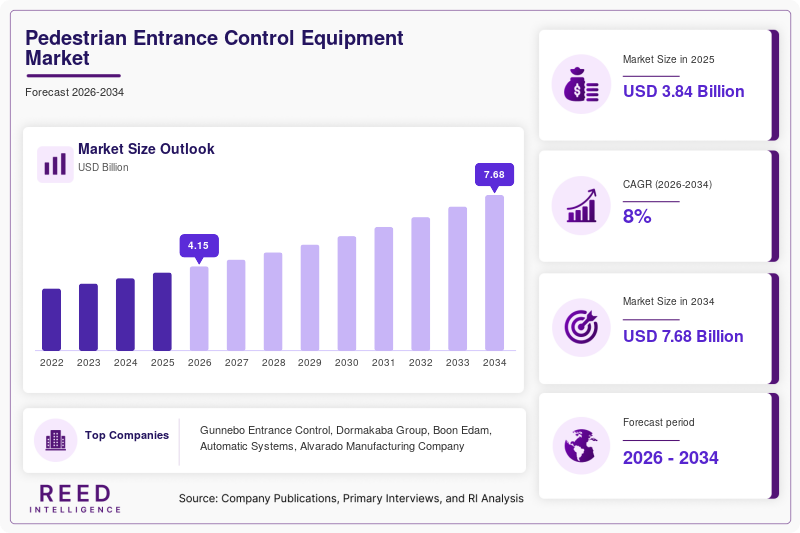
The Pedestrian Entrance Control Equipment Market was valued at USD 3.84 billion in 2026 and is projected to reach USD 7.12 billion by 2034, expanding at a CAGR of 8.0% during 2026–2034. The market continues to gain momentum as organizations across commercial, transportation, institutional, and public infrastructure sectors prioritize secure and efficient access management systems. Pedestrian entrance control equipment includes turnstiles, speed gates, swing gates, flap barriers, revolving doors, access control gates, and integrated biometric entry systems designed to regulate pedestrian movement while enhancing security and operational efficiency.
A major global factor supporting market growth has been the increasing investment in smart infrastructure development. Governments and private enterprises are integrating advanced security technologies into office buildings, airports, metro stations, stadiums, educational institutions, healthcare facilities, and public venues. The growing adoption of intelligent building management systems and digital identity verification platforms has accelerated demand for modern pedestrian entrance control solutions capable of delivering both security and convenience.
Key Highlights
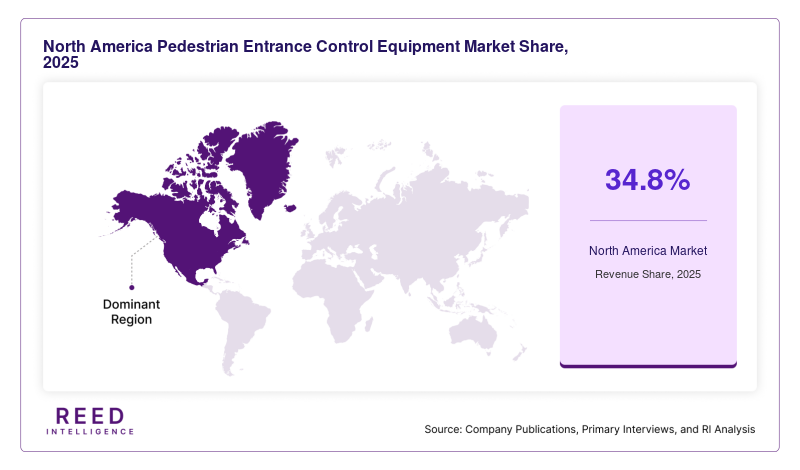
- North America accounted for the dominant regional share of 34.8% in 2025, while Asia Pacific is projected to register the fastest CAGR of 9.6% during 2026–2034.
- By Product Type, Speed Gates held the leading share of 31.4% in 2025, whereas Biometric Entrance Systems are expected to grow at the fastest CAGR of 10.4%.
- By Technology, RFID-Based Access Control represented 42.1% of market revenue in 2025, while Facial Recognition Systems are forecast to expand at 10.8% CAGR.
- By End User, Commercial Buildings accounted for 29.7% market share in 2025, whereas Transportation Infrastructure is anticipated to witness a CAGR of 9.9%.
- The United States remained the dominant country market, valued at USD 1.05 billion in 2024 and USD 1.12 billion in 2025.
Market Trends
Integration of Biometric Authentication Technologies
One of the most influential trends shaping the Pedestrian Entrance Control Equipment Market is the rapid integration of biometric authentication systems. Organizations are increasingly replacing traditional card-based access systems with fingerprint recognition, facial recognition, iris scanning, and multimodal biometric platforms. These technologies improve security accuracy while reducing credential sharing and identity fraud risks.
The growing availability of artificial intelligence-powered recognition software has enhanced verification speed and user experience. Enterprises, transportation hubs, healthcare institutions, and government facilities are increasingly deploying biometric-enabled entrance control equipment to strengthen access management frameworks.
Growth of Cloud-Connected Access Management Platforms
Cloud-based access management solutions are transforming the operational landscape of pedestrian entrance control systems. Organizations now seek centralized monitoring, remote management, real-time reporting, and predictive maintenance capabilities.
Cloud integration allows facility managers to oversee multiple locations through a unified platform while simplifying software updates and access policy administration. As digital transformation initiatives accelerate globally, demand for connected entrance control infrastructure continues to increase across both public and private sectors.
Market Drivers
Rising Investments in Smart Buildings and Intelligent Infrastructure
The rapid development of smart buildings and digitally connected infrastructure projects is a significant driver for the Pedestrian Entrance Control Equipment Market. Modern facilities require integrated security systems capable of managing occupant access while communicating with surveillance, lighting, energy management, and emergency response platforms.
Developers increasingly incorporate intelligent entrance control equipment during building design stages to improve operational efficiency and security performance. This trend continues to stimulate market expansion across commercial, institutional, and mixed-use developments.
Increasing Security Compliance Requirements Across Industries
Organizations face growing pressure to comply with evolving security regulations and risk management standards. Facilities handling sensitive information, valuable assets, or large visitor volumes increasingly invest in advanced entrance control technologies to strengthen compliance frameworks.
Modern pedestrian access systems provide detailed audit trails, user authentication records, occupancy tracking, and security reporting capabilities. These functions support regulatory requirements while helping organizations maintain secure operational environments.
Market Restraint
High Initial Installation and System Integration Costs
One major restraint affecting market expansion is the substantial upfront investment associated with advanced pedestrian entrance control infrastructure. Equipment procurement, software licensing, integration services, biometric hardware deployment, and maintenance expenditures can create financial challenges for small and medium-sized organizations. Complex retrofitting requirements in older facilities may further increase implementation costs and delay purchasing decisions.
Market Opportunities
Expansion of Contactless Access Technologies
Growing demand for touch-free access experiences presents significant opportunities for market participants. Contactless technologies such as facial recognition, mobile credentials, QR code authentication, and Bluetooth-enabled access systems continue gaining acceptance across commercial and public facilities. Vendors offering reliable and scalable contactless solutions are expected to benefit from increasing adoption.
Emerging Demand from Smart City Development Projects
Governments worldwide continue investing in smart city initiatives that emphasize urban mobility, public safety, and digital governance. Transportation hubs, municipal buildings, civic centers, and public venues increasingly require advanced pedestrian entrance control infrastructure. This expanding project pipeline creates substantial long-term growth opportunities for equipment manufacturers and solution providers.
Segmental Analysis
By Product Type
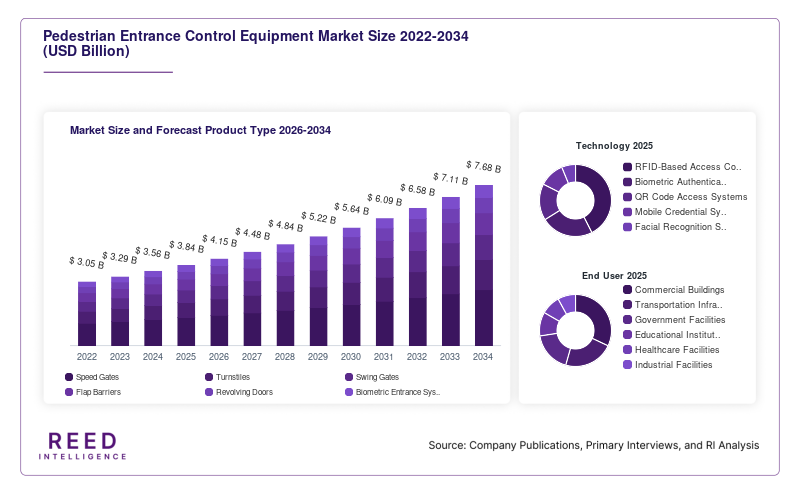
The market is segmented into Speed Gates, Turnstiles, Swing Gates, Flap Barriers, Revolving Doors, and Biometric Entrance Systems.
Speed Gates dominated the market with a 31.4% share in 2025. Their combination of security, aesthetics, and high throughput made them particularly suitable for commercial offices, corporate headquarters, financial institutions, and premium facilities.
Biometric Entrance Systems are expected to record the fastest CAGR of 10.4% during the forecast period. Growing demand for identity verification accuracy and contactless authentication capabilities will drive accelerated adoption across high-security environments.
By Technology
The market includes RFID-Based Access Control, Biometric Authentication, QR Code Access Systems, Mobile Credential Systems, and Facial Recognition Systems.
RFID-Based Access Control accounted for 42.1% of total revenue in 2025. Organizations favored RFID technology due to its cost-effectiveness, scalability, and compatibility with existing access management infrastructure.
Facial Recognition Systems are forecast to expand at a 10.8% CAGR through 2034. Improvements in artificial intelligence algorithms and increased demand for frictionless entry experiences will contribute significantly to segment growth.
By End User
The market is categorized into Commercial Buildings, Transportation Infrastructure, Government Facilities, Educational Institutions, Healthcare Facilities, and Industrial Facilities.
Commercial Buildings held the leading share of 29.7% in 2025. High deployment rates across office complexes, business parks, and mixed-use developments supported segment dominance.
Transportation Infrastructure is projected to register a CAGR of 9.9% during the forecast period. Increasing passenger volumes and modernization of transit facilities will stimulate demand for automated pedestrian management solutions.
By Installation Type
The market is segmented into New Installations and Retrofit Installations.
New Installations captured 61.3% market share in 2025 due to growing incorporation of access control infrastructure within newly constructed facilities and smart building projects.
Retrofit Installations are anticipated to grow at a 9.1% CAGR. Organizations upgrading legacy security infrastructure will increasingly invest in modern entrance control technologies to improve operational efficiency and compliance.
By Distribution Channel
The market includes Direct Sales, System Integrators, Security Solution Providers, and Authorized Distributors.
System Integrators represented the dominant distribution channel with 38.6% share in 2025. Customers increasingly preferred comprehensive implementation services that combine equipment deployment, software integration, and maintenance support.
Security Solution Providers are expected to grow at a CAGR of 9.0% through 2034 as organizations seek end-to-end managed security services.
Regional Analysis
North America
North America held 34.8% of the global Pedestrian Entrance Control Equipment Market in 2025. The region benefited from widespread implementation of advanced security technologies across corporate campuses, airports, government facilities, and healthcare institutions. Strong adoption of integrated access control ecosystems supported regional market leadership.
The United States remained the dominant country within North America. Growth was supported by increasing deployment of unified security platforms that combine entrance control equipment with video surveillance and cybersecurity management systems.
North America is expected to expand at a CAGR of 7.4% during 2026–2034.
Europe
Europe represented 27.6% of global market revenue in 2025. Demand remained strong across transportation infrastructure, financial institutions, educational campuses, and public administration facilities. Modernization of aging security infrastructure contributed to regional market development.
Germany emerged as the leading country market. The country's emphasis on industrial facility security and advanced building automation systems stimulated continued adoption of sophisticated pedestrian access solutions.
Europe will likely register a CAGR of 7.6% through 2034.
Asia Pacific
Asia Pacific accounted for 24.2% market share in 2025. Rapid urbanization, infrastructure expansion, and increasing construction activity generated substantial demand for pedestrian entrance control equipment throughout the region.
China dominated the regional market due to extensive deployment of intelligent transportation systems, smart commercial complexes, and digital government infrastructure projects. Continuous investments in urban modernization strengthened equipment demand across major metropolitan areas.
Asia Pacific is projected to witness the fastest regional growth with a CAGR of 9.6% between 2026 and 2034.
Middle East & Africa
The Middle East & Africa captured 7.1% of global revenue in 2025. Investments in commercial real estate, hospitality developments, transportation facilities, and government infrastructure projects contributed to market growth.
The United Arab Emirates served as the dominant country market. Large-scale mixed-use developments and advanced security requirements across premium commercial properties supported equipment adoption throughout the country.
The region is anticipated to grow at a CAGR of 8.2% during the forecast period.
Latin America
Latin America held 6.3% market share in 2025. Demand increased steadily across corporate offices, public transportation systems, educational institutions, and healthcare facilities seeking improved access management capabilities.
Brazil represented the largest country market. Expanding investments in commercial construction and modernization of public infrastructure projects encouraged implementation of pedestrian entrance control solutions.
Latin America is expected to achieve a CAGR of 7.8% from 2026 to 2034.
Competitive Landscape
The Pedestrian Entrance Control Equipment Market remains moderately consolidated, with leading companies focusing on technological innovation, product portfolio expansion, strategic partnerships, and geographic expansion initiatives.
Gunnebo Entrance Control maintained a leadership position through its broad portfolio of speed gates, turnstiles, and integrated access management solutions. The company recently introduced a new generation of AI-enabled entrance control systems featuring enhanced biometric compatibility and remote monitoring capabilities.
Dormakaba Group continues strengthening its market presence through intelligent access control solutions designed for commercial and institutional applications.
Boon Edam remains a significant participant in premium entrance management systems, particularly revolving doors and security entrance products.
Alvarado Manufacturing focuses on innovative pedestrian access solutions serving transportation, entertainment, and commercial sectors.
Automatic Systems maintains strong competitiveness through advanced access control technologies emphasizing security, throughput efficiency, and system integration flexibility.
Market participants continue investing in cloud connectivity, touchless authentication, predictive maintenance platforms, and AI-driven access management capabilities to enhance their competitive positioning.
Key Players List
- Gunnebo Entrance Control
- Dormakaba Group
- Boon Edam
- Automatic Systems
- Alvarado Manufacturing Company
- PERCo
- Cominfo Inc.
- Tiso Turnstiles
- Smarter Security
- Turnstar Systems
- Hayward Turnstiles
- KONE Corporation
- Magnetic Autocontrol GmbH
- Controlled Access Turnstiles
- Omnitec Systems
Pedestrian Entrance Control Equipment Market Segments
Product Type
- Speed Gates
- Turnstiles
- Swing Gates
- Flap Barriers
- Revolving Doors
- Biometric Entrance Systems
Technology
- RFID-Based Access Control
- Biometric Authentication
- QR Code Access Systems
- Mobile Credential Systems
- Facial Recognition Systems
End User
- Commercial Buildings
- Transportation Infrastructure
- Government Facilities
- Educational Institutions
- Healthcare Facilities
- Industrial Facilities
Installation Type
- New Installations
- Retrofit Installations
Distribution Channel
- Direct Sales
- System Integrators
- Security Solution Providers
- Authorized Distributors
By Region
- North America
- Europe
- APAC
- Middle East and Africa
- LATAM