Pediatric Magnetic Resonance Imaging Market Size, Share & Demand Report By Type (Closed MRI Systems, Open MRI Systems), By Field Strength (High-Field MRI, Low-Field MRI), By Application (Neurology, Cardiology, Oncology, Orthopedics), By End-Use (Hospitals, Diagnostic Imaging Centers, Specialty Clinics), By Region & Segment Forecasts, 2026–2034
USD 3950
Market Overview
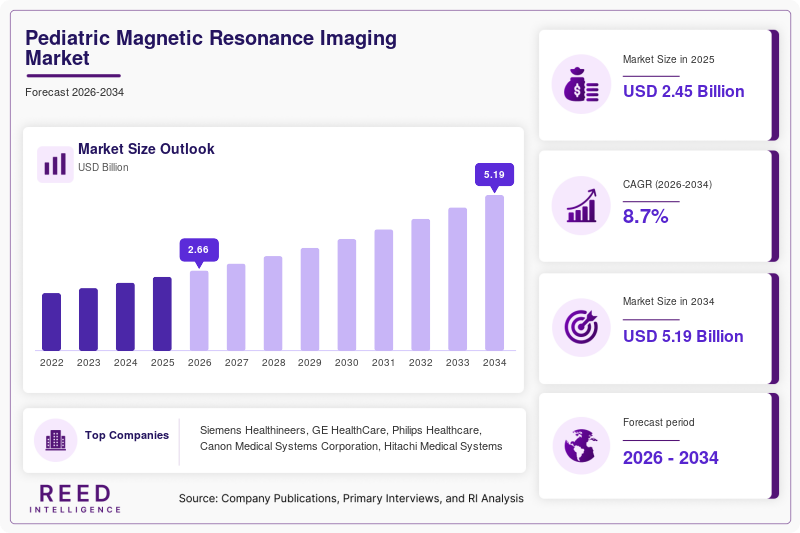
The Pediatric Magnetic Resonance Imaging Market size was valued at USD 2.45 billion in 2026 and is projected to reach USD 4.78 billion by 2034, expanding at a CAGR of 8.7% from 2026 to 2034. The market is witnessing steady expansion driven by advancements in imaging technologies tailored for pediatric applications and increasing demand for non-invasive diagnostic tools. Pediatric MRI systems offer radiation-free imaging, which is particularly critical for children, thereby supporting their adoption across healthcare facilities.
A key global factor supporting market growth is the rising emphasis on early diagnosis of neurological and developmental disorders in children. Governments and healthcare providers are investing in pediatric-specific imaging infrastructure to improve clinical outcomes and reduce long-term healthcare costs. This has encouraged the integration of child-friendly MRI systems with faster scanning capabilities and noise reduction technologies.
Key Highlights:
- North America dominated the market with 38.6% share in 2025, while Asia Pacific is projected to grow at the fastest CAGR of 10.4%.
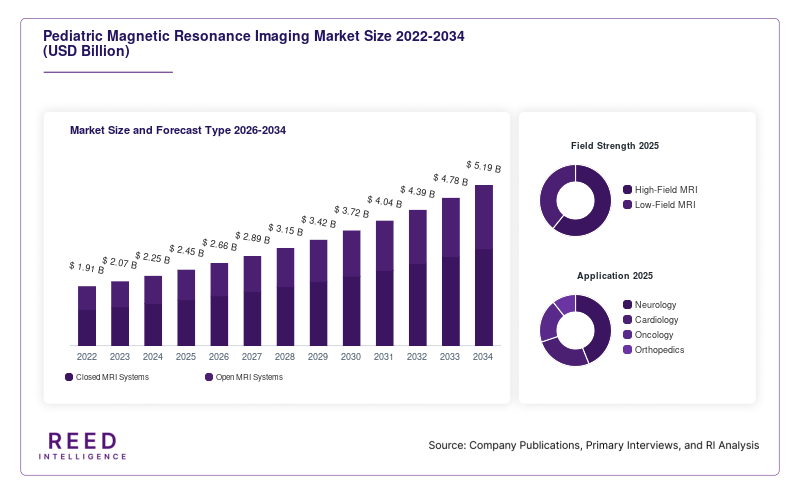
- The closed MRI systems segment led the market with a 61.2% share, whereas open MRI systems are expected to grow at a CAGR of 9.6%.
- The hospital end-use segment accounted for the largest share at 68.5%, while diagnostic imaging centers are anticipated to grow at a CAGR of 9.2%.
- The United States Pediatric Magnetic Resonance Imaging Market was valued at USD 780 million in 2024 and reached approximately USD 835 million in 2025.
Market Trends
Integration of Artificial Intelligence in Pediatric MRI
The integration of artificial intelligence (AI) in pediatric MRI systems is transforming diagnostic workflows. AI-powered tools are being used to enhance image quality, reduce scan times, and improve diagnostic accuracy. These capabilities are particularly valuable in pediatric imaging, where patient movement and shorter attention spans can impact scan quality. AI algorithms help reconstruct high-resolution images from shorter scans, minimizing the need for sedation. This trend is gaining traction as healthcare providers seek efficient and child-friendly imaging solutions.
Development of Child-Centric MRI Environments
Healthcare facilities are increasingly focusing on creating child-friendly MRI environments to reduce anxiety among pediatric patients. This includes the use of themed MRI rooms, audiovisual aids, and quieter machines. Manufacturers are designing systems with reduced acoustic noise and faster imaging sequences to enhance patient comfort. Such innovations are improving patient compliance and reducing repeat scans. As patient experience becomes a critical factor in healthcare delivery, this trend is expected to significantly influence the Pediatric Magnetic Resonance Imaging Market outlook.
Market Drivers
Rising Prevalence of Pediatric Neurological Disorders
The increasing incidence of neurological conditions such as epilepsy, brain tumors, and developmental disorders among children is driving demand for advanced imaging technologies. MRI is widely preferred due to its ability to provide detailed images without radiation exposure. This has made it a standard diagnostic tool in pediatric neurology, thereby boosting market growth.
Technological Advancements in MRI Systems
Continuous innovation in MRI technology, including high-field strength systems, faster imaging sequences, and improved software capabilities, is contributing to market expansion. Pediatric-specific MRI systems are being developed with features such as motion correction and reduced scan times. These advancements are enhancing diagnostic efficiency and expanding the use of MRI in pediatric care settings.
Market Restraint
High Cost of Pediatric MRI Systems
The high cost associated with MRI systems remains a significant barrier to market growth. Pediatric MRI machines require specialized features, including sedation support and child-friendly designs, which increase their overall cost. Additionally, maintenance expenses and the need for skilled professionals further add to operational costs.
In developing regions, budget constraints and limited healthcare infrastructure hinder the adoption of advanced MRI systems. Smaller healthcare facilities often struggle to justify the investment, leading to lower penetration rates. Reimbursement challenges in certain healthcare systems also limit the accessibility of MRI services for pediatric patients. These factors collectively restrain the expansion of the Pediatric Magnetic Resonance Imaging Market, particularly in low- and middle-income countries.
Market Opportunities
Expansion in Emerging Economies
Emerging economies present significant growth opportunities for the Pediatric Magnetic Resonance Imaging Market. Rapid urbanization, increasing healthcare expenditure, and improving healthcare infrastructure are driving demand for advanced diagnostic technologies. Governments in countries such as India and China are investing in healthcare modernization, which is expected to boost the adoption of pediatric MRI systems.
Development of Portable and Low-Field MRI Systems
The development of portable and low-field MRI systems is opening new avenues for market growth. These systems are more affordable and easier to install, making them suitable for smaller healthcare facilities and remote areas. Portable MRI solutions also enable bedside imaging, which is particularly beneficial for critically ill pediatric patients. As manufacturers focus on innovation and cost reduction, these systems are expected to gain traction in the coming years.
Segmental Analysis
By Type
Closed MRI systems dominated the Pediatric Magnetic Resonance Imaging Market with a 61.2% share in 2025. These systems provide high-resolution images and are widely used for complex diagnostic procedures. Their ability to deliver detailed imaging makes them the preferred choice in hospitals and specialized diagnostic centers.
Open MRI systems are expected to grow at the fastest CAGR of 9.6% during the forecast period. Their child-friendly design and reduced claustrophobia make them suitable for pediatric patients. The increasing demand for patient comfort and improved imaging experiences is expected to drive their adoption.
By Field Strength
High-field MRI systems accounted for the largest share of 54.8% in 2025. These systems offer superior image quality and faster scanning capabilities, making them ideal for detailed diagnostic procedures. Their widespread use in hospitals contributes to their dominance.
Low-field MRI systems are anticipated to grow at a CAGR of 9.1%. These systems are more affordable and suitable for smaller healthcare facilities. Their increasing adoption in emerging markets is expected to drive segment growth.
By Application
Neurology applications dominated the market with a 47.5% share in 2025. MRI is widely used for diagnosing neurological disorders in children, including brain tumors and epilepsy. The growing prevalence of such conditions is supporting segment growth.
Cardiology applications are projected to grow at a CAGR of 9.3%. Advances in cardiac imaging technologies and increasing awareness about pediatric heart conditions are driving demand in this segment.
By End-Use
Hospitals accounted for the largest share of 68.5% in 2025. The availability of advanced imaging infrastructure and skilled professionals makes hospitals the primary users of MRI systems.
Diagnostic imaging centers are expected to grow at a CAGR of 9.2%. These centers offer specialized imaging services and are becoming increasingly popular due to their efficiency and cost-effectiveness.
Regional Analysis
North America
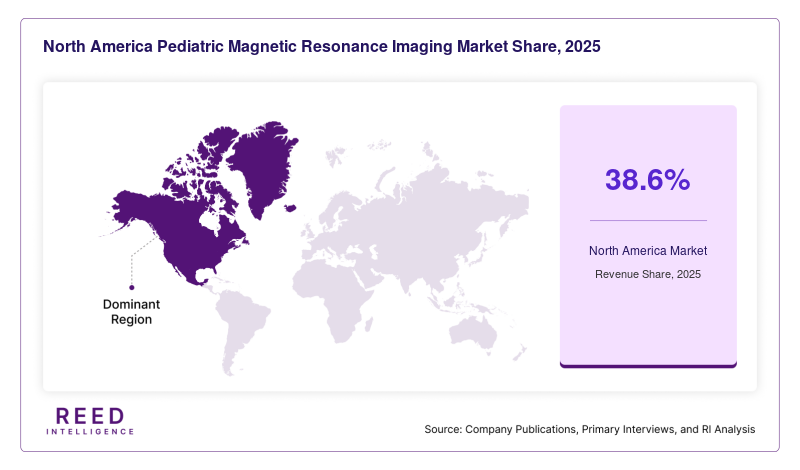
North America accounted for 38.6% of the Pediatric Magnetic Resonance Imaging Market share in 2025 and is expected to grow at a CAGR of 7.9% from 2026 to 2034. The region has a well-established healthcare infrastructure and high adoption of advanced imaging technologies. The presence of leading market players and strong investment in research and development contribute to market growth.
The United States dominated the regional market due to its advanced healthcare system and high healthcare expenditure. The increasing focus on early diagnosis and treatment of pediatric disorders is driving demand for MRI systems. Additionally, favorable reimbursement policies and technological advancements are supporting market expansion in the country.
Europe
Europe held 27.4% of the market share in 2025 and is projected to grow at a CAGR of 7.5% during the forecast period. The region benefits from strong healthcare systems and increasing awareness about pediatric health. Government initiatives aimed at improving healthcare services are contributing to market growth.
Germany emerged as the dominant country in Europe, driven by its advanced medical infrastructure and high adoption of imaging technologies. The country’s focus on innovation and quality healthcare services is supporting the growth of the Pediatric Magnetic Resonance Imaging Market.
Asia Pacific
Asia Pacific captured 21.8% of the market share in 2025 and is anticipated to grow at the fastest CAGR of 10.4%. The region is experiencing rapid economic growth and increasing healthcare investments. Rising awareness about early disease diagnosis is driving demand for advanced imaging technologies.
China dominated the regional market due to its large population and expanding healthcare infrastructure. Government initiatives to improve healthcare access and the growing number of hospitals are contributing to market growth.
Middle East & Africa
The Middle East & Africa accounted for 6.2% of the market share in 2025 and is expected to grow at a CAGR of 8.1%. The region is gradually adopting advanced medical technologies, supported by increasing healthcare investments.
Saudi Arabia led the market in this region due to its focus on healthcare modernization and infrastructure development. Government initiatives aimed at improving healthcare services are driving the adoption of pediatric MRI systems.
Latin America
Latin America held 6.0% of the market share in 2025 and is projected to grow at a CAGR of 7.8%. The region is witnessing improvements in healthcare infrastructure and increasing awareness about advanced diagnostic technologies.
Brazil dominated the regional market, supported by its large population and growing healthcare sector. Investments in healthcare facilities and increasing demand for diagnostic imaging are contributing to market growth.
Competitive Landscape
The Pediatric Magnetic Resonance Imaging Market is moderately consolidated, with several global and regional players competing based on technology, product innovation, and pricing strategies. Key companies are focusing on developing pediatric-specific MRI systems with enhanced features such as faster scan times and improved patient comfort.
Siemens Healthineers is a leading player in the market, known for its advanced MRI solutions. The company recently introduced a pediatric-focused MRI system with AI-powered imaging capabilities, enhancing diagnostic efficiency and patient experience. Other major players are also investing in research and development to strengthen their market position.
Strategic collaborations, product launches, and technological advancements are key strategies adopted by market participants to gain a competitive edge.
Key Players List
- Siemens Healthineers
- GE HealthCare
- Philips Healthcare
- Canon Medical Systems Corporation
- Hitachi Medical Systems
- Fujifilm Holdings Corporation
- Shimadzu Corporation
- Esaote SpA
- Neusoft Medical Systems
- United Imaging Healthcare
- Aspect Imaging
- Hyperfine Inc.
- Aurora Imaging Technology
- Time Medical Systems
- MR Solutions
Recent Developments
- In 2025, Siemens Healthineers launched an AI-enabled pediatric MRI platform designed to reduce scan times.
- GE HealthCare introduced a noise-reduction MRI system aimed at improving pediatric patient comfort.
- Philips Healthcare expanded its pediatric imaging portfolio with advanced software solutions.
- Canon Medical Systems developed a compact MRI system suitable for pediatric use in smaller facilities.
- Hyperfine Inc. introduced a portable MRI system for bedside pediatric imaging.
Pediatric Magnetic Resonance Imaging Market Segments
Type
- Closed MRI Systems
- Open MRI Systems
Field Strength
- High-Field MRI
- Low-Field MRI
Application
- Neurology
- Cardiology
- Oncology
- Orthopedics
End-Use
- Hospitals
- Diagnostic Imaging Centers
- Specialty Clinics
By Region
- North America
- Europe
- APAC
- Middle East and Africa
- LATAM