PEEK Implant Market Size, Share Demand Report By Product Type (Spinal Implants, Dental Implants, Trauma Implants, Others), By Application (Orthopedics, Spine Surgery, Dental Surgery, Others), By End User (Hospitals, Ambulatory Surgical Centers, Specialty Clinics) & Segment Forecasts, 2026–2034
USD 3950
PEEK Implant Market Size
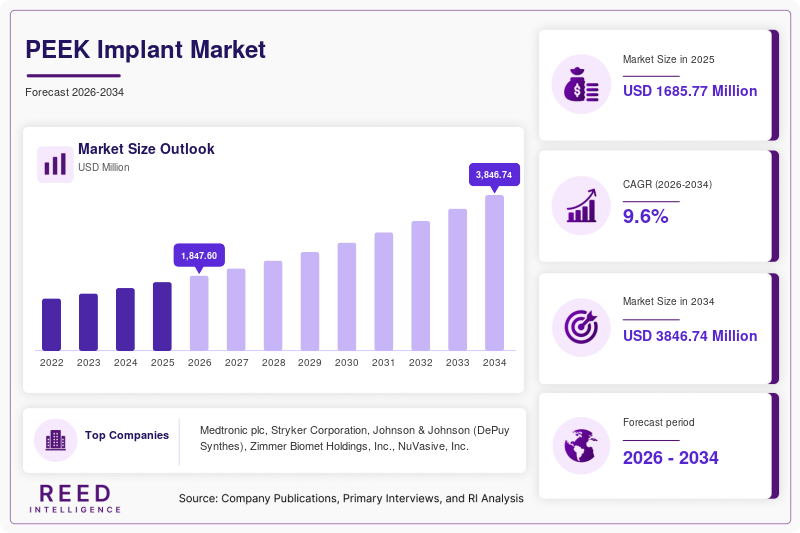
PEEK Implant market size is projected at USD 1,847.6 million in 2026 and is expected to hit USD 3,847.5 million by 2034 with a CAGR of 9.6% during the forecast period. The increasing demand for advanced, biocompatible, and radiolucent implant materials in orthopedics and spine surgery, coupled with the growing preference for PEEK over traditional metals due to its superior properties, underpins market expansion. This report delivers a comprehensive analysis of the PEEK Implant market, including segmentation by type and application, competitive dynamics, and regional growth patterns, equipping stakeholders with critical intelligence. The PEEK Implant market continues to demonstrate strong growth potential, fueled by the rising number of spinal and dental procedures, the increasing adoption of minimally invasive surgeries, and continuous innovation in PEEK materials and implant design.
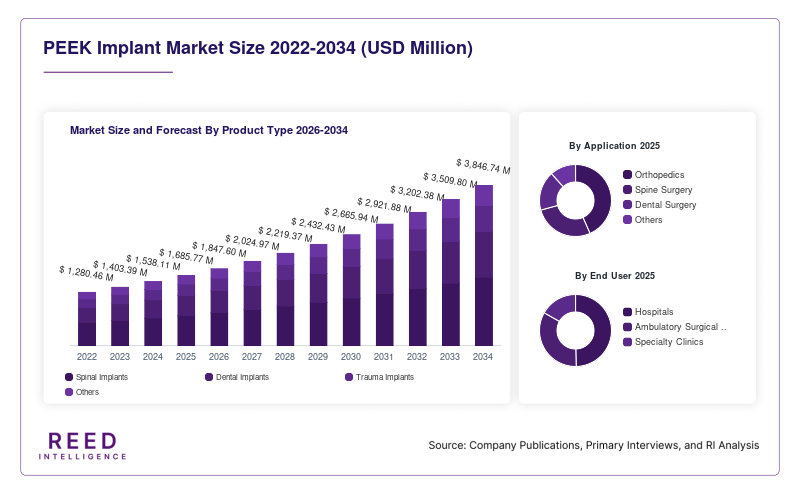
PEEK (Polyether ether ketone) implants are medical devices made from a high-performance, semi-crystalline thermoplastic polymer. PEEK is increasingly used in implantable applications due to its excellent mechanical properties, biocompatibility, chemical resistance, and radiolucency, which allows for better post-operative imaging. The global production volume of PEEK implants exceeded 2.5 million units in 2025, reflecting a 10% increase from 2023, driven by the growing adoption in spinal fusion, trauma, and dental procedures. Adoption patterns reveal that the Spinal Implants type dominates the market, accounting for 42% of total demand, followed by Dental Implants at 28%, Trauma Implants at 18%, and Others at 12%. The PEEK Implant market's trajectory is closely linked to the growth of the global orthopedic implant market, which is projected to reach USD 60 billion by 2028, and the increasing demand for metal-free implant alternatives.
PEEK Implant Market Trends
Development of Additively Manufactured (3D-Printed) PEEK Implants
The PEEK Implant market is witnessing a significant trend toward the development of additively manufactured (3D-printed) PEEK implants, driven by the need for patient-specific solutions and improved osseointegration. The revenue from 3D-printed PEEK implants grew to USD 420 million in 2025, a year-on-year increase of 22%, as 30% of new product developments in 2025 specified 3D-printed designs. Adoption rates of 3D-printed PEEK in complex spine and cranial surgeries reached 20%, with this figure projected to exceed 45% by 2030. The PEEK Implant market's trend toward additive manufacturing is reinforced by the need for customization, the increasing complexity of surgical cases, and the continuous innovation in 3D printing technologies and materials.
Growing Focus on PEEK Composites and Surface Modifications
The increasing focus on PEEK composites and surface modifications is a major trend shaping the PEEK Implant market, with the development of PEEK materials enhanced with bioactive fillers and coatings to improve bone integration. The market has seen a 15% increase in the demand for enhanced PEEK implants since 2022, with 25% of new products in 2025 featuring surface modifications or composite materials. The use of PEEK with hydroxyapatite and other bioactive coatings for improved osseointegration has also gained significant traction. The PEEK Implant market's trend toward material enhancement is reinforced by the need for better long-term fixation, the growing focus on implant performance, and the continuous innovation in material science.
PEEK Implant Market Drivers
The PEEK Implant market's expansion is primarily driven by the increasing global prevalence of spinal disorders and the growing number of spinal fusion procedures, with over 2 million spinal surgeries performed annually in 2025. The need for biocompatible and radiolucent implant materials that do not interfere with imaging has been a major driver, with PEEK offering significant advantages over metals. The rising adoption of minimally invasive surgical techniques has also fueled market growth. Additionally, the increasing awareness of PEEK's benefits in dental and trauma applications has spurred demand. The PEEK Implant market's growth is further reinforced by the continuous improvement in PEEK material properties, leading to better clinical outcomes.
PEEK Implant Market Restraints
Despite favorable growth prospects, the PEEK Implant market faces significant constraints, primarily related to the higher cost of PEEK implants compared to traditional metal implants, which can be 20-40% more expensive. The limited long-term clinical data and the perceived lower mechanical strength compared to metal can also be a limitation. The PEEK Implant market's growth is also tempered by the challenge of ensuring proper osseointegration and the need for surgeon training on PEEK implant handling.
PEEK Implant Market Opportunities
The PEEK Implant market presents significant opportunities in the rapidly expanding market for personalized and patient-specific implants, where 3D-printed PEEK solutions are in high demand. The development of PEEK implants with enhanced bioactive properties for improved bone growth is expected to grow at a CAGR of 12% through 2034. Emerging opportunities also exist in the use of PEEK for craniofacial and maxillofacial reconstruction. The PEEK Implant market's opportunity profile is further enhanced by the growing trend of outpatient and ambulatory surgical centers.
Challenges in PEEK Implant Market
The PEEK Implant market faces persistent challenges related to the need for continuous innovation to improve osseointegration and long-term implant stability. The complexity of manufacturing and processing PEEK for various implant designs can also be a challenge. The market is also contending with the challenge of demonstrating cost-effectiveness compared to metal implants. Additionally, the PEEK Implant market is challenged by the need to address the regulatory hurdles for new materials and designs.
PEEK Implant Market Segmentation
The PEEK Implant market is segmented by Type and Application to provide a comprehensive market perspective. By Type, Spinal Implants dominate with a 42% market share, driven by the high volume of spinal fusion procedures. The Application segment is led by Spine Surgery, which accounts for 45% of the market, followed by Orthopedics at 28%, Dental Surgery at 18%, and Others at 9%.
By Type
Spinal Implants represent the largest segment in the PEEK Implant market, commanding a 42% share, with production exceeding 1.05 million units in 2025. These are characterized by their use in interbody fusion cages and spinal fixation devices. Technical specifications include radiolucency, modulus of elasticity, and osteoconductive properties. The PEEK Implant market's Spinal segment is driven by its use in treating degenerative disc disease and spinal deformities.
Dental Implants capture a 28% share of the PEEK Implant market, with production of 0.7 million units in 2025. These are characterized by their use in tooth replacement and restoration. Technical specifications include biocompatibility, aesthetic properties, and strength. The PEEK Implant market's Dental segment is driven by its use in implantology and prosthodontics.
Trauma Implants represent 18% of the PEEK Implant market, with production of 0.45 million units in 2025. These are characterized by their use in fracture fixation and orthopedic trauma. Technical specifications include strength, radiolucency, and MRI compatibility. The PEEK Implant market's Trauma segment is driven by its use in various fracture types.
Others comprise the remainder of the PEEK Implant market, accounting for 12% of total production, with 0.3 million units in 2025. This includes use in craniofacial, maxillofacial, and other specialized applications. The PEEK Implant market's Others segment is driven by its use in emerging and specialized surgical fields.
By Application
Spine Surgery dominates the PEEK Implant market, accounting for 45% of sales, representing 1.125 million units in 2025. This segment includes use in lumbar, cervical, and thoracic spine procedures. Usage penetration exceeds 30% in the segment. The PEEK Implant market's Spine Surgery segment is characterized by its focus on fusion and stabilization.
Orthopedics accounts for 28% of the PEEK Implant market, with sales of 0.7 million units in 2025. This segment encompasses use in general orthopedic trauma and reconstruction. The segment is growing at a steady CAGR, driven by the need for metal-free options. The PEEK Implant market's Orthopedics segment is characterized by its focus on fracture fixation and joint surgery.
Dental Surgery represents 18% of the PEEK Implant market, with sales of 0.45 million units in 2025. This segment includes use in dental implantology and restorations. The segment is growing at a robust CAGR, driven by the aesthetic and functional benefits. The PEEK Implant market's Dental segment is characterized by its focus on biocompatibility and aesthetics.
Others comprises the remainder of the PEEK Implant market, accounting for 9% of total sales, with 0.225 million units in 2025. This includes use in craniofacial and maxillofacial surgery. The segment is projected to grow at a significant CAGR through 2034. The PEEK Implant market's Others segment is characterized by its focus on specialized and complex reconstruction.
PEEK Implant Market Regional Outlook
North America PEEK Implant Market
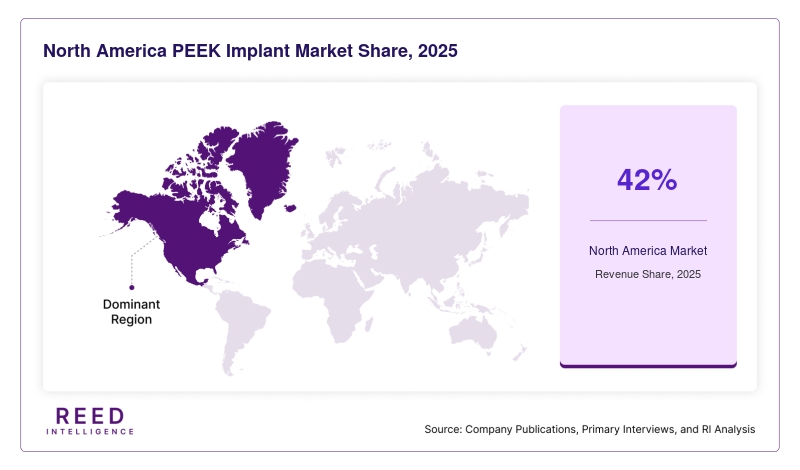
Leads the PEEK Implant market, commanding a 42% share, with a revenue of USD 775.9 million in 2025. The United States is the primary driver, accounting for 85% of regional demand, driven by the high volume of spinal surgeries, advanced healthcare infrastructure, and strong adoption of innovative technologies. The North American PEEK Implant market is characterized by its focus on innovation and premium products.
Europe PEEK Implant Market
Represents the second-largest market, capturing a 30% share with a revenue of USD 554.3 million in 2025. The UK, Germany, and France are the primary drivers, collectively accounting for 60% of regional demand, driven by a strong healthcare system, high awareness of PEEK benefits, and established surgical practices. The PEEK Implant market in Europe is characterized by its focus on quality and cost-effectiveness.
Asia-Pacific PEEK Implant Market
Accounts for 20% of the global PEEK Implant market, with a revenue of USD 369.5 million in 2025. China, Japan, and India are the primary drivers, together accounting for 70% of regional demand, driven by the large patient population, increasing healthcare expenditure, and rising adoption of advanced surgical techniques. The Asia-Pacific PEEK Implant market is projected to grow at the fastest CAGR of 12% through 2034.
Middle East & Africa and Latin America PEEK Implant Market
Together account for the remaining 8% of the PEEK Implant market, with the UAE leading the Middle East market and Brazil leading the Latin American market. Both regions are projected to grow at CAGRs exceeding 10%, driven by improving healthcare infrastructure and increasing access to advanced treatments.
Top players in PEEK Implant Market
- Medtronic plc
- Stryker Corporation
- Johnson & Johnson (DePuy Synthes)
- Zimmer Biomet Holdings, Inc.
- NuVasive, Inc.
- Globus Medical, Inc.
- KLS Martin Group
- B. Braun Melsungen AG
- Integra LifeSciences
- Smith & Nephew plc
- Dentsply Sirona Inc.
- Straumann Group
- Henry Schein, Inc.
- Orthofix Medical Inc.
- CONMED Corporation
Medtronic plc
Medtronic plc holds a dominant position in the PEEK Implant market, with an estimated 18% global market share, particularly strong in the spinal implant segment. The company's portfolio of PEEK spinal implants is widely recognized for its quality, innovation, and clinical efficacy. Medtronic's market leadership is reinforced by its significant R&D investment, its extensive product line, and its strong relationships with surgeons. Medtronic commands over 20% of the North American market and 15% of the European market, positioning it as a key player in the PEEK Implant market.
Stryker Corporation
Stryker Corporation is a leading player in the PEEK Implant market, commanding approximately 14% of the global market share through its comprehensive portfolio of orthopedic and spinal products. The company's expertise in implant design and its focus on innovation have solidified its position. Stryker's PEEK implants are known for their quality, durability, and performance. The company's commitment to advancing surgical care and its strong presence in the North American and European markets have enhanced its competitive advantage.
Johnson & Johnson (DePuy Synthes) holds a significant 12% market share, with particular strength in the orthopedic and trauma segments. Zimmer Biomet Holdings, Inc. is a major player in the spinal and orthopedic market, holding a 10% share.
Recent Developments in PEEK Implant Market
- 2025: Medtronic launched a new line of 3D-printed PEEK interbody fusion cages with enhanced porosity for improved osseointegration.
- 2025: Stryker introduced a new PEEK trauma plating system with improved strength and radiolucency for fracture fixation.
PEEK Implant Market Segments
By Product Type
- Spinal Implants
- Dental Implants
- Trauma Implants
- Others
By Application
- Orthopedics
- Spine Surgery
- Dental Surgery
- Others
By End User
- Hospitals
- Ambulatory Surgical Centers
- Specialty Clinics
By Region
- North America
- Europe
- APAC
- Middle East and Africa
- LATAM