Pelargonic Acid Market Size, Share & Demand Report By Source (Synthetic Pelargonic Acid, Bio-based Pelargonic Acid), By Application (Herbicides, Chemical Intermediates, Lubricants, Personal Care Products, Plasticizers), By End-Use Industry (Agriculture, Personal Care & Cosmetics, Chemical Manufacturing, Industrial Applications), By Region & Segment Forecasts, 2025–2034
USD 3950
Market Overview
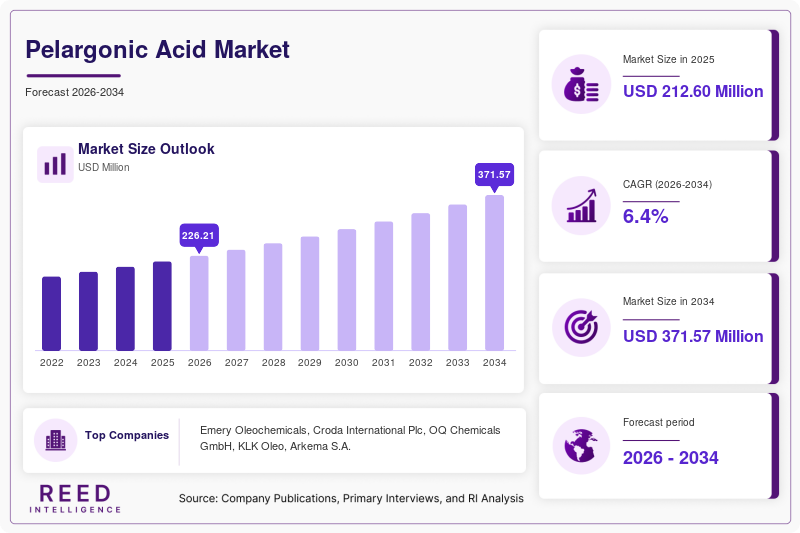
The Pelargonic Acid Market size was valued at USD 212.6 million in 2025 and is projected to reach USD 372.4 million by 2034, expanding at a CAGR of 6.4% from 2025 to 2034. Pelargonic acid, also known as nonanoic acid, is a naturally occurring fatty acid widely used in herbicides, chemical intermediates, plasticizers, and personal care products. The market size continues to expand as manufacturers increasingly adopt bio-based chemicals in industrial and agricultural applications.
One of the key global factors supporting the growth of the Pelargonic Acid Market is the increasing shift toward environmentally compatible agricultural inputs. Farmers and agrochemical companies are gradually replacing synthetic chemical herbicides with naturally derived compounds that offer fast biodegradability and lower soil persistence. Pelargonic acid-based herbicides act quickly by breaking down plant cell membranes, making them suitable for organic farming systems and urban weed control. As agricultural sustainability initiatives expand globally, the demand outlook for pelargonic acid is expected to strengthen across crop protection and landscaping applications.
Key Highlights
- Europe dominated the Pelargonic Acid Market with 34.2% share in 2025, while Asia Pacific is projected to grow at a CAGR of 7.3% through 2034.
- Herbicides application segment led with 41.6% share in 2025, while personal care applications are projected to grow at 7.8% CAGR.
- Synthetic pelargonic acid held the largest share at 63.5% in 2025, while bio-based pelargonic acid is projected to grow at 7.9% CAGR.
- The United States market was valued at USD 48.3 million in 2025 and is expected to reach USD 51.1 million in 2026.
Market Trends
Expansion of Bio-Based Chemical Manufacturing
The transition toward renewable chemical feedstocks is emerging as a prominent trend influencing the Pelargonic Acid Market. Chemical manufacturers are investing in bio-based production methods derived from vegetable oils such as sunflower and rapeseed. These production pathways reduce reliance on petroleum-based feedstocks and align with sustainability goals adopted by chemical and agricultural industries. As governments introduce environmental regulations encouraging low-toxicity agrochemicals, bio-based pelargonic acid products are gaining acceptance among herbicide manufacturers and industrial chemical producers.
In addition, brand owners in consumer goods industries are prioritizing plant-derived ingredients in their formulations. Pelargonic acid produced through bio-based processes offers compatibility with green product labeling and organic certifications. This trend is expected to continue influencing product innovation and capacity expansion across specialty chemical manufacturers.
Rising Demand in Non-Selective Contact Herbicides
Another trend shaping the Pelargonic Acid Market is the increasing use of pelargonic acid in non-selective contact herbicides for urban landscaping, horticulture, and organic farming. Pelargonic acid-based herbicides deliver rapid plant desiccation by disrupting plant cell membranes. These properties make them suitable for quick weed management in residential gardens, public parks, and greenhouse operations.
Municipal authorities and landscaping service providers are gradually replacing synthetic herbicides with naturally derived alternatives to meet environmental standards. As cities and agricultural regulators tighten chemical usage guidelines, demand for pelargonic acid formulations in weed control products is expected to rise steadily.
Market Drivers
Growth of Organic Farming Practices
The expansion of organic agriculture is a key driver supporting the Pelargonic Acid Market. Organic farming systems require crop protection inputs that comply with ecological standards and minimize environmental impact. Pelargonic acid-based herbicides are widely accepted in organic agriculture because they degrade rapidly in soil and leave minimal chemical residue.
Global organic farmland has expanded significantly over the past decade, increasing the demand for plant-derived crop protection solutions. Farmers cultivating fruits, vegetables, and specialty crops are adopting pelargonic acid formulations for weed control in both field crops and greenhouse cultivation. This shift toward organic farming methods continues to support market growth.
Increasing Demand for Specialty Chemical Intermediates
Another important driver of the Pelargonic Acid Market is its growing role as an intermediate in specialty chemical production. Pelargonic acid is widely used in manufacturing lubricants, plasticizers, coatings, and synthetic esters. Industrial sectors such as automotive, coatings, and construction require stable chemical intermediates to produce performance materials.
As global industrial activity expands, demand for specialty chemical ingredients continues to increase. Pelargonic acid offers desirable chemical properties including oxidation stability and compatibility with multiple industrial formulations. These characteristics make it a valuable component in several manufacturing processes, supporting long-term market expansion.
Market Restraint
High Production Cost of Bio-Based Pelargonic Acid
A significant restraint affecting the Pelargonic Acid Market is the relatively high production cost associated with bio-based pelargonic acid. Production processes often involve vegetable oil feedstocks, specialized catalysts, and multi-stage purification steps. These factors contribute to higher manufacturing expenses compared to conventional petrochemical alternatives.
Raw material price volatility also affects production economics. Vegetable oil feedstocks such as sunflower oil and rapeseed oil experience price fluctuations due to seasonal agricultural yields, climate conditions, and global supply chain dynamics. These cost variations can impact profit margins for pelargonic acid producers.
Furthermore, large-scale industrial applications often require competitively priced chemical intermediates. In certain cases, manufacturers may choose lower-cost alternatives when cost efficiency becomes a priority. This cost sensitivity can limit widespread adoption in some industrial sectors.
To address this challenge, chemical manufacturers are investing in process optimization, catalytic innovations, and integrated production technologies. Over time, these developments may help reduce manufacturing costs and improve price competitiveness within the broader specialty chemicals industry.
Market Opportunities
Expansion of Bio-Herbicide Product Development
Product innovation in bio-herbicides presents a significant opportunity for the Pelargonic Acid Market. Agrochemical companies are developing new formulations that combine pelargonic acid with other natural compounds to improve herbicidal performance. These formulations aim to enhance weed control efficiency while maintaining environmental compatibility.
The growing demand for low-toxicity crop protection products creates favorable conditions for the introduction of pelargonic acid-based herbicide solutions. Manufacturers that invest in formulation technology and product development can capitalize on expanding organic agriculture and sustainable landscaping markets.
Increasing Use in Personal Care and Cosmetic Formulations
The personal care industry is emerging as another opportunity area for the Pelargonic Acid Market. Pelargonic acid derivatives are used as fragrance ingredients, emollients, and antimicrobial agents in skincare and cosmetic products. As consumers increasingly prefer plant-derived ingredients, cosmetic manufacturers are incorporating fatty acid derivatives into product formulations.
The growth of natural and clean-label cosmetics is expected to support the adoption of pelargonic acid derivatives in beauty and personal care applications. With the personal care industry expanding globally, demand for bio-derived fatty acids and their derivatives is likely to increase during the forecast period.
Segmental Analysis
By Source
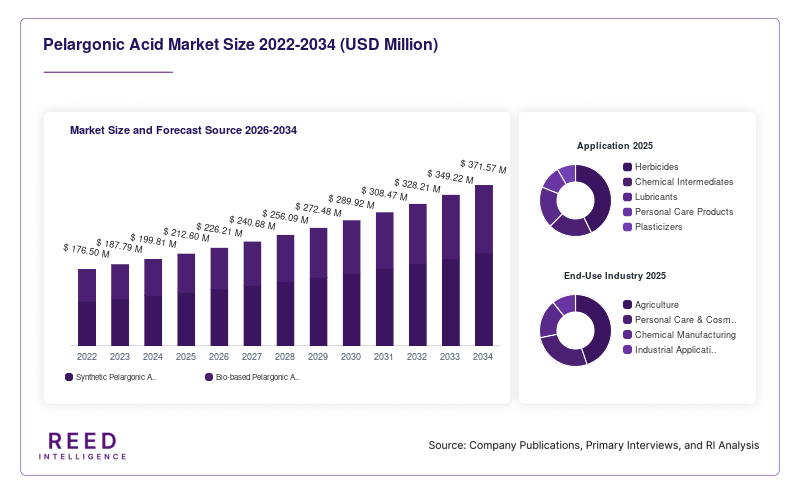
Synthetic pelargonic acid represented the dominant subsegment with 63.5% share in 2025. Synthetic production methods utilize petrochemical intermediates and well-established industrial processes, allowing manufacturers to produce pelargonic acid at commercial scale. The availability of stable supply chains and relatively lower production costs supported the widespread use of synthetic pelargonic acid across industrial applications such as lubricants, coatings, and plastic additives.
Bio-based pelargonic acid will register the fastest CAGR of 7.9% during the forecast period. Production methods using vegetable oil feedstocks such as sunflower and rapeseed are expected to gain momentum due to increasing demand for renewable chemical products. Manufacturers are likely to invest in bio-based production facilities to meet sustainability goals and regulatory expectations for environmentally compatible chemicals.
By Application
Herbicides dominated the Pelargonic Acid Market with 41.6% share in 2025. Pelargonic acid acts as a non-selective contact herbicide that rapidly disrupts plant cell membranes, resulting in quick weed desiccation. These properties make it suitable for weed control in horticulture, landscaping, and urban maintenance applications. The effectiveness of pelargonic acid formulations in fast weed suppression contributed to strong adoption within the agrochemical sector.
Personal care applications will grow at the fastest CAGR of 7.8% through 2034. Pelargonic acid derivatives are expected to gain increased use in cosmetics and skincare products due to their antimicrobial and fragrance properties. As cosmetic manufacturers continue to incorporate plant-derived ingredients into formulations, the use of fatty acid derivatives in beauty products is likely to expand.
By End-Use Industry
The agriculture sector held the largest share of 46.8% in 2025. Pelargonic acid-based herbicides are commonly used for weed management in horticultural crops, greenhouse cultivation, and urban landscaping. Agricultural producers rely on these herbicides for effective weed suppression without long soil persistence. The widespread need for crop protection products supported the dominant position of this segment.
The personal care and cosmetics industry is projected to grow at a CAGR of 7.6% during the forecast period. Cosmetic manufacturers are increasingly incorporating fatty acid derivatives into product formulations for fragrance, emollient, and antimicrobial functions. The growing demand for plant-derived ingredients in beauty products will contribute to the expansion of pelargonic acid usage within this industry.
Regional Analysis
North America
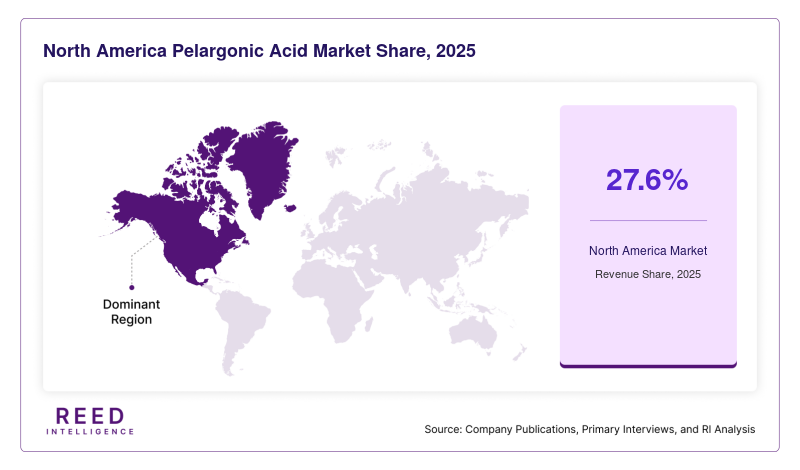
North America accounted for 27.6% of the Pelargonic Acid Market share in 2025 and will expand at a CAGR of 6.1% from 2025 to 2034. The region demonstrated steady demand due to the presence of established agrochemical manufacturers and specialty chemical producers. Market growth was supported by the increasing adoption of environmentally compatible herbicides across landscaping and horticultural applications. In addition, the presence of advanced chemical manufacturing infrastructure facilitated consistent supply of pelargonic acid for industrial uses such as lubricants and coatings.
The United States dominated the regional market due to the widespread use of pelargonic acid-based herbicides in residential landscaping and municipal weed management. Urban landscaping services across major metropolitan areas increasingly adopted pelargonic acid formulations for weed control in parks, pavements, and public spaces. These herbicides offer rapid plant desiccation without long soil persistence, making them suitable for high-traffic public areas. The presence of major specialty chemical companies also supported product development and supply chain efficiency within the country.
Europe
Europe represented 34.2% of the Pelargonic Acid Market share in 2025 and will grow at a CAGR of 6.5% through 2034. The region maintained strong demand due to strict environmental regulations governing agrochemical usage. Several European regulatory frameworks emphasize reduced chemical residues in soil and water systems, encouraging the adoption of biodegradable crop protection products. As a result, pelargonic acid-based herbicides gained traction in agricultural and horticultural sectors.
Germany led the European market due to its well-established chemical manufacturing industry and strong research capabilities. The country hosts several specialty chemical companies involved in fatty acid derivatives and bio-based chemical production. German manufacturers have been focusing on developing sustainable chemical processes using plant-derived feedstocks. This emphasis on green chemistry initiatives supported consistent demand for pelargonic acid as a raw material in both agricultural and industrial applications.
Asia Pacific
Asia Pacific accounted for 23.8% of the Pelargonic Acid Market share in 2025 and is projected to grow at the fastest CAGR of 7.3% during the forecast period. Rapid agricultural development and expanding industrial manufacturing activities supported regional demand. The growing need for effective weed control solutions in horticulture and plantation crops contributed to increased use of pelargonic acid-based herbicides. Additionally, rising industrialization stimulated demand for chemical intermediates used in coatings, lubricants, and plastic additives.
China dominated the Asia Pacific market due to its large chemical manufacturing base and strong agricultural sector. Chinese agrochemical manufacturers increasingly integrated pelargonic acid into herbicide formulations used in horticulture and vegetable farming. Furthermore, the country’s expanding specialty chemicals industry required fatty acid intermediates for multiple industrial processes. Government initiatives supporting agricultural modernization also contributed to the adoption of advanced crop protection technologies.
Middle East & Africa
The Middle East & Africa held 7.4% of the Pelargonic Acid Market share in 2025 and will grow at a CAGR of 5.8% through 2034. The market remained relatively smaller compared to other regions but demonstrated gradual expansion due to increasing agricultural investments. Governments in several countries have been promoting agricultural productivity and landscape development, creating demand for weed management solutions.
South Africa emerged as the dominant country within the region. The country has a well-developed horticulture sector and exports a wide range of fruits and vegetables. Effective weed control is essential in maintaining crop quality and productivity, encouraging farmers to adopt pelargonic acid-based herbicides. In addition, landscaping and turf management activities in urban areas supported steady demand for non-selective herbicide products.
Latin America
Latin America accounted for 7.0% of the Pelargonic Acid Market share in 2025 and will expand at a CAGR of 6.2% during the forecast period. Agriculture remains a major economic sector across several Latin American countries, and crop protection products play a crucial role in maintaining farm productivity. Pelargonic acid-based herbicides have gained interest in horticultural crops, vineyards, and fruit plantations.
Brazil dominated the regional market due to its large agricultural production and strong agrochemical distribution network. Brazilian farmers cultivate extensive areas of fruits, vegetables, and plantation crops where weed management is essential. Pelargonic acid herbicides provide quick weed suppression in orchard and plantation farming systems, contributing to increased adoption across the country.
Competitive Landscape
The Pelargonic Acid Market remains moderately consolidated, with several global specialty chemical manufacturers competing through product development, capacity expansion, and supply chain integration. Leading companies focus on developing bio-based pelargonic acid production technologies and expanding herbicide formulations for agricultural and landscaping applications.
Emery Oleochemicals emerged as a key market leader due to its strong expertise in fatty acid derivatives and integrated oleochemical production capabilities. The company recently introduced new bio-based pelargonic acid formulations aimed at sustainable agrochemical applications.
Other notable participants include Croda International Plc, OQ Chemicals GmbH, and KLK Oleo. These companies continue to invest in research initiatives to develop environmentally compatible chemical intermediates and specialty ingredients. Strategic collaborations between chemical manufacturers and agrochemical companies are expected to support product innovation and strengthen market competitiveness during the forecast period.
Key Players
- Emery Oleochemicals
- Croda International Plc
- OQ Chemicals GmbH
- KLK Oleo
- Arkema S.A.
- BASF SE
- Evonik Industries AG
- Acme Synthetic Chemicals
- Oleon NV
- VVF Ltd.
- Oxiteno S.A.
- Godrej Industries Ltd.
- Ecogreen Oleochemicals
- Matrica S.p.A.
- Caila & Parés S.A.
Recent Developments
- 2024: Emery Oleochemicals expanded its bio-based pelargonic acid production capacity to meet rising demand from herbicide manufacturers.
- 2023: Croda International Plc introduced a new pelargonic acid derivative designed for personal care formulations.
- 2023: OQ Chemicals GmbH invested in process optimization technology for fatty acid intermediates used in industrial lubricants.
- 2022: KLK Oleo developed new oleochemical feedstock supply agreements to support sustainable pelargonic acid production.
- 2022: BASF SE collaborated with agricultural technology firms to explore pelargonic acid-based weed control solutions.
Pelargonic Acid Market Segments
Source
- Synthetic Pelargonic Acid
- Bio-based Pelargonic Acid
Application
- Herbicides
- Chemical Intermediates
- Lubricants
- Personal Care Products
- Plasticizers
End-Use Industry
- Agriculture
- Personal Care & Cosmetics
- Chemical Manufacturing
- Industrial Applications
By Region
- North America
- Europe
- APAC
- Middle East and Africa
- LATAM