Pellistor Bead Chemical Sensor Market Size, Share & Demand Report By Type (Catalytic Bead Sensors, Hybrid Sensors), By Application (Industrial Safety, Environmental Monitoring, Residential Safety), By End-Use Industry (Oil & Gas, Chemical, Mining, Manufacturing, Renewable Energy), By Technology (Analog Sensors, Digital Sensors), By Region & Segment Forecasts, 2025–2034
USD 3950
Market Overview
The Pellistor Bead Chemical Sensor Market was valued at approximately USD 1.38 billion in 2025 and is projected to reach USD 2.42 billion by 2034, expanding at a CAGR of 6.5% during 2025–2034. Pellistor bead sensors, widely used for detecting combustible gases, continue to gain traction due to their reliability, cost-effectiveness, and stable performance in hazardous environments. These sensors play a critical role in industrial safety systems, particularly in sectors where flammable gas detection is essential for operational continuity and risk mitigation.
A major global factor supporting the growth of the Pellistor Bead Chemical Sensor Market is the increasing enforcement of industrial safety regulations across developed and developing economies. Governments and regulatory bodies have mandated stringent workplace safety standards, especially in oil & gas, mining, and chemical industries, leading to the widespread adoption of gas detection systems incorporating pellistor sensors.
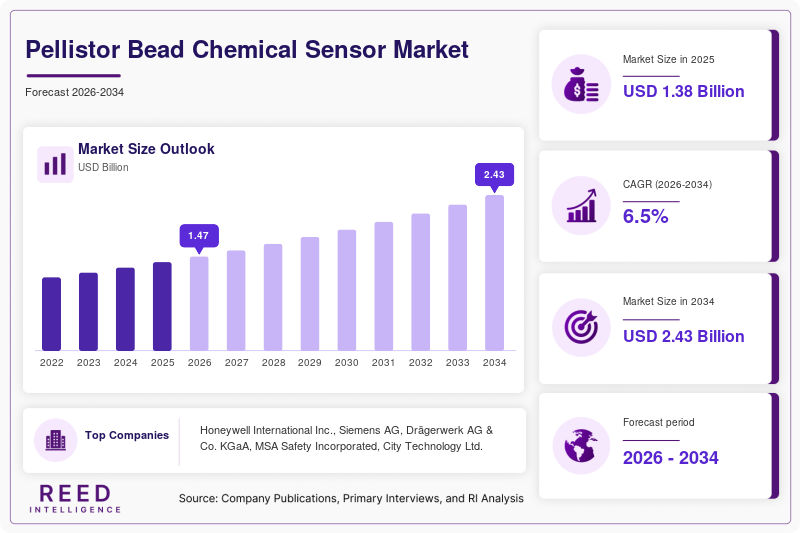
Key Highlights:
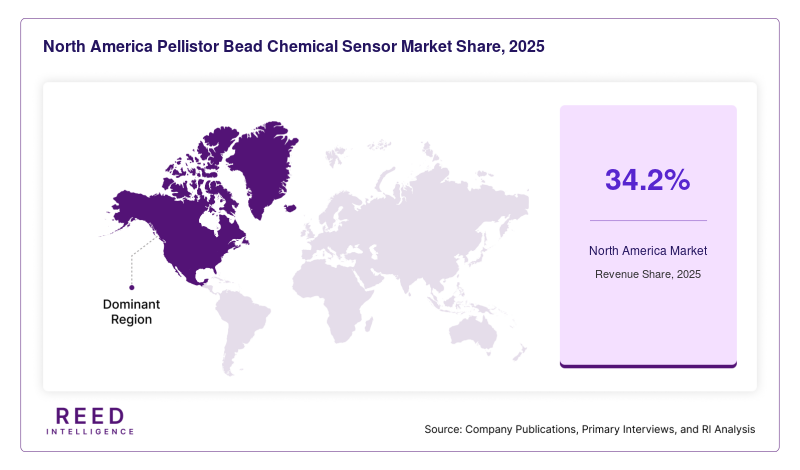
- Dominant Region: North America accounted for 34.2% market share in 2025, while Asia Pacific is expected to register the fastest CAGR of 7.4%.
- Leading Subsegments: Catalytic bead type dominated with 62% share, while infrared hybrid sensors are projected to grow at a CAGR of 7.8%. Industrial safety applications led with 48% share, while environmental monitoring is anticipated to grow at 7.2% CAGR.
- Dominant Country: The United States market was valued at USD 410 million in 2024 and reached USD 432 million in 2025.
Market Trends
Integration with Smart Monitoring Systems
The Pellistor Bead Chemical Sensor Market is witnessing increasing integration with IoT-enabled monitoring systems. Manufacturers are embedding pellistor sensors into smart gas detection platforms that offer real-time data analytics, remote monitoring, and predictive maintenance capabilities. This trend is enhancing operational efficiency and enabling industries to proactively manage safety risks.
Hybrid Sensor Technology Development
There is a growing shift toward hybrid sensor systems combining pellistor beads with infrared or semiconductor technologies. These hybrid systems improve detection accuracy and extend sensor lifespan, particularly in challenging environments where catalyst poisoning or environmental fluctuations may impact performance. As industries demand higher reliability, hybrid solutions are gaining prominence and reshaping product innovation strategies.
Market Drivers
Expansion of Oil & Gas Exploration Activities
The expansion of upstream and downstream oil & gas operations is driving demand for pellistor bead sensors. These sensors are essential for detecting combustible gases such as methane and propane, ensuring safety in drilling, refining, and storage processes. The increase in global energy demand has accelerated exploration activities, thereby boosting sensor adoption.
Rising Industrial Automation and Safety Awareness
Growing industrial automation has heightened the need for integrated safety systems. Industries are increasingly investing in advanced detection technologies to minimize human intervention and enhance operational safety. Pellistor bead sensors, known for their reliability and quick response time, are becoming a preferred choice in automated safety systems.
Market Restraint
Sensitivity to Catalyst Poisoning
One of the major challenges in the Pellistor Bead Chemical Sensor Market is the susceptibility of sensors to catalyst poisoning. Exposure to certain chemicals such as silicones, sulfur compounds, and lead can degrade sensor performance, reducing sensitivity and lifespan. This limitation necessitates frequent maintenance and replacement, increasing operational costs for end-users. Additionally, in environments with high contamination levels, the reliability of pellistor sensors may decline, prompting industries to consider alternative technologies such as infrared sensors.
Market Opportunities
Growth in Renewable Energy Infrastructure
The expansion of hydrogen and biogas infrastructure presents new opportunities for pellistor bead sensors. As these energy sources involve combustible gases, there is a rising need for effective gas detection solutions to ensure safe operations in renewable energy facilities.
Increasing Demand in Emerging Economies
Rapid industrialization in emerging economies across Asia Pacific and Latin America is creating significant demand for gas detection systems. As industries in these regions adopt stricter safety standards, the Pellistor Bead Chemical Sensor Market is expected to benefit from increased deployment in manufacturing and processing plants.
Segmental Analysis
By Type
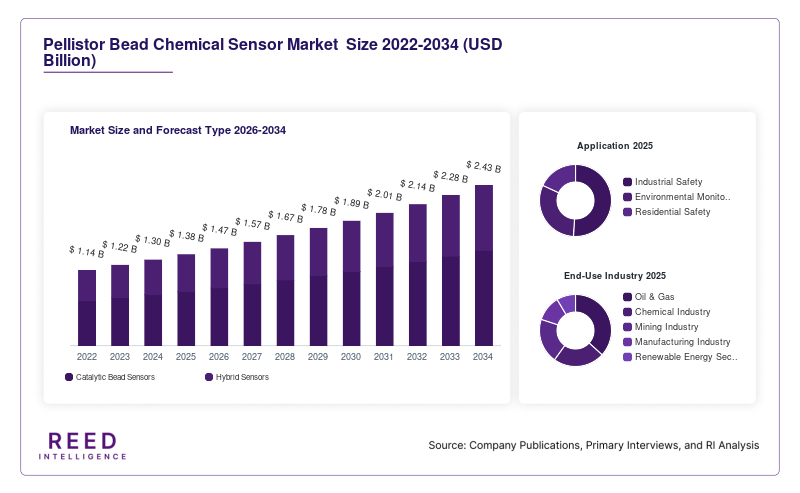
Catalytic bead sensors dominated the Pellistor Bead Chemical Sensor Market with a 62% share in 2024, owing to their widespread use in combustible gas detection and cost efficiency. These sensors have been extensively utilized in industrial safety systems due to their proven reliability.
Hybrid sensors are projected to grow at a CAGR of 7.8%, driven by their enhanced accuracy and resistance to environmental factors. The integration of multiple sensing technologies will support their rapid adoption.
By Application
Industrial safety applications accounted for 48% of the market share in 2024, driven by the need for gas detection in hazardous environments such as refineries and chemical plants.
Environmental monitoring is expected to grow at a CAGR of 7.2%, as governments and organizations increase focus on air quality and emission control.
By End-Use Industry
The oil & gas sector dominated with a 39% share in 2024, supported by extensive use of gas detection systems in exploration and refining processes.
Renewable energy is projected to grow at a CAGR of 7.6%, driven by increasing investments in hydrogen and biogas facilities requiring safety monitoring.
By Technology
Analog sensors held a 55% share in 2024, due to their simplicity and widespread adoption in traditional systems.
Digital sensors are expected to grow at a CAGR of 7.1%, supported by the adoption of smart monitoring systems and IoT integration.
Regional Analysis
North America
North America accounted for 34.2% of the Pellistor Bead Chemical Sensor Market share in 2025 and is expected to grow at a CAGR of 5.9% during the forecast period. The region’s growth will be driven by advanced industrial infrastructure and strong regulatory frameworks ensuring workplace safety.
The United States dominated the regional market due to its extensive oil & gas and chemical processing industries. The presence of strict safety standards and continuous technological advancements has supported widespread adoption of pellistor sensors across industrial applications.
Europe
Europe held approximately 26.5% market share in 2025 and is projected to grow at a CAGR of 5.7% through 2034. The region has emphasized environmental safety and industrial compliance, which has driven the adoption of gas detection technologies.
Germany emerged as the leading country, supported by its robust manufacturing sector and emphasis on industrial automation. The integration of safety systems in smart factories has further strengthened the demand for pellistor sensors.
Asia Pacific
Asia Pacific accounted for 22.8% of the market share in 2025 and is anticipated to grow at the fastest CAGR of 7.4% during the forecast period. Rapid industrialization and infrastructure development will significantly contribute to regional growth.
China dominated the market due to its large-scale manufacturing and energy sectors. Increasing investments in industrial safety and the expansion of chemical processing industries have driven demand for pellistor bead sensors in the country.
Middle East & Africa
The Middle East & Africa region held 9.3% market share in 2025 and is projected to grow at a CAGR of 6.3%. Growth in this region will be influenced by the expansion of oil & gas operations and infrastructure development.
Saudi Arabia led the regional market, supported by large-scale energy projects and increasing investments in industrial safety systems. The need for reliable gas detection solutions in harsh environments has driven the adoption of pellistor sensors.
Latin America
Latin America accounted for 7.2% market share in 2025 and is expected to grow at a CAGR of 6.1%. The region’s growth will be driven by expanding industrial activities and regulatory improvements.
Brazil dominated the market due to its growing oil & gas sector and industrial base. Increasing awareness regarding workplace safety and the adoption of monitoring systems have contributed to market expansion.
Competitive Landscape
The Pellistor Bead Chemical Sensor Market is moderately fragmented, with several global and regional players competing on product innovation and technological advancements. Companies are focusing on improving sensor durability, accuracy, and integration capabilities.
Honeywell International Inc. is a leading player in the market, known for its extensive portfolio of gas detection solutions. The company recently introduced advanced sensor systems with improved resistance to catalyst poisoning, strengthening its market position.
Other key players are investing in research and development to introduce hybrid sensor technologies and expand their presence in emerging markets.
Key Players
- Honeywell International Inc.
- Siemens AG
- Drägerwerk AG & Co. KGaA
- MSA Safety Incorporated
- City Technology Ltd.
- Figaro Engineering Inc.
- SGX Sensortech
- Membrapor AG
- Alphasense Ltd.
- Amphenol Advanced Sensors
Recent Developments
- 2024: Honeywell launched advanced pellistor sensors with enhanced durability.
- 2023: Siemens expanded its gas detection portfolio with smart monitoring integration.
- 2023: Dräger introduced hybrid sensor systems for industrial applications.
- 2024: MSA Safety enhanced its product line with IoT-enabled gas detection devices.
- 2023: SGX Sensortech developed next-generation catalytic bead sensors for improved sensitivity.
Pellistor Bead Chemical Sensor Market Segments
Type
- Catalytic Bead Sensors
- Hybrid Sensors
Application
- Industrial Safety
- Environmental Monitoring
- Residential Safety
End-Use Industry
- Oil & Gas
- Chemical Industry
- Mining Industry
- Manufacturing Industry
- Renewable Energy Sector
Technology
- Analog Sensors
- Digital Sensors
By Region
- North America
- Europe
- APAC
- Middle East and Africa
- LATAM