Pem Electrolyzer Market Size, Share & Demand Report By Type (PEM Stack, Modular Systems), By Capacity (Below 1 MW, 1–5 MW, Above 5 MW), By Application (Power-to-Gas, Industrial Hydrogen Production, Energy Storage, Mobility), By End-Use (Energy, Transportation, Industrial, Utilities), By Component (Stack, Balance of Plant, Power Supply) & Segment Forecasts, 2026–2034
USD 3950
Market Overview
The global Pem Electrolyzer Market size was valued at USD 3.4 billion in 2026 and is projected to reach USD 12.8 billion by 2034, expanding at a CAGR of 17.9% during the forecast period (2026–2034). The market is experiencing steady growth due to the increasing emphasis on clean hydrogen production and the transition toward low-carbon energy systems across multiple industries.
A major global factor supporting market expansion is the accelerating investment in green hydrogen infrastructure. Governments and private stakeholders are prioritizing hydrogen as a viable energy carrier to decarbonize hard-to-abate sectors such as steel, chemicals, and heavy transportation. Pem electrolyzers, known for their operational flexibility and high efficiency, are becoming a preferred technology for producing green hydrogen using renewable electricity sources.
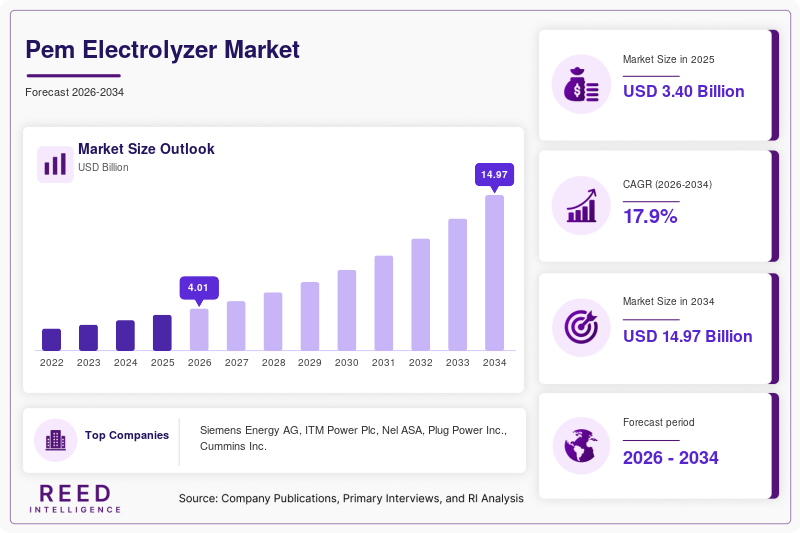
Key Highlights:
- Europe dominated the market with a 38.5% share in 2025, while Asia Pacific is expected to register the fastest growth at a CAGR of 19.6%.
- The Proton Exchange Membrane stack segment led the type category with a 52.4% share, while modular systems are projected to grow at a CAGR of 18.8%.
- In applications, power-to-gas held the largest share, whereas industrial hydrogen production is forecast to grow at 18.3% CAGR.
- Germany remained the dominant country, with market values of USD 780 million in 2024 and USD 920 million in 2025.
Market Trends
Integration of Renewable Energy with Electrolyzer Systems
One of the most prominent trends shaping the Pem Electrolyzer Market is the increasing integration of renewable energy sources such as solar and wind with electrolyzer systems. This trend is driven by the need to produce green hydrogen with minimal carbon emissions. Developers are designing hybrid energy systems where excess renewable power is stored in the form of hydrogen through PEM electrolysis. This not only enhances grid stability but also improves the economic viability of renewable energy projects. As intermittent energy generation becomes more widespread, PEM electrolyzers are increasingly deployed for load balancing and energy storage applications.
Shift Toward Decentralized Hydrogen Production
Another notable trend is the shift toward decentralized hydrogen production systems. Industries and commercial users are increasingly adopting on-site hydrogen generation to reduce dependence on centralized supply chains. Pem electrolyzers are well-suited for such applications due to their compact design, rapid response time, and scalability. This trend is particularly evident in sectors such as refueling stations, small-scale industrial operations, and backup power systems. The growing demand for localized hydrogen production is expected to support the expansion of modular and containerized electrolyzer solutions over the forecast period.
Market Drivers
Rising Demand for Green Hydrogen in Industrial Applications
The increasing demand for green hydrogen across industries such as refining, ammonia production, and steel manufacturing is a primary driver of the Pem Electrolyzer Market. Industries are actively seeking alternatives to fossil fuel-based hydrogen production methods to meet emission reduction targets. Pem electrolyzers offer a cleaner pathway by using renewable electricity, making them highly attractive for large-scale industrial deployment. This shift is supported by regulatory frameworks promoting low-carbon technologies and encouraging investments in hydrogen infrastructure.
Technological Advancements Enhancing Efficiency and Cost Competitiveness
Continuous innovation in electrolyzer technology is significantly driving market growth. Advances in membrane materials, catalysts, and system design are improving energy efficiency and reducing operational costs. Manufacturers are focusing on scaling production and optimizing system configurations to achieve economies of scale. These improvements are making PEM electrolyzers more competitive compared to traditional alkaline systems. As costs decline and performance improves, adoption across diverse applications is expected to accelerate, contributing to sustained market expansion.
Market Restraint
High Capital Costs and Material Constraints
Despite strong growth prospects, the Pem Electrolyzer Market faces challenges related to high capital costs and reliance on expensive materials such as platinum and iridium. These precious metals are essential for catalyst performance but significantly increase the overall system cost. Additionally, supply constraints and price volatility of these materials pose risks to large-scale deployment.
The initial investment required for installing PEM electrolyzer systems remains a barrier, particularly for small and medium enterprises. While operational costs are gradually declining, the upfront expenditure can limit adoption in cost-sensitive markets. Furthermore, the lack of standardized manufacturing processes and limited production capacity contribute to higher system prices.
Addressing these challenges requires continued research into alternative catalyst materials and scalable manufacturing techniques. Without cost reduction and supply chain optimization, the pace of market expansion may be constrained in certain regions.
Market Opportunities
Expansion of Hydrogen Refueling Infrastructure
The growing development of hydrogen refueling infrastructure presents a significant opportunity for the Pem Electrolyzer Market. As fuel cell vehicles gain traction, the demand for on-site hydrogen production at refueling stations is increasing. PEM electrolyzers are ideal for this application due to their compact size and ability to produce high-purity hydrogen. Investments in hydrogen mobility ecosystems are expected to drive the adoption of electrolyzers in transportation networks.
Adoption in Energy Storage and Grid Stabilization
Another emerging opportunity lies in the use of PEM electrolyzers for energy storage and grid stabilization. With the increasing penetration of renewable energy, grid operators are seeking solutions to manage variability and ensure reliability. Hydrogen production through electrolysis provides a flexible storage medium that can be converted back to electricity when needed. This application is gaining traction in regions with high renewable energy capacity, offering new growth avenues for market participants.
Segmental Analysis
By Type
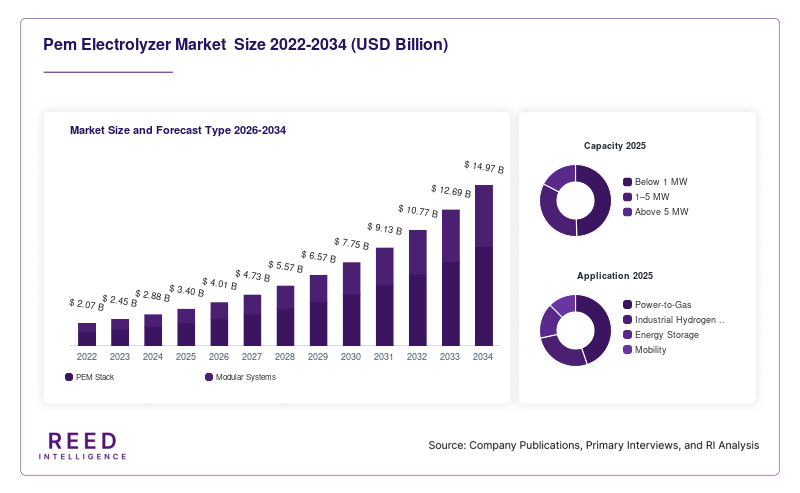
The Proton Exchange Membrane stack segment dominated the market, accounting for 52.4% of the share in 2025. This dominance was attributed to its superior efficiency, compact design, and ability to operate under dynamic conditions. The segment is widely used in applications requiring high-purity hydrogen and rapid response times.
Modular PEM electrolyzer systems are expected to be the fastest-growing subsegment, with a projected CAGR of 18.8%. Their scalability and ease of deployment make them suitable for decentralized hydrogen production. The increasing demand for flexible and transportable systems is driving growth in this segment.
By Capacity
Large-scale electrolyzers (above 5 MW) held the largest share of 46.7% in 2025. These systems are primarily used in industrial applications and large hydrogen production facilities. Their ability to deliver high output efficiently makes them ideal for bulk hydrogen generation.
Small-scale systems (below 1 MW) are anticipated to grow at a CAGR of 18.5%. Their adoption is increasing in localized applications such as refueling stations and backup power systems. The growing trend of decentralized energy systems is supporting this segment’s growth.
By Application
Power-to-gas applications dominated the market with a 41.3% share in 2025. This segment benefits from the integration of renewable energy sources with hydrogen production, enabling energy storage and grid balancing.
Industrial hydrogen production is projected to grow at a CAGR of 18.3%. Industries are increasingly adopting PEM electrolyzers to produce green hydrogen and reduce reliance on fossil fuels. The push for sustainable industrial processes is a key growth factor.
By End-Use Industry
The energy sector accounted for the largest share of 44.6% in 2025. The adoption of PEM electrolyzers in renewable energy projects and grid stabilization initiatives contributed to this dominance.
The transportation sector is expected to grow at a CAGR of 19.1%, driven by the rising adoption of hydrogen fuel cell vehicles. The expansion of refueling infrastructure is further supporting this segment.
By Component
Electrolyzer stacks dominated the component segment with a 49.8% share in 2025. These components are critical to system performance and efficiency, making them a major revenue contributor.
Power supply units are expected to grow at a CAGR of 17.9%, driven by advancements in power electronics and the need for efficient energy conversion systems.
Regional Analysis
North America
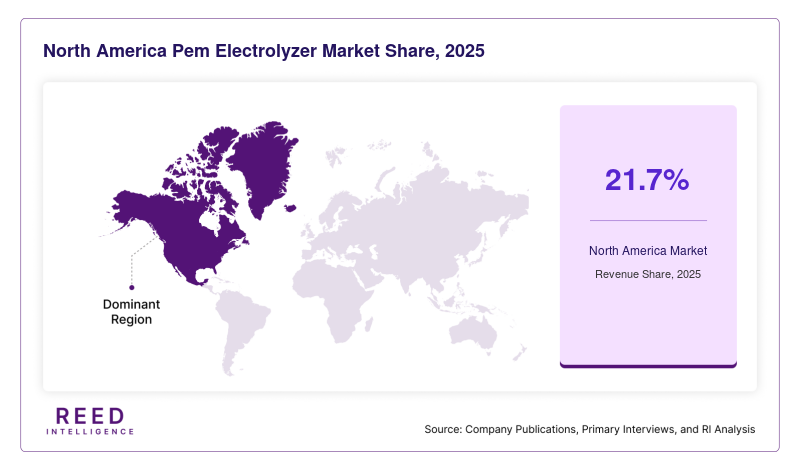
North America accounted for 21.7% of the Pem Electrolyzer Market share in 2025 and is projected to grow at a CAGR of 17.2% during 2026–2034. The region’s growth trajectory is supported by increasing investments in clean energy technologies and the expansion of hydrogen pilot projects.
The United States emerged as the dominant country due to strong federal support for hydrogen initiatives. Government funding programs and tax incentives aimed at reducing carbon emissions have encouraged the deployment of electrolyzer systems. Additionally, collaborations between technology providers and energy companies are fostering innovation and scaling up production capabilities.
Europe
Europe held the largest share of 38.5% in 2025 and is expected to grow at a CAGR of 16.8% over the forecast period. The region has been a leader in hydrogen adoption, driven by stringent environmental regulations and ambitious decarbonization targets.
Germany dominated the regional market due to its comprehensive hydrogen strategy and strong industrial base. The country’s focus on integrating renewable energy with hydrogen production has accelerated the deployment of PEM electrolyzers. Public-private partnerships and funding initiatives are further supporting market growth.
Asia Pacific
Asia Pacific represented 24.3% of the market in 2025 and is anticipated to register the fastest growth at a CAGR of 19.6%. Rapid industrialization and increasing energy demand are key factors contributing to market expansion in this region.
China led the market due to large-scale investments in hydrogen infrastructure and manufacturing capabilities. The country’s focus on reducing carbon emissions and enhancing energy security has resulted in significant adoption of PEM electrolyzers across industrial and transportation sectors.
Middle East & Africa
The Middle East & Africa accounted for 8.1% of the market share in 2025 and is projected to grow at a CAGR of 18.1%. The region is leveraging its abundant renewable energy resources to produce green hydrogen for export and domestic use.
Saudi Arabia emerged as the dominant country, driven by large-scale hydrogen projects and investments in renewable energy. The country’s strategic initiatives to diversify its energy portfolio are supporting the deployment of PEM electrolyzers in various applications.
Latin America
Latin America held 7.4% of the market in 2025 and is expected to grow at a CAGR of 17.5% during the forecast period. The region is gradually adopting hydrogen technologies as part of its energy transition strategies.
Brazil dominated the market due to its strong renewable energy base and increasing focus on sustainable energy solutions. The country’s efforts to develop hydrogen infrastructure and attract foreign investments are contributing to the growth of the Pem Electrolyzer Market.
Competitive Landscape
The Pem Electrolyzer Market is moderately competitive, with several global and regional players focusing on innovation and capacity expansion. The market leader, Siemens Energy AG, has strengthened its position through continuous technological advancements and strategic partnerships. The company recently launched a high-capacity PEM electrolyzer system designed for large-scale hydrogen production, enhancing its market presence.
Other key players are investing in research and development to improve system efficiency and reduce costs. Collaborations with energy companies and government agencies are common strategies to expand market reach. The competitive landscape is characterized by a focus on scaling production, improving performance, and developing cost-effective solutions to meet growing demand.
Key Players List
- Siemens Energy AG
- ITM Power Plc
- Nel ASA
- Plug Power Inc.
- Cummins Inc.
- Air Liquide
- Linde plc
- Toshiba Energy Systems & Solutions
- McPhy Energy S.A.
- Hydrogenics Corporation
- Ballard Power Systems
- Bloom Energy Corporation
- Enapter S.r.l.
- Green Hydrogen Systems
- Next Hydrogen Solutions
Recent Developments
- 2025: Siemens Energy expanded its PEM electrolyzer manufacturing capacity in Europe.
- 2025: ITM Power announced a new modular electrolyzer system for decentralized hydrogen production.
- 2024: Plug Power partnered with industrial firms to deploy large-scale green hydrogen plants.
- 2024: Nel ASA introduced an upgraded PEM electrolyzer with improved efficiency and reduced cost.
- 2025: Cummins Inc. launched a next-generation electrolyzer platform for industrial applications.
Pem Electrolyzer Market Segments
Type
- PEM Stack
- Modular Systems
Capacity
- Below 1 MW
- 1–5 MW
- Above 5 MW
Application
- Power-to-Gas
- Industrial Hydrogen Production
- Energy Storage
- Mobility
End-Use
- Energy
- Transportation
- Industrial
- Utilities
Component
- Stack
- Balance of Plant
- Power Supply
By Region
- North America
- Europe
- APAC
- Middle East and Africa
- LATAM