Pentachlorophenol Market Size, Share & Demand Report By Application (Wood Preservation, Industrial Biocides, Agriculture, Others), By End-Use Industry (Utilities, Agriculture, Industrial, Construction), By Form (Liquid, Powder), By Distribution Channel (Direct Sales, Distributors), By Region & Segment Forecasts, 2026–2034
USD 3950
Market Overview
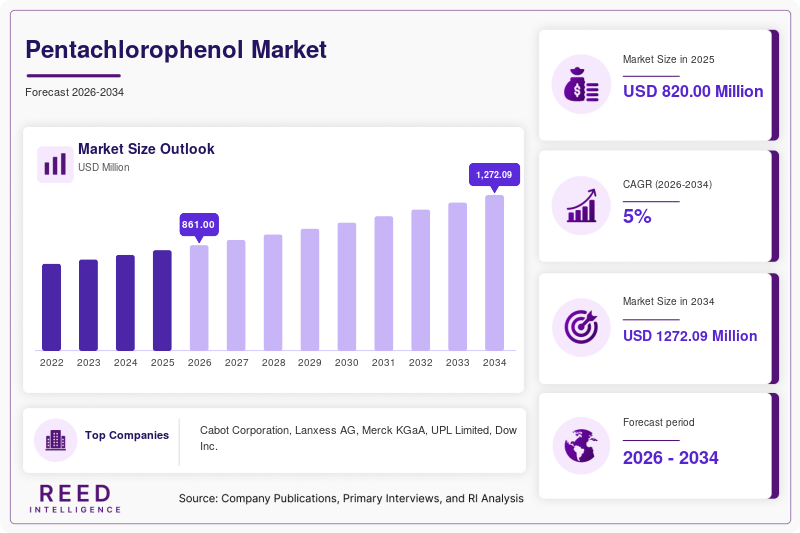
The global Pentachlorophenol Market size was valued at approximately USD 820 million in 2026 and is projected to reach USD 1,210 million by 2034, expanding at a CAGR of 5.0% during the forecast period (2026–2034). Pentachlorophenol (PCP) is widely used as a wood preservative, pesticide, and industrial biocide due to its strong antimicrobial and insecticidal properties. Despite regulatory scrutiny in certain regions, demand remains stable across infrastructure and utility sectors.
A key global factor supporting market growth is the continued expansion of utility infrastructure, particularly in developing economies. Wooden utility poles and cross-arms treated with pentachlorophenol offer durability and resistance against fungi, termites, and weathering, making them essential for electricity transmission networks in rural and semi-urban areas.
Key Highlights:
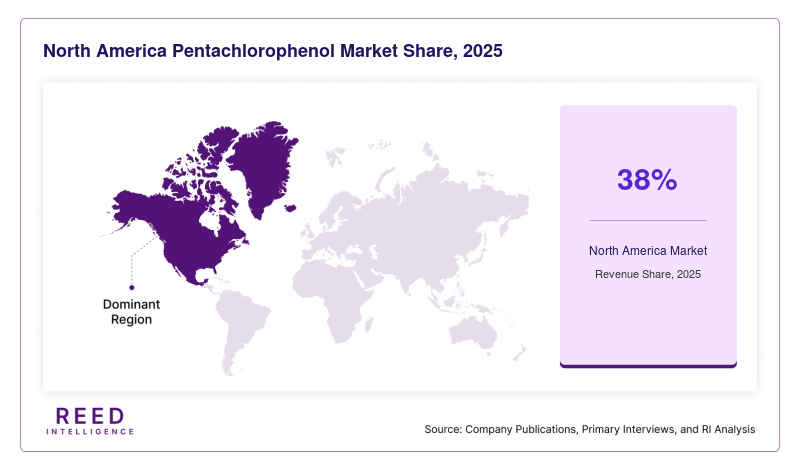
- North America dominated the Pentachlorophenol Market with 38% share, while Asia Pacific is projected to be the fastest-growing region at a CAGR of 6.4%.
- The wood preservation segment led with 62% share, while industrial biocides are expected to grow fastest at a CAGR of 5.8%.
- The utility poles application held the largest share, whereas agricultural chemicals are projected to expand at a CAGR of 5.6%.
- The United States remained the dominant country with market values of USD 270 million in 2024 and USD 285 million in 2025.
Market Trends
Shift Toward Controlled and Regulated Usage
A notable trend shaping the Pentachlorophenol Market is the transition toward regulated and controlled application frameworks. Governments and environmental agencies are imposing stricter guidelines on PCP usage due to concerns regarding toxicity and persistence in the environment. This has led to the development of improved formulations and safer handling practices. Companies are investing in compliance strategies and advanced treatment processes to minimize environmental impact. As a result, the market is witnessing a gradual shift from unrestricted usage to specialized industrial applications, particularly in regions where regulatory clarity exists.
Increasing Demand for Long-Life Utility Infrastructure
Another key trend is the growing demand for durable wood preservation solutions in utility infrastructure. Electricity distribution networks continue to expand globally, especially in emerging economies. Wooden poles treated with pentachlorophenol remain a preferred choice due to their cost-effectiveness and extended lifespan. This trend is further supported by government electrification programs and rural infrastructure initiatives. As utilities seek reliable and low-maintenance materials, PCP-treated wood is gaining traction. The market is also seeing innovations in treatment technologies that enhance wood longevity while optimizing chemical usage, reinforcing this trend across both developed and developing regions.
Market Drivers
Rising Demand for Wood Preservation in Utility Applications
The increasing deployment of wooden poles and cross-arms in power distribution networks is a primary driver of the Pentachlorophenol Market. PCP-treated wood offers resistance to biological degradation, making it suitable for long-term outdoor use. Utility companies prefer treated wood due to its durability and cost advantages compared to alternative materials such as steel or concrete. As global electrification efforts expand, especially in rural areas, the demand for wood preservation chemicals continues to rise.
Growth in Industrial Biocide Applications
Pentachlorophenol is widely used as a biocide in industrial settings, including oilfields, textiles, and leather processing. Its effectiveness in controlling microbial growth enhances product quality and operational efficiency. Industries that require contamination control are increasingly adopting PCP-based formulations. The expansion of manufacturing activities and industrial output in developing economies further supports this driver. Additionally, advancements in chemical formulations are improving the efficacy and safety of PCP-based biocides, contributing to sustained market growth.
Market Restraint
Environmental and Health Concerns Limiting Adoption
A major restraint impacting the Pentachlorophenol Market is the growing concern over its environmental and health effects. Pentachlorophenol is classified as a persistent organic pollutant in several regions, leading to restrictions or bans on its usage. Prolonged exposure can pose risks to human health, including toxicity and potential carcinogenic effects. Environmental contamination through soil and water systems has also raised alarms among regulatory authorities.
As a result, many countries have implemented strict regulations governing the production, distribution, and application of PCP. Compliance with these regulations increases operational costs for manufacturers and limits market expansion. Furthermore, the availability of alternative wood preservatives and biocides is gradually reducing dependence on pentachlorophenol. This shift is particularly evident in Europe and certain parts of Asia, where sustainability initiatives are influencing purchasing decisions. These factors collectively act as a barrier to the widespread adoption of PCP products.
Market Opportunities
Emerging Markets with Expanding Infrastructure
Developing regions present significant growth opportunities for the Pentachlorophenol Market. Countries in Asia Pacific, Africa, and Latin America are investing heavily in infrastructure development, including electricity distribution and rural electrification. These projects require durable materials, creating demand for PCP-treated wood. The relatively lenient regulatory frameworks in some of these regions further support market penetration. Manufacturers can capitalize on this opportunity by expanding their presence and forming partnerships with local distributors.
Technological Advancements in Safer Formulations
Another promising opportunity lies in the development of enhanced and safer PCP formulations. Research and innovation efforts are focused on reducing toxicity while maintaining efficacy. Advanced treatment methods and encapsulation technologies are enabling controlled release and minimizing environmental impact. Companies investing in sustainable solutions can gain a competitive edge and access markets with stricter regulations. This approach not only supports compliance but also aligns with evolving industry standards and customer preferences, driving long-term growth.
Segmental Analysis
By Application
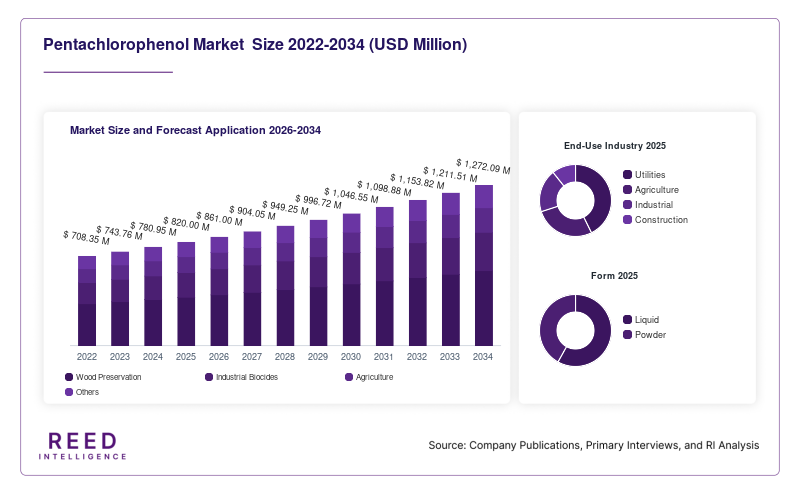
The wood preservation segment dominated the Pentachlorophenol Market with a 62% share in 2025. This segment benefited from widespread use in treating utility poles, railway sleepers, and construction materials. The ability of pentachlorophenol to protect wood from fungi, insects, and moisture made it a preferred solution in outdoor applications.
The industrial biocides segment is expected to be the fastest-growing, registering a CAGR of 5.8% during the forecast period. Growth will be driven by increasing demand for microbial control in industries such as oil & gas, textiles, and leather processing. Enhanced formulations and improved safety measures will further support segment expansion.
By End-Use Industry
The utilities sector accounted for the largest share of 55% in 2025, driven by the extensive use of treated wood in power distribution networks. Utility companies rely on PCP-treated poles for their durability and cost efficiency, particularly in rural electrification projects.
The agriculture sector is projected to grow at a CAGR of 5.6%, supported by the use of PCP in pesticides and crop protection. Increasing agricultural productivity requirements and pest management needs will drive demand in this segment.
By Form
The liquid form dominated the market with a 68% share in 2025, owing to its ease of application and effectiveness in wood treatment processes. Liquid formulations allow for deeper penetration and uniform distribution, enhancing preservation outcomes.
The powder form is expected to grow at a CAGR of 4.9%, driven by its suitability for specific industrial applications. Its stability and ease of storage make it attractive for manufacturers requiring controlled usage.
By Distribution Channel
The direct sales channel held the largest share of 60% in 2025, as manufacturers primarily supply PCP products directly to industrial and utility clients. This channel ensures quality control and long-term supply agreements.
The distributor channel is anticipated to grow at a CAGR of 5.3%, supported by expanding market reach in emerging regions. Local distributors play a crucial role in facilitating product availability and customer support.
Regional Analysis
North America
North America accounted for 38% of the Pentachlorophenol Market share in 2025 and is expected to grow at a CAGR of 4.6% during 2026–2034. The region’s market was characterized by stable demand driven by utility infrastructure maintenance and replacement cycles. Regulatory oversight remained strong, influencing controlled usage patterns across industrial applications.
The United States dominated the regional market due to its extensive electricity distribution network. The country’s reliance on wooden utility poles for rural and suburban electrification supported consistent demand for pentachlorophenol. Additionally, established treatment facilities and technological advancements in wood preservation contributed to market stability.
Europe
Europe held approximately 22% share of the Pentachlorophenol Market in 2025 and is projected to grow at a CAGR of 3.8% through 2034. The region experienced limited growth due to stringent environmental regulations and restrictions on PCP usage. Market activity was largely confined to specialized industrial applications.
Germany emerged as a key country, supported by its advanced industrial sector. The demand for biocides in niche applications such as leather processing and industrial preservation sustained market presence. However, regulatory compliance requirements influenced market dynamics, encouraging the adoption of alternative chemicals.
Asia Pacific
Asia Pacific represented 26% of the global market share in 2025 and is anticipated to expand at a CAGR of 6.4%, making it the fastest-growing region. Rapid urbanization, industrialization, and infrastructure development contributed to strong demand for wood preservation solutions.
China led the regional market due to its large-scale infrastructure projects and expanding utility networks. The country’s focus on rural electrification and industrial growth created substantial demand for PCP-treated wood. Additionally, cost-effective manufacturing capabilities supported regional supply.
Middle East & Africa
The Middle East & Africa accounted for 8% of the Pentachlorophenol Market share in 2025 and is expected to grow at a CAGR of 5.2% during the forecast period. Market growth was driven by infrastructure development and increasing investments in energy projects.
South Africa dominated the region, supported by its established utility sector. The need for durable materials in electricity distribution networks contributed to demand for wood preservatives. Expanding industrial activities also supported the use of PCP in biocide applications.
Latin America
Latin America held 6% of the market share in 2025 and is projected to grow at a CAGR of 5.0% through 2034. The region’s market was influenced by infrastructure development and agricultural activities.
Brazil emerged as the leading country, driven by its expanding power distribution network and agricultural sector. The use of pentachlorophenol in wood preservation and crop protection supported market growth. Increasing investments in rural electrification further strengthened demand.
Competitive Landscape
The Pentachlorophenol Market is moderately consolidated, with key players focusing on product innovation, regulatory compliance, and geographic expansion. Leading companies are investing in advanced formulations to enhance safety and performance.
KMG Chemicals (now part of Cabot Corporation) is recognized as a market leader, leveraging its strong distribution network and product portfolio. The company recently introduced improved wood treatment solutions designed to meet evolving environmental standards.
Other prominent players are strengthening their market presence through strategic partnerships and capacity expansions. Competitive strategies include technological advancements, cost optimization, and targeted expansion into emerging markets. The focus on sustainable practices and regulatory adherence continues to shape the competitive landscape.
Key Players List
- Cabot Corporation
- Lanxess AG
- Merck KGaA
- UPL Limited
- Dow Inc.
- BASF SE
- Arkema Group
- Occidental Petroleum Corporation
- Sigma-Aldrich Corporation
- Jubilant Ingrevia Limited
- Nantong Jiangshan Agrochemical & Chemicals Co., Ltd.
- Wuhan Sanjiang Space Good Biotech Co., Ltd.
- Shandong Qilu Chemical Co., Ltd.
- Alfa Aesar
- Tokyo Chemical Industry Co., Ltd.
Recent Developments
- 2025: Cabot Corporation expanded its wood preservation product line with enhanced formulations.
- 2024: Lanxess AG invested in sustainable chemical solutions to meet regulatory requirements.
- 2024: UPL Limited strengthened its presence in emerging markets through distribution partnerships.
- 2023: BASF SE introduced improved industrial biocide solutions targeting efficiency and safety.
- 2023: Merck KGaA focused on research initiatives to develop safer PCP alternatives.
Pentachlorophenol Market Segments
Application
- Wood Preservation
- Industrial Biocides
- Agriculture
- Others
End-Use Industry
- Utilities
- Agriculture
- Industrial
- Construction
Form
- Liquid
- Powder
Distribution Channel
- Direct Sales
- Distributors
By Region
- North America
- Europe
- APAC
- Middle East and Africa
- LATAM