Pentylene Glycol Market Size, Share & Demand Report By Type (Synthetic Pentylene Glycol, Bio-Based Pentylene Glycol), By Application (Cosmetics & Personal Care, Pharmaceuticals, Industrial Applications), By End-Use Industry (Personal Care, Healthcare, Chemical Industry), By Distribution Channel (Direct Sales, Distributors, Online Channels), By Region & Segment Forecasts, 2026–2034
USD 3950
Market Overview
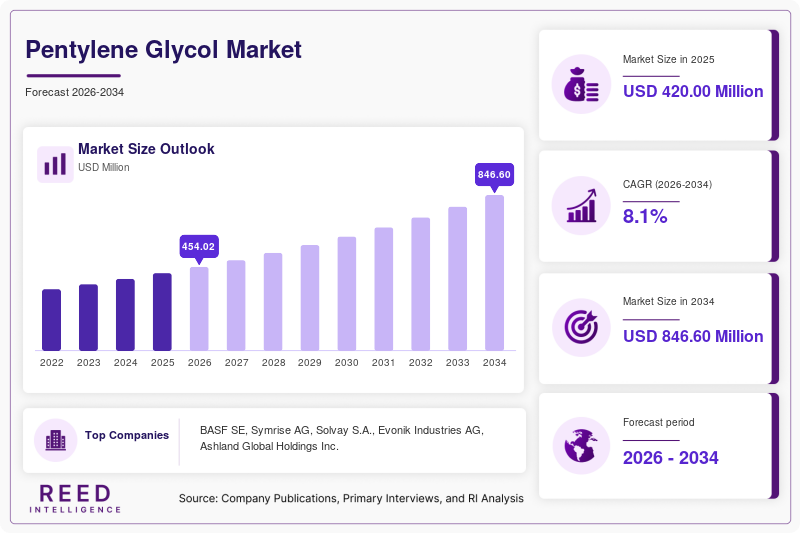
The global Pentylene Glycol Market size was valued at approximately USD 420 million in 2026 and is projected to reach USD 780 million by 2034, expanding at a CAGR of 8.1% during the forecast period (2026–2034). Pentylene glycol, a multifunctional ingredient widely used as a humectant, solvent, and antimicrobial agent, has gained notable traction across cosmetics, personal care, and pharmaceutical formulations.
One of the primary global factors supporting market growth is the increasing consumer preference for clean-label and multifunctional cosmetic ingredients. Pentylene glycol, being both a preservative booster and a skin-conditioning agent, aligns well with the industry’s shift toward minimalistic formulations. This trend has driven its adoption in premium skincare and dermatological products, particularly in developed markets.
Key Highlights:
- North America dominated the market with a share of 34% in 2025, while Asia Pacific is projected to register the fastest growth at a CAGR of 9.4%.
- In segmentation, synthetic pentylene glycol was the leading type segment, while bio-based pentylene glycol is anticipated to be the fastest-growing with a CAGR of 9.8%.
- Among applications, cosmetics & personal care led with the largest share, whereas pharmaceutical applications are projected to grow at the fastest rate of 8.9% CAGR.
- The United States remained the dominant country, with market values of USD 120 million in 2024 and USD 128 million in 2025.
Market Trends
Shift Toward Bio-Based Ingredients
A significant trend shaping the Pentylene Glycol Market is the rising shift toward bio-based and sustainable ingredients. Manufacturers are increasingly developing pentylene glycol from renewable raw materials such as sugarcane and corn derivatives. This shift is largely driven by regulatory pressures and growing consumer awareness regarding environmental impact. Bio-based variants offer reduced carbon footprints and improved biodegradability, making them suitable for eco-conscious product lines. Personal care brands are leveraging this trend to position their offerings as environmentally responsible, thereby enhancing brand value and consumer trust.
Increasing Demand for Multifunctional Cosmetic Ingredients
Another notable trend is the growing demand for multifunctional ingredients in cosmetic formulations. Pentylene glycol serves multiple roles, including moisturizing, antimicrobial stabilization, and solvent capabilities. This multifunctionality helps manufacturers reduce formulation complexity and eliminate the need for multiple additives. As a result, it supports the development of simplified and cost-efficient formulations. The trend is particularly prominent in skincare and dermatological products where ingredient transparency and efficacy are critical. The adoption of multifunctional ingredients also aligns with the industry’s move toward minimal ingredient lists, which is becoming a key marketing strategy in premium and organic product segments.
Market Drivers
Expanding Personal Care Industry
The growth of the global personal care and cosmetics industry is a major driver for the Pentylene Glycol Market. Increasing disposable incomes, urbanization, and rising consumer awareness about skincare have led to higher demand for advanced cosmetic products. Pentylene glycol is widely used in moisturizers, serums, and lotions due to its hydrating and preservative-boosting properties. As consumers increasingly seek products with improved performance and safety profiles, manufacturers are incorporating pentylene glycol into a broader range of formulations.
Rising Demand for Safe and Effective Preservative Alternatives
There is a growing demand for safer alternatives to traditional preservatives such as parabens and formaldehyde-releasing agents. Pentylene glycol acts as a preservative enhancer, reducing the need for harsh chemicals while maintaining product stability. This has made it an attractive ingredient for clean-label formulations. Regulatory scrutiny on synthetic preservatives has further accelerated this shift. As a result, pentylene glycol is gaining traction as a reliable and effective component in both cosmetic and pharmaceutical products, contributing significantly to market growth.
Market Restraint
High Production Costs of Bio-Based Variants
A key restraint in the Pentylene Glycol Market is the relatively high production cost associated with bio-based pentylene glycol. The use of renewable feedstocks and advanced processing technologies increases manufacturing expenses compared to conventional synthetic methods. These higher costs often translate into elevated product prices, limiting adoption among price-sensitive consumers and manufacturers.
Additionally, supply chain constraints for bio-based raw materials can further impact production consistency and cost efficiency. Small and medium-sized manufacturers may find it challenging to integrate bio-based pentylene glycol into their formulations due to budget limitations. While demand for sustainable ingredients is increasing, cost considerations continue to act as a barrier to widespread adoption, particularly in emerging markets where affordability remains a critical factor.
Market Opportunities
Growth in Pharmaceutical Applications
The expanding pharmaceutical sector presents a significant opportunity for the Pentylene Glycol Market. Pentylene glycol is increasingly used as a solvent and stabilizer in topical formulations and drug delivery systems. Its antimicrobial properties enhance product shelf life and efficacy. As the demand for dermatological treatments and topical medications continues to rise, the adoption of pentylene glycol in pharmaceutical formulations is expected to grow steadily.
Rising Demand in Emerging Economies
Emerging economies in Asia Pacific and Latin America offer substantial growth opportunities due to increasing consumer spending on personal care products. Rapid urbanization, expanding middle-class populations, and growing awareness of skincare are driving demand for high-quality cosmetic ingredients. Manufacturers are focusing on these regions to expand their market presence and tap into untapped potential. Local production and strategic partnerships are likely to further support market growth in these regions.
Segmental Analysis
By Type
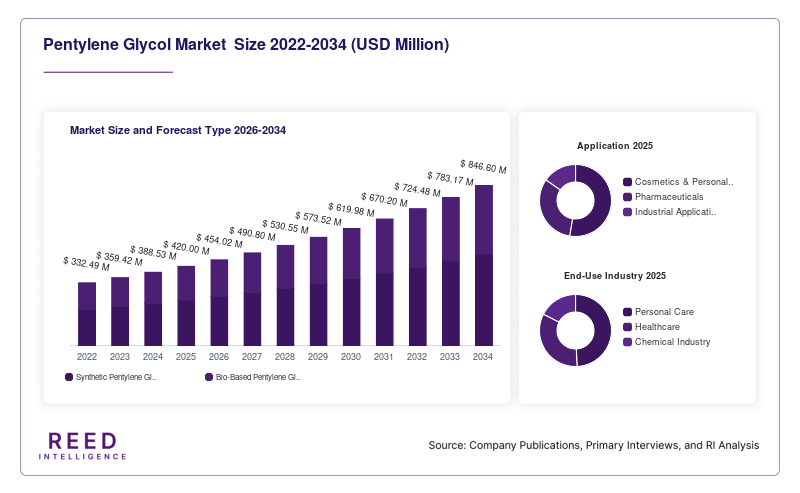
Synthetic pentylene glycol dominated the market, accounting for approximately 68% of the share in 2025 due to its cost-effectiveness and widespread availability. It has been widely used in large-scale manufacturing processes where cost efficiency is crucial.
Bio-based pentylene glycol is expected to be the fastest-growing segment, with a projected CAGR of 9.8%, driven by increasing demand for sustainable and eco-friendly ingredients. Its adoption will be fueled by regulatory support and consumer preference for green products.
By Application
The cosmetics & personal care segment held the largest share of around 62% in 2025, driven by extensive use in skincare and haircare products. Pentylene glycol’s multifunctional properties make it a preferred ingredient in this segment.
The pharmaceutical segment is projected to grow at a CAGR of 8.9%, supported by increasing use in topical formulations and drug delivery systems. Its antimicrobial properties will continue to drive demand in this segment.
By End-Use Industry
The personal care industry dominated with a 60% share in 2025, reflecting strong demand for skincare and beauty products.
The healthcare sector is expected to witness the fastest growth, with a CAGR of 8.7%, driven by increasing demand for dermatological treatments and topical medications.
By Distribution Channel
Direct sales accounted for the largest share of 55% in 2025, as manufacturers prefer direct engagement with large-scale buyers.
Online distribution channels are expected to grow at a CAGR of 9.2%, driven by increasing digitalization and ease of procurement.
Regional Analysis
North America
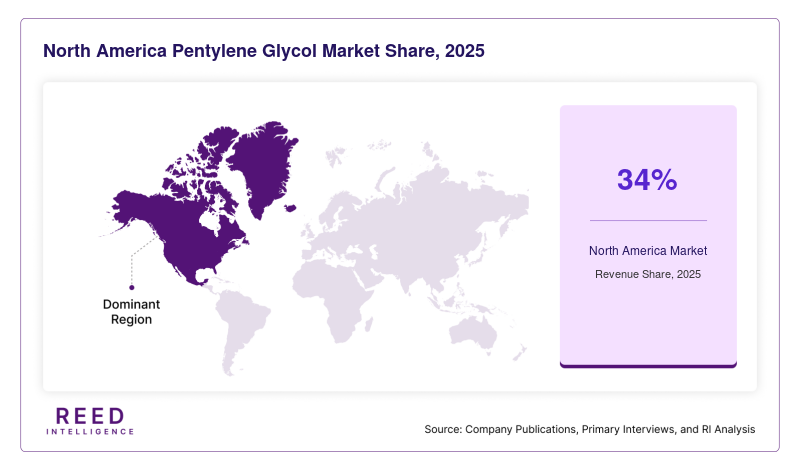
North America accounted for approximately 34% of the global Pentylene Glycol Market share in 2025 and was characterized by strong demand from the cosmetics and pharmaceutical industries. The region will continue to grow at a CAGR of 7.6% from 2026 to 2034, driven by innovation in skincare formulations and increasing consumer preference for clean-label products.
The United States dominated the regional market due to its advanced cosmetic industry and strong presence of key manufacturers. The country’s growth is supported by continuous product innovation and increasing investment in sustainable ingredient development.
Europe
Europe held around 28% market share in 2025, supported by stringent regulations promoting safe and eco-friendly ingredients. The region will expand at a CAGR of 7.8% during the forecast period.
Germany emerged as the dominant country, driven by its robust chemical manufacturing base and strong focus on sustainable production practices. The country’s emphasis on green chemistry has encouraged the adoption of bio-based pentylene glycol.
Asia Pacific
Asia Pacific represented 22% of the market share in 2025 and is expected to witness the fastest growth at a CAGR of 9.4%. Rapid urbanization and increasing consumer awareness are key factors driving demand.
China led the regional market due to its large population and expanding cosmetics industry. The country’s growth is supported by rising disposable incomes and increasing demand for premium skincare products.
Middle East & Africa
The Middle East & Africa accounted for 9% of the market share in 2025 and will grow at a CAGR of 7.2%. The region’s growth is supported by increasing demand for personal care products and expanding retail infrastructure.
The United Arab Emirates dominated the market due to its strong retail sector and high consumer spending on luxury cosmetics.
Latin America
Latin America held approximately 7% of the market share in 2025 and is projected to grow at a CAGR of 7.5%. The region’s growth is driven by increasing consumer awareness and rising demand for skincare products.
Brazil emerged as the dominant country, supported by its large consumer base and growing beauty industry.
Competitive Landscape
The Pentylene Glycol Market is moderately consolidated, with key players focusing on product innovation and strategic partnerships. Leading companies are investing in bio-based production technologies to meet growing sustainability demands.
BASF SE is a major market leader, known for its extensive product portfolio and strong global presence. The company recently expanded its bio-based pentylene glycol production capacity to cater to rising demand. Other prominent players are actively enhancing their distribution networks and focusing on research and development to maintain competitive positioning.
Key Players List
- BASF SE
- Symrise AG
- Solvay S.A.
- Evonik Industries AG
- Ashland Global Holdings Inc.
- Clariant AG
- Croda International Plc
- Lanxess AG
- Arkema S.A.
- INEOS Group
- Dow Inc.
- Eastman Chemical Company
- Lonza Group AG
- Kao Corporation
- LG Chem Ltd.
Recent Developments
- BASF SE expanded its bio-based pentylene glycol production facility in 2025.
- Symrise AG introduced a new sustainable pentylene glycol variant for cosmetic applications.
- Evonik Industries AG invested in R&D for advanced multifunctional ingredients.
- Clariant AG partnered with regional distributors to strengthen its market presence.
- Croda International Plc launched a new line of eco-friendly cosmetic ingredients.
Pentylene Glycol Market Segments
Type
- Synthetic Pentylene Glycol
- Bio-Based Pentylene Glycol
Application
- Cosmetics & Personal Care
- Pharmaceuticals
- Industrial Applications
End-Use Industry
- Personal Care
- Healthcare
- Chemical Industry
Distribution Channel
- Direct Sales
- Distributors
- Online Channels
By Region
- North America
- Europe
- APAC
- Middle East and Africa
- LATAM