Perfluoroalkoxy Alkane Market Size, Share & Demand Report By Type (Granular PFA, Dispersion PFA), By Application (Semiconductor Processing, Chemical Processing, Medical Devices, Electronics), By End-Use Industry (Chemical Industry, Automotive, Electronics, Healthcare) & Segment Forecasts, 2026–2034
USD 3950
Market Overview
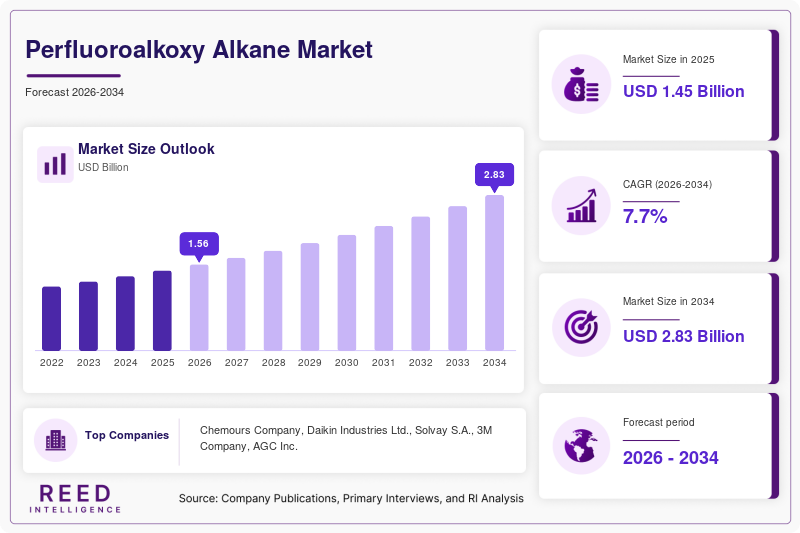
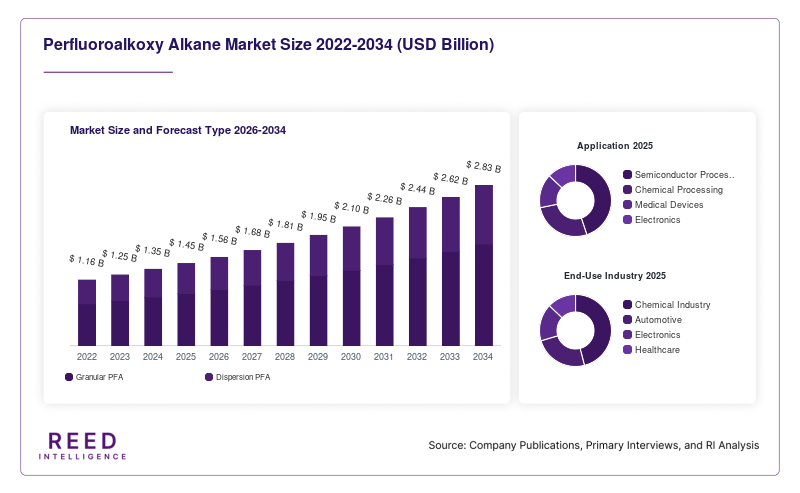
The Perfluoroalkoxy Alkane Market size was valued at USD 1.45 billion in 2026 and is projected to reach USD 2.63 billion by 2034, expanding at a CAGR of 7.7% during the forecast period (2026–2034). The market reflects steady growth driven by the rising demand for high-performance fluoropolymers across critical industries such as semiconductor manufacturing, chemical processing, and automotive systems. Perfluoroalkoxy alkane (PFA) resins are valued for their exceptional chemical resistance, high thermal stability, and non-reactive surface properties, making them suitable for harsh industrial environments.
One global factor supporting market expansion is the rapid advancement in semiconductor fabrication technologies. The increasing complexity of chip manufacturing processes requires ultra-pure materials that can withstand aggressive chemicals without contamination. PFA-based tubing, fittings, and coatings are increasingly adopted in these applications due to their ability to maintain integrity under extreme conditions. As chip demand continues to rise globally, this factor plays a consistent role in supporting market growth.
Key Highlights
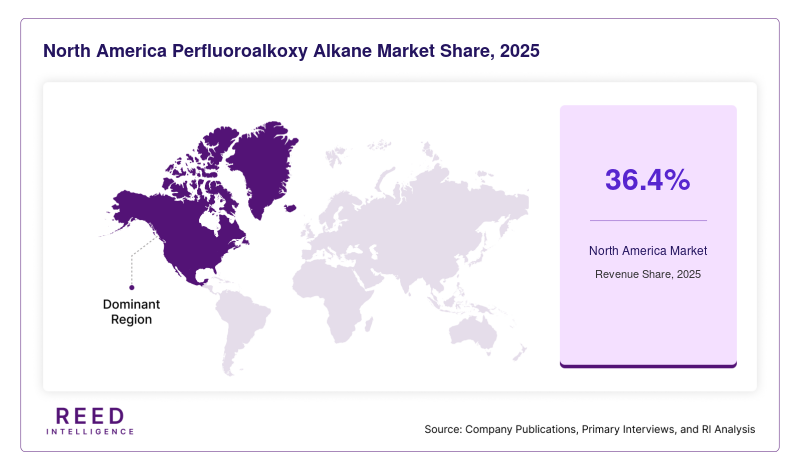
- North America dominated the market with a 36.4% share in 2025.
- Asia Pacific is expected to grow at the fastest CAGR of 9.1% during 2026–2034.
- By type, granular PFA accounted for the largest share of 44.2%, while dispersion-grade PFA is projected to grow at a CAGR of 8.8%.
- By application, semiconductor processing led with a 39.6% share, whereas medical devices are expected to expand at a CAGR of 9.4%.
- The United States remained the dominant country, with market values of USD 520 million in 2024 and USD 570 million in 2025.
Market Trends
Increasing Adoption in Semiconductor Manufacturing
The growing complexity of semiconductor manufacturing processes is driving the adoption of advanced fluoropolymers such as perfluoroalkoxy alkane. Fabrication plants require materials that maintain ultra-high purity and chemical resistance to avoid contamination during wafer processing. PFA is widely used in fluid handling systems, valves, and coatings because it can withstand aggressive acids and solvents without degradation. The trend toward smaller chip geometries and higher processing temperatures further increases reliance on PFA-based components. Additionally, investments in semiconductor manufacturing facilities across Asia Pacific and North America are reinforcing demand for high-performance materials. As manufacturers prioritize yield efficiency and operational stability, PFA continues to gain traction as a preferred material.
Rising Demand for High-Performance Materials in Medical Applications
The healthcare sector is increasingly utilizing perfluoroalkoxy alkane due to its biocompatibility and resistance to sterilization processes. Medical devices, including tubing, catheters, and surgical instruments, benefit from PFA’s non-reactive surface and durability under repeated sterilization cycles. This trend is supported by the expansion of minimally invasive procedures and advanced diagnostic equipment. The ability of PFA to maintain structural integrity under high temperatures and exposure to disinfectants makes it a reliable choice for medical manufacturers. Furthermore, regulatory emphasis on safety and performance standards is encouraging the adoption of premium-grade materials, contributing to steady growth in this segment.
Market Drivers
Expansion of Chemical Processing Industry
The chemical processing industry is a major driver for the perfluoroalkoxy alkane market due to its reliance on corrosion-resistant materials. PFA is widely used in piping systems, linings, and storage containers where exposure to highly reactive chemicals is common. Its ability to resist acids, solvents, and extreme temperatures ensures longer service life and reduced maintenance costs. As global chemical production increases, particularly in emerging economies, the need for durable materials is rising. This growth is also supported by stricter safety regulations that require industries to adopt materials capable of preventing leaks and contamination. Consequently, PFA demand is closely linked to the expansion of chemical manufacturing activities.
Growth in Automotive Electrification
The shift toward electric vehicles is driving demand for advanced materials that can withstand high temperatures and chemical exposure in battery systems. Perfluoroalkoxy alkane is increasingly used in insulation, wiring, and fluid handling components within electric vehicles. Its thermal stability and resistance to degradation make it suitable for battery cooling systems and electronic components. As governments promote cleaner transportation and automakers invest in electrification, the need for high-performance polymers is expanding. This trend is expected to create sustained demand for PFA across the automotive sector, particularly in regions with strong EV adoption rates.
Market Restraint
High Production Costs and Environmental Concerns
The production of perfluoroalkoxy alkane involves complex manufacturing processes and expensive raw materials, leading to higher costs compared to conventional polymers. This cost factor can limit adoption in price-sensitive applications, particularly in developing regions. Additionally, environmental concerns related to fluoropolymer production and disposal are influencing market dynamics. Regulatory bodies are increasingly scrutinizing the environmental impact of fluorinated compounds, which may result in stricter compliance requirements. For example, certain regions have introduced regulations on per- and polyfluoroalkyl substances, affecting the production and use of related materials. These challenges can slow market growth by increasing operational costs and limiting application scope.
Market Opportunities
Emerging Applications in Renewable Energy Systems
The renewable energy sector presents significant opportunities for the perfluoroalkoxy alkane market. Solar panels, hydrogen fuel cells, and energy storage systems require materials that can endure harsh environmental conditions and chemical exposure. PFA’s durability and resistance to UV radiation and temperature fluctuations make it suitable for these applications. As countries invest in renewable energy infrastructure, the demand for reliable materials is increasing. Additionally, the push for energy efficiency and sustainability is encouraging the use of advanced polymers that enhance system performance. This trend is expected to open new growth avenues for PFA manufacturers.
Expansion in Aerospace and Defense Applications
The aerospace and defense sector is another area offering growth potential for perfluoroalkoxy alkane. Aircraft systems require materials that can withstand extreme temperatures, pressure variations, and chemical exposure. PFA is used in fuel systems, wiring insulation, and hydraulic components due to its stability and reliability. Increasing defense budgets and advancements in aerospace technology are driving demand for high-performance materials. Moreover, the need for lightweight and durable components aligns with the properties of PFA. As the industry continues to innovate, the adoption of advanced fluoropolymers is expected to rise.
Segmental Analysis
By Type
Granular PFA emerged as the dominant subsegment, accounting for approximately 44.2% of the market share in 2024. This dominance is attributed to its widespread use in injection molding and extrusion processes. Granular PFA offers excellent processability and mechanical properties, making it suitable for manufacturing complex components. Industries such as semiconductor and chemical processing prefer this form due to its ability to maintain consistency and performance under demanding conditions. The availability of different grades further enhances its applicability across various industries.
Dispersion-grade PFA is expected to be the fastest-growing subsegment, with a projected CAGR of 8.8% during the forecast period. This growth is driven by its increasing use in coating applications, where uniform coverage and chemical resistance are critical. The ability to form thin, protective layers makes it suitable for advanced industrial applications. Additionally, the rising demand for protective coatings in electronics and medical devices supports its growth.
By Application
Semiconductor processing dominated the application segment, holding a 39.6% share in 2024. The need for ultra-pure materials in chip manufacturing drives demand for PFA in this segment. Components such as tubing, valves, and fittings rely on PFA to prevent contamination and ensure process efficiency. The continuous advancement of semiconductor technology further strengthens this segment’s position.
Medical devices represent the fastest-growing application segment, with a CAGR of 9.4%. The increasing adoption of advanced medical equipment and minimally invasive procedures drives demand for PFA. Its biocompatibility and resistance to sterilization processes make it ideal for healthcare applications. This growth is supported by rising healthcare investments globally.
By End-Use Industry
The chemical processing industry accounted for the largest share of 41.3% in 2024. This dominance is driven by the need for corrosion-resistant materials in handling aggressive chemicals. PFA’s durability and reliability make it a preferred choice in this industry. The expansion of chemical manufacturing activities further supports its demand.
The automotive industry is the fastest-growing end-use segment, with a CAGR of 8.5%. The shift toward electric vehicles increases the need for high-performance materials. PFA is used in battery systems and electronic components due to its thermal stability. This trend is expected to drive significant growth in the segment.
Regional Analysis
North America
North America accounted for approximately 36.4% of the global market share in 2025 and is projected to grow at a CAGR of 6.9% during the forecast period. The region benefits from a well-established industrial base, particularly in semiconductor manufacturing and chemical processing. The presence of advanced infrastructure and strong investment in research and development supports the adoption of high-performance materials such as PFA. Additionally, regulatory standards emphasizing safety and environmental compliance encourage the use of durable and reliable polymers.
The United States dominates the regional market, driven by its strong semiconductor industry and technological advancements. One unique growth factor is the increasing investment in domestic chip manufacturing facilities, which require high-purity materials. This trend is supported by government initiatives aimed at reducing reliance on imported semiconductors, further boosting demand for PFA products.
Europe
Europe held a market share of 24.8% in 2025 and is expected to grow at a CAGR of 6.5% during the forecast period. The region’s growth is supported by its strong automotive and chemical industries, which rely on advanced materials for efficiency and safety. Additionally, environmental regulations in Europe encourage the use of durable materials that reduce waste and improve operational efficiency. These factors contribute to steady demand for PFA across various applications.
Germany is the dominant country in the European market, driven by its robust industrial base. A unique growth factor is the country’s focus on sustainable manufacturing practices, which promotes the adoption of high-performance materials. This emphasis on sustainability aligns with the properties of PFA, supporting its increased usage.
Asia Pacific
Asia Pacific accounted for 28.7% of the market share in 2025 and is projected to grow at the fastest CAGR of 9.1% during the forecast period. The region’s growth is driven by rapid industrialization, expanding semiconductor manufacturing, and increasing investments in infrastructure. Countries such as China, Japan, and South Korea are major contributors to market expansion due to their strong electronics industries.
China leads the regional market, supported by its large-scale manufacturing capabilities. A unique growth factor is the government’s focus on technological self-sufficiency, which drives investment in semiconductor production. This initiative significantly increases demand for high-performance materials like PFA.
Middle East & Africa
The Middle East & Africa region held a market share of 5.6% in 2025 and is expected to grow at a CAGR of 6.2% during the forecast period. Growth in this region is driven by the expansion of the oil and gas and chemical processing industries. These sectors require materials that can withstand extreme conditions, making PFA a suitable choice.
Saudi Arabia dominates the regional market due to its strong petrochemical industry. A unique growth factor is the country’s investment in downstream processing facilities, which increases demand for corrosion-resistant materials. This trend supports the adoption of PFA in industrial applications.
Latin America
Latin America accounted for 4.5% of the market share in 2025 and is projected to grow at a CAGR of 6.0% during the forecast period. The region’s growth is supported by increasing industrial activities and infrastructure development. The demand for durable materials in chemical processing and automotive applications contributes to market expansion.
Brazil is the dominant country in this region, driven by its growing industrial sector. A unique growth factor is the expansion of local manufacturing industries, which increases the need for high-performance materials. This trend supports the adoption of PFA across various applications.
Competitive Landscape
The perfluoroalkoxy alkane market is moderately consolidated, with key players focusing on product innovation and capacity expansion. Leading companies invest in research and development to enhance material performance and meet evolving industry requirements. Strategic collaborations and partnerships are also common, enabling companies to expand their market presence and improve supply chain efficiency.
One of the leading players in the market is Chemours, which has maintained a strong position through continuous product innovation and expansion of its fluoropolymer portfolio. A recent development includes the launch of advanced PFA grades designed for semiconductor applications, offering improved purity and performance. Other major companies are also focusing on sustainability initiatives and developing environmentally friendly production processes to align with regulatory requirements.
Key Players
- Chemours Company
- Daikin Industries Ltd.
- Solvay S.A.
- 3M Company
- AGC Inc.
- Dongyue Group Ltd.
- Gujarat Fluorochemicals Ltd.
- HaloPolymer OJSC
- Arkema S.A.
- Shanghai 3F New Materials Co., Ltd.
- Shandong Huaxia Shenzhou New Materials Co., Ltd.
- Zhejiang Juhua Co., Ltd.
- Fluorex Chemical Co., Ltd.
- Sinochem Lantian Co., Ltd.
- Kureha Corporation
Recent Developments
- Chemours introduced a new high-purity PFA grade designed for advanced semiconductor manufacturing applications.
- Daikin Industries expanded its fluoropolymer production capacity in Asia to meet rising regional demand.
- Solvay announced investments in sustainable production technologies aimed at reducing environmental impact in fluoropolymer manufacturing.
Perfluoroalkoxy Alkane Market Segments
Type
- Granular PFA
- Dispersion PFA
Application
- Semiconductor Processing
- Chemical Processing
- Medical Devices
- Electronics
End-Use Industry
- Chemical Industry
- Automotive
- Electronics
- Healthcare
By Region
- North America
- Europe
- APAC
- Middle East and Africa
- LATAM