Perforated And Exp&ed Metal Market Size, Share & Demand Report By Material Type (Stainless Steel, Aluminum, Carbon Steel, Copper, Others), By Application (Construction and Architecture, Industrial Filtration, Safety and Security, Transportation, Industrial Machinery, Others), By End-Use Industry (Commercial Infrastructure, Industrial Manufacturing, Automotive, Energy and Utilities, Renewable Energy, Others) By Region & Segment Forecasts, 2026–2034
USD 3950
Market Overview
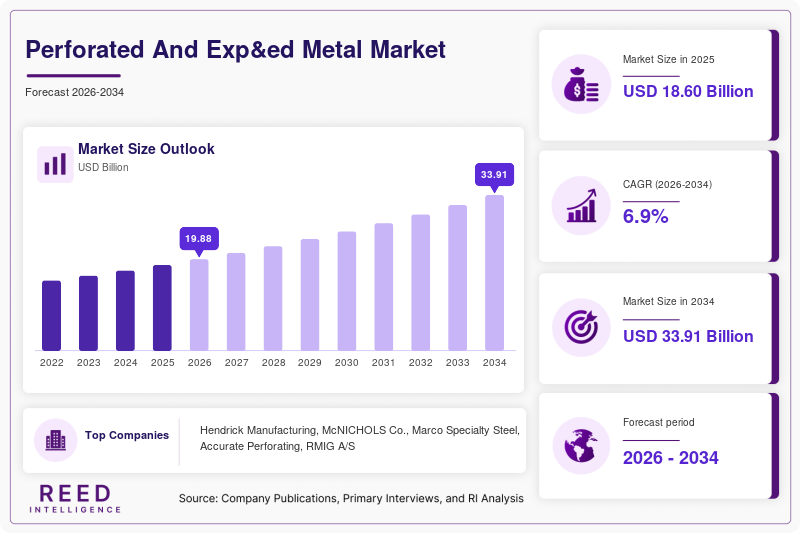
The global Perforated And Exp&ed Metal Market size was valued at USD 18.6 billion in 2026 and is projected to reach USD 31.9 billion by 2034, expanding at a CAGR of 6.9% during the forecast period. The market is experiencing stable growth due to increasing demand for lightweight, durable, and corrosion-resistant metal products across construction, automotive, industrial filtration, infrastructure, and architectural applications. Perforated and expanded metal materials are widely used in facades, fencing systems, ventilation structures, walkways, machine guards, and acoustic panels because of their structural strength and cost efficiency. The growing adoption of energy-efficient building materials and advanced metal fabrication technologies has also contributed to broader market expansion.
One of the major global factors supporting market growth is the rapid increase in commercial and industrial infrastructure development. Governments and private investors are allocating significant capital toward transportation networks, smart buildings, warehouses, and manufacturing facilities. These projects require durable and adaptable metal solutions that can improve ventilation, safety, and structural performance. Perforated and expanded metal products provide design flexibility while reducing overall material consumption, making them suitable for sustainable construction strategies. Increasing investments in urban redevelopment projects and public infrastructure modernization are also strengthening product demand across developed and developing economies.
Key Highlights
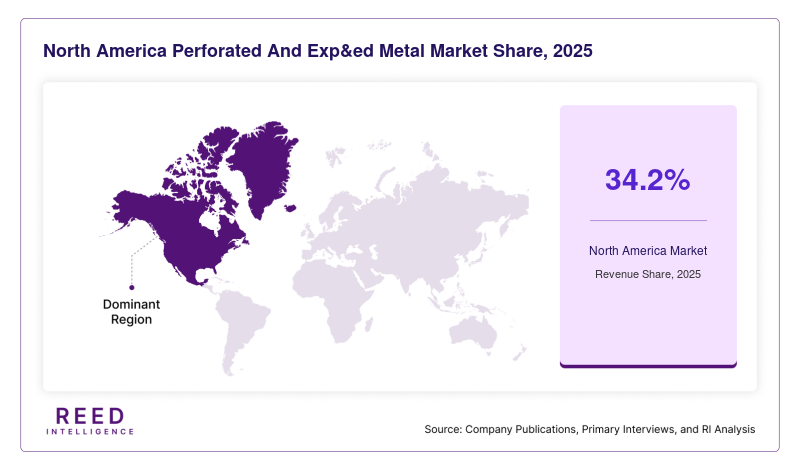
- North America dominated the market with a 34.2% share in 2025, while Asia Pacific is expected to grow at the fastest CAGR of 8.8% during 2026–2034.
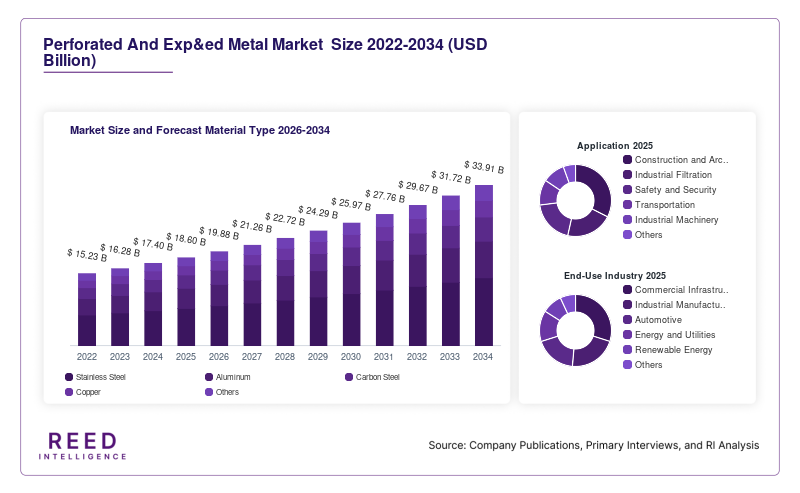
- By material type, stainless steel accounted for the largest share of 39.4%, while aluminum is projected to grow at a CAGR of 9.3%.
- By application, construction and architecture led with a 43.6% share, whereas industrial filtration is expected to expand at a CAGR of 8.9%.
- By end-use industry, commercial infrastructure accounted for the highest share of 37.8%, while renewable energy projects are projected to grow at a CAGR of 9.5%.
- The United States remained the dominant country, with market values of USD 4.8 billion in 2024 and USD 5.2 billion in 2025.
Market Trends
Integration of Decorative Architectural Designs in Commercial Construction
Architectural firms and commercial developers are increasingly integrating perforated and expanded metal products into modern building designs. These materials are being used for decorative facades, sunshades, suspended ceilings, partitions, and acoustic wall systems due to their combination of aesthetic appeal and structural durability. Demand for visually appealing and energy-efficient commercial buildings has encouraged manufacturers to introduce customized hole patterns, textured finishes, and lightweight alloy products. Advanced laser-cutting technologies are also enabling more precise fabrication and design flexibility. Large urban redevelopment projects in North America, Europe, and Asia Pacific are accelerating the use of perforated metal systems in airports, shopping complexes, and mixed-use commercial buildings.
The trend is also supported by the increasing adoption of green building standards and sustainable architecture. Perforated metal panels improve airflow and natural lighting while reducing heat accumulation in buildings. This helps developers lower operational energy costs and improve environmental performance. Architects are using expanded metal structures in exterior cladding systems to enhance ventilation and reduce material usage without compromising strength. Growing investments in smart city projects and urban infrastructure modernization are expected to sustain demand for decorative and functional metal products over the coming years.
Rising Adoption of Lightweight Metals in Transportation and Industrial Equipment
The transportation and industrial manufacturing sectors are increasing the use of lightweight perforated and expanded metal materials to improve operational efficiency and reduce overall equipment weight. Automotive manufacturers are incorporating aluminum-based expanded metal products into vehicle ventilation systems, battery enclosures, safety guards, and filtration applications. The growing production of electric vehicles is further supporting demand for lightweight metals that can contribute to energy efficiency and improved battery performance.
Industrial equipment manufacturers are also replacing heavier traditional components with advanced expanded metal materials to improve durability and simplify maintenance procedures. Improved corrosion resistance and ease of fabrication are making these products suitable for harsh industrial environments, including chemical processing facilities and offshore operations. Technological advancements in metal coating and precision stamping are enabling manufacturers to produce customized solutions for specialized applications. The increasing focus on operational efficiency, sustainability, and product lifespan is expected to continue driving the adoption of lightweight perforated and expanded metal products across multiple industries.
Market Drivers
Expansion of Global Infrastructure and Industrial Construction Activities
The rapid expansion of global infrastructure projects is significantly contributing to the growth of the Perforated And Exp&ed Metal Market. Governments across emerging and developed economies are increasing investments in transportation systems, industrial parks, airports, railways, warehouses, and public facilities. These projects require durable and versatile materials for fencing, walkways, ventilation systems, facades, and structural support applications. Perforated and expanded metal products offer strong load-bearing capacity while maintaining lightweight characteristics, making them suitable for large-scale infrastructure projects.
The increasing construction of manufacturing facilities and logistics centers is also strengthening product demand. Industrial operators prefer perforated metal systems because they improve airflow, safety, and machine protection while reducing maintenance requirements. Infrastructure modernization projects in urban regions are creating continuous demand for customized metal fabrication products. Manufacturers are expanding production capacities and adopting automated processing technologies to address rising order volumes from construction and infrastructure sectors. Growing industrialization in Asia Pacific, Latin America, and the Middle East is expected to sustain long-term market growth.
Increasing Demand for Energy-Efficient and Sustainable Materials
The growing emphasis on sustainability and energy efficiency is encouraging industries to adopt perforated and expanded metal products in various applications. These materials help reduce overall material consumption while maintaining structural strength and durability. Construction companies are increasingly using perforated metal facades and shading systems to improve natural ventilation and reduce building energy consumption. This aligns with global environmental regulations and green building certification standards.
The renewable energy sector is also contributing to market expansion. Solar farms and wind energy projects require corrosion-resistant and lightweight metal components for protective structures, equipment enclosures, and ventilation systems. Expanded metal products are widely used in energy infrastructure because of their durability and ease of installation. Manufacturers are investing in recyclable metals and environmentally friendly coating technologies to strengthen their sustainability profiles. The increasing awareness of environmentally responsible construction practices and industrial operations is expected to support the adoption of perforated and expanded metal products throughout the forecast period.
Market Restraint
Volatility in Raw Material Prices and Supply Chain Disruptions
Fluctuating prices of raw materials such as stainless steel, aluminum, carbon steel, and specialty alloys continue to create challenges for manufacturers operating in the Perforated And Exp&ed Metal Market. Price instability directly impacts production costs, profit margins, and long-term supply agreements. Metal producers are heavily influenced by global mining activities, energy costs, geopolitical tensions, and international trade regulations. Sudden increases in steel or aluminum prices can reduce profitability for manufacturers and force suppliers to revise pricing structures for end users.
Supply chain disruptions also affect the timely availability of raw materials and fabricated products. Delays in transportation, labor shortages, and trade restrictions can interrupt manufacturing schedules and project timelines. Smaller manufacturers are particularly vulnerable because they often have limited supplier networks and lower purchasing power. Construction contractors and industrial buyers may postpone procurement decisions during periods of price uncertainty, which can temporarily reduce market demand. In addition, competition from alternative lightweight materials such as engineered plastics and composite panels may limit market penetration in certain applications where cost reduction is a priority. These factors collectively create operational and financial pressure for market participants.
Market Opportunities
Growth Potential in Renewable Energy Infrastructure Development
The expansion of renewable energy infrastructure presents substantial opportunities for the Perforated And Exp&ed Metal Market. Solar energy installations, wind farms, and energy storage facilities require lightweight and corrosion-resistant metal components for protective barriers, ventilation systems, cable management, and structural support applications. Governments are increasing investments in renewable energy projects to reduce carbon emissions and strengthen energy security, particularly in Asia Pacific, Europe, and North America.
Perforated and expanded metal products are gaining attention because they provide durability, airflow optimization, and low maintenance requirements in demanding environmental conditions. Manufacturers are developing specialized coatings and weather-resistant alloys to improve performance in outdoor renewable energy applications. The rising construction of battery storage facilities and electric vehicle charging infrastructure is also expected to generate additional demand. As renewable energy capacity continues to expand globally, suppliers that focus on customized and sustainable metal solutions are likely to gain long-term growth opportunities.
Expansion of Smart Buildings and Advanced Urban Infrastructure
The increasing development of smart buildings and technologically advanced urban infrastructure is creating new opportunities for perforated and expanded metal manufacturers. Smart commercial complexes, transportation hubs, and public facilities require advanced building materials that can improve ventilation, acoustics, safety, and energy efficiency. Perforated metal systems are widely used in intelligent building designs because they support airflow control, lighting management, and architectural aesthetics.
Urbanization in developing economies is driving demand for modern construction materials that can enhance structural performance while supporting sustainable urban planning objectives. Governments are investing in metro stations, pedestrian bridges, stadiums, and public transportation terminals that incorporate durable metal solutions for safety and decorative applications. The adoption of digital fabrication technologies is enabling manufacturers to produce customized patterns and precision-engineered components for complex urban projects. As smart city initiatives continue to expand worldwide, the demand for advanced perforated and expanded metal products is expected to increase significantly.
Segmental Analysis
By Material Type
Stainless steel accounted for the largest share of the Perforated And Exp&ed Metal Market in 2024, representing 39.4% of total revenue. The dominance of stainless steel is linked to its high durability, corrosion resistance, and suitability for industrial and architectural applications. Construction companies and industrial operators widely use stainless steel perforated and expanded metal products in facades, ventilation systems, walkways, machine guards, and filtration units. The material performs effectively in harsh environmental conditions, making it suitable for chemical processing plants, transportation facilities, and marine applications. Stainless steel products are also preferred in commercial buildings because they provide long operational life with limited maintenance requirements. Increasing demand for aesthetically appealing architectural structures and durable industrial safety systems continues to strengthen the adoption of stainless steel products across multiple industries.
Aluminum is projected to register the fastest CAGR of 9.3% during the forecast period due to rising demand for lightweight and energy-efficient materials. Aluminum-based perforated and expanded metal products are increasingly used in transportation systems, renewable energy projects, and modern architectural applications because of their low weight and corrosion resistance. Electric vehicle manufacturers are adopting aluminum materials to improve energy efficiency and reduce overall vehicle weight. In the construction industry, aluminum panels are widely used in decorative facades and roofing systems due to their flexibility and ease of installation. Manufacturers are also investing in advanced aluminum fabrication technologies to improve product strength and design versatility. The increasing focus on sustainable materials and recyclable metal products is expected to support long-term demand growth for aluminum-based solutions.
By Application
Construction and architecture emerged as the dominant application segment in 2024, accounting for 43.6% of the global market share. Perforated and expanded metal products are extensively used in commercial buildings, transportation hubs, parking structures, stadiums, and public infrastructure projects. Architects prefer these materials because they provide structural strength, airflow management, decorative flexibility, and energy efficiency. Expanded metal products are widely applied in stairways, facades, ceilings, and security barriers due to their durability and low maintenance requirements. Increasing urbanization and infrastructure modernization activities are driving demand for advanced architectural materials across developed and developing economies. Government investments in airports, railway stations, and smart city projects are also contributing to the expansion of the construction and architecture segment.
Industrial filtration is expected to witness the fastest CAGR of 8.9% during the forecast period because of growing demand from manufacturing, chemical processing, water treatment, and energy industries. Perforated metal materials are increasingly used in filtration systems due to their ability to withstand high pressure and corrosive environments. Industries are adopting advanced filtration technologies to improve operational efficiency and comply with stricter environmental regulations. The oil and gas sector is also using perforated metal components in separation systems and processing equipment. Manufacturers are introducing precision-engineered filtration products with improved airflow and durability characteristics to meet specialized industrial requirements. Rising industrial automation and increased investments in wastewater treatment infrastructure are expected to further accelerate growth in this application segment.
By End-Use Industry
Commercial infrastructure represented the largest end-use industry segment in 2024, accounting for 37.8% of the global Perforated And Exp&ed Metal Market. The segment includes office buildings, shopping centers, transportation terminals, warehouses, educational institutions, and healthcare facilities. Perforated and expanded metal products are widely used in these facilities for ceiling systems, partitions, walkways, fencing, ventilation structures, and decorative facades. Rapid urban expansion and increasing investments in commercial real estate development are supporting segment growth. Building owners and developers are adopting advanced metal solutions because they provide long-term durability, low maintenance costs, and improved design flexibility. Increasing focus on energy-efficient commercial buildings and sustainable infrastructure practices is also contributing to higher demand for perforated and expanded metal products in this segment.
Renewable energy projects are anticipated to record the fastest CAGR of 9.5% during the forecast period due to increasing investments in solar power, wind energy, and energy storage infrastructure. Perforated and expanded metal products are being used in equipment enclosures, protective barriers, cable trays, and ventilation systems within renewable energy facilities. Governments are implementing supportive policies and financial incentives to accelerate clean energy adoption, creating new opportunities for manufacturers. Wind farms and solar installations require corrosion-resistant and lightweight materials that can perform effectively in outdoor conditions. Manufacturers are developing specialized coatings and high-performance alloys to meet the durability requirements of renewable energy infrastructure. The rapid global transition toward low-carbon energy systems is expected to create sustained growth opportunities for suppliers operating in this end-use segment.
Regional Analysis
North America
North America accounted for 34.2% of the global Perforated And Exp&ed Metal Market in 2025 and is projected to expand at a CAGR of 6.4% during the forecast period. The region benefits from strong demand across commercial construction, industrial manufacturing, transportation infrastructure, and architectural applications. Investments in warehouse development, data centers, and public infrastructure modernization are supporting the adoption of perforated and expanded metal systems. The growing emphasis on sustainable building materials and energy-efficient infrastructure solutions is also contributing to regional market growth.
The United States remains the dominant country in North America due to its extensive industrial base and large-scale infrastructure investments. Increasing construction of airports, commercial complexes, and manufacturing facilities is generating steady demand for perforated metal facades, walkways, and safety barriers. A unique growth factor in the country is the rapid expansion of data center infrastructure, where perforated metal products are widely used for ventilation systems, cooling equipment enclosures, and protective structures. Rising investments in logistics and e-commerce facilities are also supporting market expansion.
Europe
Europe represented 27.6% of the global market in 2025 and is anticipated to register a CAGR of 6.1% from 2026 to 2034. The region is characterized by strong demand for architectural metal solutions, industrial filtration systems, and transportation infrastructure materials. Strict environmental regulations and sustainability standards are encouraging the adoption of recyclable and energy-efficient construction materials. European manufacturers are also investing in advanced fabrication technologies to improve product quality and production efficiency.
Germany remains the leading country in the European market because of its advanced manufacturing sector and established industrial infrastructure. The country has witnessed increasing demand for perforated and expanded metal products in automotive production facilities, railway projects, and industrial processing plants. A unique growth factor in Germany is the strong integration of automation and precision engineering in metal fabrication processes. This enables manufacturers to produce highly customized products for specialized industrial and architectural applications, strengthening the country’s competitive position in the regional market.
Asia Pacific
Asia Pacific held 24.8% of the global Perforated And Exp&ed Metal Market in 2025 and is projected to grow at the fastest CAGR of 8.8% during the forecast period. Rapid urbanization, industrialization, and infrastructure development are major factors supporting regional growth. Countries across the region are investing heavily in transportation networks, residential construction, industrial parks, and renewable energy infrastructure. Demand for lightweight and durable metal products is increasing in both public and private sector projects.
China dominates the Asia Pacific market due to its large-scale manufacturing capabilities and extensive infrastructure development activities. The country continues to invest in smart cities, industrial facilities, and transportation systems that require perforated and expanded metal products for structural and decorative applications. A unique growth factor in China is the rapid expansion of renewable energy projects, including solar and wind installations. These projects require corrosion-resistant and lightweight metal components for equipment protection and ventilation systems, creating substantial opportunities for manufacturers.
Middle East & Africa
The Middle East & Africa region accounted for 7.1% of the global market in 2025 and is expected to expand at a CAGR of 6.7% through 2034. Market growth is supported by increasing investments in commercial construction, industrial facilities, and tourism infrastructure. Governments across the Gulf countries are focusing on economic diversification projects that include airports, hotels, stadiums, and mixed-use developments. Perforated and expanded metal products are widely used in decorative architectural applications and industrial safety systems.
Saudi Arabia is the dominant country in the region because of its large infrastructure pipeline and industrial expansion initiatives. The country is investing heavily in smart city developments, transportation networks, and renewable energy projects under long-term economic transformation programs. A unique growth factor in Saudi Arabia is the increasing demand for climate-responsive building materials that can improve ventilation and reduce heat accumulation in commercial structures. This has accelerated the use of perforated metal facades and shading systems in modern construction projects.
Latin America
Latin America captured 6.3% of the global Perforated And Exp&ed Metal Market in 2025 and is projected to grow at a CAGR of 5.9% during the forecast period. The region is witnessing moderate growth due to increasing investments in industrial infrastructure, mining operations, and commercial construction activities. Perforated and expanded metal products are widely used in industrial safety applications, filtration systems, and transportation infrastructure projects. Demand is also increasing in agricultural processing facilities and warehouse construction.
Brazil remains the leading country in the Latin American market because of its strong industrial and construction sectors. The country is investing in transportation modernization, industrial manufacturing, and energy infrastructure projects that require durable and lightweight metal solutions. A unique growth factor in Brazil is the expansion of mining and mineral processing activities, where perforated and expanded metal products are used in screening systems, filtration applications, and protective barriers. Rising industrial output and infrastructure upgrades are expected to support long-term market growth.
Competitive Landscape
The Perforated And Exp&ed Metal Market is moderately fragmented, with the presence of global manufacturers and regional fabrication companies competing on product quality, customization capabilities, pricing, and distribution networks. Market participants are focusing on automation, precision fabrication technologies, and sustainable production practices to strengthen their competitive positions. Companies are also expanding their product portfolios to address growing demand from construction, industrial filtration, renewable energy, and transportation industries.
Hendrick Manufacturing remains one of the leading companies in the market because of its broad product portfolio and strong presence across industrial and architectural applications. The company has continued investing in advanced perforation technologies and customized fabrication capabilities to support evolving customer requirements. Other major players are expanding manufacturing facilities, entering strategic partnerships, and increasing investments in corrosion-resistant coatings and lightweight materials.
Recent developments in the industry include the launch of advanced aluminum perforated panels for sustainable construction projects, expansion of automated production lines for precision metal fabrication, and increased adoption of recyclable materials in manufacturing processes. Companies are also strengthening regional distribution networks to improve delivery efficiency and customer service. Competitive intensity is expected to increase further as demand for customized and energy-efficient metal solutions continues to rise.
Key Players
- Hendrick Manufacturing
- McNICHOLS Co.
- Marco Specialty Steel
- Accurate Perforating
- RMIG A/S
- Direct Metals Company
- Niles Expanded Metals
- BOK Modern
- Diamond Manufacturing Company
- Ferguson Perforating
- Ohio Gratings Inc.
- Metart Building Tech
- Anping Enzar Metal Products Co.
- Banker Wire
- Arrow Metal
Recent Developments
- Hendrick Manufacturing expanded its precision perforation facility in North America in 2025 to increase production capacity for architectural metal panels and industrial filtration products.
- RMIG A/S introduced a new range of lightweight aluminum expanded metal products in 2024 designed for sustainable commercial building applications and renewable energy infrastructure.
- McNICHOLS Co. invested in automated metal fabrication technologies in 2025 to improve customization capabilities and reduce production lead times for industrial customers.
- Accurate Perforating launched advanced corrosion-resistant coating solutions in 2024 to enhance the durability of perforated metal products used in offshore and industrial processing environments.
- Locker Group strengthened its Asia Pacific distribution network in 2025 to support growing demand from transportation infrastructure and commercial construction projects.
Perforated And Exp&ed Metal Market Segments
Material Type
- Stainless Steel
- Aluminum
- Carbon Steel
- Copper
- Others
Application
- Construction and Architecture
- Industrial Filtration
- Safety and Security
- Transportation
- Industrial Machinery
- Others
End-Use Industry
- Commercial Infrastructure
- Industrial Manufacturing
- Automotive
- Energy and Utilities
- Renewable Energy
- Others
By Region
- North America
- Europe
- APAC
- Middle East and Africa
- LATAM