Perineal Care Market Size, Share & Demand Report By Product Type (Wipes, Cleansers, Creams & Ointments), By Application (Hospitals, Homecare, Clinics), By End-Use (Long-Term Care Facilities, Hospitals, Home Users) & Segment Forecasts, 2025–2034
USD 3950
Market Overview
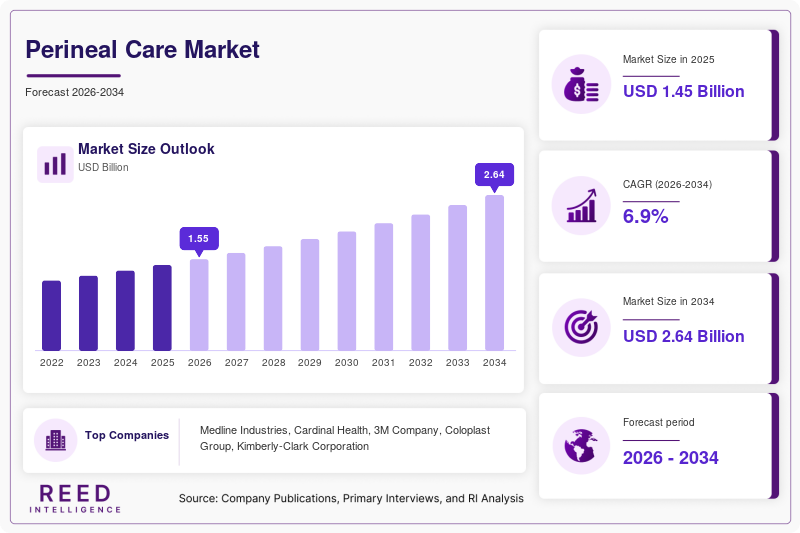
The Perineal Care Market size is estimated at approximately USD 1.45 billion and is projected to reach around USD 1.58 billion in 2026. Over the forecast period from 2025 to 2034, the market is expected to grow at a compound annual growth rate (CAGR) of 6.9%, reaching nearly USD 2.78 billion by 2034. This growth trajectory reflects increasing demand across hospitals, homecare settings, and long-term care facilities.
One of the primary growth factors is the rising prevalence of chronic conditions such as urinary incontinence and mobility impairments, which require consistent perineal hygiene management. The expanding elderly population worldwide is further contributing to demand, as older adults are more susceptible to infections and require specialized hygiene products. Additionally, the growing focus on infection prevention in healthcare settings is boosting the adoption of advanced perineal care products such as no-rinse cleansers, disposable wipes, and antimicrobial solutions.
Key Highlights
- The market size was estimated at USD 1.45 billion in 2025 and is projected to reach USD 2.78 billion by 2034, reflecting steady long-term expansion.
- The market is expected to grow at a CAGR of 6.9% during the forecast period from 2025 to 2034, supported by consistent demand across healthcare settings.
- Increasing demand is driven by the growing aging population and the rising prevalence of chronic conditions such as incontinence and mobility limitations.
- Adoption is rising significantly in home healthcare and long-term care settings due to the need for convenient, easy-to-use hygiene solutions.
Market Trends
Shift Toward Disposable and Pre-moistened Products
The Perineal Care Market is witnessing a shift toward disposable and pre-moistened products due to their convenience, hygiene benefits, and time efficiency. Healthcare providers and caregivers increasingly prefer disposable wipes and washcloths that eliminate the need for water and reduce the risk of cross-contamination. These products are particularly useful in hospital and long-term care settings, where infection control is critical. Manufacturers are focusing on improving product quality by incorporating skin-friendly ingredients, such as aloe vera and vitamin E, to enhance comfort. This trend is also supported by the growing demand for ready-to-use solutions in homecare environments.
Growing Demand for Skin-Friendly and Eco-Conscious Formulations
Consumers are becoming more conscious of product ingredients and environmental impact, leading to increased demand for skin-friendly and eco-conscious perineal care solutions. Products with pH-balanced, hypoallergenic, and alcohol-free formulations are gaining popularity among users with sensitive skin. At the same time, sustainability is influencing purchasing decisions, prompting manufacturers to develop biodegradable wipes and recyclable packaging. Regulatory pressures and environmental awareness campaigns are encouraging companies to adopt greener practices. This trend is expected to reshape product development strategies and enhance brand differentiation in the market.
Market Drivers
Increasing Geriatric Population and Chronic Health Conditions
The rising global geriatric population is a major driver of the Perineal Care Market. Older adults are more likely to experience mobility limitations, incontinence, and other health conditions that require regular hygiene care. As life expectancy increases, the demand for specialized perineal care products is growing across both developed and emerging markets. Healthcare systems are adapting to this demographic shift by investing in long-term care facilities and home healthcare services, which rely heavily on perineal hygiene products. This trend is expected to sustain demand and support market expansion over the forecast period.
Rising Focus on Infection Prevention and Hygiene Standards
Healthcare providers are placing greater emphasis on infection prevention and hygiene standards, which is significantly driving the adoption of perineal care products. Hospital-acquired infections remain a concern, prompting facilities to implement strict hygiene protocols. Perineal care products such as no-rinse cleansers and antimicrobial wipes play a crucial role in maintaining cleanliness and preventing infections. Additionally, increased awareness among caregivers and patients about the importance of hygiene is boosting product usage. This driver is further reinforced by regulatory guidelines that promote safe and effective hygiene practices in healthcare environments.
Market Restraint
High Cost of Advanced Perineal Care Products
The high cost associated with advanced perineal care products is a key restraint affecting market growth. Premium products that offer added benefits such as antimicrobial protection, skin conditioning, and eco-friendly formulations often come at a higher price point. This can limit their adoption, particularly in cost-sensitive regions and smaller healthcare facilities with constrained budgets. For example, long-term care centers in developing countries may opt for traditional cleaning methods instead of investing in disposable or specialized products due to cost concerns.
This restraint also impacts homecare users, where affordability plays a critical role in purchasing decisions. While awareness of hygiene is increasing, consumers may still prefer lower-cost alternatives. Manufacturers face the challenge of balancing product innovation with affordability to expand their customer base. Addressing this issue requires cost-effective production methods and strategic pricing to ensure accessibility without compromising quality.
Market Opportunities
Expansion in Emerging Markets
Emerging markets present significant growth opportunities for the Perineal Care Market due to increasing healthcare investments and rising awareness of hygiene practices. Countries in Asia Pacific, Latin America, and parts of Africa are witnessing improvements in healthcare infrastructure and access to medical services. As disposable income levels rise, consumers are more willing to spend on personal care and hygiene products. Manufacturers can capitalize on this opportunity by introducing affordable product lines tailored to local needs. Strategic partnerships with healthcare providers and distributors can further enhance market penetration in these regions.
Growth of Home Healthcare and E-commerce Channels
The rapid growth of home healthcare services and e-commerce platforms is creating new avenues for market expansion. Patients and caregivers are increasingly opting for home-based care, driving demand for convenient and easy-to-use perineal care products. Online retail channels enable consumers to access a wide range of products, compare options, and make informed purchasing decisions. This shift is encouraging manufacturers to strengthen their digital presence and invest in direct-to-consumer strategies. The convenience of online shopping, combined with targeted marketing, is expected to boost product visibility and sales.
Segmental Analysis
By Product Type
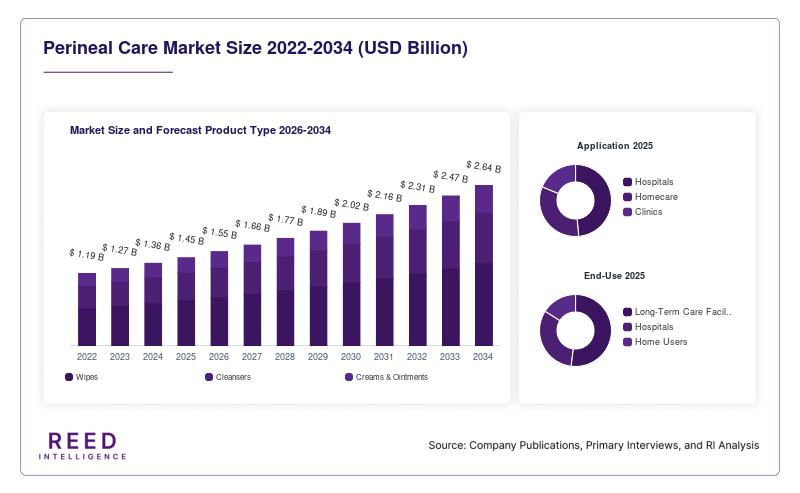
The wipes segment dominated the Perineal Care Market in 2024, accounting for approximately 41% of the total market share. Wipes are widely used due to their convenience, ease of use, and effectiveness in maintaining hygiene. They are particularly popular in healthcare settings where quick and efficient cleaning is essential. Pre-moistened wipes eliminate the need for additional water or cleaning solutions, making them a preferred choice among caregivers. The availability of various formulations, including fragrance-free and hypoallergenic options, further enhances their adoption across different user groups.
The cleansers segment is expected to be the fastest-growing category, with a projected CAGR of 7.5% during the forecast period. The growth is driven by increasing demand for no-rinse and pH-balanced formulations that provide gentle yet effective cleaning. These products are gaining traction in both healthcare and homecare settings due to their ability to reduce skin irritation and improve patient comfort. The focus on skin health and the development of advanced formulations are key factors supporting the growth of this segment.
By Application
Hospitals accounted for the largest share of the market in 2024, contributing approximately 46% of total revenue. The high patient volume and strict hygiene protocols in hospitals drive the demand for perineal care products. These facilities rely on disposable and easy-to-use solutions to maintain cleanliness and prevent infections. The increasing incidence of hospital-acquired infections further emphasizes the importance of effective perineal care, supporting the dominance of this segment.
Homecare is expected to be the fastest-growing application segment, with a CAGR of 7.8% over the forecast period. The shift toward home-based care is driven by rising healthcare costs and patient preference for familiar environments. Caregivers in home settings require convenient and reliable products to ensure proper hygiene. The availability of user-friendly solutions and the growth of online retail channels are contributing to the expansion of this segment.
By End-Use
Long-term care facilities held a significant share of the market in 2024, accounting for approximately 38% of total revenue. These facilities cater to elderly and chronically ill patients who require continuous hygiene care. The consistent need for perineal care products in such settings ensures steady demand. The adoption of disposable products helps maintain hygiene standards and reduces the risk of infections, supporting the growth of this segment.
The home users segment is projected to grow at the fastest rate, with a CAGR of 8.0% during the forecast period. Increasing awareness of personal hygiene and the rise of home healthcare services are key factors driving this growth. Consumers are seeking products that are easy to use, effective, and gentle on the skin. The expansion of e-commerce platforms and direct-to-consumer sales channels is further supporting the growth of this segment.
Regional Analysis
North America
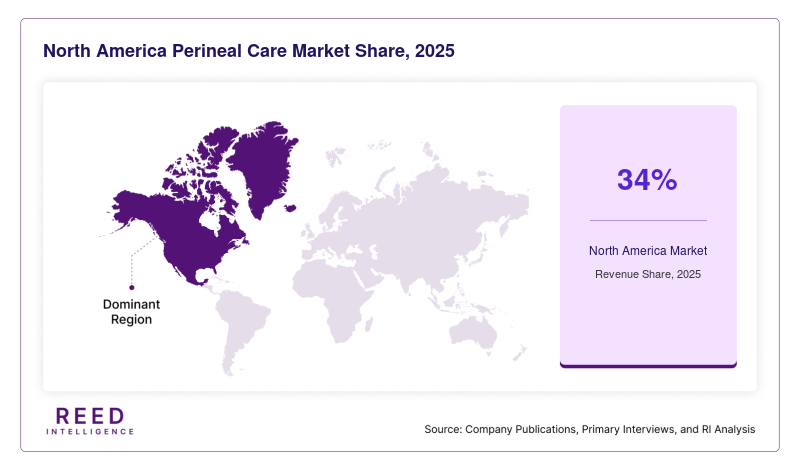
North America accounted for a significant share of the Perineal Care Market in 2025, contributing approximately 34% of global revenue. The region is expected to maintain steady growth with a CAGR of around 6.2% through 2034. The presence of advanced healthcare infrastructure and high awareness levels regarding hygiene practices support market expansion. Additionally, the widespread adoption of disposable hygiene products in hospitals and long-term care facilities drives consistent demand.
The United States dominates the regional market due to its large elderly population and well-established healthcare system. A unique growth factor in this region is the strong emphasis on infection control protocols in healthcare facilities. Hospitals and nursing homes are adopting advanced perineal care solutions to minimize infection risks, which continues to drive product innovation and adoption.
Europe
Europe held approximately 27% of the global market share in 2025 and is projected to grow at a CAGR of 6.5% during the forecast period. The region benefits from strong regulatory frameworks that promote hygiene and patient safety. Increasing healthcare expenditure and the growing elderly population contribute to steady demand for perineal care products.
Germany leads the European market, supported by its robust healthcare infrastructure and high standards of patient care. A unique growth factor is the increasing adoption of eco-friendly and sustainable products. Consumers and healthcare providers in the region are prioritizing environmentally responsible solutions, which is influencing product development and market dynamics.
Asia Pacific
Asia Pacific accounted for around 22% of the market share in 2025 and is expected to register the fastest CAGR of 8.1% through 2034. Rapid urbanization, improving healthcare infrastructure, and rising awareness of hygiene are key factors driving growth in this region. The expanding middle-class population is also contributing to increased demand for personal care products.
China dominates the regional market due to its large population and growing healthcare investments. A unique growth factor is the increasing penetration of e-commerce platforms, which makes perineal care products more accessible to consumers. Online channels are playing a crucial role in expanding product reach and driving sales.
Middle East & Africa
The Middle East & Africa region held a smaller share of approximately 9% in 2025 but is expected to grow at a CAGR of 6.8% over the forecast period. Improvements in healthcare infrastructure and rising awareness of hygiene practices are supporting market growth. Government initiatives aimed at enhancing healthcare services are also contributing to demand.
Saudi Arabia is a key market within the region, driven by increasing healthcare spending and modernization efforts. A unique growth factor is the rising number of healthcare facilities and hospitals, which are adopting advanced hygiene solutions. This trend is expected to boost the adoption of perineal care products in the coming years.
Latin America
Latin America accounted for around 8% of the global market share in 2025 and is projected to grow at a CAGR of 6.6% through 2034. The region is experiencing gradual improvements in healthcare infrastructure and increasing awareness of personal hygiene. These factors are driving steady demand for perineal care products.
Brazil leads the regional market due to its large population and expanding healthcare sector. A unique growth factor is the growing focus on home healthcare services. As more patients opt for home-based care, the demand for convenient and effective perineal care products is increasing, supporting market growth.
Competitive Landscape
The Perineal Care Market is moderately fragmented, with several global and regional players competing to enhance their market presence. Leading companies focus on product innovation, strategic partnerships, and expansion into emerging markets to strengthen their position. The competitive environment is shaped by continuous advancements in product formulations and the introduction of eco-friendly solutions.
One of the leading players in the market is Medline Industries, which has established a strong presence through its extensive product portfolio and distribution network. The company recently introduced a new range of biodegradable wipes designed to meet sustainability goals and improve patient comfort. Other key players are also investing in research and development to create products that address specific consumer needs, such as sensitive skin and infection prevention.
Key Players
- Medline Industries
- Cardinal Health
- 3M Company
- Coloplast Group
- Kimberly-Clark Corporation
- Procter & Gamble
- SCA Hygiene Products
- McKesson Corporation
- Hartmann Group
- Essity AB
- BD (Becton, Dickinson and Company)
- Convatec Group
- Dynarex Corporation
- Medtronic plc
- Cleanis SAS
Recent Developments
- A leading manufacturer launched biodegradable perineal wipes with improved skin-conditioning properties to address sustainability concerns.
- A major healthcare company expanded its distribution network in Asia Pacific to strengthen its presence in emerging markets.
- A new product line featuring alcohol-free and pH-balanced formulations was introduced to cater to sensitive skin needs and enhance patient comfort.
Perineal Care Market Segments
Product Type
- Wipes
- Cleansers
- Creams & Ointments
Application
- Hospitals
- Homecare
- Clinics
End-Use
- Long-Term Care Facilities
- Hospitals
- Home Users
By Region
- North America
- Europe
- APAC
- Middle East and Africa
- LATAM