Personal Care Products Market Size, Share & Demand Report By Product Type (Skincare Products, Haircare Products, Oral Care Products, Cosmetics and Makeup Products, Fragrances, Natural and Organic Personal Care Products), By Distribution Channel (Supermarkets and Hypermarkets, Specialty Stores, Pharmacies and Drug Stores, Online Retail Platforms, Convenience Stores), By End User (Women, Men, Children), By Region & Segment Forecasts, 2026–2034
USD 3950
Market Overview
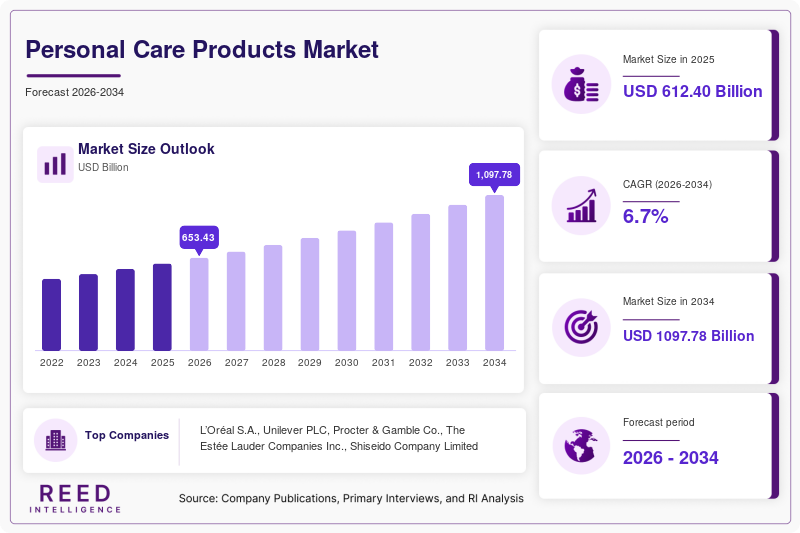
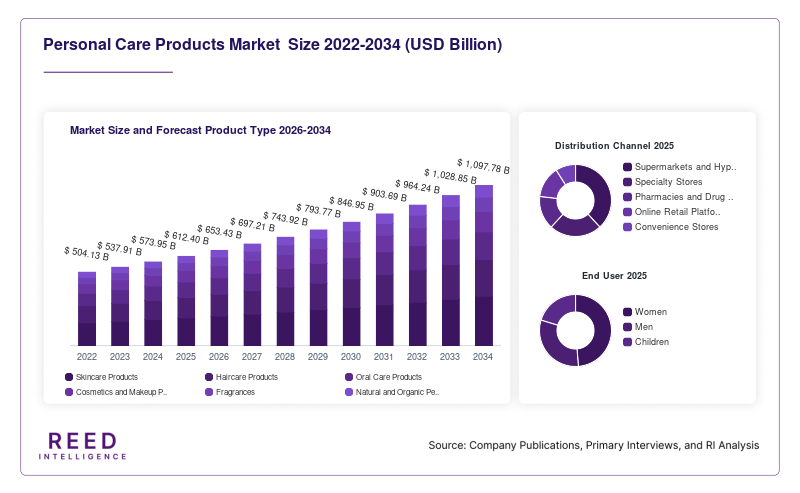
The global Personal Care Products Market size was valued at USD 612.4 billion in 2026 and is projected to reach USD 1,028.7 billion by 2034, expanding at a CAGR of 6.7% during the forecast period from 2026 to 2034. Rising consumer awareness regarding hygiene, skincare, wellness, and premium grooming products continues to support long-term market expansion across developed and emerging economies. Consumers are increasingly shifting toward multifunctional products that combine convenience, sustainability, and ingredient transparency. The growing penetration of digital retail platforms and influencer-driven product marketing has further strengthened product visibility and consumer engagement worldwide.
A major global factor supporting market growth is the increasing demand for clean-label and organic personal care formulations. Consumers are actively seeking products with natural ingredients, reduced chemical content, and environmentally responsible packaging. Manufacturers are investing in plant-based formulations, dermatologically tested products, and sustainable packaging materials to meet changing consumer expectations. In addition, rapid urbanization, rising disposable income, and increasing participation of men in grooming routines are contributing to consistent demand across skincare, haircare, oral care, and cosmetic categories.
Key Highlights
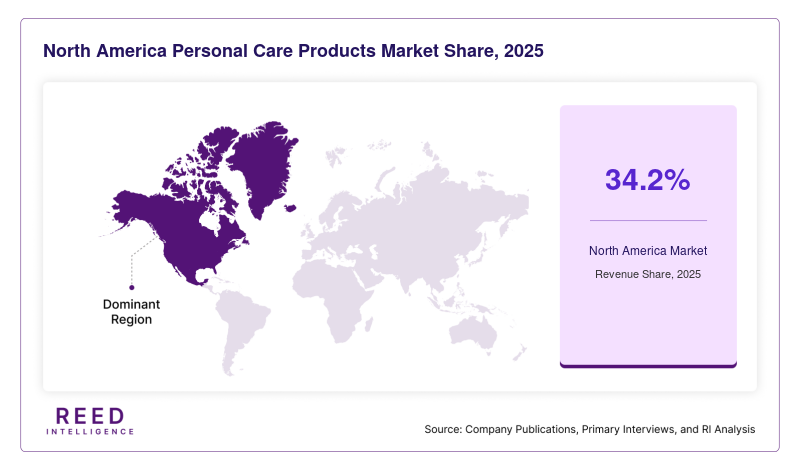
- North America dominated the market with a 34.2% share in 2025, while Asia Pacific is expected to grow at the fastest CAGR of 8.9% during 2026–2034.
- By product type, skincare products accounted for the largest share of 36.8% in 2025, while natural and organic personal care products are projected to grow at a CAGR of 9.8%.
- By distribution channel, supermarkets and hypermarkets led with a 39.4% share, whereas online retail platforms are expected to expand at a CAGR of 10.6%.
- By end user, women represented the largest share of 58.7%, while men’s grooming products are anticipated to grow at a CAGR of 8.7% during the forecast period.
- The United States remained the dominant country, with market values of USD 118.6 billion in 2024 and USD 125.4 billion in 2025.
Market Trends
Growing Preference for Sustainable and Clean Beauty Products
Consumers are increasingly prioritizing sustainability and ingredient transparency while purchasing personal care products. The shift toward clean beauty products with organic, cruelty-free, vegan, and paraben-free formulations is transforming product development strategies across the global market. Manufacturers are focusing on environmentally friendly packaging solutions such as refillable containers, biodegradable materials, and reduced plastic usage to strengthen consumer trust and brand loyalty. Regulatory pressure regarding harmful chemicals in cosmetics and skincare products is also encouraging companies to adopt safer formulations. Younger consumers, particularly millennials and Gen Z buyers, are actively supporting brands that promote sustainability and ethical sourcing practices. This trend is expected to reshape product portfolios and encourage long-term investments in green manufacturing technologies.
Expansion of Digital Commerce and Personalized Beauty Solutions
The increasing use of e-commerce platforms, beauty applications, and social media marketing is significantly influencing the Personal Care Products Market. Online platforms enable consumers to compare ingredients, prices, reviews, and product performance before making purchasing decisions. Brands are leveraging artificial intelligence and skin analysis technologies to provide personalized product recommendations based on skin type, lifestyle, and environmental conditions. Subscription-based skincare kits and virtual beauty consultations are gaining popularity among urban consumers seeking convenience and customized experiences. In addition, beauty influencers and content creators are playing an important role in promoting new product launches and increasing brand engagement. The integration of digital technologies into beauty retail is expected to improve customer retention and strengthen online sales growth globally.
Market Drivers
Rising Consumer Awareness Regarding Personal Hygiene and Wellness
Increasing awareness related to personal hygiene, health, and wellness is a major factor driving demand for personal care products across global markets. Consumers are becoming more conscious about skincare protection, hair health, oral hygiene, and overall grooming routines. The influence of social media campaigns, dermatological education, and wellness-focused lifestyles has encouraged consumers to adopt daily personal care regimens. Demand for products containing vitamins, antioxidants, herbal extracts, and skin-friendly ingredients continues to increase among health-conscious buyers. In addition, rising disposable income in developing countries is enabling consumers to spend more on premium beauty and grooming products. The expansion of wellness culture and self-care routines is expected to support continuous product demand throughout the forecast period.
Increasing Product Innovation and Premiumization Strategies
Continuous product innovation and premiumization strategies are contributing significantly to the growth of the Personal Care Products Market. Manufacturers are introducing multifunctional products with anti-aging, sun protection, hydration, and pollution-defense benefits to attract a broader consumer base. Premium skincare and haircare categories are experiencing higher demand due to consumer preference for clinically tested and high-performance formulations. Companies are also investing in research and development activities to launch personalized and technologically advanced products. The use of biotechnology, probiotic ingredients, and advanced fragrance technologies is improving product differentiation in competitive markets. Furthermore, celebrity-backed product launches and luxury beauty collaborations are strengthening consumer interest in premium personal care categories across global retail channels.
Market Restraint
Regulatory Challenges and Rising Raw Material Costs
The Personal Care Products Market faces significant challenges associated with stringent regulatory standards and fluctuations in raw material prices. Governments and regulatory agencies across several countries have implemented strict guidelines regarding ingredient safety, product labeling, environmental compliance, and packaging standards. Compliance with varying international regulations increases operational complexity and manufacturing costs for global companies. At the same time, rising prices of natural oils, herbal extracts, fragrances, and sustainable packaging materials are creating pressure on profit margins.
Smaller manufacturers often struggle to maintain competitive pricing while meeting quality and sustainability expectations. Delays in ingredient approvals and restrictions on synthetic chemicals can also affect product launches and innovation timelines. For example, several cosmetic brands have reformulated products to comply with updated regulations related to preservatives and artificial fragrances in European markets. These adjustments require additional research investments, supply chain modifications, and testing procedures. Such factors may limit growth opportunities for smaller companies and create barriers for new market entrants during the forecast period.
Market Opportunities
Growing Demand for Men’s Grooming and Gender-Neutral Products
The increasing acceptance of male grooming routines and gender-neutral beauty products presents substantial growth opportunities for manufacturers operating in the Personal Care Products Market. Men are becoming more engaged in skincare, beard care, hair styling, and anti-aging treatments, particularly in urban markets. Brands are expanding product portfolios to include moisturizers, serums, sunscreens, and grooming kits specifically designed for male consumers. In addition, gender-neutral branding strategies are gaining traction among younger demographics seeking inclusive and minimalist beauty solutions. Companies are introducing fragrance-neutral, multifunctional, and universal-use products to appeal to wider consumer groups. The growing influence of social media, celebrity endorsements, and wellness culture is expected to further strengthen demand for inclusive personal care products globally.
Expansion Potential in Emerging Economies and Rural Markets
Emerging economies across Asia Pacific, Latin America, and Africa offer significant untapped opportunities for personal care product manufacturers. Rapid urbanization, improving retail infrastructure, rising internet penetration, and increasing middle-class populations are driving product accessibility in these regions. Consumers in developing economies are gradually shifting from basic hygiene products toward premium skincare, haircare, and cosmetic categories. International brands are expanding regional manufacturing facilities and distribution partnerships to improve market penetration and reduce supply chain costs.
In rural markets, the availability of affordable product packaging and smaller product sizes is supporting consumer adoption. Companies are also leveraging local ingredients and culturally relevant marketing campaigns to strengthen regional brand recognition. Increasing smartphone usage and digital payment adoption are expected to enhance online retail growth in emerging economies. These factors create long-term expansion opportunities for both established brands and new market participants.
Segmental Analysis
By Product Type
Skincare products dominated the Personal Care Products Market and accounted for 36.8% of the global market share in 2024. The dominance of this subsegment is supported by increasing consumer focus on hydration, anti-aging solutions, sun protection, and skin repair treatments. Consumers across all age groups are investing more in serums, moisturizers, face masks, and sunscreen products as skincare routines become more integrated into daily wellness practices. The expansion of dermatology-backed skincare brands and clinically tested formulations is further contributing to market demand. In addition, rising pollution levels and exposure to harsh environmental conditions have increased consumer awareness regarding skin protection. Premium skincare products with multifunctional benefits are particularly gaining popularity among urban consumers in developed and emerging economies.
Natural and organic personal care products are projected to witness the fastest CAGR of 9.8% during the forecast period. Growth in this subsegment is primarily driven by increasing consumer preference for chemical-free formulations containing botanical extracts and naturally sourced ingredients. Consumers are actively avoiding sulfates, parabens, and artificial fragrances due to concerns regarding skin sensitivity and long-term health impacts. Manufacturers are responding by expanding organic product lines across skincare, haircare, oral care, and cosmetic categories. In addition, government regulations promoting ingredient transparency are encouraging brands to adopt cleaner formulations. The increasing popularity of vegan beauty products and sustainable packaging solutions is expected to further strengthen the growth potential of this subsegment globally.
By Distribution Channel
Supermarkets and hypermarkets accounted for the largest share of 39.4% in the Personal Care Products Market in 2024. These retail channels continue to dominate due to broad product availability, promotional discounts, and convenient consumer access. Consumers prefer supermarkets and hypermarkets because they offer multiple brands, product comparisons, and bulk purchasing options under a single retail environment. Established retail chains also provide strong visibility for new product launches and promotional campaigns. In developing economies, expanding organized retail infrastructure is further supporting the dominance of these distribution channels. Additionally, partnerships between personal care brands and retail chains are improving shelf placement strategies and increasing consumer engagement through in-store promotional activities.
Online retail platforms are expected to grow at the fastest CAGR of 10.6% during the forecast period due to rising digital commerce adoption and smartphone penetration. Consumers increasingly prefer online channels because they provide convenience, product variety, personalized recommendations, and access to customer reviews. Beauty brands are investing heavily in direct-to-consumer platforms, mobile applications, and influencer-driven marketing strategies to strengthen digital sales. Subscription-based beauty kits and virtual skincare consultations are also enhancing customer retention across online platforms. The availability of discounts, doorstep delivery, and easy return policies further supports online purchasing behavior. Emerging economies are expected to witness particularly strong online retail growth due to improving digital payment systems and internet connectivity.
By End User
Women represented the dominant end-user segment and held 58.7% of the global Personal Care Products Market share in 2024. Female consumers continue to account for significant spending across skincare, cosmetics, haircare, and fragrance categories. Demand for anti-aging products, premium skincare treatments, and multifunctional beauty solutions remains particularly strong among urban female consumers. Beauty brands are launching targeted products based on skin type, age group, and lifestyle preferences to improve customer engagement. The influence of social media trends, beauty influencers, and celebrity endorsements has also strengthened product adoption among female consumers globally. In addition, increasing participation of women in professional work environments continues to support higher spending on grooming and personal appearance products.
Men’s grooming products are projected to register the fastest CAGR of 8.7% during the forecast period due to changing consumer attitudes toward self-care and appearance management. Men are increasingly purchasing skincare products, beard oils, facial cleansers, hair styling products, and anti-aging solutions as grooming awareness expands globally. Companies are introducing simplified skincare routines, multifunctional products, and masculine branding strategies to attract male consumers. Social media marketing and celebrity influence are playing a critical role in normalizing advanced grooming practices among younger demographics. In addition, rising disposable income and increasing urbanization in emerging markets are encouraging higher spending on premium men’s grooming products.
Regional Analysis
North America
North America accounted for 34.2% of the global Personal Care Products Market share in 2025 and is projected to expand at a CAGR of 5.9% during the forecast period. The region maintains strong market leadership due to high consumer spending on skincare, cosmetics, premium grooming products, and wellness-focused personal care solutions. Consumers across the United States and Canada demonstrate strong demand for dermatologically tested products, anti-aging formulations, and sustainable beauty solutions. Established retail infrastructure, strong digital commerce penetration, and continuous product innovation continue to support regional market expansion.
The United States remained the dominant country within North America due to strong consumer awareness, high disposable income, and advanced beauty retail networks. A unique growth factor supporting the regional market is the rapid adoption of personalized skincare technologies powered by artificial intelligence and skin diagnostic applications. Major beauty brands are investing heavily in direct-to-consumer business models and subscription-based beauty services to improve customer retention. Increasing demand for multifunctional products and clean-label cosmetics is also strengthening market growth across the country.
Europe
Europe represented 27.1% of the global Personal Care Products Market in 2025 and is anticipated to register a CAGR of 5.8% from 2026 to 2034. The regional market benefits from strong demand for premium cosmetics, organic skincare products, and environmentally sustainable beauty solutions. European consumers place significant emphasis on ingredient transparency, ethical sourcing, and product safety standards. Manufacturers across the region are increasingly focusing on eco-friendly packaging and plant-based formulations to align with evolving regulatory requirements and consumer preferences.
Germany emerged as the dominant country in the European market due to its advanced cosmetics manufacturing industry and strong consumer purchasing power. A key growth factor in the country is the rising demand for certified natural and vegan beauty products. Consumers are actively seeking sustainable alternatives with reduced chemical content and recyclable packaging materials. In addition, partnerships between beauty brands and pharmaceutical companies are contributing to the development of science-based skincare products designed for sensitive and aging skin populations.
Asia Pacific
Asia Pacific held 24.8% of the global Personal Care Products Market share in 2025 and is expected to record the fastest CAGR of 8.9% during the forecast period. Rapid urbanization, rising disposable income, and expanding middle-class populations are driving significant product demand across major economies in the region. Consumers are increasingly purchasing skincare, haircare, and cosmetic products influenced by beauty trends, celebrity endorsements, and social media marketing. The rapid growth of e-commerce platforms and mobile shopping applications is also improving product accessibility across urban and semi-urban regions.
China remained the leading country within Asia Pacific due to strong domestic consumption, large-scale manufacturing capabilities, and digital retail expansion. One unique growth factor supporting the Chinese market is the increasing popularity of technologically advanced skincare products integrated with beauty devices and personalized diagnostics. Domestic and international brands are investing in influencer marketing and live-stream commerce strategies to attract younger consumers. In addition, growing consumer interest in premium beauty products and Korean-inspired skincare routines is supporting long-term market expansion.
Middle East & Africa
The Middle East & Africa accounted for 7.2% of the global Personal Care Products Market in 2025 and is projected to grow at a CAGR of 6.4% during the forecast period. Increasing urbanization, rising disposable income, and growing awareness regarding personal grooming practices are contributing to regional market development. Consumers are gradually shifting toward premium fragrances, skincare products, and halal-certified cosmetics. Retail expansion through shopping malls, beauty specialty stores, and online platforms is further improving product availability across several countries in the region.
Saudi Arabia emerged as the dominant country within the Middle East & Africa market due to high spending on luxury beauty products and premium fragrances. A unique growth factor driving market growth is the increasing demand for halal-certified and alcohol-free personal care formulations. Manufacturers are introducing culturally aligned products tailored to regional consumer preferences and climate conditions. In addition, rising participation of women in the workforce and increasing tourism activities are supporting stronger demand for cosmetics and grooming products.
Latin America
Latin America captured 6.7% of the global Personal Care Products Market share in 2025 and is expected to grow at a CAGR of 6.1% between 2026 and 2034. The market is benefiting from increasing awareness regarding skincare routines, hair treatment solutions, and affordable cosmetic products. Consumers across the region are increasingly influenced by beauty trends promoted through social media platforms and digital advertising campaigns. Local and international brands are expanding distribution networks across supermarkets, pharmacies, and online retail channels to improve product accessibility.
Brazil remained the dominant country in the Latin American market due to its large consumer base and strong beauty culture. A major growth factor supporting the country’s market is the rising demand for haircare products designed for diverse hair textures and climate-related conditions. Domestic manufacturers are focusing on botanical ingredients sourced from regional biodiversity to strengthen product differentiation. The growing popularity of affordable premium beauty products and salon-quality formulations is also contributing to sustained market expansion across Brazil.
Competitive Landscape
The global Personal Care Products Market is characterized by intense competition, continuous product innovation, and strong investment in branding and digital marketing strategies. Leading companies are focusing on expanding their product portfolios through natural formulations, sustainable packaging, and premium beauty solutions. Strategic partnerships, mergers, and acquisitions are also being used to strengthen geographic presence and improve consumer reach across emerging markets.
L’Oréal S.A. remained one of the leading companies in the global market due to its extensive product portfolio, strong research capabilities, and global distribution network. The company continues to invest in artificial intelligence-driven beauty technology and personalized skincare solutions. Other major players including Unilever PLC, Procter & Gamble Co., Estée Lauder Companies Inc., and Shiseido Company Limited are expanding product innovation strategies and sustainability initiatives to strengthen market positioning.
Key Players
- L’Oréal S.A.
- Unilever PLC
- Procter & Gamble Co.
- The Estée Lauder Companies Inc.
- Shiseido Company Limited
- Beiersdorf AG
- Johnson & Johnson
- Colgate-Palmolive Company
- Coty Inc.
- Kao Corporation
- Amorepacific Corporation
- Natura & Co.
- Revlon Inc.
- Avon Products Inc.
- Henkel AG & Co. KGaA
Recent Developments
- In February 2026, L’Oréal S.A. launched an AI-powered personalized skincare platform designed to provide customized product recommendations based on skin analysis and environmental conditions.
- In August 2025, Unilever PLC expanded its sustainable beauty product portfolio by introducing refillable packaging solutions across multiple skincare and haircare brands in Europe.
- In November 2025, Procter & Gamble Co. announced a strategic partnership with biotechnology firms to develop plant-based ingredients for premium personal care formulations.
- In April 2026, Shiseido Company Limited introduced advanced anti-aging skincare products featuring probiotic-based formulations targeted at Asian and North American consumers.
- In January 2026, Estée Lauder Companies Inc. strengthened its direct-to-consumer strategy through the expansion of virtual beauty consultations and digital skincare diagnostic services across global online platforms.
Personal Care Products Market Segments
Product Type
- Skincare Products
- Haircare Products
- Oral Care Products
- Cosmetics and Makeup Products
- Fragrances
- Natural and Organic Personal Care Products
Distribution Channel
- Supermarkets and Hypermarkets
- Specialty Stores
- Pharmacies and Drug Stores
- Online Retail Platforms
- Convenience Stores
End User
- Women
- Men
- Children
By Region
- North America
- Europe
- APAC
- Middle East and Africa
- LATAM