Personalized Gifts Market Size, Share & Trends Analysis Report By Product Type (Personalized Home Décor, Personalized Apparel & Accessories, Personalized Jewelry, Personalized Photo Gifts, Personalized Drinkware, Personalized Stationery), By Personalization Type (Names & Monograms, Photos & Images, Custom Text & Messages, Engraving & Embroidery, Custom Designs), By Occasion (Birthdays, Weddings & Anniversaries, Holidays & Festivals, Graduations, Baby & Family Events, Corporate & Other Occasions)
USD 3950
Personalized Gifts Market Size
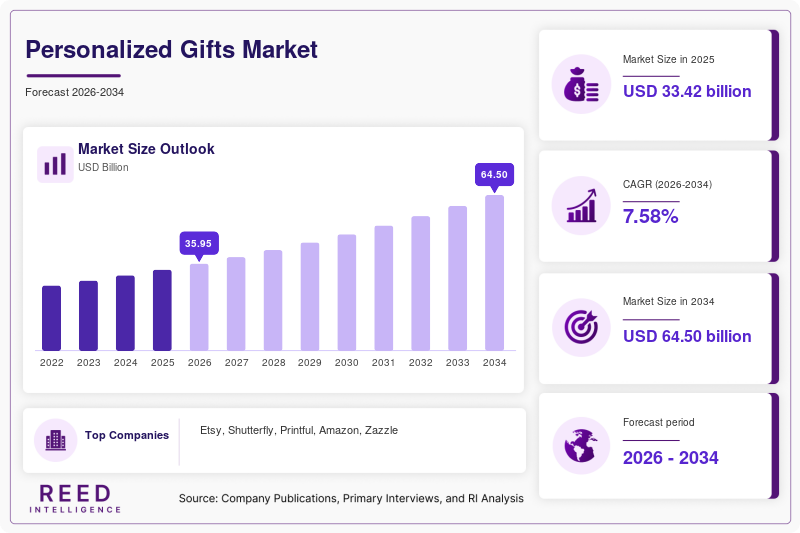
The global personalized gifts market size was valued at USD 33.42 billion in 2025 and is projected to grow from USD 35.95 billion in 2026 to USD 64.50 billion by 2034, registering a CAGR of 7.58% during the forecast period from 2026 to 2034.
The market is benefiting from the combination of gifting occasions and increasingly accessible customization technology. Etsy reported that approximately 30% of its 2025 gross merchandise sales came from custom or made-to-order merchandise, while its buyer research found that 31% of surveyed buyers searched for something custom or personalized during the year.
At the same time, e-commerce is becoming an increasingly important fulfillment channel for customized goods. U.S. retail e-commerce sales reached USD 340.2 billion in Q2 2026, up 12.2% year over year, according to the U.S. Census Bureau.
Personalized gifts have shifted from a niche made-to-order category toward a broad consumer-goods segment spanning home décor, jewelry, apparel, drinkware, photo products, stationery and keepsakes. The underlying commercial proposition is simple: customization increases the perceived uniqueness of an otherwise standardized product.
Etsy provides one of the clearest current market signals. Its 2025 annual report states that custom or made-to-order merchandise represented approximately 30% of marketplace GMS, while gifting, holidays and personal milestones remained important purchase occasions.
Personalized Gifts Market Drivers
Expansion of E-Commerce and Mobile Gift Purchasing
Online commerce is changing how consumers discover, configure and purchase personalized products. The U.S. Census Bureau reported that e-commerce sales reached USD 340.2 billion in the second quarter of 2026, representing 17.1% of total retail sales and a 12.2% year-over-year increase.
Personalized products benefit particularly from digital commerce because consumers need customization tools before purchase. Online stores can let customers upload photographs, enter names, select fonts, choose colors and preview designs without requiring physical inventory in every variation.
Mobile shopping is reinforcing this model. Adobe reported that mobile devices represented 56.4% of U.S. online holiday revenue in 2025, the first holiday season in which mobile accounted for more than half of online spending.
This creates a direct mechanism for personalized-gift sellers: customization can occur on the same device used for product discovery, social sharing and checkout. The ability to produce individual items on demand then reduces the inventory requirement associated with carrying thousands of personalized SKUs.
Gifting and Personal Milestones Create Recurring Purchase Occasions
Personalized gifts are connected to birthdays, weddings, anniversaries, graduations, baby events, holidays, memorials and family milestones. This makes the market less dependent on a single annual shopping period.
Etsy reported that gifting, holidays and personal milestones such as weddings remained important purchase occasions in 2025, while its marketplace continued to emphasize unique and personalized products.
Current product offerings from Shutterfly also demonstrate the breadth of these occasions, with personalized products organized around birthdays, weddings, anniversaries, graduations, baby events and memorials.
The commercial mechanism is repeat purchasing. A consumer may buy a personalized wedding gift in one period, a baby keepsake later and holiday ornaments afterward. This creates multiple demand windows for the same customer rather than relying exclusively on product replacement.
Customization Technology Is Lowering Production Barriers
Digital printing, laser engraving, embroidery, automated design tools and print-on-demand production are making one-off manufacturing commercially practical.
Printful allows customers and merchants to create customized products using uploaded artwork, text and graphics and offers products ranging from apparel to drinkware, phone cases, water bottles, towels and blankets without minimum order quantities.
Amazon's current seller guidance similarly identifies customized T-shirts, mugs, phone cases, engraved jewelry, monogrammed accessories and made-to-order furniture as customized product categories.
The implication is important for the market structure. A merchant can test a personalized product with limited inventory risk, while successful designs can then be scaled through automated production and fulfillment. This expands the number of sellers entering the market and increases product variety.
Personalized Gifts Market Restraints
Higher Production Complexity and Fulfillment Requirements
Personalization adds steps that standard mass-produced goods do not require. Customer information must be collected accurately, designs must be checked, individual products must be produced and orders must be matched correctly with recipients.
This becomes particularly important during high-volume gifting periods. A personalized mug, engraved necklace or photo blanket cannot always be replaced as quickly as a standardized product because the customization makes the product specific to one customer.
The issue can affect delivery performance as well. Consumers often purchase personalized products for a fixed occasion, so a delayed wedding gift, graduation product or Christmas item has a higher perceived cost than a delayed general merchandise purchase.
Platforms therefore need automated proofing, production scheduling and fulfillment systems. Shutterfly's extensive customization workflow and product filters illustrate the operational complexity involved in managing large numbers of personalized product configurations.
Discretionary Spending and Price Sensitivity
Personalized gifts are largely discretionary purchases, making the category sensitive to household budgets and promotional intensity. Etsy reported that its marketplace GMS declined 4% in 2025 to USD 10.5 billion, citing ongoing pressure on consumer discretionary spending and changing buyer behavior.
Consumers can also compare personalized products with inexpensive standardized alternatives. This creates pricing pressure for sellers, particularly for basic mugs, T-shirts, phone cases and printed products where personalization itself may not provide enough differentiation.
The market therefore depends on maintaining perceived value through better designs, materials, craftsmanship, faster delivery, premium packaging and stronger emotional relevance.
Personalized Gifts Market Opportunities
AI-Assisted Product Discovery and Personalization
Generative AI is changing how consumers search for products and how retailers present recommendations. Adobe reported that traffic from generative-AI sources to U.S. retail sites increased 693.4% during the 2025 holiday season compared with the previous holiday period.
For personalized gifts, AI can reduce the effort involved in creating designs. A consumer can potentially move from an idea such as “a birthday gift for a new mother” to a customized design involving names, photographs, colors and messages within a single shopping session.
Etsy has also identified personalized browsing, discovery and buyer experiences as strategic areas in its 2026 product roadmap, alongside AI-driven tools, recommendation models and agentic shopping partnerships.
The commercial opportunity extends from design generation to product recommendations, recipient-based search, automated gift suggestions and customized visual previews.
Expansion Into Everyday and “Just Because” Gifting
Personalization is increasingly moving beyond traditional occasions. Etsy's 2026 trend research identified “little treat” and “just because” purchasing as an opportunity, noting that 39% of surveyed Gen Z consumers celebrated “just because” moments during the previous year.
This creates a larger addressable purchase calendar. Instead of restricting personalization to Christmas, birthdays and weddings, retailers can market personalized drinkware, accessories, stationery, apparel and small home products for everyday appreciation, friendship, hobbies and self-expression.
The commercial mechanism is higher purchase frequency. Lower-priced personalized products can function as spontaneous purchases when customization is quick, affordable and supported by gift-ready packaging.
Segmental Analysis
By Product Type
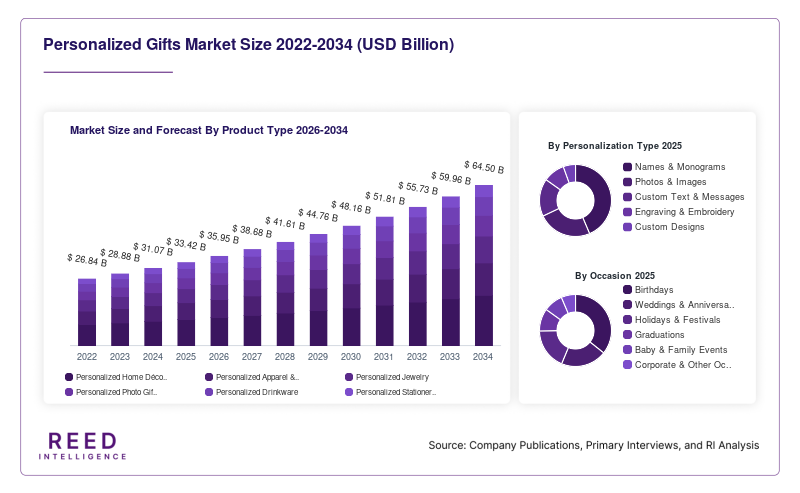
Personalized Home Décor represents approximately 27% of the global market in 2025, making it the dominant product category. Personalized wall art, blankets, frames, signs, ornaments and decorative products have broad gifting applications and can incorporate photographs, names, dates and custom artwork.
Shutterfly's current product range includes personalized blankets, acrylic floating frames, engraved picture frames, ornaments and desk organizers, illustrating the breadth of home-oriented customization.
Personalized Jewelry is the fastest-growing product category, with approximately 9.1% CAGR. Jewelry naturally accommodates names, initials, dates, birthstones, coordinates and other individualized details while supporting relatively high average selling prices.
Current personalized-gift marketplaces show strong representation of customized necklaces, lockets, bracelets and engraved accessories.
By Personalization Type
Names & Monograms account for approximately 31% of the market in 2025, supported by their broad applicability across apparel, jewelry, bags, drinkware, stationery and home products.
Custom Designs are the fastest-growing personalization type at approximately 9.5% CAGR. The category benefits from digital design tools that allow consumers to combine images, artwork, text and stylistic elements rather than simply adding a name.
Printful's current customization platform allows merchants to upload artwork or create designs digitally, while Amazon's customized-product tools support text, images and product configuration.
By Occasion
Birthdays account for approximately 28% of the market in 2025, reflecting the large number of annual birthday-gifting occasions across age groups.
Weddings & Anniversaries are the fastest-growing occasion category, with approximately 8.8% CAGR. These events create strong demand for personalized jewelry, home décor, photo products, keepsakes, wedding-party gifts and engraved products.
Etsy specifically identifies weddings and other personal milestones as important purchase occasions for unique and personalized merchandise.
Baby events and graduations also provide recurring demand because personalization can incorporate names, birth dates, school years, photographs and other milestone information.
By Distribution Channel
Online distribution accounts for approximately 68% of the global market in 2025, reflecting the importance of digital product configuration and direct-to-consumer purchasing.
U.S. e-commerce sales reached USD 340.2 billion in Q2 2026 and represented 17.1% of total retail sales.
Online distribution is also the fastest-growing channel at approximately 8.5% CAGR. Digital platforms allow consumers to preview personalization, upload photos and compare designs without visiting a physical store.
Etsy reported that 45% of its 2025 GMS was transacted through its mobile app, up from 42% in 2024, reinforcing the importance of mobile discovery and checkout for personalized products.
Regional Analysis
North America Personalized Gifts Market
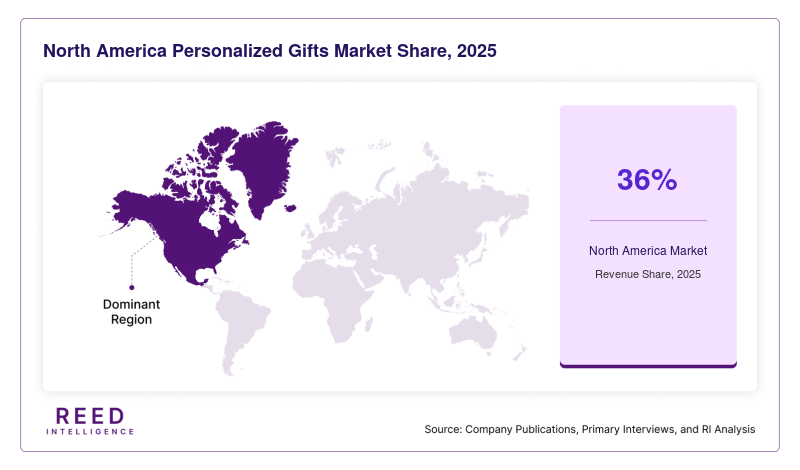
North America accounts for approximately 36% of the global personalized gifts market in 2025, making it the largest regional market. The region benefits from mature e-commerce infrastructure, extensive gifting occasions, strong photo-product businesses and large online marketplaces.
U.S. e-commerce provides a major distribution foundation. The Census Bureau reported USD 340.2 billion in adjusted retail e-commerce sales in Q2 2026, up 12.2% from Q2 2025.
The U.S. holiday season is particularly important. Adobe recorded USD 257.8 billion in online holiday spending during November–December 2025, up 6.8% year over year. Mobile devices generated 56.4% of online holiday revenue.
The region also has strong specialized providers. Shutterfly offers photo books, personalized décor, blankets, drinkware, ornaments and engraved products, while Walgreens Photo provides customized wall décor, stationery and gift products.
North America is projected to grow at approximately 7.0% CAGR. The region's maturity means future expansion will depend increasingly on higher purchase frequency, AI-enabled discovery, premium products and personalized everyday goods rather than basic occasion-only products.
Europe Personalized Gifts Market
Europe represents approximately 29% of the global market in 2025 and is projected to grow at approximately 7.2% CAGR. The region has a strong culture of gifting around Christmas, birthdays, weddings, anniversaries and family events, while cross-border e-commerce enables personalized-gift sellers to reach consumers across multiple countries.
Etsy's marketplace provides a useful indicator of the region's interest in customized goods. The company's global marketplace focuses heavily on unique, custom and made-to-order products, while its 2026 trend research identifies personalization and products that feel individually made as important consumer themes.
European consumers also have substantial access to local customization businesses specializing in engraved jewelry, personalized home décor, apparel, wedding products and stationery.
Europe's growth mechanism is the combination of mature online gifting, personalized wedding and family products, and expansion of cross-border marketplace commerce. Privacy requirements and differences in language, currency and delivery expectations create operational complexity for cross-border sellers.
APAC Personalized Gifts Market
APAC represents approximately 23% of the global market in 2025 and is the fastest-growing region, with approximately 9.2% CAGR. The region combines large populations, increasing digital commerce adoption, mobile-first purchasing and expanding middle-income consumer groups.
India, China, Japan, South Korea and Australia are important markets, although gifting traditions differ significantly. Personalization can be integrated into culturally specific occasions such as weddings, festivals, birthdays and family celebrations.
Mobile commerce is particularly important. Etsy reported that 45% of its 2025 marketplace GMS was generated through its mobile app, demonstrating how personalized product discovery and purchasing increasingly occur through smartphones.
Local digital marketplaces and print-on-demand businesses also make customization more accessible to smaller sellers. Products such as personalized apparel, mugs, photo gifts, jewelry and home décor can be produced locally, reducing delivery times.
APAC's faster growth is driven by digital commerce expansion, mobile shopping, increasing premium consumption and the incorporation of personalization into culturally important gifting occasions.
Middle East and Africa Personalized Gifts Market
Middle East and Africa account for approximately 5% of the global market in 2025 and are projected to grow at approximately 8.0% CAGR. Demand is concentrated in Gulf markets and major African urban centers where premium retail, e-commerce and occasion-based gifting are developing.
Personalized jewelry, luxury accessories, wedding products, home décor and corporate gifts are particularly relevant. The region's extensive wedding and family-event culture creates multiple opportunities for customized products.
E-commerce expansion also improves access to specialized products that may not be available through local physical retailers. Online customization allows consumers to order personalized products from international and regional suppliers.
The main constraints are differences in logistics infrastructure, cross-border delivery costs and purchasing power across countries. The market is therefore concentrated in higher-income urban centers and digitally connected consumers.
LATAM Personalized Gifts Market
LATAM represents approximately 7% of the global market in 2025 and is projected to grow at approximately 8.1% CAGR. The region's demand is supported by strong family-oriented gifting occasions, celebrations and increasing e-commerce penetration.
Personalized apparel, jewelry, drinkware, photo gifts and home décor are suitable for birthdays, weddings, anniversaries and family celebrations. Local production is also commercially attractive because customized goods can be produced in smaller quantities without the need for large inventories.
Digital marketplaces and social commerce provide smaller personalized-gift businesses with access to consumers beyond their immediate geographic areas.
LATAM is expected to expand faster than the mature North American market, but uneven purchasing power, currency volatility and logistics infrastructure remain constraints. Faster adoption of mobile commerce and localized digital payment systems can improve the addressable customer base.
Competitive Landscape
The personalized gifts market is highly fragmented, with competition among specialized photo-product companies, online marketplaces, print-on-demand platforms, jewelry companies, specialty retailers and independent makers.
Etsy is a major marketplace for personalized products. Its 2025 annual report states that custom or made-to-order merchandise represented approximately 30% of marketplace GMS, while the company continues investing in personalized browsing, recommendations, AI-driven discovery and agentic shopping capabilities.
Shutterfly competes through a broad vertically integrated photo-personalization model. Its current catalog includes hundreds of personalized products spanning photo books, blankets, mugs, frames, ornaments, lockets, desk organizers and other gift formats.
Printful competes through print-on-demand infrastructure, allowing merchants to sell customized apparel, accessories, drinkware and home products without maintaining inventory.
Amazon provides customized-product infrastructure that allows sellers to offer text, image and product-option personalization, giving independent merchants access to a large general-commerce marketplace.
Key Market Players
- Etsy
- Shutterfly
- Printful
- Amazon
- Zazzle
- Walgreens Photo
- Personalization Mall
- Vistaprint
- Snapfish
- Minted
- Moonpig
- Papier
- Things Remembered
- Giftagram
- Redbubble
- CafePress
- Uncommon Goods
- VistaCreate / VistaPrint
- Contrado
- The Bouqs Company
Recent Market Developments
- March 2026 – Etsy: Etsy's Spring/Summer 2026 Trend Edit emphasized products that feel personal, handmade and individualized, with sellers using personalization to differentiate products from mass-market merchandise.
- August 2026 – U.S. Census Bureau: U.S. retail e-commerce sales reached USD 340.2 billion in Q2 2026, up 12.2% year over year and accounting for 17.1% of total retail sales.
Personalized Gifts Market Segments
By Product Type
- Personalized Home Décor
- Personalized Apparel & Accessories
- Personalized Jewelry
- Personalized Photo Gifts
- Personalized Drinkware
- Personalized Stationery & Other Gifts
By Personalization Type
- Names & Monograms
- Photos & Images
- Custom Text & Messages
- Engraving & Embroidery
- Custom Designs
By Occasion
- Birthdays
- Weddings & Anniversaries
- Holidays & Festivals
- Graduations
- Baby & Family Events
- Corporate & Other Occasions
By Distribution Channel
- Online
- Offline
By Region
- North America
- Europe
- APAC
- Middle East and Africa
- LATAM