Pervious Concrete Installation Market Size, Share & Demand Report By Material Type (Cement-Based Pervious Concrete, Polymer-Modified Pervious Concrete), By Application (Parking Lots, Sidewalks, Pedestrian Walkways, Low-Volume Roads, Patios), By End-Use (Municipal Infrastructure, Commercial Construction, Residential Construction), By Installation Method (Cast-in-Place Installations, Precast Pervious Concrete Systems), By Region & Segment Forecasts, 2026–2034
USD 3950
Market Overview
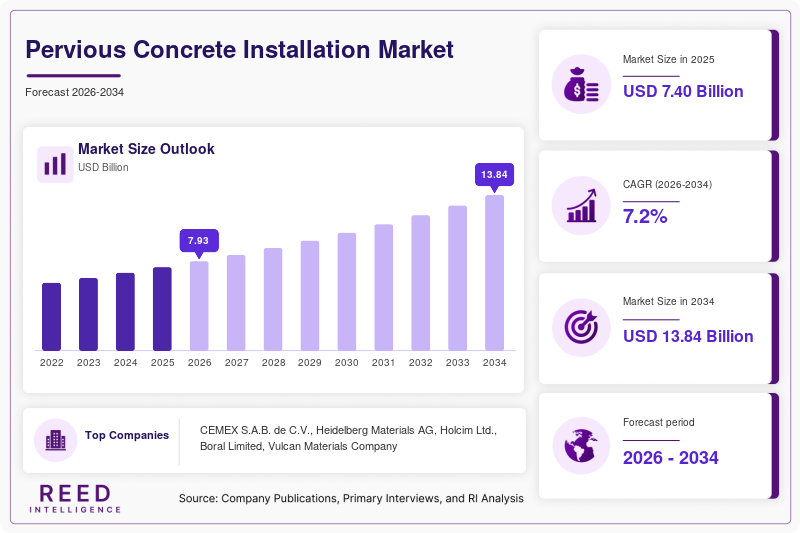
The Pervious Concrete Installation Market size was valued at USD 7.4 billion in 2026 and is projected to reach USD 12.9 billion by 2034, expanding at a CAGR of 7.2% during the forecast period of 2026–2034. The global Pervious Concrete Installation Market growth was supported by the increasing global focus on sustainable urban infrastructure and advanced stormwater management systems. Governments and municipal authorities across developed and developing economies continued to adopt eco-friendly pavement materials to reduce surface runoff, improve groundwater recharge, and comply with environmental regulations. The rising integration of green building standards in commercial and public infrastructure projects further accelerated the demand for pervious concrete installation services across residential, industrial, and transportation applications.
The growing frequency of urban flooding and drainage overload issues significantly influenced the expansion of the Pervious Concrete Installation Market. Construction companies increasingly adopted permeable pavement systems for parking lots, sidewalks, low-traffic roads, pedestrian areas, and recreational infrastructure. In addition, smart city development initiatives and sustainable landscaping programs created favorable opportunities for long-term market growth. The increasing use of recycled aggregates and advanced admixture technologies also enhanced durability and water permeability, improving the adoption rate among contractors and infrastructure planners.
Key Highlights
- North America dominated the Pervious Concrete Installation Market with 36.8% share in 2025, while Asia Pacific is projected to register the fastest CAGR of 8.4% during 2026–2034.
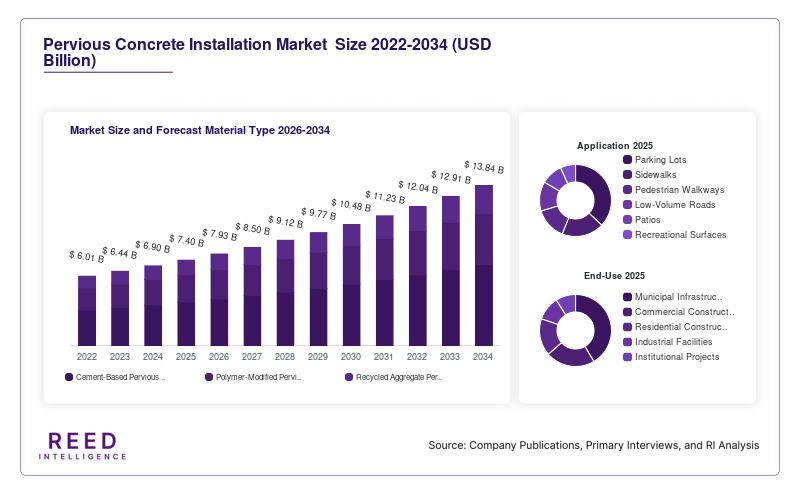
- By application, parking lots accounted for the largest market share of 31.6% in 2025, while pedestrian walkways are anticipated to witness the fastest CAGR of 8.8% during the forecast period.
- By end-use, municipal infrastructure held the dominant share of 34.2% in 2025, whereas commercial construction is forecast to grow at a CAGR of 8.1% through 2034.
- By material type, cement-based pervious concrete remained the leading segment with 61.4% share in 2025, while polymer-modified pervious concrete is expected to grow at a CAGR of 8.6%.
- The U.S. Pervious Concrete Installation Market was valued at USD 1.86 billion in 2024 and reached USD 2.01 billion in 2025.
Market Trends
Adoption of Sustainable Stormwater Infrastructure
One of the major trends shaping the Pervious Concrete Installation Market is the increasing adoption of sustainable stormwater management systems in urban construction projects. Municipal authorities and environmental agencies are implementing permeable pavement standards to reduce water runoff and improve groundwater recharge efficiency. Pervious concrete installations are increasingly replacing conventional asphalt and impermeable surfaces in public infrastructure projects such as parking areas, parks, and low-volume roadways. This trend has gained momentum due to rising climate concerns and stricter urban drainage regulations across developed economies.
Construction firms are also integrating advanced filtration and water retention technologies with pervious concrete systems. This combination improves pollutant filtration and supports sustainable urban water management. The trend is particularly visible in commercial real estate developments where environmental certifications and green infrastructure compliance have become critical project requirements.
Integration of Recycled Materials in Concrete Mixes
The increasing incorporation of recycled aggregates and eco-friendly additives in pervious concrete production is another major trend influencing the market. Contractors and manufacturers are using recycled concrete materials, industrial byproducts, and supplementary cementitious materials to improve sustainability and reduce production costs. This trend supports circular economy objectives while helping reduce the carbon footprint associated with construction activities.
Advanced admixture technologies are also improving structural performance, freeze-thaw resistance, and durability of pervious concrete installations. As infrastructure developers seek cost-efficient and sustainable alternatives, recycled material integration is expected to become increasingly important in future construction projects.
Market Drivers
Rising Investments in Green Infrastructure Projects
Increasing investments in green infrastructure development are driving the growth of the Pervious Concrete Installation Market. Governments across major economies are allocating significant funding toward sustainable transportation systems, eco-friendly public spaces, and water-sensitive urban infrastructure. Pervious concrete installations help manage stormwater naturally while reducing dependency on expensive drainage systems. This advantage has increased adoption in municipal projects, airports, educational institutions, and commercial complexes.
Urban planners are increasingly incorporating permeable surfaces into smart city projects to improve environmental performance and climate resilience. The long-term cost benefits associated with reduced drainage maintenance and flood mitigation continue to support market expansion.
Expansion of Commercial and Public Construction Activities
The continuous expansion of commercial buildings, recreational facilities, and transportation infrastructure is another important driver supporting market growth. Shopping centers, office complexes, sports facilities, and public parking zones increasingly require sustainable pavement solutions that comply with environmental standards. Pervious concrete systems provide effective water infiltration while maintaining structural integrity in low-traffic applications.
The growing development of public walkways, green campuses, and urban redevelopment projects further accelerated installation demand. Infrastructure modernization in emerging economies also contributed significantly to the expansion of the Pervious Concrete Installation Market.
Market Restraint
High Installation and Maintenance Complexity
One of the major restraints affecting the Pervious Concrete Installation Market is the complexity associated with installation and long-term maintenance. Pervious concrete requires specialized placement techniques, controlled curing conditions, and experienced labor to achieve proper permeability and structural performance. Inadequate installation practices may reduce water infiltration capacity and lead to surface clogging over time.
In addition, regular maintenance such as vacuum cleaning and sediment removal is necessary to maintain functionality. These operational challenges may limit adoption among small-scale contractors and budget-sensitive construction projects.
Market Opportunities
Growth of Smart City Development Programs
The increasing expansion of smart city initiatives presents substantial opportunities for the Pervious Concrete Installation Market. Urban development authorities are prioritizing sustainable transportation networks and climate-adaptive infrastructure solutions. Pervious concrete systems align with these objectives by supporting efficient stormwater management and environmentally responsible urban planning.
Emerging economies in Asia Pacific and the Middle East are investing heavily in integrated smart infrastructure, creating long-term opportunities for installation contractors and material suppliers.
Rising Demand for Sustainable Residential Landscaping
The growing popularity of sustainable landscaping and eco-conscious residential construction is creating additional market opportunities. Residential developers are increasingly using permeable driveways, garden pathways, and outdoor recreational surfaces to improve water management and reduce environmental impact.
The increasing consumer preference for green homes and environmentally sustainable communities is expected to support demand for decorative and functional pervious concrete installations in residential applications.
Segmental Analysis
By Material Type
Based on material type, the Pervious Concrete Installation Market is segmented into cement-based pervious concrete, polymer-modified pervious concrete, and recycled aggregate pervious concrete.
Cement-based pervious concrete dominated the market with 61.4% share in 2025 due to its cost efficiency, structural reliability, and widespread adoption in municipal infrastructure projects. Contractors preferred this material for parking areas, sidewalks, and public pavements because of its easy availability and established performance characteristics.
Polymer-modified pervious concrete is projected to witness the fastest CAGR of 8.6% during the forecast period. The increasing need for enhanced durability, improved freeze-thaw resistance, and higher load-bearing capacity will support segment growth. Commercial infrastructure projects requiring long operational life are expected to increase adoption of advanced polymer-modified systems.
By Application
Based on application, the market is categorized into parking lots, sidewalks, pedestrian walkways, low-volume roads, patios, and recreational surfaces.
Parking lots accounted for the largest market share of 31.6% in 2025 due to growing implementation of stormwater management standards in commercial infrastructure developments. Shopping centers, office buildings, and institutional facilities increasingly adopted permeable parking systems to reduce drainage costs and improve environmental compliance.
Pedestrian walkways are anticipated to grow at the fastest CAGR of 8.8% during 2026–2034. Urban beautification projects and sustainable landscape development initiatives are expected to accelerate segment growth. Increasing investments in parks, public spaces, and residential landscaping will support demand.
By End-Use
Based on end-use, the market includes municipal infrastructure, commercial construction, residential construction, industrial facilities, and institutional projects.
Municipal infrastructure held the dominant share of 34.2% in 2025 due to increasing government investments in sustainable transportation systems and public drainage management projects. Urban authorities widely adopted permeable pavement technologies to improve flood control and groundwater recharge.
Commercial construction is forecast to register the fastest CAGR of 8.1% during the forecast period. Rising development of green office buildings, retail complexes, and mixed-use urban projects will support segment growth. Environmental certification requirements are expected to increase installation activities in commercial developments.
By Installation Method
Based on installation method, the market is segmented into cast-in-place installations and precast pervious concrete systems.
Cast-in-place installations dominated the market in 2025 with 68.5% share due to their flexibility in customized infrastructure projects and large-scale pavement applications. Contractors preferred this installation method for municipal and transportation projects requiring on-site adaptability.
Precast pervious concrete systems are expected to witness significant growth during the forecast period with a CAGR of 7.9%. Faster installation time, lower labor dependency, and improved quality consistency will drive adoption in commercial and residential developments.
Regional Analysis
North America
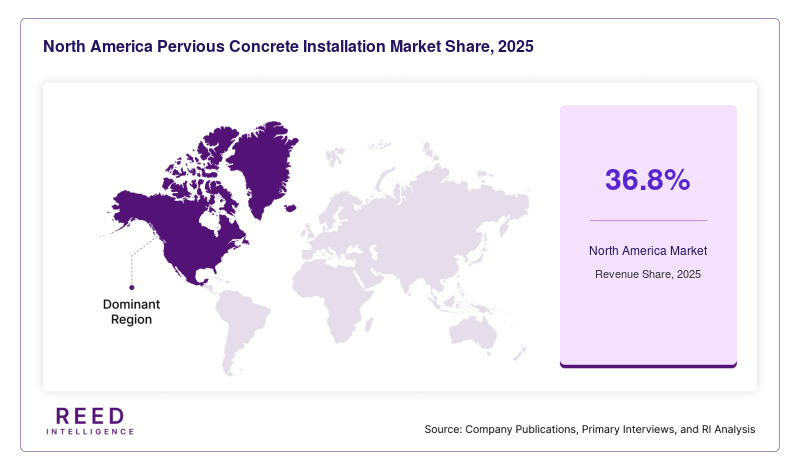
North America accounted for 36.8% of the Pervious Concrete Installation Market share in 2025 and is expected to grow at a CAGR of 6.9% during 2026–2034. The region maintained strong market demand due to established green building regulations and extensive investments in sustainable urban infrastructure. Municipal authorities across the U.S. and Canada increasingly adopted permeable pavement systems to reduce urban flooding and improve drainage efficiency.
The U.S. remained the dominant country in the region due to increasing investments in transportation modernization and environmental infrastructure improvement. The growing implementation of stormwater management mandates significantly supported installation demand across municipal and commercial projects.
Europe
Europe held 27.4% of the global Pervious Concrete Installation Market share in 2025 and is projected to expand at a CAGR of 6.7% during the forecast period. The region experienced strong demand due to strict environmental regulations and increasing adoption of sustainable construction materials. European countries continued to invest in low-impact urban drainage systems and eco-friendly transportation infrastructure.
Germany dominated the regional market owing to its focus on sustainable urban planning and climate-resilient infrastructure development. The growing use of permeable pavement systems in public infrastructure and smart city projects contributed to regional market growth.
Asia Pacific
Asia Pacific represented 23.1% of the global market share in 2025 and is anticipated to witness the fastest CAGR of 8.4% during 2026–2034. Rapid urbanization, infrastructure development, and increasing environmental awareness supported strong regional growth. Governments across China, India, Japan, and Southeast Asia increased investments in modern drainage infrastructure and sustainable construction technologies.
China emerged as the leading country in the region due to extensive smart city projects and large-scale urban redevelopment activities. The expansion of commercial infrastructure and public transportation networks created strong demand for permeable concrete installations.
Middle East & Africa
The Middle East & Africa accounted for 6.5% of the Pervious Concrete Installation Market share in 2025 and is forecast to grow at a CAGR of 6.1% through 2034. The region witnessed increasing adoption of sustainable infrastructure solutions in commercial construction and tourism-related projects. Governments continued investing in environmentally sustainable urban developments to improve water conservation and drainage management.
The United Arab Emirates led the regional market due to the growing construction of smart urban communities and environmentally sustainable commercial projects. The integration of advanced landscaping infrastructure supported regional demand.
Latin America
Latin America captured 6.2% of the global market share in 2025 and is expected to expand at a CAGR of 6.3% during the forecast period. Increasing investments in urban infrastructure and flood mitigation programs supported regional growth. Governments across the region adopted sustainable construction practices to improve environmental resilience and public infrastructure performance.
Brazil remained the dominant country in Latin America owing to rising urban redevelopment activities and increasing demand for eco-friendly public infrastructure solutions. Municipal investments in drainage improvement projects further contributed to market growth.
Competitive Landscape
The Pervious Concrete Installation Market remains moderately fragmented with the presence of global construction material suppliers, infrastructure contractors, and specialized pavement solution providers. Market participants are focusing on sustainable product innovation, strategic partnerships, and regional expansion to strengthen their competitive position.
CEMEX S.A.B. de C.V. remained a leading player in the market due to its extensive sustainable construction portfolio and strong global infrastructure presence. The company recently expanded its permeable concrete solutions for urban drainage and green infrastructure applications.
LafargeHolcim continued focusing on low-carbon construction materials and sustainable pavement technologies. Heidelberg Materials increased investments in environmentally sustainable concrete production and drainage infrastructure projects. Boral Limited strengthened its regional installation network for commercial permeable pavement systems. Vulcan Materials Company focused on recycled aggregate integration and advanced permeable concrete solutions.
Key Players List
- CEMEX S.A.B. de C.V.
- Heidelberg Materials AG
- Holcim Ltd.
- Boral Limited
- Vulcan Materials Company
- CRH plc
- Sika AG
- BASF SE
- Chaney Enterprises
- Cemstone Products Company
- Lafarge Canada Inc.
- Tarmac Holdings Limited
- U.S. Concrete Inc.
- Aggregate Industries
- Breedon Group plc
Recent Developments
- In 2025, Holcim Ltd. introduced an advanced permeable pavement solution designed for commercial drainage improvement projects.
- In 2024, Heidelberg Materials expanded its sustainable concrete manufacturing facilities in Europe to support rising infrastructure demand.
- In 2025, CEMEX launched a new eco-friendly pervious concrete product line focused on urban flood management applications.
- In 2024, Boral Limited partnered with municipal contractors for sustainable transportation infrastructure projects in Australia.
- In 2025, Sika AG introduced advanced admixture technologies to improve permeability and durability in pervious concrete installations.
Pervious Concrete Installation Market Segments
Material Type
- Cement-Based Pervious Concrete
- Polymer-Modified Pervious Concrete
- Recycled Aggregate Pervious Concrete
Application
- Parking Lots
- Sidewalks
- Pedestrian Walkways
- Low-Volume Roads
- Patios
- Recreational Surfaces
End-Use
- Municipal Infrastructure
- Commercial Construction
- Residential Construction
- Industrial Facilities
- Institutional Projects
Installation Method
- Cast-in-Place Installations
- Precast Pervious Concrete Systems
Distribution Channel
- Direct Contractors
- Infrastructure Development Firms
- Construction Material Distributors
- Government Procurement Contracts
By Region
- North America
- Europe
- APAC
- Middle East and Africa
- LATAM