Pervious Concrete Paver Market Size, Share & Demand Report By Type (Interlocking Pervious Concrete Pavers, Grid Pavers), By Application (Commercial Infrastructure, Residential Landscaping), By End-Use (Construction Sector, Municipal Projects), By Region & Segment Forecasts, 2026–2034
USD 3950
Market Overview
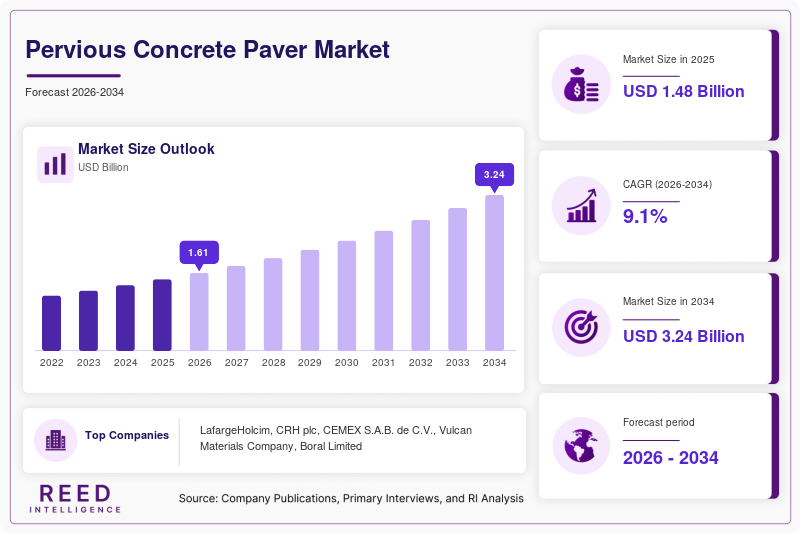
The Pervious Concrete Paver Market size was valued at approximately USD 1.48 billion in 2026 and is projected to reach around USD 2.96 billion by 2034, expanding at a CAGR of 9.1% during the forecast period from 2026 to 2034. The market has gained momentum due to the increasing global emphasis on sustainable urban infrastructure and stormwater management solutions. Pervious concrete pavers are widely adopted for their ability to allow water infiltration, reducing surface runoff and mitigating urban flooding challenges in densely populated regions.
A key global factor supporting market growth is the rising adoption of green building standards and environmental regulations. Governments and municipal bodies are actively encouraging permeable paving systems to reduce waterlogging, improve groundwater recharge, and enhance urban resilience against climate change. This shift has significantly boosted the demand for pervious concrete pavers in both residential and commercial construction sectors.
Key Highlights
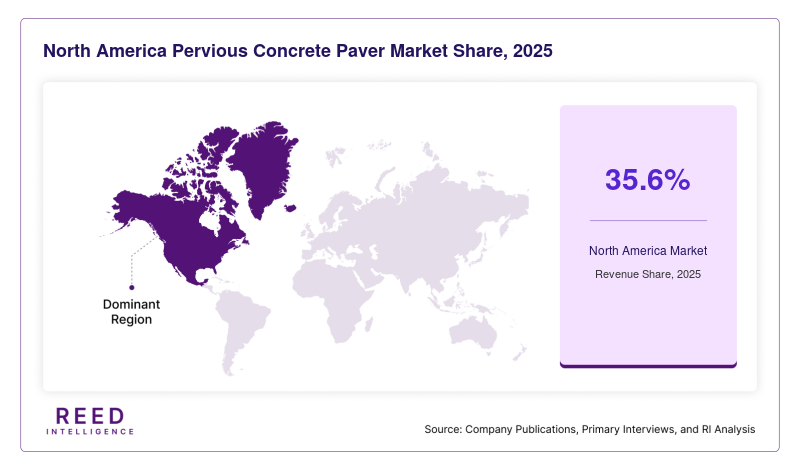
- North America dominated the market with a 35.6% share in 2025.
- Asia Pacific is expected to grow at the fastest CAGR of 10.8% during 2026–2034.
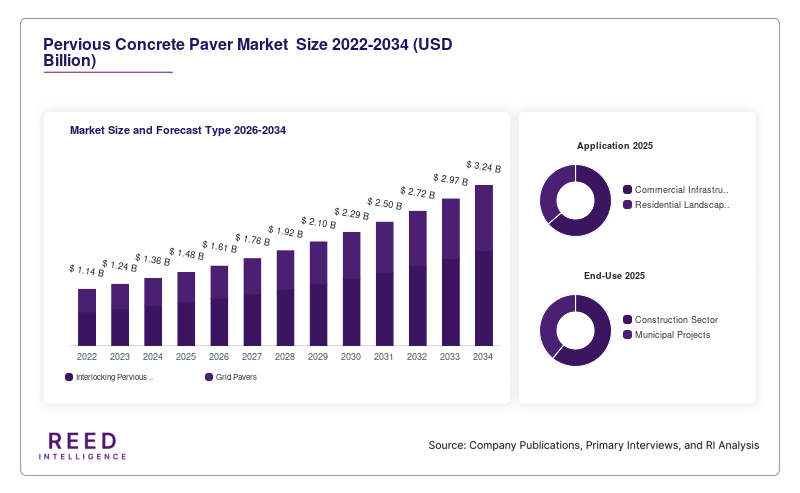
- By type, interlocking pervious concrete pavers accounted for the largest share of 42.3%, while grid pavers are projected to grow at a CAGR of 10.5%.
- By application, commercial infrastructure led with a 39.8% share, whereas residential landscaping is expected to expand at a CAGR of 9.9%.
- The United States remained the dominant country, with market values of USD 420 million in 2024 and USD 455 million in 2025.
Market Trends
Growing integration of sustainable urban drainage systems
The adoption of sustainable urban drainage systems has emerged as a prominent trend shaping the Pervious Concrete Paver Market. Urban planners and developers are increasingly focusing on reducing the environmental footprint of infrastructure projects, which has accelerated the use of permeable paving materials. Pervious concrete pavers play a key role in managing stormwater runoff by allowing water to pass through the surface into the ground, thereby reducing pressure on conventional drainage systems. This trend is particularly strong in developed economies where regulatory frameworks promote green infrastructure. In addition, smart city initiatives are incorporating permeable surfaces into design standards, further strengthening demand. The integration of pervious paving solutions with rainwater harvesting systems is also gaining traction, creating new design opportunities and improving water conservation outcomes.
Rising preference for aesthetic and functional landscaping solutions
Another significant trend influencing the market is the increasing demand for aesthetically appealing and functional landscaping solutions in residential and commercial spaces. Pervious concrete pavers are being designed in various shapes, colors, and textures, making them suitable for decorative applications such as walkways, patios, driveways, and public plazas. This trend reflects a broader shift toward combining sustainability with visual appeal in construction materials. Developers are prioritizing materials that not only perform well but also enhance the overall appearance of properties. Additionally, hospitality and retail sectors are adopting pervious pavers to create environmentally friendly outdoor spaces that align with their sustainability branding. This convergence of design flexibility and ecological benefits is expected to further accelerate market penetration across urban and suburban developments.
Market Drivers
Increasing demand for effective stormwater management solutions
The growing need for efficient stormwater management systems is a primary driver of the Pervious Concrete Paver Market. Rapid urbanization has led to an increase in impervious surfaces such as asphalt and traditional concrete, which contribute to flooding and waterlogging. Pervious concrete pavers offer a viable solution by facilitating water infiltration and reducing runoff volume. Governments are implementing regulations that mandate the use of permeable materials in construction projects to mitigate flood risks. This has significantly boosted adoption across public infrastructure projects, including parking lots, sidewalks, and roadways. Furthermore, the rising frequency of extreme weather events has heightened awareness about sustainable drainage solutions, encouraging both public and private sectors to invest in pervious paving technologies.
Expansion of green building initiatives and environmental regulations
Another major driver is the expansion of green building initiatives and stricter environmental regulations worldwide. Certification programs such as green building standards are encouraging the use of eco-friendly construction materials, including pervious concrete pavers. These materials contribute to credits related to water efficiency, heat island reduction, and sustainable site development. Developers and contractors are increasingly incorporating pervious pavers into their projects to meet compliance requirements and enhance property value. Additionally, incentives and subsidies offered by governments for sustainable construction practices are further supporting market growth. The increasing awareness among consumers about environmental sustainability is also influencing purchasing decisions, leading to higher adoption of permeable paving solutions across various end-use sectors.
Market Restraint
High installation costs and maintenance complexity
One of the primary challenges limiting the growth of the Pervious Concrete Paver Market is the relatively high installation cost and maintenance requirements associated with these systems. Compared to traditional paving materials, pervious concrete pavers require specialized design, skilled labor, and precise installation techniques to ensure proper functionality. This increases initial project costs, making them less attractive for budget-constrained developments. Additionally, maintenance involves regular cleaning to prevent clogging of pores, which can reduce permeability over time. In regions with high sediment or debris accumulation, this becomes a significant concern. The lack of awareness and technical expertise among contractors in developing markets further complicates adoption. As a result, despite long-term environmental benefits, cost considerations continue to act as a barrier, particularly in price-sensitive regions.
Market Opportunities
Rising infrastructure development in emerging economies
The rapid pace of infrastructure development in emerging economies presents a significant opportunity for the Pervious Concrete Paver Market. Countries in Asia Pacific, Latin America, and parts of Africa are investing heavily in urban infrastructure, including roads, public spaces, and residential developments. As these regions face increasing challenges related to urban flooding and water scarcity, the adoption of permeable paving solutions is expected to grow. Governments are gradually incorporating sustainability guidelines into infrastructure planning, creating a favorable environment for pervious concrete pavers. Additionally, international funding and partnerships for climate-resilient infrastructure projects are further supporting market expansion. The growing construction industry in these regions offers substantial untapped potential for manufacturers and suppliers.
Technological advancements in material composition and design
Advancements in material science and product design are creating new growth opportunities for the market. Manufacturers are developing high-performance pervious concrete mixes that offer improved strength, durability, and permeability. Innovations such as polymer-modified pavers and enhanced aggregate compositions are addressing previous limitations related to load-bearing capacity and lifespan. These advancements are expanding the application scope of pervious concrete pavers to include heavy-duty uses such as highways and industrial pavements. Additionally, digital design tools and prefabrication technologies are enabling customized solutions tailored to specific project requirements. As technology continues to evolve, the efficiency and cost-effectiveness of pervious paving systems are expected to improve, driving broader adoption across multiple sectors.
Segmental Analysis
By Type
Interlocking pervious concrete pavers dominated the market, accounting for 42.3% of the share in 2024. These pavers are widely used due to their durability, ease of installation, and ability to handle moderate to heavy loads. They are particularly popular in commercial and residential applications where both functionality and aesthetics are important. Interlocking designs provide structural stability while maintaining permeability, making them suitable for various environments. Their versatility and availability in different patterns and colors have further enhanced their adoption across multiple projects.
Grid pavers are expected to be the fastest-growing subsegment, with a CAGR of 10.5% during the forecast period. The growth of this segment is driven by their ability to support vegetation while allowing water infiltration, making them ideal for eco-friendly landscaping. These pavers are increasingly used in parking areas and green spaces, where maintaining a natural appearance is important. The rising demand for sustainable and visually appealing solutions is expected to drive their adoption.
By Application
Commercial infrastructure emerged as the dominant application segment, accounting for 39.8% of the market share in 2024. The segment includes applications such as parking lots, sidewalks, and public spaces, where effective stormwater management is essential. The adoption of pervious concrete pavers in commercial projects is driven by regulatory requirements and the need to enhance sustainability. These pavers offer long-term benefits such as reduced maintenance costs and improved environmental performance.
Residential landscaping is projected to be the fastest-growing segment, with a CAGR of 9.9%. The increasing focus on outdoor aesthetics and sustainable living is driving demand for pervious pavers in residential settings. Homeowners are increasingly adopting permeable paving solutions for driveways, patios, and gardens to improve drainage and enhance visual appeal. The growing awareness of environmental benefits is expected to support continued growth.
By End-Use
The construction sector dominated the market, accounting for a significant share in 2024. The widespread use of pervious concrete pavers in infrastructure projects such as roads, walkways, and public spaces has contributed to this dominance. The sector benefits from increasing investments in urban development and the growing emphasis on sustainable construction practices. Pervious pavers are increasingly being integrated into building designs to meet environmental standards.
Municipal projects are expected to be the fastest-growing end-use segment, with a CAGR of 10.2%. The growth is driven by government initiatives aimed at improving urban infrastructure and managing stormwater effectively. Municipalities are increasingly adopting permeable paving solutions to reduce flooding risks and enhance water conservation. This trend is expected to continue as cities focus on sustainable development.
Regional Analysis
North America
North America accounted for a significant share of the Pervious Concrete Paver Market, representing 35.6% in 2025, and is expected to grow at a CAGR of 8.7% during the forecast period. The region benefits from strong regulatory support for sustainable construction practices and widespread adoption of green infrastructure solutions. The presence of advanced construction technologies and high awareness among stakeholders has contributed to the steady growth of the market. Additionally, increasing investments in urban redevelopment projects have further boosted demand.
The United States remains the dominant country in the region, driven by stringent environmental regulations and extensive infrastructure modernization initiatives. A unique growth factor is the widespread implementation of stormwater management policies at municipal levels, which mandate the use of permeable paving materials in new developments. This regulatory push continues to drive market expansion.
Europe
Europe held a market share of 27.4% in 2025 and is projected to grow at a CAGR of 8.9% through 2034. The region’s strong focus on environmental sustainability and climate change mitigation has significantly influenced the adoption of pervious concrete pavers. Governments across Europe are promoting eco-friendly construction practices through incentives and regulations, which has created a favorable market environment.
Germany stands out as the dominant country, supported by its advanced construction industry and emphasis on sustainable urban planning. A unique growth factor in the region is the integration of permeable paving systems into smart city projects, where sustainability and resource efficiency are key priorities. This trend is expected to continue driving demand.
Asia Pacific
Asia Pacific is the fastest-growing region, with a projected CAGR of 10.8% from 2026 to 2034 and a market share of 21.8% in 2025. Rapid urbanization and increasing infrastructure investments are major factors contributing to market growth. Governments are recognizing the importance of sustainable drainage systems, which has led to increased adoption of pervious concrete pavers.
China dominates the regional market due to its large-scale infrastructure development and urban expansion. A unique growth factor is the government’s focus on sponge city initiatives, which aim to improve urban water management through permeable surfaces. This initiative has significantly boosted the demand for pervious paving solutions.
Middle East & Africa
The Middle East & Africa region accounted for 8.1% of the market share in 2025 and is expected to grow at a CAGR of 9.3% during the forecast period. The increasing focus on sustainable urban development and water conservation is driving the adoption of pervious concrete pavers. Infrastructure development projects in urban centers are also contributing to market growth.
The United Arab Emirates is a key market within the region, driven by its focus on innovative construction practices. A unique growth factor is the emphasis on water conservation in arid climates, which has encouraged the use of permeable paving systems to enhance groundwater recharge and reduce water wastage.
Latin America
Latin America held a market share of 7.1% in 2025 and is projected to grow at a CAGR of 9.0% through 2034. The region is witnessing increasing investments in infrastructure and urban development, which is driving demand for sustainable construction materials. Government initiatives aimed at improving urban resilience are also supporting market growth.
Brazil leads the market in Latin America, supported by its expanding construction sector. A unique growth factor is the growing adoption of eco-friendly building materials in response to environmental concerns and regulatory requirements. This trend is expected to continue driving demand for pervious concrete pavers.
Competitive Landscape
The Pervious Concrete Paver Market is characterized by moderate competition, with several established players focusing on product innovation and strategic partnerships. Leading companies are investing in research and development to enhance product performance and expand their application scope. The market also includes regional players who cater to specific geographic demands.
One of the leading companies in the market is LafargeHolcim, which has a strong global presence and a diverse product portfolio. The company recently introduced advanced permeable paving solutions designed for high-traffic areas, reflecting its focus on innovation and sustainability. Other key players are also expanding their production capacities and strengthening distribution networks to gain a competitive edge.
Key Players
- LafargeHolcim
- CRH plc
- CEMEX S.A.B. de C.V.
- Vulcan Materials Company
- Boral Limited
- Unilock
- Belgard
- Oldcastle Infrastructure
- Basalite Concrete Products
- Pavestone
- Techo-Bloc
- Nitterhouse Masonry Products
- Brikmakers
- Tobermore
- Wausau Tile
Recent Developments
- Several companies have introduced high-performance pervious concrete pavers with enhanced durability and permeability, targeting infrastructure projects.
- Strategic collaborations between construction firms and material manufacturers have increased to promote sustainable paving solutions.
- Investments in advanced manufacturing technologies have enabled companies to produce customized and cost-effective pervious pavers for diverse applications.
Pervious Concrete Paver Market Segments
Type
- Interlocking Pervious Concrete Pavers
- Grid Pavers
Application
- Commercial Infrastructure
- Residential Landscaping
End-Use
- Construction Sector
- Municipal Projects
By Region
- North America
- Europe
- APAC
- Middle East and Africa
- LATAM