Pet Type Antiblock Masterbatch Market Size, Share Demand Report By Type (Inorganic Antiblock Masterbatch, Organic Antiblock Masterbatch), By Application (Packaging Films, Industrial Films, Agricultural Films), By End-Use Industry (Food & Beverage, Pharmaceuticals, Consumer Goods, Industrial), By Distribution Channel (Direct Sales, Distributors, Online Channels), By Region & Segment Forecasts, 2025–2034
USD 3950
Market Overview
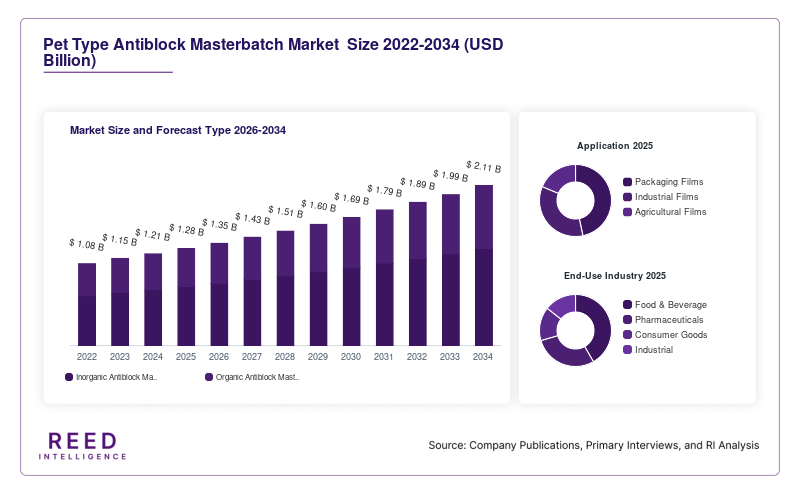
The global Pet Type Antiblock Masterbatch Market was valued at approximately USD 1.28 billion in 2025 and is projected to reach USD 2.11 billion by 2034, registering a compound annual growth rate (CAGR) of 5.7% during the forecast period (2025–2034). The market growth is primarily driven by the expanding packaging industry, particularly flexible and rigid plastic packaging applications that require enhanced surface properties and improved film performance.
A key global factor supporting market expansion is the increasing demand for high-performance polymer additives in food-grade and industrial packaging. As manufacturers seek to enhance product quality, reduce friction between film layers, and improve machinability, the adoption of PET-based antiblock masterbatch solutions has grown steadily across multiple industries.
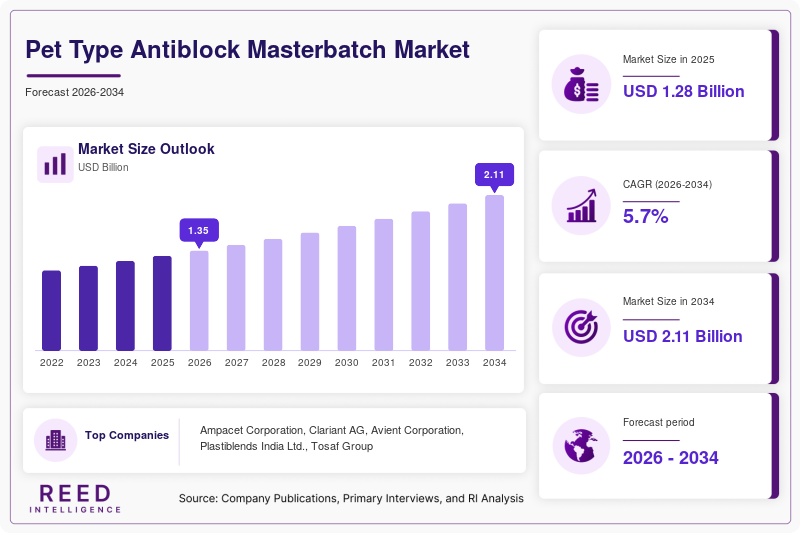
Key Highlights:
- Asia Pacific dominated the market with a share of 41.6% in 2025, while it is expected to be the fastest-growing region at a CAGR of 6.4%.
- By type, inorganic antiblock masterbatch held the leading share of 62.3%, while organic antiblock masterbatch is projected to grow at a CAGR of 6.1%.
- By application, packaging films accounted for the largest share at 48.7%, while industrial films are expected to grow fastest at a CAGR of 6.3%.
- China remained the dominant country, with market values of USD 312 million in 2024 and USD 330 million in 2025.
Market Trends
Increasing Demand for High-Clarity Packaging Films
The Pet Type Antiblock Masterbatch Market is witnessing a growing trend toward high-clarity and glossy packaging films. Manufacturers are increasingly focusing on producing visually appealing packaging that enhances product visibility and shelf appeal. Antiblock masterbatch formulations designed for PET films are evolving to provide improved transparency while maintaining antiblocking efficiency. This trend is particularly evident in food and beverage packaging, where clarity plays a critical role in consumer purchasing decisions.
Shift Toward Sustainable and Recyclable Additives
Another notable trend is the shift toward environmentally compatible masterbatch solutions. With rising regulatory pressures and corporate sustainability goals, manufacturers are investing in recyclable and eco-friendly antiblock additives. PET-based masterbatch products are gaining traction due to their recyclability and compatibility with circular economy initiatives. This trend is encouraging innovation in bio-based and low-residue antiblock materials, supporting long-term market growth.
Market Drivers
Expansion of Flexible Packaging Industry
The rapid expansion of the flexible packaging sector is a major driver of the Pet Type Antiblock Masterbatch Market. Flexible packaging solutions require enhanced film properties such as reduced adhesion and improved processing efficiency. Antiblock masterbatch plays a critical role in preventing film sticking, thereby improving manufacturing throughput and product quality. The increasing use of flexible packaging in food, personal care, and pharmaceutical industries is significantly boosting demand.
Rising Demand for Process Efficiency in Plastic Manufacturing
Manufacturers are increasingly focusing on improving operational efficiency and reducing production downtime. Antiblock masterbatch solutions enable smoother film processing by minimizing friction and preventing surface defects. This results in higher productivity and reduced waste, making these additives essential in large-scale polymer processing operations. The emphasis on cost optimization and efficiency is therefore driving the adoption of advanced PET antiblock masterbatch products.
Market Restraints
Volatility in Raw Material Prices
One of the major challenges facing the Pet Type Antiblock Masterbatch Market is the volatility in raw material prices. The production of antiblock masterbatch relies on petrochemical derivatives and specialty additives, which are subject to price fluctuations due to changes in crude oil prices, supply chain disruptions, and geopolitical factors.
These fluctuations can significantly impact production costs and profit margins for manufacturers. Smaller players, in particular, may find it difficult to absorb these cost variations, leading to pricing pressures and reduced competitiveness. Additionally, inconsistent raw material availability can disrupt production schedules, affecting supply reliability.The uncertainty associated with raw material pricing may also discourage long-term investments in capacity expansion and innovation. As a result, market growth could face constraints, especially in regions heavily dependent on imports of key raw materials.
Market Opportunities
Growth in Emerging Economies
Emerging economies present significant growth opportunities for the Pet Type Antiblock Masterbatch Market. Rapid industrialization, urbanization, and increasing consumer demand for packaged goods are driving the expansion of the packaging sector in countries across Asia, Africa, and Latin America. These regions offer untapped potential for manufacturers to expand their market presence and increase production capacities.
Development of Advanced Functional Additives
The development of advanced functional additives represents another promising opportunity. Manufacturers are investing in research and development to create multifunctional masterbatch solutions that combine antiblocking with additional properties such as UV resistance, anti-fogging, and antimicrobial features. These value-added products can cater to specialized applications and command higher margins, thereby enhancing overall market profitability.
Segmental Analysis
By Type
Inorganic antiblock masterbatch dominated the Pet Type Antiblock Masterbatch Market, accounting for 62.3% of the market share in 2024. These products are widely used due to their cost-effectiveness and strong antiblocking performance. Inorganic additives such as silica and talc provide consistent results and are suitable for high-volume applications, particularly in packaging films.
Organic antiblock masterbatch is expected to be the fastest-growing segment, with a projected CAGR of 6.1%. The growth is attributed to the increasing demand for high-clarity films and reduced abrasion properties. Organic additives offer improved transparency and lower wear on processing equipment, making them suitable for premium packaging applications.
By Application
Packaging films held the largest share of 48.7% in 2024, driven by widespread use in food, beverage, and consumer goods packaging. The need for efficient film processing and improved product quality supported the dominance of this segment.
Industrial films are anticipated to grow at the fastest CAGR of 6.3% during the forecast period. The growth is driven by increasing applications in construction, agriculture, and industrial packaging. These films require enhanced durability and performance, boosting demand for advanced antiblock masterbatch solutions.
By End-Use Industry
The food and beverage industry dominated the market with a share of 36.5% in 2024. The demand for safe, durable, and visually appealing packaging drove the adoption of PET antiblock masterbatch solutions in this sector.
The pharmaceutical industry is expected to grow at the fastest CAGR of 6.5%. The need for high-quality packaging materials with strict safety standards is driving demand for advanced masterbatch products in pharmaceutical applications.
By Distribution Channel
Direct sales accounted for the largest share of 55.2% in 2024, as manufacturers prefer direct engagement with suppliers to ensure product quality and consistency.
Online distribution channels are expected to grow at a CAGR of 6.7%. The increasing adoption of digital platforms for procurement and the convenience of online purchasing are driving growth in this segment.
Regional Analysis
North America
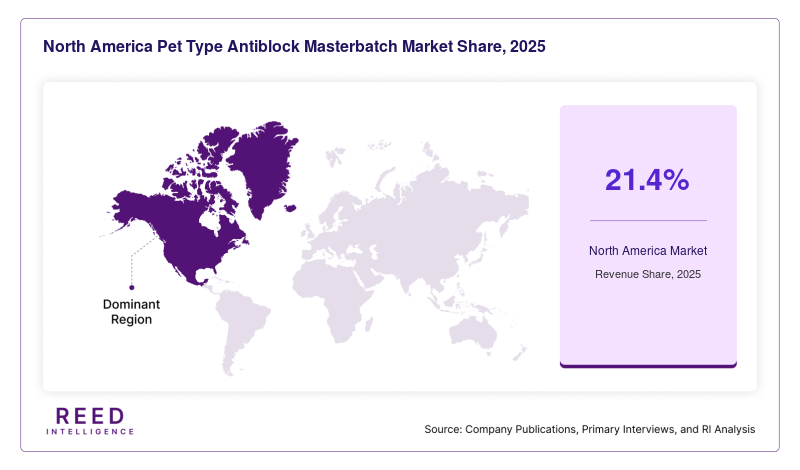
North America accounted for 21.4% of the Pet Type Antiblock Masterbatch Market share in 2025 and is expected to grow at a CAGR of 4.8% during the forecast period. The region’s mature packaging industry and strong demand for high-performance materials supported steady market growth.
The United States dominated the regional market due to its advanced manufacturing infrastructure and high consumption of packaged goods. The increasing demand for convenience food products and stringent quality standards drove the adoption of antiblock masterbatch solutions in PET films.
Europe
Europe held a 19.7% share of the market in 2025 and is projected to grow at a CAGR of 4.6% through 2034. The region’s emphasis on sustainability and regulatory compliance influenced market dynamics.
Germany emerged as the leading country, driven by its strong plastics and packaging industry. The focus on recyclable materials and environmentally friendly additives contributed to the adoption of PET-based antiblock masterbatch solutions.
Asia Pacific
Asia Pacific dominated the Pet Type Antiblock Masterbatch Market with a share of 41.6% in 2025 and is anticipated to grow at a CAGR of 6.4% during the forecast period. Rapid industrialization and expanding packaging demand supported market expansion.
China led the region due to its large manufacturing base and growing consumption of packaged goods. The country’s focus on improving production efficiency and expanding export-oriented industries fueled demand for antiblock masterbatch products.
Middle East & Africa
The Middle East & Africa region accounted for 9.3% of the market share in 2025 and is expected to grow at a CAGR of 5.2%. Increasing investments in packaging and industrial sectors supported growth.
Saudi Arabia dominated the region, driven by its expanding petrochemical industry and growing demand for plastic products. The availability of raw materials and government initiatives to diversify the economy contributed to market development.
Latin America
Latin America held a 8.0% share of the market in 2025 and is projected to grow at a CAGR of 5.0% over the forecast period. The region experienced steady growth due to rising demand for packaged consumer goods.
Brazil emerged as the leading country, supported by its large consumer base and expanding food and beverage industry. The increasing adoption of flexible packaging solutions drove demand for antiblock masterbatch products.
Competitive Landscape
The Pet Type Antiblock Masterbatch Market is moderately fragmented, with several global and regional players competing based on product quality, innovation, and pricing strategies. Leading companies are focusing on expanding their product portfolios and investing in research and development to meet evolving customer requirements.
Ampacet Corporation is a prominent market leader, known for its advanced additive solutions and strong global presence. The company recently introduced a new range of high-performance antiblock masterbatch products designed for improved clarity and processing efficiency in PET films.
Other key players are also emphasizing strategic collaborations, capacity expansions, and technological advancements to strengthen their market positions. The competitive landscape is characterized by continuous innovation and a focus on sustainability.
Key Players
- Ampacet Corporation
- A. Schulman, Inc.
- Clariant AG
- Avient Corporation
- Plastiblends India Ltd.
- PolyOne Corporation
- Hubron International
- Tosaf Group
- Gabriel-Chemie Group
- Plastika Kritis S.A.
Recent Developments
- In 2024, Ampacet Corporation launched a new PET-compatible antiblock masterbatch designed for high-speed film processing.
- In 2023, Clariant AG expanded its additive masterbatch production capacity in Asia to meet rising regional demand.
- In 2024, Avient Corporation introduced sustainable antiblock solutions aligned with circular economy goals.
- In 2023, Plastiblends India Ltd. enhanced its product portfolio with advanced antiblock additives for packaging applications.
- In 2024, Tosaf Group developed multifunctional masterbatch solutions combining antiblock and anti-fog properties.
Pet Type Antiblock Masterbatch Market Segments
Type
- Inorganic Antiblock Masterbatch
- Organic Antiblock Masterbatch
Application
- Packaging Films
- Industrial Films
- Agricultural Films
End-Use Industry
- Food & Beverage
- Pharmaceuticals
- Consumer Goods
- Industrial
Distribution Channel
- Direct Sales
- Distributors
- Online Channels
By Region
- North America
- Europe
- APAC
- Middle East and Africa
- LATAM