Petri Dish Market Size, Share & Demand Report By Product Type (Plastic Petri Dishes, Glass Petri Dishes), By Application (Microbiological Testing, Pharmaceutical Research, Food & Beverage Testing, Environmental Testing), By End-Use (Hospitals & Diagnostic Laboratories, Academic & Research Institutes, Pharmaceutical & Biotechnology Companies), By Region & Segment Forecasts, 2026–2034
USD 3950
Market Overview
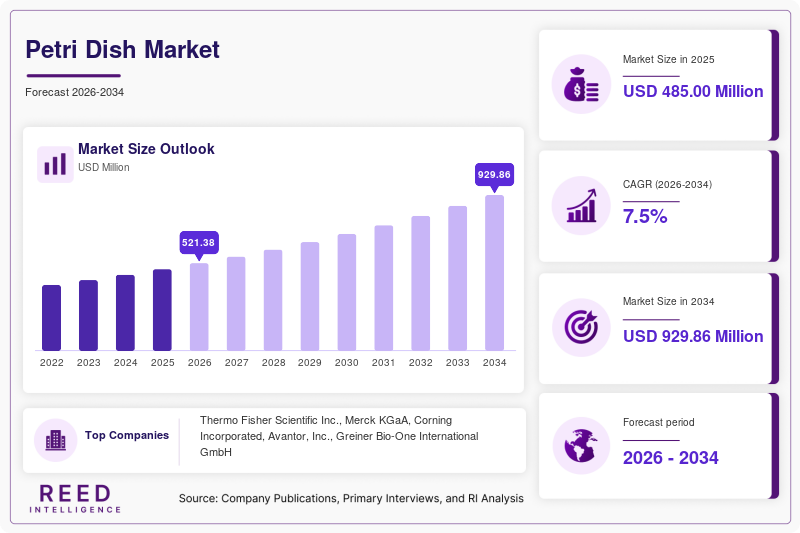
The global Petri Dish Market size was valued at approximately USD 485 million in 2026 and is projected to reach USD 865 million by 2034, registering a compound annual growth rate (CAGR) of 7.5% during the forecast period (2026–2034). The market continues to expand steadily due to the growing demand for microbiological testing across pharmaceutical, biotechnology, food safety, and clinical diagnostics sectors. Increasing research activities, especially in life sciences and infectious disease studies, are significantly contributing to the sustained demand for Petri dishes across both developed and emerging economies.
A major global factor supporting market growth is the expansion of laboratory infrastructure worldwide. Governments and private organizations are investing heavily in healthcare and research facilities, especially after increased awareness around infectious disease surveillance. This has led to a higher consumption of laboratory consumables such as Petri dishes. Additionally, the rise of biotechnology startups and academic research institutions has further accelerated demand for reliable and cost-effective culturing tools.
Key Highlights
- North America dominated the market with a 36.1% share in 2025.
- Asia Pacific is expected to grow at the fastest CAGR of 9.1% during 2026–2034.
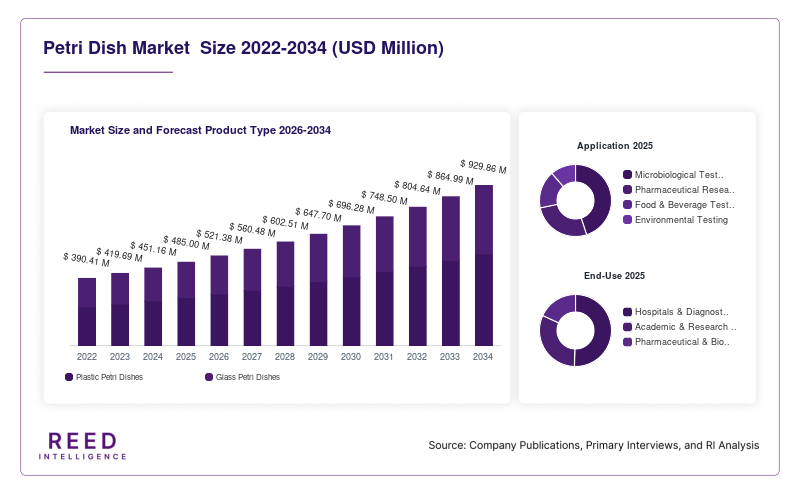
- By product type, plastic Petri dishes accounted for the largest share of 62.4%.
- while glass Petri dishes are projected to grow at a CAGR of 8.3%.
- By application, microbiological testing led with a 44.8% share, whereas pharmaceutical research is expected to expand at a CAGR of 8.7%.
- The United States remained the dominant country, with market values of USD 162 million in 2024 and USD 174 million in 2025.
Market Trends
Increasing Adoption of Disposable Plastic Petri Dishes
The shift toward disposable plastic Petri dishes is a notable trend shaping the Petri Dish Market. Laboratories are increasingly favoring single-use plastic variants due to their convenience, sterility assurance, and reduced risk of cross-contamination. Unlike reusable glass dishes, plastic options eliminate the need for cleaning and sterilization, saving time and operational costs. This trend is particularly evident in high-throughput testing environments such as diagnostic labs and pharmaceutical manufacturing units, where efficiency and contamination control are critical.
Furthermore, advancements in polymer materials have improved the quality and clarity of plastic Petri dishes, making them suitable for precise microbial observations. Manufacturers are also introducing eco-friendly biodegradable plastics to address environmental concerns, which is gaining traction among sustainability-focused organizations. As regulatory standards for laboratory practices become stricter, the demand for pre-sterilized disposable consumables is expected to continue rising, reinforcing this trend across global markets.
Growth in Biotechnology and Life Sciences Research
The expansion of biotechnology and life sciences research is another key trend driving the Petri Dish Market. Increasing investments in genetic engineering, cell culture studies, and vaccine development have significantly boosted the demand for laboratory consumables. Petri dishes remain a fundamental tool for culturing microorganisms and cells, making them indispensable in research workflows.
Academic institutions and private research organizations are scaling up their laboratory capabilities, particularly in emerging economies. The rise of personalized medicine and advanced therapeutics has further fueled the need for controlled laboratory experiments. Additionally, collaborations between pharmaceutical companies and research institutes are increasing, leading to higher consumption of laboratory supplies. This trend is expected to strengthen over the forecast period as innovation in biotechnology continues to accelerate.
Market Drivers
Rising Demand for Clinical Diagnostics and Disease Testing
The growing demand for clinical diagnostics is a major driver of the Petri Dish Market. With the increasing prevalence of infectious diseases and chronic conditions, diagnostic laboratories are expanding their testing capabilities. Petri dishes are widely used for microbial culture and analysis, making them essential in identifying pathogens and determining treatment approaches.
Healthcare systems worldwide are emphasizing early disease detection and preventive care, which has led to higher testing volumes. This trend is particularly strong in urban healthcare centers and diagnostic chains. Additionally, government initiatives aimed at improving public health infrastructure are supporting the establishment of new laboratories. These developments are driving consistent demand for laboratory consumables, including Petri dishes, across both developed and developing regions.
Expansion of Food Safety and Environmental Testing
Another significant driver is the increasing focus on food safety and environmental monitoring. Regulatory authorities are enforcing strict guidelines to ensure the safety and quality of food products, which requires extensive microbiological testing. Petri dishes are widely used in food testing laboratories to detect contaminants and ensure compliance with safety standards.
Environmental testing is also gaining importance due to rising concerns about pollution and public health. Water and soil testing laboratories rely on microbial culture techniques to assess contamination levels. As awareness about environmental sustainability grows, governments and organizations are investing in monitoring programs. This has led to an increased demand for laboratory tools, including Petri dishes, thereby supporting market growth.
Market Restraint
Environmental Concerns Related to Plastic Waste
One of the key restraints in the Petri Dish Market is the environmental impact associated with plastic waste. The widespread use of disposable plastic Petri dishes has raised concerns about sustainability and waste management. Laboratories generate significant amounts of plastic waste, which often requires specialized disposal methods due to biohazard risks. This increases operational costs and creates environmental challenges.
Regulatory bodies are imposing stricter guidelines on plastic usage and waste disposal, which may limit the adoption of single-use products. For example, some regions are encouraging the use of reusable glass alternatives or biodegradable materials. However, transitioning to these options can be costly and may not always be feasible for high-throughput laboratories. This restraint is expected to influence market dynamics, pushing manufacturers to innovate and develop eco-friendly solutions while balancing performance and cost efficiency.
Market Opportunities
Development of Eco-Friendly and Biodegradable Petri Dishes
The growing emphasis on sustainability presents a significant opportunity for the Petri Dish Market. Manufacturers are increasingly focusing on developing eco-friendly and biodegradable Petri dishes to address environmental concerns. These products are designed to reduce plastic waste while maintaining the performance standards required for laboratory applications.
Innovations in materials science have enabled the production of biodegradable plastics that can decompose under specific conditions. This aligns with the sustainability goals of research institutions and healthcare organizations. As environmental regulations become more stringent, the adoption of such products is expected to increase. Companies that invest in sustainable solutions are likely to gain a competitive advantage in the market, making this a promising area for growth.
Increasing Laboratory Infrastructure in Emerging Economies
Emerging economies offer substantial growth opportunities for the Petri Dish Market. Countries in Asia Pacific, Latin America, and Africa are investing heavily in healthcare and research infrastructure. The establishment of new laboratories and research centers is driving demand for laboratory consumables.
Additionally, the expansion of pharmaceutical manufacturing and biotechnology industries in these regions is contributing to market growth. Governments are supporting research initiatives and encouraging foreign investments, which is boosting the overall ecosystem. As these economies continue to develop, the demand for Petri dishes is expected to rise significantly, creating new opportunities for market players to expand their presence.
Segmental Analysis
By Product Type
Plastic Petri dishes dominated the Petri Dish Market, accounting for approximately 62.4% of the market share in 2024. Their widespread adoption is attributed to their cost-effectiveness, convenience, and availability in sterile packaging. Plastic dishes are particularly favored in high-throughput laboratories where efficiency and contamination control are critical. Their lightweight nature and disposability make them suitable for clinical diagnostics and food testing applications.
Glass Petri dishes are gaining traction as the fastest-growing subsegment, expected to grow at a CAGR of 8.3% during the forecast period. The growth is driven by increasing environmental concerns and the need for reusable laboratory tools. Glass dishes offer durability and resistance to high temperatures, making them suitable for repeated sterilization. Laboratories focusing on sustainability are increasingly adopting glass alternatives.
By Application
Microbiological testing held the largest share of 44.8% in 2024, driven by its extensive use in clinical diagnostics, food safety, and environmental monitoring. Petri dishes are essential for culturing microorganisms, making them indispensable in laboratories. The increasing prevalence of infectious diseases and the need for accurate diagnostic testing are driving this segment.
Pharmaceutical research is the fastest-growing application segment, projected to grow at a CAGR of 8.7%. The growth is fueled by increasing investments in drug development and biotechnology research. Petri dishes are widely used in cell culture studies and experimental research, supporting innovation in the pharmaceutical industry.
By End-Use
Hospitals and diagnostic laboratories dominated the market with a share of 48.2% in 2024. These facilities rely heavily on Petri dishes for routine testing and diagnostics. The growing demand for disease testing and the expansion of healthcare infrastructure are key factors supporting this segment.
Academic and research institutes are the fastest-growing end-use segment, expected to grow at a CAGR of 8.9%. The increase in research activities and funding for scientific studies is driving demand. Universities and research centers are expanding their laboratory capabilities, contributing to the growth of this segment.
Regional Analysis
North America
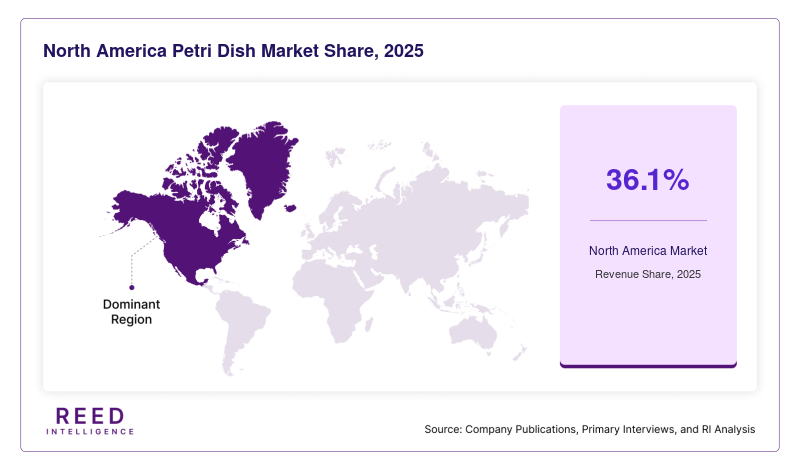
North America accounted for a dominant share of approximately 36.1% in 2025 in the Petri Dish Market and is projected to maintain steady growth with a CAGR of around 6.8% during the forecast period. The region benefits from well-established healthcare infrastructure, advanced research facilities, and strong investments in biotechnology. The presence of leading pharmaceutical companies and academic institutions contributes significantly to the demand for laboratory consumables.
The United States leads the regional market due to its extensive network of research laboratories and diagnostic centers. A unique growth factor is the high level of funding for life sciences research from both government and private sectors. This funding supports innovation and drives the adoption of advanced laboratory tools, including Petri dishes, across various applications.
Europe
Europe held a market share of approximately 27.4% in 2025 and is expected to grow at a CAGR of 6.9% during the forecast period. The region's growth is supported by stringent regulatory standards for laboratory practices and a strong focus on research and development. Countries across Europe are investing in healthcare infrastructure and promoting scientific research, which drives demand for Petri dishes.
Germany is the dominant country in this region, supported by its robust pharmaceutical and biotechnology industries. A unique growth factor is the emphasis on quality standards and compliance with regulatory frameworks. This ensures consistent demand for high-quality laboratory consumables, including Petri dishes, across various sectors.
Asia Pacific
Asia Pacific is the fastest-growing region in the Petri Dish Market, with a CAGR of 9.1% during 2026–2034 and a market share of 22.8% in 2025. Rapid industrialization, increasing healthcare investments, and growing research activities are driving market growth. The region is witnessing a surge in laboratory infrastructure development, particularly in emerging economies.
China dominates the regional market due to its expanding pharmaceutical manufacturing sector and increasing research capabilities. A unique growth factor is the government's focus on strengthening healthcare systems and promoting biotechnology innovation. This has led to increased demand for laboratory consumables, including Petri dishes.
Middle East & Africa
The Middle East & Africa region accounted for approximately 7.6% of the market share in 2025 and is expected to grow at a CAGR of 7.2%. The region is gradually developing its healthcare and research infrastructure, which is supporting market growth. Increasing awareness about disease testing and food safety is also contributing to demand.
Saudi Arabia is a key market in this region, driven by investments in healthcare infrastructure. A unique growth factor is the government's initiatives to diversify the economy and invest in the healthcare sector. This includes the establishment of new laboratories and research centers, boosting demand for Petri dishes.
Latin America
Latin America held a market share of around 6.1% in 2025 and is projected to grow at a CAGR of 7.0% during the forecast period. The region is experiencing steady growth due to increasing healthcare investments and expanding laboratory networks. Rising awareness about food safety and environmental testing is also contributing to market demand.
Brazil dominates the regional market due to its large healthcare system and growing research activities. A unique growth factor is the expansion of public health programs, which require extensive diagnostic testing. This drives the demand for laboratory consumables, including Petri dishes.
Competitive Landscape
The Petri Dish Market is moderately fragmented, with several global and regional players competing based on product quality, pricing, and innovation. Leading companies are focusing on expanding their product portfolios and investing in sustainable solutions to address environmental concerns. The market is characterized by continuous product development and strategic collaborations.
Thermo Fisher Scientific is a leading player in the market, known for its extensive range of laboratory consumables. The company recently introduced eco-friendly Petri dishes made from biodegradable materials, reflecting its commitment to sustainability. Other key players are also investing in advanced manufacturing technologies to improve product quality and efficiency. Competitive strategies include mergers, acquisitions, and partnerships aimed at strengthening market presence and expanding global reach.
Key Players List
- Thermo Fisher Scientific Inc.
- Merck KGaA
- Corning Incorporated
- Avantor, Inc.
- Greiner Bio-One International GmbH
- SARSTEDT AG & Co. KG
- Eppendorf AG
- HiMedia Laboratories
- DWK Life Sciences
- VWR International
- CellTreat Scientific Products
- Tarsons Products Limited
- Phoenix Biomedical
- Kartell Labware
- Nest Biotechnology
Recent Developments
- Thermo Fisher Scientific launched a new range of biodegradable Petri dishes aimed at reducing plastic waste in laboratories.
- Corning Incorporated expanded its manufacturing capacity to meet the growing demand for laboratory consumables in Asia Pacific.
- Merck KGaA introduced advanced sterile packaging solutions for Petri dishes to enhance product safety and shelf life.
Petri Dish Market Segments
Product Type
- Plastic Petri Dishes
- Glass Petri Dishes
Application
- Microbiological Testing
- Pharmaceutical Research
- Food & Beverage Testing
- Environmental Testing
End-Use
- Hospitals & Diagnostic Laboratories
- Academic & Research Institutes
- Pharmaceutical & Biotechnology Companies
By Region
- North America
- Europe
- APAC
- Middle East and Africa
- LATAM