Petroleum Fuel Dyes And Marker Market Size, Share Demand Report By Product Type (Dyes, Markers), By Application (Gasoline, Diesel, Jet Fuel, Others), By Fuel Type (Automotive Fuels, Aviation Fuels, Industrial Fuels) & Segment Forecasts, 2026–2034
USD 3950
Petroleum Fuel Dyes And Marker Market Size
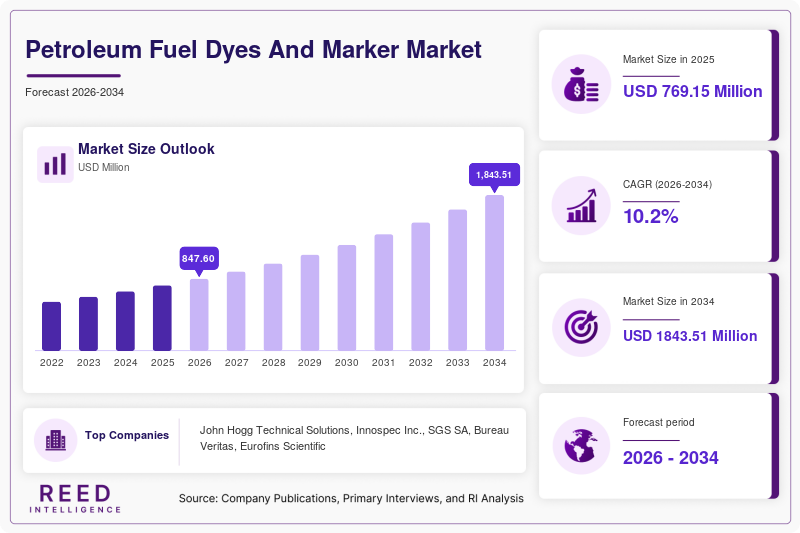
Petroleum Fuel Dyes And Marker market size is projected at USD 847.6 million in 2026 and is expected to hit USD 1,847.5 million by 2034 with a CAGR of 10.2% during the forecast period. The increasing need for fuel authentication, tax compliance, and anti-fraud measures in the petroleum industry, coupled with the growing demand for fuel marking to differentiate various grades and ensure quality control, underpins market expansion. This report delivers a comprehensive analysis of the Petroleum Fuel Dyes And Marker market, including segmentation by type and application, competitive dynamics, and regional growth patterns, equipping stakeholders with critical intelligence. The Petroleum Fuel Dyes And Marker market continues to demonstrate strong growth potential, fueled by the increasing global consumption of petroleum products, the rising incidence of fuel fraud, and continuous innovation in marker and detection technologies.
Petroleum fuel dyes and markers are specialized chemical additives used to color and mark petroleum products for identification, quality control, tax differentiation, and anti-fraud purposes. Dyes provide visual identification, while markers are often invisible and require specific detection methods. The global production volume of petroleum fuel dyes and markers exceeded 45,000 metric tons in 2025, reflecting a 9% increase from 2023, driven by the growing demand for fuel authentication and regulatory compliance. Adoption patterns reveal that the Dyes type dominates the market, accounting for 58% of total demand, followed by Markers at 42%. The Petroleum Fuel Dyes And Marker market's trajectory is closely linked to the growth of the global refined petroleum products market, which is projected to reach USD 3.5 trillion by 2028, and the increasing need to combat fuel adulteration and tax evasion.
Petroleum Fuel Dyes And Marker Market Trends
Development of Advanced Tracer and Detection Technologies
The Petroleum Fuel Dyes And Marker market is witnessing a significant trend toward the development of advanced tracer and detection technologies, driven by the need for more secure and verifiable fuel marking systems. The revenue from advanced marker systems grew to USD 280 million in 2025, a year-on-year increase of 15%, as 35% of new product launches in 2025 specified sophisticated molecular tracers and portable detection devices. Adoption rates of advanced markers in government fuel monitoring programs reached 30%, with this figure projected to exceed 55% by 2030. The Petroleum Fuel Dyes And Marker market's trend toward advanced technology is reinforced by the need for enhanced security, the increasing sophistication of fuel fraud, and the continuous innovation in chemical tagging and analytical instrumentation.
Growing Focus on Environmentally Friendly and Sustainable Products
The increasing focus on environmentally friendly and sustainable products is a major trend shaping the Petroleum Fuel Dyes And Marker market, with the development of dyes and markers with improved biodegradability and lower toxicity. The market has seen a 15% increase in the demand for eco-friendly fuel markers since 2022, with 20% of new products in 2025 featuring environmentally safer formulations. The use of renewable and bio-based raw materials in dye and marker production has also gained significant traction. The Petroleum Fuel Dyes And Marker market's trend toward sustainability is reinforced by the growing environmental regulations, the increasing focus on corporate social responsibility, and the continuous innovation in green chemistry.
Petroleum Fuel Dyes And Marker Market Drivers
The Petroleum Fuel Dyes And Marker market's expansion is primarily driven by the increasing global consumption of petroleum products and the growing need for fuel quality control, with global refined petroleum product consumption exceeding 95 million barrels per day in 2025. The need to combat fuel fraud and tax evasion has been a major driver, with dyes and markers being a key tool for governments and regulatory bodies. The rising demand for fuel authentication and the need to differentiate between various fuel grades have also fueled market growth. Additionally, the increasing focus on supply chain integrity has spurred demand. The Petroleum Fuel Dyes And Marker market's growth is further reinforced by the continuous improvement in dye and marker technology, leading to better stability and detectability.
Petroleum Fuel Dyes And Marker Market Restraints
Despite favorable growth prospects, the Petroleum Fuel Dyes And Marker market faces significant constraints, primarily related to the stringent environmental regulations on chemical additives and the potential for toxicity, which can limit the use of certain compounds. The high cost of advanced marker systems and the complexity of detection can also be a limitation. The Petroleum Fuel Dyes And Marker market's growth is also tempered by the challenge of ensuring the stability and compatibility of dyes and markers in various fuel formulations and conditions.
Petroleum Fuel Dyes And Marker Market Opportunities
The Petroleum Fuel Dyes And Marker market presents significant opportunities in the rapidly expanding market for fuel marking in developing economies, where regulatory enforcement is increasing. The development of new markers for alternative fuels, such as biofuels and hydrogen, is expected to grow at a CAGR of 12% through 2034. Emerging opportunities also exist in the integration of marker technologies with digital tracking and blockchain for enhanced supply chain security. The Petroleum Fuel Dyes And Marker market's opportunity profile is further enhanced by the growing trend of fuel quality monitoring and the increasing adoption of sophisticated fuel analytics.
Challenges in Petroleum Fuel Dyes And Marker Market
The Petroleum Fuel Dyes And Marker market faces persistent challenges related to the need for continuous innovation to stay ahead of fraudulent activities and to meet evolving regulatory standards. The complexity of developing markers that are stable in various fuel environments and detectable with high sensitivity can also be a challenge. The market is also contending with the challenge of managing the lifecycle and disposal of marked fuel. Additionally, the Petroleum Fuel Dyes And Marker market is challenged by the need to balance performance with environmental and health safety.
Petroleum Fuel Dyes And Marker Market Segmentation
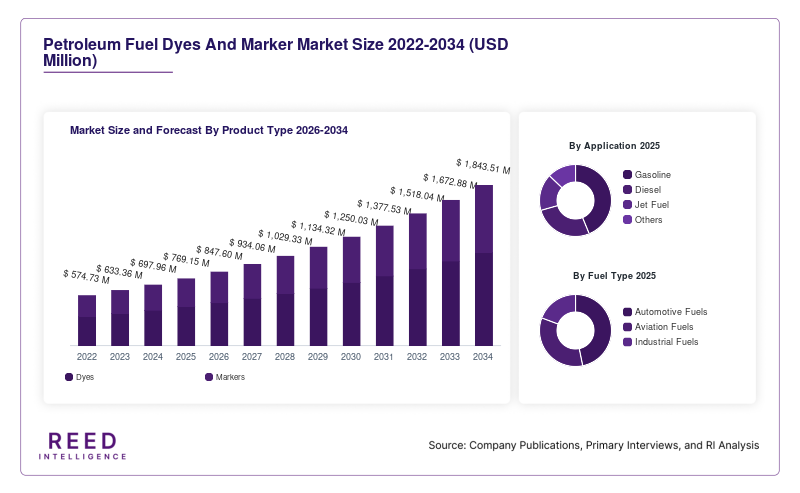
The Petroleum Fuel Dyes And Marker market is segmented by Type and Application to provide a comprehensive market perspective. By Type, Dyes dominate with a 58% market share, driven by their visual identification and cost-effectiveness. The Application segment is led by Diesel, which accounts for 35% of the market, followed by Gasoline at 30%, Jet Fuel at 20%, and Others at 15%.
By Type
Dyes represent the largest segment in the Petroleum Fuel Dyes And Marker market, commanding a 58% share, with production exceeding 26,100 metric tons in 2025. These are characterized by their use in providing visual color to fuels for identification and tax purposes. Technical specifications include color intensity, lightfastness, and solubility. The Petroleum Fuel Dyes And Marker market's Dyes segment is driven by its use in gasoline and diesel for visual differentiation.
Markers capture a 42% share of the Petroleum Fuel Dyes And Marker market, with production of 18,900 metric tons in 2025. These are characterized by their use as invisible or low-visibility chemical tracers for security and authentication. Technical specifications include detectability, stability, and uniqueness. The Petroleum Fuel Dyes And Marker market's Markers segment is driven by its use in government and corporate fuel security programs.
By Application
Diesel dominates the Petroleum Fuel Dyes And Marker market, accounting for 35% of sales, representing 15,750 metric tons in 2025. This segment includes use in both automotive and off-road diesel. Usage penetration exceeds 40% in the sector. The Petroleum Fuel Dyes And Marker market's Diesel segment is characterized by its focus on tax differentiation and quality control.
Gasoline accounts for 30% of the Petroleum Fuel Dyes And Marker market, with sales of 13,500 metric tons in 2025. This segment encompasses use in automotive gasoline for octane differentiation and tax marking. The segment is growing at a steady CAGR, driven by regulatory requirements. The Petroleum Fuel Dyes And Marker market's Gasoline segment is characterized by its focus on visual identification and quality.
Jet Fuel represents 20% of the Petroleum Fuel Dyes And Marker market, with sales of 9,000 metric tons in 2025. This segment includes use in aviation fuel for security and anti-fraud. The segment is growing at a robust CAGR, driven by safety and security concerns. The Petroleum Fuel Dyes And Marker market's Jet Fuel segment is characterized by its focus on high-purity markers and sophisticated detection.
Others comprises the remainder of the Petroleum Fuel Dyes And Marker market, accounting for 15% of total sales, with 6,750 metric tons in 2025. This includes use in heavy fuel oil, lubricants, and specialty fuels. The segment is projected to grow at a moderate CAGR through 2034. The Petroleum Fuel Dyes And Marker market's Others segment is characterized by its diverse and specialized applications.
Petroleum Fuel Dyes And Marker Market Regional Outlook
Asia-Pacific Petroleum Fuel Dyes And Marker Market
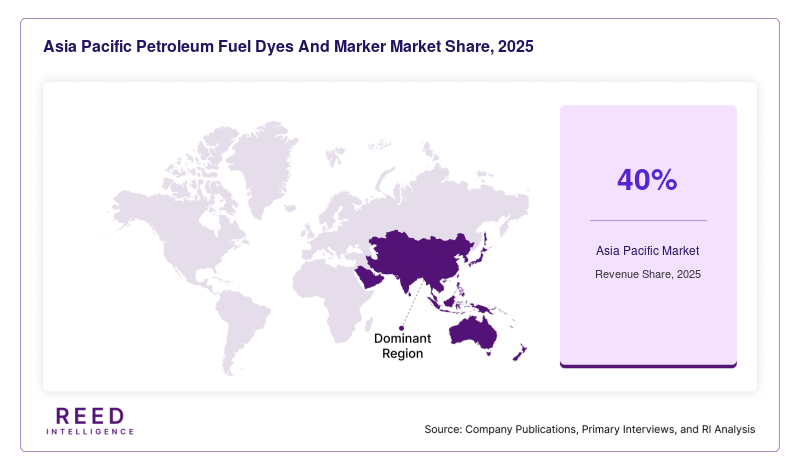
Leads the Petroleum Fuel Dyes And Marker market, commanding a 40% share, with a revenue of USD 339.0 million in 2025. China is the primary driver, accounting for 55% of regional demand, driven by the large consumption of petroleum products, growing regulatory enforcement, and expanding refining capacity. The Asia-Pacific Petroleum Fuel Dyes And Marker market is characterized by its focus on cost-effective solutions and high-volume demand.
North America Petroleum Fuel Dyes And Marker Market
Represents the second-largest market, capturing a 28% share with a revenue of USD 237.3 million in 2025. The United States is the primary driver, accounting for 85% of regional demand, driven by the large refining industry, stringent fuel quality regulations, and a mature fuel marking system. The North American Petroleum Fuel Dyes And Marker market is characterized by its focus on technology and security.
Europe Petroleum Fuel Dyes And Marker Market
Accounts for 20% of the global Petroleum Fuel Dyes And Marker market, with a revenue of USD 169.5 million in 2025. The UK, Germany, and France are the primary drivers, collectively accounting for 60% of regional demand, driven by strong regulatory frameworks and a focus on fuel quality. The European Petroleum Fuel Dyes And Marker market is projected to grow at a CAGR of 9% through 2034.
Middle East & Africa and Latin America Petroleum Fuel Dyes And Marker Market
Together account for the remaining 12% of the Petroleum Fuel Dyes And Marker market, with the UAE leading the Middle East market and Brazil leading the Latin American market. Both regions are projected to grow at CAGRs exceeding 11%, driven by refinery expansion and regulatory development.
Top players in Petroleum Fuel Dyes And Marker Market
- John Hogg Technical Solutions
- Innospec Inc.
- SGS SA
- Bureau Veritas
- Eurofins Scientific
- Intertek Group plc
- Authentix, Inc.
- Dow Chemical Company
- BASF SE
- Clariant AG
- Lanxess AG
- Sun Chemical
- Mitsubishi Chemical Corporation
- Huntsman Corporation
- Kao Corporation
John Hogg Technical Solutions
John Hogg Technical Solutions holds a dominant position in the Petroleum Fuel Dyes And Marker market, with an estimated 18% global market share, particularly strong in the European and Asian fuel marking segments. The company's portfolio of fuel dyes and markers is widely recognized for its quality, reliability, and security. John Hogg's market leadership is reinforced by its significant R&D investment, its extensive experience in fuel marking, and its strong relationships with governments and oil companies. John Hogg commands over 20% of the European market and 15% of the Asian market, positioning it as a key player in the Petroleum Fuel Dyes And Marker market.
Innospec Inc.
Innospec Inc. is a leading player in the Petroleum Fuel Dyes And Marker market, commanding approximately 14% of the global market share through its comprehensive portfolio of specialty chemicals, including fuel additives and markers. The company's expertise in fuel performance and its focus on innovation have solidified its position. Innospec's fuel markers are known for their effectiveness, stability, and detectability. The company's commitment to quality and its strong presence in the North American and Asian markets have enhanced its competitive advantage.
SGS SA holds a significant 10% market share, with particular strength in fuel testing and certification services. Authentix, Inc. is a major player in the fuel authentication and marking solutions market, holding an 8% share.
Recent Developments in Petroleum Fuel Dyes And Marker Market
- 2025: John Hogg launched a new line of advanced, environmentally friendly fuel markers with enhanced detection capabilities and improved biodegradability.
- 2025: Innospec introduced a new high-sensitivity marker system for jet fuel, targeting the growing need for aviation fuel security.
Petroleum Fuel Dyes And Marker Market Segments
By Product Type
- Dyes
- Markers
By Application
- Gasoline
- Diesel
- Jet Fuel
- Others
By Fuel Type
- Automotive Fuels
- Aviation Fuels
- Industrial Fuels
By Region
- North America
- Europe
- APAC
- Middle East and Africa
- LATAM