Petroleum Refining Blue Hydrogen Market Size, Share & Demand Report By Technology (Steam Methane Reforming (SMR) with CCS, Autothermal Reforming (ATR), Partial Oxidation), By Supply Mode (On-site Production, Merchant Supply), By Application (Hydrocracking, Hydrotreating, Desulfurization), By End-Use (Large Refineries, Medium Refineries, Small Refineries), By Region & Segment Forecasts, 2025–2034
USD 3950
Market Overview
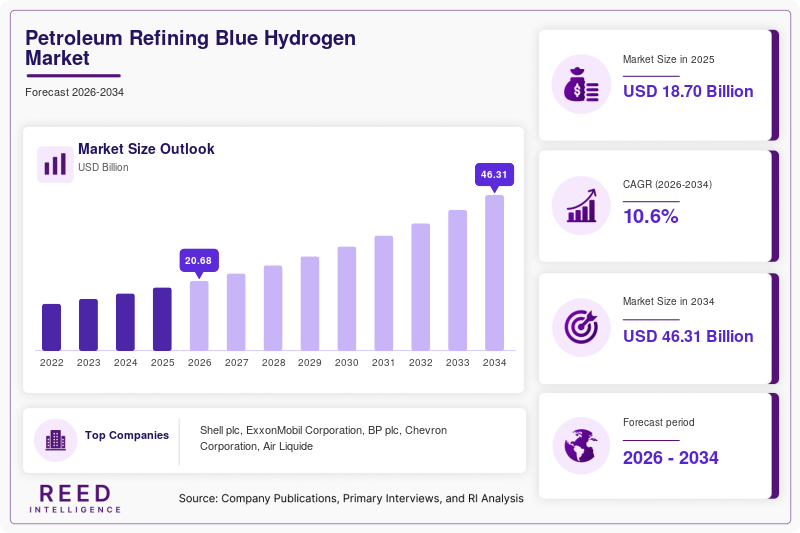
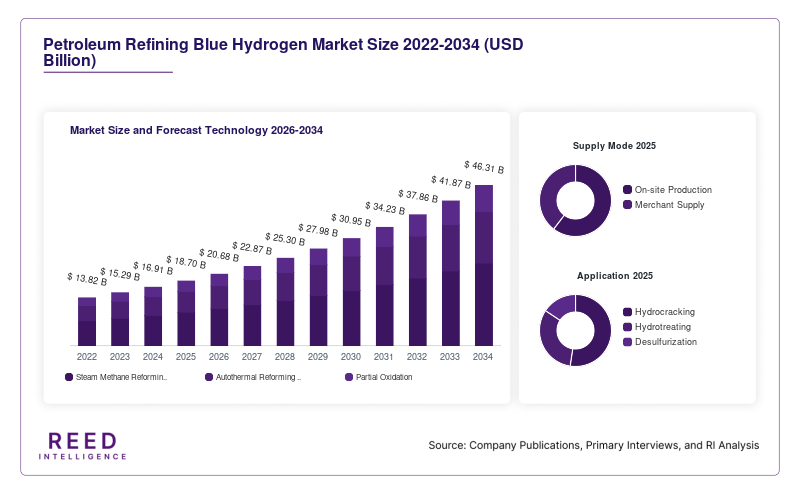
The Petroleum Refining Blue Hydrogen Market size was valued at USD 18.7 billion in 2025 and is projected to reach USD 46.2 billion by 2034, expanding at a CAGR of 10.6% from 2025 to 2034. The market is witnessing steady expansion as refiners increasingly integrate low-carbon hydrogen solutions to comply with environmental targets while maintaining operational efficiency. Blue hydrogen, produced using natural gas with carbon capture and storage (CCS), is gaining traction as a transitional fuel that balances cost-effectiveness with emissions reduction.
A major global factor supporting market growth is the tightening of carbon emission regulations across refining industries. Governments and regulatory bodies are mandating reductions in greenhouse gas emissions, compelling refineries to adopt cleaner hydrogen production methods. This shift has significantly accelerated investments in blue hydrogen infrastructure, particularly in regions with established natural gas supply chains and carbon storage capabilities.
Key Highlights
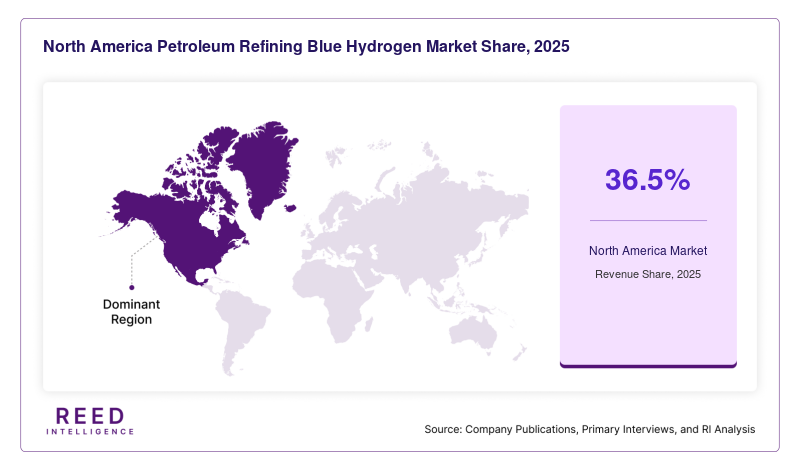
- North America dominated the market with a 36.5% share in 2025, while Asia Pacific is expected to grow at the fastest CAGR of 11.9%.
- Steam Methane Reforming (SMR) with CCS emerged as the leading technology segment with a 61.2% share, while Autothermal Reforming (ATR) is projected to grow at a CAGR of 12.4%.
- On-site hydrogen production led the supply mode segment with a 68.7% share, while merchant supply is expected to grow at a CAGR of 11.6%.
- The United States recorded a market size of USD 5.8 billion in 2025 and is estimated to reach USD 6.3 billion in 2026.
Market Trends
Integration of Carbon Capture Technologies in Refineries
Refiners are increasingly incorporating carbon capture and storage systems into hydrogen production units. This integration allows facilities to significantly reduce carbon emissions while continuing to use existing infrastructure. The Petroleum Refining Blue Hydrogen Market is benefiting from advancements in CCS efficiency and cost reduction, making blue hydrogen a more viable solution for large-scale refining operations.
Strategic Partnerships for Hydrogen Infrastructure Development
Market participants are forming partnerships to develop hydrogen production and distribution networks. Oil and gas companies, technology providers, and governments are collaborating to establish integrated hydrogen ecosystems. These alliances are accelerating project deployment timelines and improving access to financing. As a result, the Petroleum Refining Blue Hydrogen Market is experiencing increased project announcements and cross-border collaborations, particularly in regions aiming to build hydrogen export capabilities.
Market Drivers
Rising Demand for Low-Carbon Fuels in Refining Operations
Refineries are under pressure to reduce their carbon footprint while maintaining output levels. Blue hydrogen offers a practical solution by enabling lower emissions without requiring a complete shift to renewable hydrogen. This compatibility with existing systems is driving adoption across large refining complexes.
Availability of Natural Gas and Existing Infrastructure
The widespread availability of natural gas and established pipeline networks is facilitating the growth of blue hydrogen production. Many refineries already rely on natural gas-based hydrogen production, making the transition to blue hydrogen relatively seamless with the addition of carbon capture technologies. This infrastructure advantage is a key factor driving the Petroleum Refining Blue Hydrogen Market forward.
Market Restraint
High Capital Investment for Carbon Capture and Storage Systems
The integration of carbon capture technology significantly increases the initial capital expenditure for hydrogen production facilities. Costs associated with CO₂ capture, transportation, and storage infrastructure can be substantial, particularly for smaller refineries. Additionally, uncertainties around long-term storage liabilities and regulatory frameworks may deter investment. These financial and operational challenges act as a restraint, limiting the pace of adoption in certain regions within the Petroleum Refining Blue Hydrogen Market.
Market Opportunities
Expansion of Carbon Storage Infrastructure
The development of large-scale carbon storage hubs presents a significant opportunity for the market. Shared infrastructure can reduce costs for individual refineries and encourage wider adoption of blue hydrogen. Regions investing in geological storage sites are likely to attract new projects and partnerships.
Integration with Hydrogen Export Markets
Blue hydrogen production can be linked with international hydrogen trade. Countries with abundant natural gas resources are exploring export opportunities, positioning themselves as suppliers of low-carbon hydrogen. This trend is expected to create new revenue streams and expand the global footprint of the Petroleum Refining Blue Hydrogen Market.
Segmental Analysis
By Technology
Steam Methane Reforming (SMR) with CCS dominated the Petroleum Refining Blue Hydrogen Market in 2025, accounting for 61.2% of the share. This dominance was attributed to its widespread use and compatibility with existing refining infrastructure.
Autothermal Reforming (ATR) is expected to grow at the fastest CAGR of 12.4% during the forecast period. Its ability to integrate efficiently with carbon capture systems and produce hydrogen at lower emissions levels will drive its adoption.
By Supply Mode
On-site hydrogen production held the largest share of 68.7% in 2025, as refineries preferred integrated systems for operational efficiency and cost control.
Merchant hydrogen supply is projected to grow at a CAGR of 11.6%. Increasing demand for flexible supply options and the development of hydrogen distribution networks will support this growth.
By Application
Hydrocracking accounted for the largest share of 39.4% in 2025, driven by the need for hydrogen in refining heavy crude oils.
Hydrotreating is expected to grow at the fastest CAGR of 11.8%, as refiners focus on producing cleaner fuels and meeting regulatory standards.
By End-Use
Large-scale refineries dominated the market with a 72.5% share in 2025, owing to their higher hydrogen consumption and investment capacity.
Medium-scale refineries are anticipated to grow at a CAGR of 10.9%, supported by gradual adoption of blue hydrogen technologies.
Regional Analysis
North America
North America accounted for 36.5% of the Petroleum Refining Blue Hydrogen Market share in 2025 and is expected to grow at a CAGR of 10.2% during the forecast period. The region benefited from strong policy support and established carbon capture infrastructure.
The United States dominated the regional market due to its extensive refining capacity and early adoption of CCS technologies. Government incentives and tax credits for carbon capture have encouraged refiners to invest in blue hydrogen projects, strengthening the country’s market position.
Europe
Europe held a 24.3% market share in 2025 and is projected to expand at a CAGR of 10.8%. The region has focused on reducing industrial emissions through stringent environmental policies.
Germany emerged as the leading country, driven by its commitment to energy transition and decarbonization. Investments in hydrogen infrastructure and cross-border collaborations have supported market growth in the country.
Asia Pacific
Asia Pacific accounted for 21.7% of the market in 2025 and is anticipated to grow at the fastest CAGR of 11.9%. Rapid industrialization and increasing energy demand are key factors influencing the region.
China led the regional market due to its large refining sector and government initiatives promoting cleaner energy solutions. The country’s focus on reducing emissions from heavy industries has accelerated the adoption of blue hydrogen.
Middle East & Africa
The Middle East & Africa region held a 10.2% share in 2025 and is expected to grow at a CAGR of 10.5%. The region’s abundant natural gas reserves provide a strong foundation for blue hydrogen production.
Saudi Arabia dominated the market, leveraging its energy resources and strategic investments in hydrogen projects. The country is positioning itself as a key player in the global hydrogen economy.
Latin America
Latin America accounted for 7.3% of the market in 2025 and is projected to grow at a CAGR of 9.8%. The region is gradually adopting low-carbon technologies in refining operations.
Brazil emerged as the leading country, driven by investments in energy infrastructure and growing awareness of environmental sustainability. The country’s refining sector is exploring blue hydrogen to reduce emissions.
Competitive Landscape
The Petroleum Refining Blue Hydrogen Market is moderately consolidated, with key players focusing on strategic collaborations and technological advancements. Leading companies are investing in carbon capture technologies and expanding their hydrogen production capacities.
Shell plc is a market leader, actively developing large-scale blue hydrogen projects integrated with CCS. The company recently announced the expansion of its hydrogen production facility to support refinery decarbonization efforts.
Other major players such as ExxonMobil Corporation, BP plc, Air Liquide, and Linde plc are also strengthening their market positions through partnerships and infrastructure investments. These companies are focusing on enhancing efficiency and reducing production costs to remain competitive in the evolving market landscape.
Key Players List
- Shell plc
- ExxonMobil Corporation
- BP plc
- Chevron Corporation
- Air Liquide
- Linde plc
- Air Products and Chemicals, Inc.
- Equinor ASA
- TotalEnergies SE
- Saudi Aramco
- Mitsubishi Heavy Industries Ltd.
- Technip Energies
- Honeywell UOP
- Siemens Energy AG
- Iwatani Corporation
Recent Developments
- In 2025, Shell plc announced a new blue hydrogen project integrating CCS technology at its refining complex.
- ExxonMobil expanded its carbon capture capacity to support hydrogen production in North America.
- BP plc entered a partnership to develop hydrogen hubs in Europe.
- Air Liquide launched a new hydrogen production facility with integrated carbon capture systems.
- Linde plc signed agreements to supply blue hydrogen to multiple refinery clients.
Petroleum Refining Blue Hydrogen Market Segments
Technology
- Steam Methane Reforming (SMR) with CCS
- Autothermal Reforming (ATR)
- Partial Oxidation
Supply Mode
- On-site Production
- Merchant Supply
Application
- Hydrocracking
- Hydrotreating
- Desulfurization
End-Use
- Large Refineries
- Medium Refineries
- Small Refineries
By Region
- North America
- Europe
- APAC
- Middle East and Africa
- LATAM