Peyronies Disease Treatment Market Size, Share Demand Report By Treatment Type (Injectable Therapy, Oral Therapy, Surgical Treatment, Shockwave Therapy), By Disease Stage (Acute Stage, Chronic Stage), By End-Use (Hospitals, Specialty Clinics, Ambulatory Surgical Centers) By Region & Segment Forecasts, 2025–2034
USD 3950
Market Overview
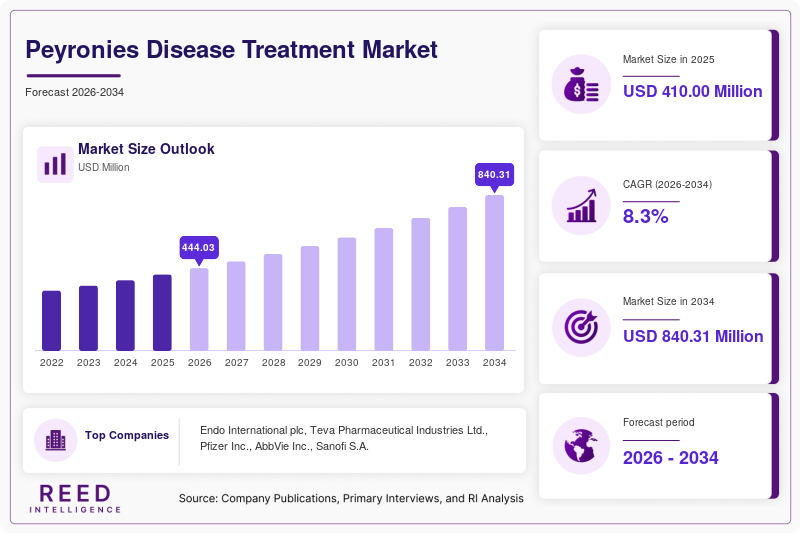
The Peyronies Disease Treatment Market size was estimated at USD 410 million in 2025 and is projected to reach approximately USD 445 million in 2026. With sustained clinical innovation and growing patient acceptance of therapeutic interventions, the market is forecast to reach USD 910 million by 2034, registering a compound annual growth rate (CAGR) of 8.3% during the forecast period from 2025 to 2034.
The growing prevalence of Peyronie’s disease, particularly among aging male populations, is one of the primary factors supporting market growth. Studies indicate that the condition remains underdiagnosed due to social stigma and lack of awareness, but improved healthcare access and awareness campaigns are gradually increasing patient inflow. Additionally, technological advancements in treatment options such as collagenase injections, shockwave therapy, and surgical interventions are expanding the therapeutic landscape and improving patient outcomes.
Key Highlights
- The market size was estimated at USD 410 million in 2025 and is expected to reach USD 445 million in 2026. This steady increase reflects growing diagnosis rates and expanding access to treatment options across key regions.
- The market is projected to reach USD 910 million by 2034, registering a CAGR of 8.3% during the forecast period. Sustained growth is supported by ongoing innovation and rising patient awareness globally.
- Rising prevalence of Peyronie’s disease along with improved diagnosis rates is significantly driving treatment demand. Increasing awareness and reduced stigma are encouraging more patients to seek medical intervention.
- The increasing adoption of minimally invasive and non-surgical therapies is transforming the treatment landscape. Patients and healthcare providers are favoring these options due to shorter recovery times and lower procedural risks.
Market Trends
Growing Adoption of Minimally Invasive Therapies
The Peyronies Disease Treatment Market is experiencing a clear shift toward minimally invasive therapies, driven by patient preference and advancements in medical technology. Injectable treatments, particularly collagenase-based therapies, have gained significant traction due to their ability to reduce penile curvature without requiring surgical intervention. These therapies are increasingly being administered in outpatient settings, reducing hospital stays and associated healthcare costs. In addition, advancements in shockwave therapy and traction devices are further supporting this trend by offering non-invasive alternatives with promising clinical outcomes. Physicians are also favoring these treatments as they involve lower complication rates and shorter recovery periods. This shift is expected to continue as clinical data supporting the efficacy and safety of minimally invasive options becomes more robust.
Increasing Focus on Combination Therapies
Another notable trend in the market is the growing use of combination therapies to enhance treatment effectiveness. Healthcare providers are increasingly combining pharmacological treatments with mechanical therapies such as penile traction devices or vacuum erection devices. This integrated approach aims to improve patient outcomes by addressing multiple aspects of the condition simultaneously. Clinical studies have shown that combination therapies can lead to better curvature reduction and improved patient satisfaction compared to standalone treatments. Additionally, the development of personalized treatment plans based on disease severity and patient profile is gaining traction. This trend is supported by ongoing research and clinical trials exploring optimal combinations of therapies, which is expected to drive further innovation and adoption in the market.
Market Drivers
Rising Prevalence and Awareness of Peyronie’s Disease
The increasing prevalence of Peyronie’s disease, particularly among men aged 40 and above, is a key driver of market growth. Lifestyle factors, comorbid conditions such as diabetes, and aging-related tissue changes contribute to the rising incidence of the disease. At the same time, awareness campaigns and educational initiatives are helping to reduce stigma associated with the condition, encouraging more patients to seek medical advice. Improved diagnostic capabilities and greater availability of urology specialists are also supporting early detection and treatment. As awareness continues to grow, the number of diagnosed cases is expected to rise, directly boosting demand for treatment options and contributing to market expansion.
Advancements in Therapeutic and Surgical Techniques
Technological advancements in both pharmacological and surgical treatments are significantly driving the Peyronies Disease Treatment Market. Innovations such as enzyme-based injectable therapies have revolutionized treatment by offering non-surgical solutions with proven efficacy. Additionally, improvements in surgical techniques, including grafting procedures and penile implants, have enhanced treatment outcomes for severe cases. These advancements are reducing complication rates and improving patient satisfaction, making treatment more accessible and acceptable. Furthermore, ongoing research and development activities are leading to the introduction of new therapies with improved safety profiles, further driving market growth and expanding the range of available treatment options.
Market Restraint
High Treatment Costs and Limited Accessibility
One of the major restraints affecting the Peyronies Disease Treatment Market is the high cost associated with advanced therapies and surgical procedures. Injectable treatments, particularly enzyme-based therapies, can be expensive and often require multiple sessions, increasing the overall financial burden on patients. Surgical interventions, while effective, involve significant costs related to hospitalization, anesthesia, and post-operative care. In many regions, especially in developing economies, limited insurance coverage and reimbursement policies further restrict access to these treatments.
This cost barrier has a direct impact on market growth, as many patients opt to delay or avoid treatment altogether. For instance, patients in low- and middle-income countries may rely on conservative management or over-the-counter solutions due to affordability issues. Additionally, the lack of specialized healthcare infrastructure and trained professionals in certain regions limits the availability of advanced treatment options. These challenges highlight the need for cost-effective therapies and improved healthcare access to ensure broader market penetration.
Market Opportunities
Expansion in Emerging Markets
Emerging economies present significant growth opportunities for the Peyronies Disease Treatment Market. Countries in Asia Pacific, Latin America, and parts of the Middle East are witnessing improvements in healthcare infrastructure and increasing investments in medical facilities. As awareness of men’s health issues grows, more patients are seeking diagnosis and treatment for conditions such as Peyronie’s disease. Additionally, rising disposable incomes and expanding middle-class populations are enabling greater access to healthcare services. Pharmaceutical and medical device companies are increasingly targeting these regions through strategic partnerships and localized product offerings. This expansion is expected to drive market growth and create new revenue streams for industry participants.
Development of Novel Therapies and Biologics
The development of novel therapies, particularly biologics and regenerative medicine approaches, offers a promising opportunity for market growth. Research is focused on developing treatments that target the underlying causes of Peyronie’s disease, such as fibrosis and plaque formation. Innovations in stem cell therapy and gene therapy are also being explored as potential solutions. These advanced therapies have the potential to provide more effective and long-lasting results compared to traditional treatments. As clinical trials progress and regulatory approvals are obtained, these novel therapies are expected to enter the market and significantly enhance the treatment landscape, attracting both patients and healthcare providers.
Segmental Analysis
By Treatment Type
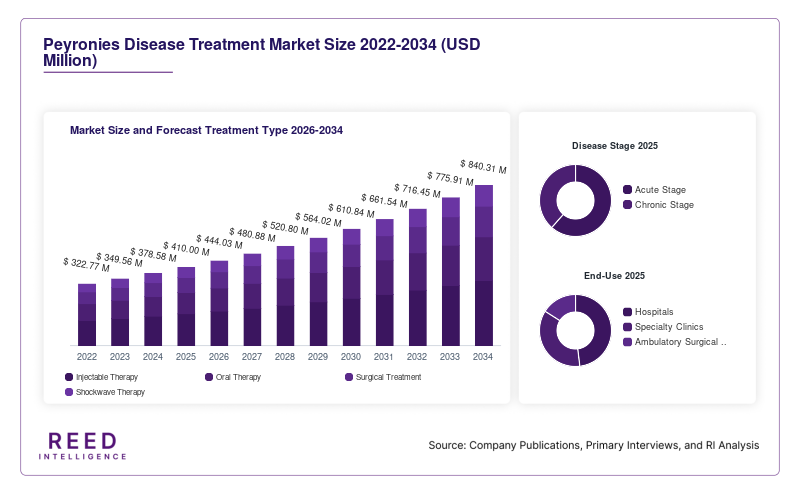
The injectable therapy segment dominated the Peyronies Disease Treatment Market in 2024, accounting for approximately 42% of the total market share. This dominance is attributed to the widespread use of collagenase-based injections, which have demonstrated significant efficacy in reducing penile curvature. Injectable therapies are preferred due to their minimally invasive nature and shorter recovery time compared to surgical options. Additionally, the growing availability of these treatments in outpatient settings has increased patient accessibility. Healthcare providers also favor injectable therapies as they offer a balance between effectiveness and safety, making them suitable for a wide range of patients.
The surgical treatment segment is expected to be the fastest-growing segment, with a projected CAGR of 8.7% during the forecast period. This growth is driven by the increasing number of severe cases requiring surgical intervention. Advances in surgical techniques, such as grafting and penile implants, are improving patient outcomes and reducing complications. Additionally, the growing availability of skilled surgeons and specialized healthcare facilities is supporting the adoption of surgical treatments. As awareness of advanced surgical options increases, more patients are opting for these procedures, contributing to segment growth.
By Disease Stage
The acute stage segment held the largest share of the Peyronies Disease Treatment Market in 2024, accounting for approximately 55% of the total market. This is primarily due to the higher number of patients seeking treatment during the early stages of the disease when symptoms such as pain and inflammation are more pronounced. Early intervention is crucial in preventing disease progression, which has led to increased demand for treatments targeting the acute stage. Additionally, healthcare providers are emphasizing early diagnosis and treatment, further supporting segment growth.
The chronic stage segment is expected to grow at the fastest rate, with a CAGR of 8.5% during the forecast period. This growth is driven by the increasing number of patients diagnosed at later stages of the disease. Chronic stage treatments often involve more complex interventions, including surgery and combination therapies. Advances in treatment options and improved patient outcomes are encouraging more patients to seek treatment during this stage. Additionally, ongoing research into therapies targeting chronic-stage fibrosis is expected to drive segment growth.
By End-Use
Hospitals accounted for the largest share of the Peyronies Disease Treatment Market in 2024, representing approximately 48% of the total market. Hospitals are the primary treatment centers for both surgical and advanced non-surgical therapies. They offer access to specialized healthcare professionals, advanced diagnostic tools, and comprehensive treatment options. Additionally, hospitals are equipped to handle complex cases and provide post-treatment care, making them the preferred choice for many patients.
Specialty clinics are expected to be the fastest-growing segment, with a CAGR of 9.0% during the forecast period. This growth is driven by the increasing number of urology clinics offering specialized treatments for Peyronie’s disease. These clinics provide personalized care and focus on minimally invasive therapies, attracting a growing number of patients. Additionally, shorter waiting times and a more patient-centric approach are contributing to the rising popularity of specialty clinics, supporting segment growth.
Regional Analysis
North America
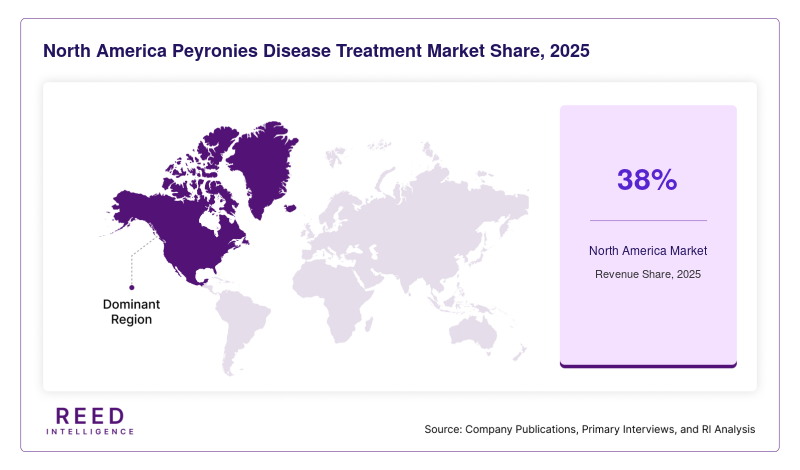
North America held the largest share of the Peyronies Disease Treatment Market in 2025, accounting for approximately 38% of the global market. The region is expected to maintain its dominance during the forecast period, with a CAGR of around 7.9%. The high prevalence of the condition, combined with strong healthcare infrastructure and high awareness levels, contributes to the region’s leading position. Additionally, favorable reimbursement policies and the presence of key market players support sustained growth.
The United States dominates the North American market due to its advanced healthcare system and strong focus on research and development. A unique growth factor in this region is the high adoption of innovative therapies, including enzyme-based injectables and advanced surgical techniques. The availability of specialized urology clinics and skilled healthcare professionals further enhances treatment accessibility and drives market expansion.
Europe
Europe accounted for a significant share of the Peyronies Disease Treatment Market in 2025, contributing around 27% of the global revenue. The region is projected to grow at a CAGR of approximately 8.1% during the forecast period. Increasing awareness of men’s health issues and improved access to healthcare services are key factors driving market growth. Additionally, government initiatives aimed at improving healthcare quality are supporting treatment adoption.
Germany leads the European market, supported by its well-established healthcare infrastructure and high healthcare expenditure. A unique growth factor in the region is the increasing focus on early diagnosis and preventive care. Healthcare providers are emphasizing regular check-ups and early intervention, which is helping to identify cases at an earlier stage and improve treatment outcomes.
Asia Pacific
Asia Pacific is emerging as a high-growth region in the Peyronies Disease Treatment Market, with a market share of approximately 18% in 2025 and a projected CAGR of 9.2%. Rapid urbanization, increasing healthcare investments, and growing awareness of urological conditions are driving market growth in the region. Additionally, the expanding middle-class population is contributing to increased healthcare spending.
China dominates the Asia Pacific market due to its large population and improving healthcare infrastructure. A unique growth factor in the region is the rising number of private healthcare facilities offering specialized treatments. These facilities are equipped with advanced technologies and provide access to innovative therapies, thereby enhancing treatment availability and driving market growth.
Middle East & Africa
The Middle East & Africa region accounted for around 9% of the Peyronies Disease Treatment Market in 2025 and is expected to grow at a CAGR of 8.0%. The market is driven by improving healthcare infrastructure and increasing awareness of men’s health issues. Government initiatives aimed at enhancing healthcare access are also contributing to market growth.
Saudi Arabia is a key market in the region, supported by significant investments in healthcare development. A unique growth factor is the increasing adoption of advanced medical technologies in private hospitals. These institutions are playing a crucial role in introducing innovative treatments and improving patient outcomes, thereby driving market expansion.
Latin America
Latin America held approximately 8% of the Peyronies Disease Treatment Market in 2025 and is projected to grow at a CAGR of 8.4%. The region is witnessing steady growth due to improving healthcare systems and increasing awareness of urological conditions. Economic development and rising healthcare expenditure are also supporting market growth.
Brazil leads the Latin American market due to its large population and expanding healthcare sector. A unique growth factor is the growing number of public-private partnerships aimed at improving healthcare access. These collaborations are helping to expand the availability of advanced treatments and enhance patient care, thereby supporting market growth.
Competitive Landscape
The Peyronies Disease Treatment Market is moderately competitive, with several established pharmaceutical and medical device companies actively participating. Key players are focusing on product innovation, strategic collaborations, and geographic expansion to strengthen their market position. The market leader is recognized for its strong portfolio of injectable therapies and extensive distribution network, which enables it to maintain a significant share.
Companies are increasingly investing in research and development to introduce advanced therapies with improved efficacy and safety profiles. Recent developments include the launch of new formulations and the expansion of clinical trials for novel treatments. Additionally, partnerships between pharmaceutical companies and healthcare providers are helping to enhance treatment accessibility and drive market growth. The competitive landscape is expected to evolve further as new entrants introduce innovative solutions.
Key Players List
- Endo International plc
- Teva Pharmaceutical Industries Ltd.
- Pfizer Inc.
- AbbVie Inc.
- Sanofi S.A.
- Novartis AG
- GlaxoSmithKline plc
- Bayer AG
- Johnson & Johnson
- Boston Scientific Corporation
- Coloplast Group
- Medtronic plc
- Mylan N.V.
- Cipla Limited
- Sun Pharmaceutical Industries Ltd.
Recent Developments
- A leading pharmaceutical company expanded its clinical trial program for a next-generation collagenase-based therapy aimed at improving treatment outcomes.
- A medical device manufacturer introduced an advanced penile traction device designed to enhance the effectiveness of combination therapies.
- A strategic partnership between a biotech firm and a healthcare provider was established to develop novel biologic treatments for Peyronie’s disease.
Peyronies Disease Treatment Market Segments
Treatment Type
- Injectable Therapy
- Oral Therapy
- Surgical Treatment
- Shockwave Therapy
Disease Stage
- Acute Stage
- Chronic Stage
End-Use
- Hospitals
- Specialty Clinics
- Ambulatory Surgical Centers
By Region
- North America
- Europe
- APAC
- Middle East and Africa
- LATAM