Pharmaceutical Dextran Glucose Market Size, Share & Demand Report By Type (Dextran 40, Dextran 70, Other Dextran Variants), By Application (Plasma Volume Expansion, Drug Delivery Systems, Other Therapeutic Applications), By End-Use (Hospitals, Pharmaceutical Companies, Research Institutes) & Segment Forecasts, 2026–2034
USD 3950
Market Overview
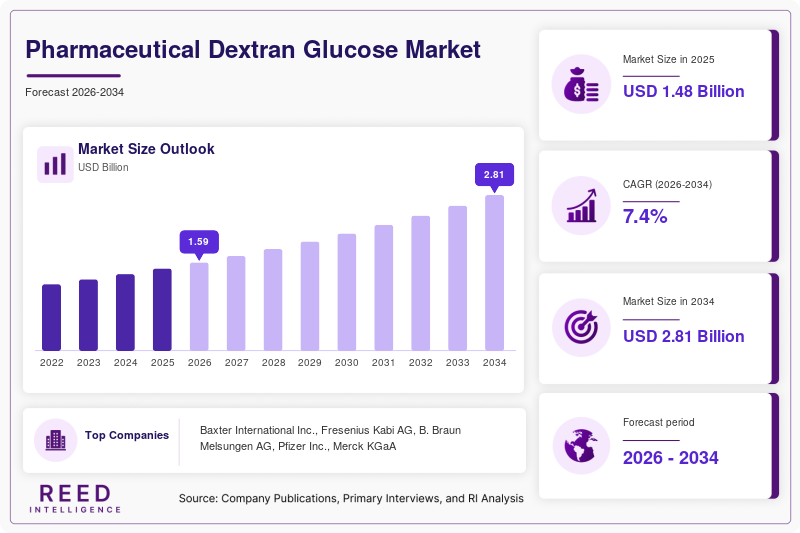
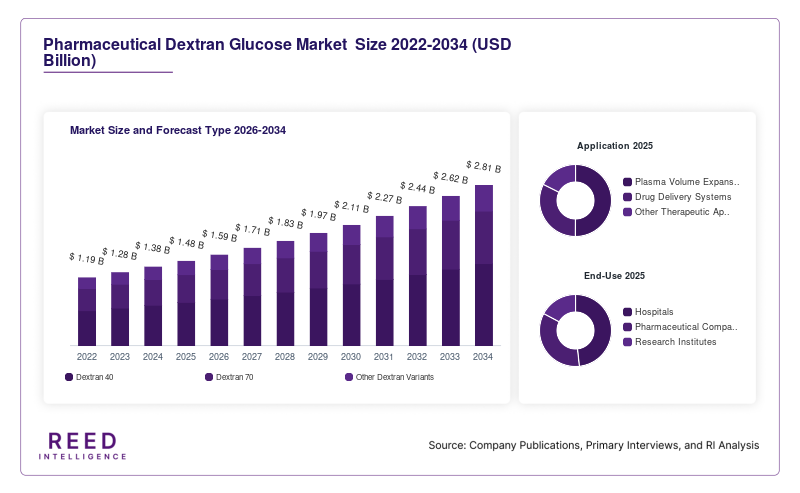
The Pharmaceutical Dextran Glucose Market size was valued at approximately USD 1.48 billion in 2026 and is projected to reach USD 2.62 billion by 2034, expanding at a CAGR of 7.4% during 2026–2034. Dextran glucose, widely used as a plasma volume expander and excipient in pharmaceutical formulations, continues to gain traction due to its biocompatibility and stability. The market has witnessed steady expansion as healthcare systems prioritize efficient drug delivery systems and supportive care therapies, especially in surgical and emergency settings.
One major global factor supporting market growth is the increasing incidence of chronic diseases and surgical procedures worldwide. As patient volumes rise, the need for plasma expanders and supportive infusion therapies has increased, leading to higher demand for dextran-based glucose solutions. Additionally, advancements in pharmaceutical manufacturing technologies have enabled better formulation quality, improving product adoption across developed and emerging markets.
Key Highlights
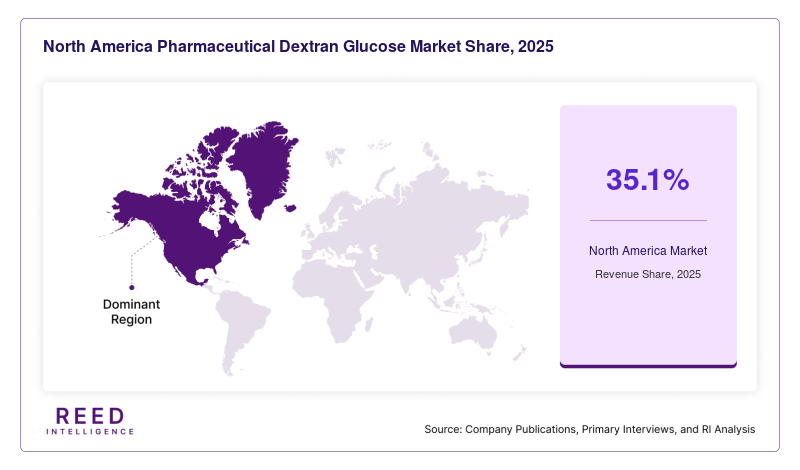
- North America dominated the market with a 35.1% share in 2025.
- Asia Pacific is expected to grow at the fastest CAGR of 9.2% during 2026–2034.
- By type, Dextran 40 accounted for the largest share of 42.6%.
- while Dextran 70 is projected to grow at a CAGR of 8.6%.
- By application, plasma volume expansion led with a 44.3% share, whereas drug delivery systems are expected to expand at a CAGR of 9.8%.
- The United States remained the dominant country, with market values of USD 420 million in 2024 and USD 455 million in 2025.
Market Trends
Increasing Use of Dextran in Advanced Drug Delivery Systems
The Pharmaceutical Dextran Glucose Market is witnessing a shift toward advanced drug delivery applications. Dextran’s molecular flexibility and water solubility make it a preferred material for controlled drug release and targeted delivery systems. Pharmaceutical companies are leveraging dextran derivatives to improve drug bioavailability and reduce toxicity in complex therapies, including oncology and immunology treatments. This trend is particularly strong in developed markets where innovation-driven healthcare systems prioritize efficient therapeutics. Furthermore, research institutions are exploring dextran-based nanoparticles and conjugates to enhance therapeutic precision. The integration of dextran into novel delivery platforms is expected to support long-term market growth, especially as personalized medicine gains momentum globally.
Rising Demand for Biocompatible Infusion Solutions in Hospitals
Another significant trend shaping the market is the increasing demand for biocompatible infusion solutions in clinical settings. Dextran glucose solutions are widely used in hospitals for fluid resuscitation and volume expansion due to their safety profile and effectiveness. Healthcare providers are prioritizing products that minimize adverse reactions while ensuring rapid patient recovery. This has led to growing adoption of dextran-based formulations in emergency and surgical care. Additionally, improvements in manufacturing processes have enhanced the purity and consistency of these products, making them more reliable for critical care use. As healthcare infrastructure continues to expand globally, especially in emerging regions, the demand for such infusion solutions is expected to rise steadily.
Market Drivers
Growth in Surgical Procedures and Emergency Care Services
The increasing number of surgical procedures worldwide is a key driver for the Pharmaceutical Dextran Glucose Market. Dextran glucose solutions are commonly used during surgeries to maintain blood volume and improve circulation. With the global rise in aging populations and chronic disease prevalence, the number of surgeries such as cardiovascular and orthopedic procedures has increased significantly. Hospitals rely on plasma expanders to ensure patient stability during operations, boosting demand for dextran-based products. Moreover, advancements in surgical techniques and healthcare access in developing regions have further contributed to the growing need for supportive infusion therapies, strengthening overall market demand.
Expanding Pharmaceutical Applications of Dextran Compounds
Dextran compounds are increasingly being utilized in various pharmaceutical applications beyond traditional plasma expansion. Their role as stabilizers, carriers, and excipients in drug formulations has expanded significantly. Pharmaceutical manufacturers are incorporating dextran into vaccines, injectable drugs, and biologics to improve product stability and delivery efficiency. This diversification of applications has broadened the market scope, attracting investments in research and development. Additionally, regulatory approvals for dextran-based formulations in multiple therapeutic areas have enhanced market confidence, encouraging further adoption. As pharmaceutical innovation continues, the versatility of dextran glucose is expected to drive sustained market growth.
Market Restraint
Risk of Allergic Reactions and Regulatory Challenges
One of the primary restraints affecting the Pharmaceutical Dextran Glucose Market is the risk of allergic reactions associated with dextran-based products. Although generally considered safe, dextran can cause hypersensitivity reactions in certain patients, particularly when used in high doses or repeated treatments. This has led to cautious adoption among healthcare providers, especially in regions with stringent patient safety protocols. Additionally, regulatory bodies impose strict guidelines on the production, labeling, and administration of dextran-based pharmaceuticals, increasing compliance costs for manufacturers.
The regulatory landscape varies significantly across regions, creating challenges for global market expansion. Companies must invest heavily in clinical trials and quality assurance processes to meet regulatory standards, which can delay product launches. For example, variations in approval timelines between North America and emerging markets can impact supply chains and revenue generation. These factors collectively limit the rapid adoption of dextran glucose products, particularly in cost-sensitive markets where alternative solutions may be preferred. Despite these challenges, ongoing research aimed at improving product safety and reducing adverse reactions may help mitigate this restraint over time.
Market Opportunities
Expansion in Emerging Healthcare Markets
Emerging economies present significant growth opportunities for the Pharmaceutical Dextran Glucose Market. Countries in Asia Pacific, Latin America, and parts of Africa are investing heavily in healthcare infrastructure, increasing access to hospital-based treatments. As these regions experience rising patient populations and improving healthcare systems, the demand for plasma expanders and infusion solutions is expected to grow. Pharmaceutical companies are expanding their presence in these markets through partnerships, local manufacturing, and distribution networks. This expansion not only increases market penetration but also reduces production costs, enabling competitive pricing strategies. The growing middle-class population and rising healthcare awareness further support market development in these regions.
Development of Novel Dextran-Based Therapeutics
The development of innovative dextran-based therapeutics offers another major opportunity for market growth. Researchers are exploring the use of dextran in targeted drug delivery, gene therapy, and regenerative medicine. These applications have the potential to revolutionize treatment approaches for complex diseases such as cancer and autoimmune disorders. Pharmaceutical companies are investing in advanced technologies to create customized dextran derivatives with enhanced functionality. As clinical trials progress and new products receive regulatory approvals, the market is expected to witness significant expansion. This innovation-driven approach not only increases product diversity but also enhances the overall value proposition of dextran glucose in the pharmaceutical industry.
Segmental Analysis
By Type
Dextran 40 emerged as the dominant subsegment in 2024, accounting for approximately 42.6% of the total market share. Its widespread use as a plasma volume expander and its ability to improve microcirculation make it a preferred choice in clinical settings. Dextran 40 is particularly effective in treating hypovolemia and preventing thrombosis, which has increased its adoption in hospitals. Additionally, its relatively lower molecular weight allows for faster renal excretion, reducing the risk of long-term accumulation. Pharmaceutical manufacturers continue to focus on improving the formulation and stability of Dextran 40 products, further strengthening its position in the market.
Dextran 70 is expected to be the fastest-growing subsegment, with a projected CAGR of 8.6% during the forecast period. Its higher molecular weight provides prolonged plasma expansion effects, making it suitable for specific medical applications. The growing demand for long-acting infusion solutions is a key factor driving its growth. Additionally, advancements in pharmaceutical formulations have improved the safety profile of Dextran 70, increasing its adoption in developed markets. As healthcare providers seek more efficient and durable treatment options, the demand for this subsegment is expected to rise significantly.
By Application
Plasma volume expansion dominated the application segment in 2024, accounting for 44.3% of the market share. Dextran glucose solutions are widely used in surgical and emergency settings to maintain blood volume and ensure patient stability. The increasing number of surgeries and trauma cases has significantly contributed to the growth of this subsegment. Hospitals rely on these solutions for rapid fluid replacement, making them an essential component of critical care. Additionally, improvements in healthcare infrastructure have increased the availability of such treatments in emerging markets, further supporting growth.
Drug delivery systems are expected to be the fastest-growing application, with a CAGR of 9.8% during the forecast period. The use of dextran in targeted drug delivery has gained significant attention due to its ability to enhance therapeutic efficiency. Pharmaceutical companies are developing innovative delivery systems using dextran derivatives to improve drug performance. This trend is particularly strong in oncology and chronic disease treatments, where precision and efficacy are critical. As research continues to advance, the adoption of dextran-based drug delivery systems is expected to increase rapidly.
By End-Use
Hospitals dominated the end-use segment in 2024, accounting for approximately 51.2% of the market share. The high volume of surgical procedures and emergency treatments in hospitals drives the demand for dextran glucose solutions. These institutions require reliable and effective plasma expanders to ensure patient safety and recovery. Additionally, the availability of skilled healthcare professionals and advanced medical equipment in hospitals supports the widespread use of dextran-based products. Continuous investments in hospital infrastructure further strengthen this segment’s dominance.
Pharmaceutical companies are projected to be the fastest-growing end-use segment, with a CAGR of 8.9%. These companies are increasingly utilizing dextran in drug formulation and development processes. The growing focus on innovation and the development of advanced therapeutics have increased the demand for dextran-based materials. Additionally, collaborations between pharmaceutical firms and research institutions are driving the development of new applications. As the pharmaceutical industry continues to evolve, the demand for dextran glucose in research and production is expected to grow significantly.
Regional Analysis
North America
North America accounted for approximately 35.1% of the Pharmaceutical Dextran Glucose Market share in 2025 and is expected to maintain steady growth at a CAGR of 6.8% during the forecast period. The region benefits from advanced healthcare infrastructure, high healthcare spending, and strong pharmaceutical research capabilities. The presence of leading pharmaceutical companies and ongoing clinical research activities further supports market growth. Additionally, increasing surgical procedures and hospital admissions contribute to sustained demand for dextran glucose products.
The United States dominates the North American market due to its well-established healthcare system and high adoption of advanced medical technologies. A key growth factor in the country is the increasing focus on emergency care services and critical care infrastructure. Hospitals are continuously upgrading their facilities, driving demand for reliable plasma expanders. Moreover, favorable reimbursement policies and strong regulatory frameworks support product adoption across healthcare institutions.
Europe
Europe held a market share of around 27.4% in 2025 and is projected to grow at a CAGR of 6.5% during 2026–2034. The region’s growth is driven by a robust healthcare system and increasing demand for infusion therapies. Countries such as Germany, France, and the United Kingdom are major contributors to the market, supported by strong pharmaceutical manufacturing capabilities. Additionally, the aging population in Europe has increased the need for surgical procedures and supportive treatments.
Germany stands out as the dominant country in the European market, primarily due to its advanced healthcare infrastructure and strong pharmaceutical industry. A unique growth factor in Germany is the emphasis on research and development in biocompatible materials. Pharmaceutical companies in the country are actively developing improved dextran formulations, enhancing product quality and market competitiveness.
Asia Pacific
Asia Pacific is the fastest-growing region, with a CAGR of 9.2% during the forecast period and a market share of 22.8% in 2025. Rapid economic development, expanding healthcare infrastructure, and increasing patient populations are key factors driving growth. Countries such as China, India, and Japan are investing heavily in healthcare systems, boosting demand for pharmaceutical products, including dextran glucose.
China dominates the Asia Pacific market due to its large population and growing healthcare sector. A unique growth factor in China is the increasing government support for domestic pharmaceutical manufacturing. Policies encouraging local production and innovation have led to increased availability of dextran-based products. Additionally, rising healthcare awareness and improved access to medical services further support market expansion.
Middle East & Africa
The Middle East & Africa region accounted for approximately 7.3% of the market share in 2025 and is expected to grow at a CAGR of 7.0%. The region is witnessing gradual improvements in healthcare infrastructure, particularly in Gulf Cooperation Council countries. Increasing investments in hospitals and medical facilities are driving demand for infusion therapies and supportive care products.
Saudi Arabia leads the market in this region, supported by government initiatives to modernize healthcare systems. A key growth factor is the expansion of public and private healthcare facilities, which has increased access to advanced medical treatments. Additionally, rising healthcare expenditure and efforts to reduce dependence on imports are contributing to market growth.
Latin America
Latin America held a market share of around 7.4% in 2025 and is projected to grow at a CAGR of 7.3% during the forecast period. The region’s growth is driven by improving healthcare infrastructure and increasing demand for cost-effective medical treatments. Brazil and Mexico are the primary contributors to market expansion, supported by growing pharmaceutical industries.
Brazil dominates the Latin American market due to its large population and expanding healthcare sector. A unique growth factor in Brazil is the increasing adoption of locally manufactured pharmaceutical products. Government initiatives to promote domestic production have improved product availability and affordability, driving demand for dextran glucose solutions across hospitals and clinics.
Competitive Landscape
The Pharmaceutical Dextran Glucose Market is moderately competitive, with several established players focusing on product innovation, strategic partnerships, and geographic expansion. Companies are investing in research and development to enhance product quality and expand application areas. The market is characterized by the presence of both global pharmaceutical firms and regional manufacturers, creating a dynamic competitive environment.
One of the leading players in the market is Baxter International Inc., which has a strong portfolio of infusion therapies and plasma expanders. The company continues to invest in advanced manufacturing technologies to improve product efficiency and safety. A recent development includes the expansion of its production facilities to meet increasing global demand. Other key players are focusing on collaborations and acquisitions to strengthen their market position and expand their product offerings. Overall, competition is expected to intensify as new entrants and technological advancements reshape the market landscape.
Key Players List
- Baxter International Inc.
- Fresenius Kabi AG
- B. Braun Melsungen AG
- Pfizer Inc.
- Merck KGaA
- Thermo Fisher Scientific Inc.
- Lonza Group AG
- Grifols S.A.
- CSL Limited
- Hikma Pharmaceuticals PLC
- Sun Pharmaceutical Industries Ltd.
- Cipla Limited
- Dr. Reddy’s Laboratories Ltd.
- Aurobindo Pharma Limited
- Lupin Limited
Recent Developments
- In 2025, a leading pharmaceutical company expanded its dextran production capacity to meet rising global demand for infusion therapies.
- In 2024, a new dextran-based drug delivery formulation received regulatory approval, enhancing treatment efficiency in targeted therapies.
- In 2025, a strategic partnership between two pharmaceutical firms was announced to develop advanced dextran derivatives for biomedical applications.
Pharmaceutical Dextran Glucose Market Segments
Type
- Dextran 40
- Dextran 70
- Other Dextran Variants
Application
- Plasma Volume Expansion
- Drug Delivery Systems
- Other Therapeutic Applications
End-Use
- Hospitals
- Pharmaceutical Companies
- Research Institutes
By Region
- North America
- Europe
- APAC
- Middle East and Africa
- LATAM