Pharmaceutical Grade Lithium Carbonate Market Size, Share & Demand Report By Purity Type (≥99.5% Purity, ≥99.9% Purity), By Application (Bipolar Disorder Treatment, Depression Management, Neurodegenerative Diseases, Others), By End-Use (Pharmaceutical Companies, Research Institutes, Hospitals), By Distribution Channel (Direct Sales, Third-Party Distributors), By Region & Segment Forecasts, 2026–2034
USD 3950
Market Overview
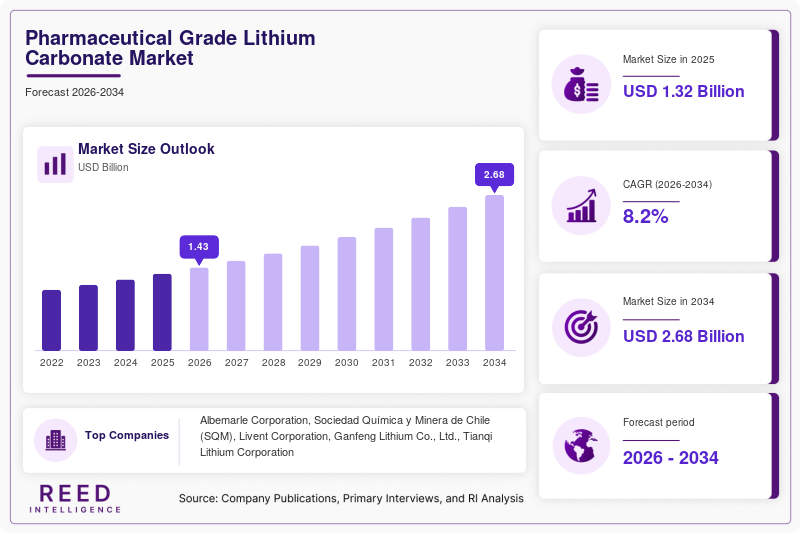
The Pharmaceutical Grade Lithium Carbonate Market size was valued at approximately USD 1.32 billion in 2026 and is projected to reach USD 2.48 billion by 2034, expanding at a CAGR of 8.2% during the forecast period (2026–2034). The market has demonstrated consistent expansion due to the growing global burden of psychiatric disorders, particularly bipolar disorder, where lithium carbonate remains a clinically established mood stabilizer.
One of the key global factors supporting market growth is the increasing awareness and diagnosis of mental health conditions, driven by improved healthcare access and reduced social stigma. Governments and healthcare organizations have expanded mental health programs, leading to higher prescription rates of lithium-based medications.
Key Highlights
- North America dominated the market with a 38.6% share in 2025, while Asia Pacific is expected to register the fastest growth at a CAGR of 9.5%.
- By application, bipolar disorder treatment accounted for the largest share at 61.2% in 2025, whereas neuroprotective therapies are projected to grow fastest at a CAGR of 10.1%.
- By purity type, ≥99.5% purity lithium carbonate held the dominant share of 54.7% in 2025, while ultra-high purity grades (≥99.9%) are anticipated to expand at a CAGR of 9.8%.
- The United States remained the dominant country, with market values of USD 402 million in 2024 and USD 428 million in 2025.
Market Trends
Rising Integration of Lithium in Neurodegenerative Research
Lithium carbonate is increasingly being explored for its neuroprotective properties beyond traditional psychiatric applications. Research into Alzheimer’s disease, Parkinson’s disease, and other neurodegenerative conditions is expanding, with lithium being evaluated for its ability to regulate cellular signaling pathways and reduce neuroinflammation. This trend is gradually shifting the perception of lithium from a niche psychiatric drug to a broader neurological therapeutic candidate.
Shift Toward High-Purity Pharmaceutical Grades
Pharmaceutical manufacturers are focusing on higher purity lithium carbonate to meet stringent regulatory requirements and improve drug efficacy. The demand for ultra-high purity grades (≥99.9%) is rising due to their reduced impurity levels and improved patient safety profiles. This shift is also supported by advancements in refining technologies, enabling manufacturers to produce consistent, high-quality pharmaceutical-grade lithium compounds.
Market Drivers
Increasing Prevalence of Bipolar Disorder and Mood Disorders
The growing incidence of bipolar disorder and related mood disorders has significantly contributed to the demand for pharmaceutical grade lithium carbonate. Lithium remains a first-line treatment due to its proven effectiveness in stabilizing mood swings and preventing relapse. As diagnosis rates improve globally, particularly in emerging economies, the demand for lithium-based medications continues to rise.
Expansion of Mental Health Infrastructure
Governments and private healthcare providers are investing in mental health services, including specialized psychiatric care facilities and telemedicine platforms. This expansion has improved patient access to treatment, leading to higher prescription volumes of lithium carbonate. In addition, reimbursement policies in developed regions have made treatment more affordable, further boosting market growth.
Market Restraint
Narrow Therapeutic Index and Side Effects
Lithium carbonate has a narrow therapeutic index, requiring careful monitoring of dosage to avoid toxicity. Side effects such as kidney dysfunction, thyroid abnormalities, and gastrointestinal issues can limit its use, particularly among elderly patients. These concerns have led some clinicians to consider alternative therapies, thereby restraining market expansion.
Market Opportunities
Emerging Applications in Neurodegenerative Diseases
Ongoing research into lithium’s role in neuroprotection presents a significant opportunity for market expansion. Clinical trials investigating its efficacy in slowing disease progression in Alzheimer’s and Parkinson’s patients could open new therapeutic avenues and increase demand for pharmaceutical grade lithium carbonate.
Growth in Emerging Markets
Developing regions such as Asia Pacific and Latin America offer substantial growth potential due to improving healthcare infrastructure and rising awareness of mental health. Increasing investments in pharmaceutical manufacturing and favorable regulatory reforms are expected to create new opportunities for market players.
Segmental Analysis
By Purity Type
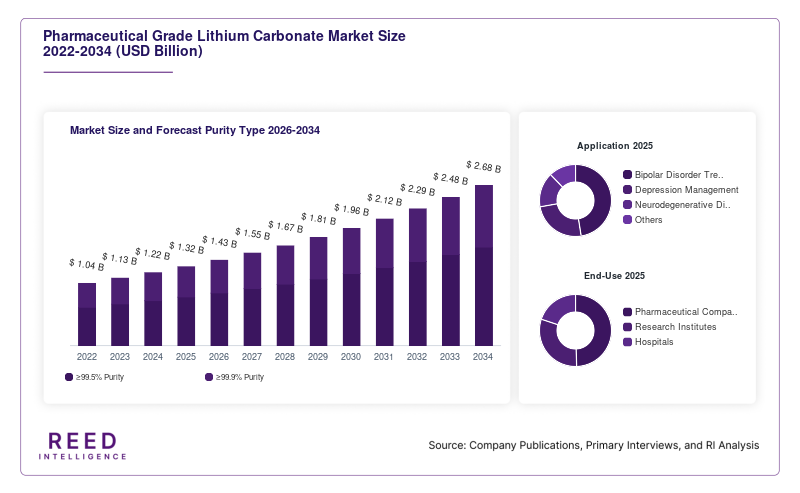
The ≥99.5% purity segment dominated the market with a 54.7% share in 2025, as it is widely used in standard pharmaceutical formulations due to its balance between cost and quality.
The ≥99.9% purity segment is expected to grow at the fastest CAGR of 9.8%, driven by increasing regulatory requirements and demand for high-quality drug formulations with minimal impurities.
By Application
The bipolar disorder treatment segment accounted for the largest share of 61.2% in 2025, reflecting lithium’s long-standing role as a primary treatment option.
The neurodegenerative disease segment is projected to grow at a CAGR of 10.1%, supported by ongoing clinical research and expanding therapeutic applications.
By End-Use
The pharmaceutical companies segment held the dominant share of 68.5% in 2025, as these organizations are the primary producers of lithium-based medications.
The research institutes segment is expected to grow at a CAGR of 9.3%, driven by increased funding for neurological and psychiatric research.
By Distribution Channel
The direct sales segment dominated with a 57.9% share in 2025, as pharmaceutical manufacturers prefer direct procurement for quality assurance and cost efficiency.
The third-party distributors segment is anticipated to grow at a CAGR of 8.7%, supported by expanding global supply chains and increased outsourcing.
Regional Analysis
North America
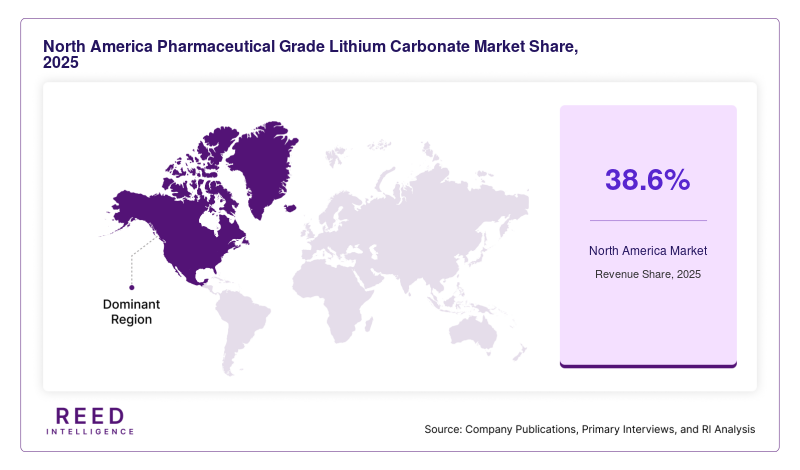
North America accounted for a 38.6% share of the Pharmaceutical Grade Lithium Carbonate Market in 2025 and is expected to grow at a CAGR of 7.8% during the forecast period. The United States dominated the region due to its advanced healthcare system and high mental health awareness. The presence of well-established pharmaceutical companies and strong regulatory frameworks contributed to consistent demand.
Europe
Europe held a 27.4% market share in 2025 and is projected to grow at a CAGR of 7.6%. Germany emerged as the dominant country, supported by its robust pharmaceutical manufacturing sector and widespread adoption of lithium-based therapies. Increasing government initiatives to address mental health challenges have further strengthened market growth.
Asia Pacific
Asia Pacific captured 21.8% of the market in 2025 and is anticipated to expand at the fastest CAGR of 9.5%. China led the region due to its strong lithium production capabilities and growing pharmaceutical industry. Rising awareness of mental health and increasing healthcare spending are key factors driving regional growth.
Middle East & Africa
The Middle East & Africa accounted for 6.2% of the market share in 2025 and is expected to grow at a CAGR of 6.9%. Saudi Arabia dominated the region, driven by government investments in healthcare infrastructure and mental health programs. However, limited awareness in certain areas remains a challenge.
Latin America
Latin America held a 6.0% share in 2025 and is projected to grow at a CAGR of 7.2%. Brazil emerged as the leading country, supported by improving healthcare access and increasing diagnosis rates of psychiatric disorders. The expansion of pharmaceutical distribution networks has further supported market growth.
Competitive Landscape
The Pharmaceutical Grade Lithium Carbonate Market is moderately consolidated, with key players focusing on product quality, supply chain integration, and research collaborations. Leading companies include Albemarle Corporation, SQM S.A., Livent Corporation, Ganfeng Lithium Co., Ltd., and Tianqi Lithium Corporation. Among these, Albemarle Corporation is a market leader due to its extensive lithium production capacity and strong global distribution network.
The company has recently expanded its pharmaceutical-grade lithium refining capabilities to meet rising demand from the healthcare sector. Other players are investing in advanced purification technologies and strategic partnerships with pharmaceutical firms to strengthen their market presence. Competition is driven by product purity, regulatory compliance, and pricing strategies. Companies are also exploring sustainable lithium extraction methods to align with environmental regulations and improve long-term supply stability.
Key Players List
- Albemarle Corporation
- Sociedad Química y Minera de Chile (SQM)
- Livent Corporation
- Ganfeng Lithium Co., Ltd.
- Tianqi Lithium Corporation
- Jiangxi Special Electric Motor Co., Ltd.
- FMC Corporation
- Sichuan Yahua Industrial Group Co., Ltd.
- LevertonHELM Limited
- American Elements
- Merck KGaA
- Tokyo Chemical Industry Co., Ltd.
- Noah Technologies Corporation
- Thermo Fisher Scientific Inc.
- Central Glass Co., Ltd.
Recent Developments
- In 2025, a leading lithium producer expanded its pharmaceutical-grade lithium carbonate production capacity to address growing demand from mental health drug manufacturers.
- A major pharmaceutical company initiated clinical trials exploring lithium carbonate’s efficacy in treating early-stage Alzheimer’s disease.
- Several manufacturers adopted advanced purification technologies to produce ultra-high purity lithium carbonate, improving product quality and compliance with regulatory standards.
- Strategic collaborations between lithium suppliers and pharmaceutical firms increased, aiming to secure long-term supply agreements.
- Governments in emerging economies introduced policies to support domestic production of pharmaceutical-grade lithium compounds, reducing reliance on imports.
Pharmaceutical Grade Lithium Carbonate Market Segments
Purity Type
- ≥99.5% Purity
- ≥99.9% Purity
Application
- Bipolar Disorder Treatment
- Depression Management
- Neurodegenerative Diseases
- Others
End-Use
- Pharmaceutical Companies
- Research Institutes
- Hospitals
Distribution Channel
- Direct Sales
- Third-Party Distributors
By Region
- North America
- Europe
- APAC
- Middle East and Africa
- LATAM