Pharmaceutical Manufacturing And Processing Equipment Market Size, Share & Demand Report By Equipment Type (Mixing and Blending Equipment, Granulation Equipment, Drying Equipment, Filtration Equipment), By Application (Solid Dosage Manufacturing, Liquid Dosage Manufacturing), By End User (Pharmaceutical Manufacturers, Biopharmaceutical Companies), By Automation Level (Manual Equipment, Semi-Automated Equipment), By Region & Segment Forecasts, 2026–2034
USD 3950
Market Overview
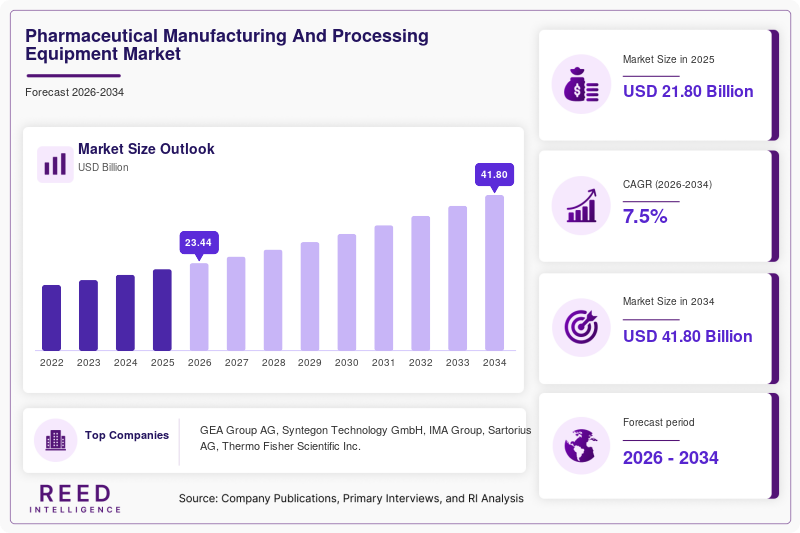
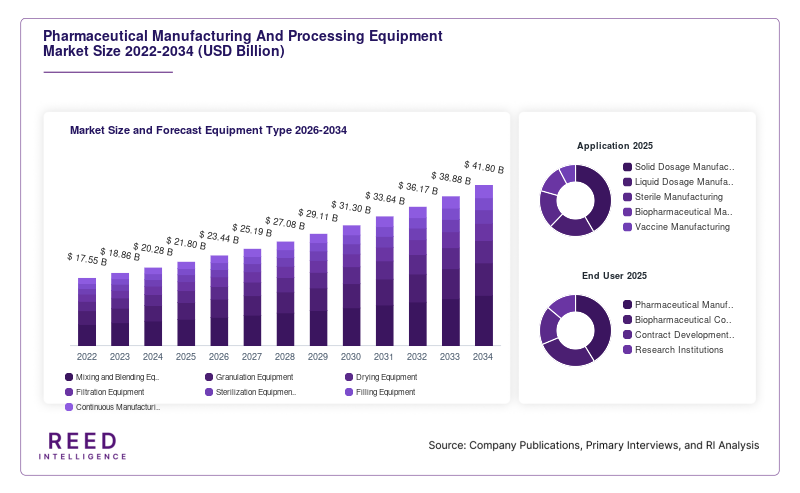
The Pharmaceutical Manufacturing And Processing Equipment Market was valued at USD 21.8 billion in 2026 and is projected to reach USD 38.9 billion by 2034, expanding at a CAGR of 7.5% during the forecast period (2026–2034). Pharmaceutical manufacturing and processing equipment comprises a wide range of machinery and integrated systems used in formulation, granulation, mixing, drying, sterilization, filling, packaging, and quality assurance processes across pharmaceutical production facilities. These systems play a critical role in ensuring product consistency, regulatory compliance, manufacturing efficiency, and scalability.
A significant global factor supporting market expansion has been the sustained increase in pharmaceutical production capacity worldwide. Growing demand for prescription medicines, biologics, vaccines, and specialty therapeutics has encouraged manufacturers to invest in advanced production infrastructure and automated processing technologies. As pharmaceutical companies expand manufacturing footprints and modernize facilities, demand for sophisticated processing equipment continues to rise.
Key Highlights
- North America dominated the market with 35.9% share in 2025, while Asia Pacific is projected to register the fastest CAGR of 9.2% during 2026–2034.
- By Equipment Type, Mixing and Blending Equipment held the largest share of 24.6% in 2025, while Continuous Manufacturing Equipment is expected to expand at a CAGR of 10.4%.
- By Application, Solid Dosage Manufacturing accounted for 38.8% market share in 2025, whereas Biopharmaceutical Manufacturing is projected to grow at a CAGR of 10.8%.
- By End User, Pharmaceutical Manufacturers represented 63.7% of market revenue in 2025, while Contract Development and Manufacturing Organizations (CDMOs) are anticipated to grow at a CAGR of 9.7%.
- By Automation Level, Semi-Automated Equipment captured 48.3% share in 2025, while Fully Automated Equipment is forecast to register a CAGR of 11.2%.
- The United States remained the dominant country market and was valued at USD 5.48 billion in 2024, increasing to USD 5.82 billion in 2025.
Market Trends
Growing Adoption of Continuous Manufacturing Technologies
Continuous manufacturing is gaining momentum across pharmaceutical production environments. Compared with traditional batch manufacturing processes, continuous systems enable uninterrupted production, reduced material loss, improved process consistency, and enhanced operational efficiency. Pharmaceutical companies are increasingly investing in continuous processing technologies to optimize throughput and maintain quality standards. The trend is expected to accelerate as manufacturers seek greater productivity and cost efficiency.
Expansion of Smart Manufacturing and Industry 4.0 Integration
The integration of Industry 4.0 technologies is reshaping pharmaceutical production facilities. Equipment manufacturers are embedding sensors, industrial analytics platforms, predictive maintenance tools, and cloud-based monitoring systems into processing equipment. These technologies improve equipment utilization, enhance production visibility, and support regulatory compliance. Smart manufacturing adoption continues to influence purchasing decisions across pharmaceutical facilities worldwide.
Market Drivers
Increasing Pharmaceutical Production Capacity Expansion
Global pharmaceutical manufacturers continue expanding production infrastructure to address rising demand for medicines and healthcare products. New manufacturing plants and facility expansion projects require advanced equipment capable of supporting higher production volumes and regulatory standards. Growing investments in pharmaceutical infrastructure are contributing significantly to market expansion.
Rising Demand for Biologics Manufacturing Infrastructure
The growing commercialization of biologic drugs is driving demand for highly specialized manufacturing systems. Production of biologics requires advanced processing equipment capable of maintaining sterile environments and precise process parameters. Increasing biologics approvals and commercial launches are encouraging pharmaceutical companies to invest in dedicated production facilities and advanced equipment technologies.
Market Restraint
High Capital Investment Requirements
The acquisition, installation, validation, and maintenance of pharmaceutical processing equipment involve substantial capital expenditure. Smaller manufacturers often face budget constraints when upgrading production facilities or implementing advanced automation systems. These high upfront costs may delay equipment replacement cycles and limit adoption among certain market participants.
Market Opportunities
Expansion of Contract Manufacturing Facilities
The rapid growth of contract manufacturing services is creating substantial opportunities for equipment suppliers. CDMOs are expanding manufacturing capacity to support increasing outsourcing demand from pharmaceutical companies. Facility expansions require investments in formulation, processing, packaging, and inspection equipment, creating favorable market conditions.
Emergence of Personalized Medicine Manufacturing
The development of personalized therapeutics is creating demand for flexible and modular production systems. Future pharmaceutical manufacturing environments will increasingly require equipment capable of handling smaller production batches while maintaining efficiency and precision. Equipment manufacturers that develop adaptable manufacturing platforms are expected to benefit from this evolving trend.
Segmental Analysis
By Equipment Type
The Pharmaceutical Manufacturing And Processing Equipment Market is segmented into Mixing and Blending Equipment, Granulation Equipment, Drying Equipment, Filtration Equipment, Sterilization Equipment, Filling Equipment, and Continuous Manufacturing Equipment.
Mixing and Blending Equipment held the dominant share of 24.6% in 2025. The segment maintained leadership because blending operations are fundamental to a wide range of pharmaceutical manufacturing processes. Consistent product quality and formulation uniformity continue to drive equipment demand across pharmaceutical production facilities.
Continuous Manufacturing Equipment is projected to register the fastest CAGR of 10.4% during the forecast period. Growth will be supported by increasing adoption of uninterrupted production technologies that improve efficiency, reduce waste, and enhance product consistency. Pharmaceutical manufacturers will continue investing in continuous processing systems to improve operational performance.
By Application
The market is segmented into Solid Dosage Manufacturing, Liquid Dosage Manufacturing, Sterile Manufacturing, Biopharmaceutical Manufacturing, and Vaccine Manufacturing.
Solid Dosage Manufacturing accounted for 38.8% of market revenue in 2025. The segment dominated due to extensive global production of tablets, capsules, and oral formulations. High production volumes generated sustained demand for associated manufacturing and processing equipment.
Biopharmaceutical Manufacturing is expected to expand at a CAGR of 10.8% through 2034. Growth will result from increasing commercialization of biologic therapies requiring specialized production systems capable of maintaining strict process controls and sterile environments.
By End User
The market is segmented into Pharmaceutical Manufacturers, Biopharmaceutical Companies, Contract Development and Manufacturing Organizations (CDMOs), and Research Institutions.
Pharmaceutical Manufacturers held the largest share of 63.7% in 2025. Large-scale commercial production operations and ongoing facility expansion projects contributed to significant procurement of manufacturing equipment.
CDMOs are forecast to register a CAGR of 9.7% during 2026–2034. Growth will be driven by increasing outsourcing of pharmaceutical manufacturing activities and rising demand for flexible production services across global markets.
By Automation Level
The market is segmented into Manual Equipment, Semi-Automated Equipment, and Fully Automated Equipment.
Semi-Automated Equipment accounted for 48.3% share in 2025. Manufacturers favored semi-automated systems due to their balance between productivity enhancement and manageable investment costs. These solutions remain widely utilized across pharmaceutical facilities.
Fully Automated Equipment is projected to grow at a CAGR of 11.2% through 2034. Increasing emphasis on process efficiency, labor optimization, and production accuracy will support adoption of advanced automated manufacturing technologies.
Regional Analysis
North America
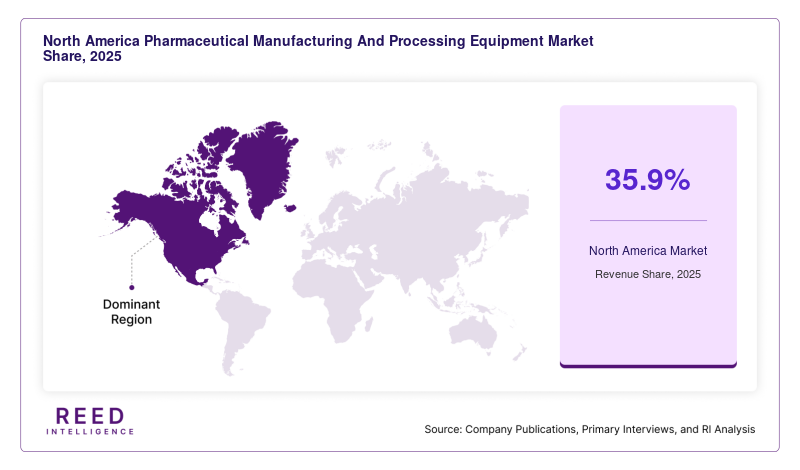
North America accounted for 35.9% of the global Pharmaceutical Manufacturing And Processing Equipment Market share in 2025 and is projected to expand at a CAGR of 6.8% through 2034.
The United States remained the dominant country market. Growth was supported by ongoing modernization of pharmaceutical manufacturing facilities and increasing investment in domestic drug production infrastructure. Manufacturers continued adopting advanced processing systems to improve production efficiency and meet regulatory requirements.
Europe
Europe represented 28.4% of global market revenue in 2025 and is forecast to register a CAGR of 6.9% during the forecast period.
Germany emerged as the dominant country market. The country's strong industrial engineering capabilities and established pharmaceutical manufacturing base supported continued investment in advanced processing technologies. Equipment upgrades designed to improve operational performance contributed significantly to regional growth.
Asia Pacific
Asia Pacific held 24.1% market share in 2025 and is anticipated to expand at a CAGR of 9.2% during 2026–2034.
China remained the largest country market. Growth was driven by substantial investments in pharmaceutical production infrastructure and increasing domestic drug manufacturing activity. The country's expanding industrial base supported strong demand for modern processing equipment across multiple pharmaceutical sectors.
Middle East & Africa
The Middle East & Africa accounted for 5.2% of global market revenue in 2025 and is expected to grow at a CAGR of 7.8% during the forecast period.
Saudi Arabia represented the dominant country market. Government initiatives aimed at strengthening domestic pharmaceutical manufacturing capabilities encouraged investments in modern production facilities and associated processing equipment.
Latin America
Latin America captured 6.4% of the global Pharmaceutical Manufacturing And Processing Equipment Market share in 2025 and is projected to register a CAGR of 7.1% through 2034.
Brazil remained the leading country market. Growth was supported by ongoing investments in pharmaceutical manufacturing expansion and increased focus on improving domestic healthcare production capabilities.
Competitive Landscape
The Pharmaceutical Manufacturing And Processing Equipment Market remains highly competitive, with global manufacturers focusing on product innovation, automation integration, strategic partnerships, and geographic expansion. Companies continue investing in advanced engineering capabilities to meet evolving pharmaceutical manufacturing requirements.
GEA Group AG
GEA Group AG maintained a leading position due to its extensive portfolio of pharmaceutical processing technologies. The company recently introduced upgraded continuous manufacturing systems featuring enhanced automation and process monitoring capabilities designed to improve production efficiency.
Syntegon Technology GmbH
Syntegon Technology GmbH continues expanding its pharmaceutical processing solutions portfolio, focusing on flexible manufacturing technologies and integrated production systems.
IMA Group
IMA Group remains active in equipment innovation, offering advanced pharmaceutical processing, filling, and packaging technologies that support operational optimization.
Sartorius AG
Sartorius AG continues strengthening its position in biopharmaceutical manufacturing equipment through investments in process technologies and production solutions designed for biologic manufacturing environments.
Thermo Fisher Scientific Inc.
Thermo Fisher Scientific Inc. maintains a strong presence through integrated manufacturing solutions supporting pharmaceutical and biopharmaceutical production requirements across global markets.
Key Players List
- GEA Group AG
- Syntegon Technology GmbH
- IMA Group
- Sartorius AG
- Thermo Fisher Scientific Inc.
- Bausch+Ströbel SE + Co. KG
- Körber AG
- Romaco Group
- Marchesini Group S.p.A.
- Fette Compacting GmbH
- Glatt GmbH
- ACG Group
- SPX FLOW Inc.
- SaintyCo
- Cadmach Machinery Co. Pvt. Ltd.
Recent Developments
- In January 2026, a leading equipment manufacturer launched an advanced continuous pharmaceutical production platform featuring integrated digital monitoring capabilities.
- In April 2026, multiple pharmaceutical companies expanded production facilities, resulting in increased procurement of automated processing systems.
- In August 2026, equipment suppliers introduced enhanced sterile processing technologies designed for biologics and vaccine manufacturing applications.
- In November 2026, manufacturers launched predictive maintenance solutions utilizing artificial intelligence to improve equipment reliability and operational efficiency.
- In February 2027, several companies expanded modular manufacturing equipment portfolios to support flexible pharmaceutical production environments.
- In June 2027, strategic partnerships were announced between automation providers and pharmaceutical equipment manufacturers to accelerate smart factory implementation.
- In October 2027, next-generation filling and packaging systems were introduced with enhanced traceability and process control capabilities.
- In March 2028, major equipment suppliers expanded regional manufacturing operations to meet growing demand from emerging pharmaceutical markets.
Pharmaceutical Manufacturing And Processing Equipment Market Segments
Equipment Type
- Mixing and Blending Equipment
- Granulation Equipment
- Drying Equipment
- Filtration Equipment
- Sterilization Equipment
- Filling Equipment
- Continuous Manufacturing Equipment
Application
- Solid Dosage Manufacturing
- Liquid Dosage Manufacturing
- Sterile Manufacturing
- Biopharmaceutical Manufacturing
- Vaccine Manufacturing
End User
- Pharmaceutical Manufacturers
- Biopharmaceutical Companies
- Contract Development and Manufacturing Organizations (CDMOs)
- Research Institutions
Automation Level
- Manual Equipment
- Semi-Automated Equipment
- Fully Automated Equipment
By Region
- North America
- Europe
- APAC
- Middle East and Africa
- LATAM