Global Pharmacovigilance and Drug Safety Software Market Size, Share & Trends Analysis Report By Software Type (Adverse Event Reporting Software, Drug Safety Data Management Software, Signal Detection Software, Risk Management Software), By Delivery Mode (On-Premise Software, Cloud-Based Software, Web-Based Software), By Country (North America, Europe, APAC, Middle East and Africa, Latin America) and Forecast, 2026-2034
USD 3950
Pharmacovigilance and Drug Safety Software Market Size
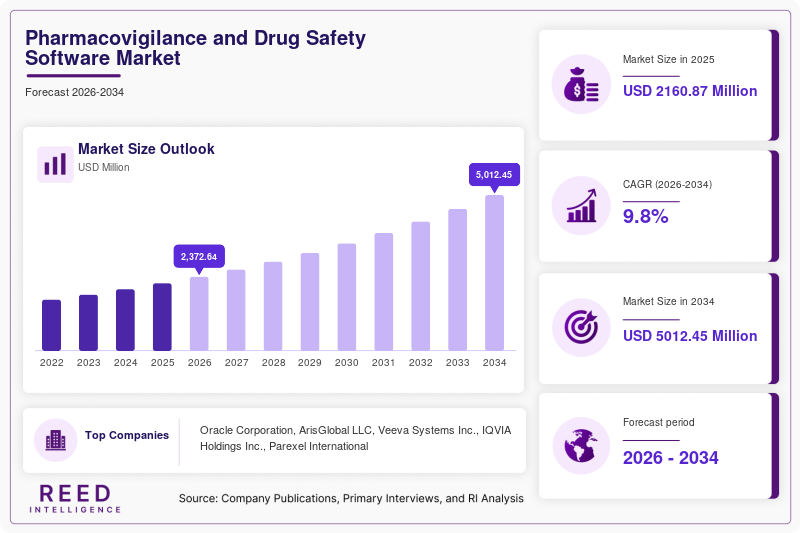
Global Pharmacovigilance and Drug Safety Software Market size is projected at USD 2,372.64 million in 2026 and is expected to hit USD 5,018.83 million by 2034 with a CAGR of 9.8%. The 2025 base-year valuation stood at USD 2,160.56 million, implying an absolute expansion of USD 2,646.19 million between 2026 and 2034. Demand assessment requires detailed analysis across software type, delivery mode, functionality, end user, geography, technology adoption, and an increasingly competitive vendor landscape.
Key Takeaways
- Asia Pacific dominates geographically, accounting for approximately 35.63% of 2026 revenue, while North America represents approximately 31.11%; North America records the fastest regional CAGR at 10.00%.
- Adverse Event Reporting Software leads software-type revenue with approximately 33.14% in 2026 and USD 786.07 million, reaching USD 1,639.01 million by 2034 at 9.62% CAGR.
- Regulatory Compliance Software is the fastest-growing software category at 10.01% CAGR, increasing from USD 258.13 million in 2026 to USD 553.72 million by 2034.
- Asia Pacific expands from USD 845.51 million in 2026 to USD 1,766.80 million in 2034 at 9.65% CAGR, supported by pharmaceutical development, outsourcing, digitization, and regulatory modernization.
- North America rises from USD 738.18 million to USD 1,582.35 million over 2026–2034, adding USD 844.17 million in annual revenue.
The market encompasses software platforms used to collect, validate, process, analyze, monitor, and submit drug-safety information across pre-market and post-market lifecycles. Asia Pacific contributes 35.63% of the 2026 global value, compared with 31.11% for North America, 20.13% for Europe, 7.99% for Middle East and Africa, and 5.13% for Latin America. By software type, Adverse Event Reporting Software contributes approximately 33.14%, Drug Safety Data Management Software 20.44%, Signal Detection Software 15.21%, Risk Management Software 14.77%, Regulatory Compliance Software 10.88%, and EDC and Analytics Integration Tools 5.57%. These percentages indicate strong penetration of core case-management systems while advanced signal, analytics, and regulatory automation applications continue gaining operational relevance.
Pharmacovigilance and Drug Safety Software Market Trends
AI-Enabled Safety Automation and Cloud-Native Pharmacovigilance
Artificial intelligence, natural-language processing, machine learning, and workflow automation are moving deeper into adverse-event intake, duplicate detection, narrative generation, coding, translation, signal prioritization, and regulatory reporting. IQVIA reports that modern safety case files can reach roughly 20 MB versus about 2 MB a decade earlier, illustrating a 10-fold increase in data intensity. Its safety operations also report intelligent automation translating 130 million words annually across 11 languages.
Technology adoption is shifting from isolated databases toward SaaS, multi-tenant cloud environments and interoperable safety ecosystems. In one 2025 implementation, a pharmaceutical organization processing approximately 20,000 safety cases annually selected a multi-tenant cloud platform across Japan, the United States, and Europe. Separately, AI-assisted signal technology has demonstrated an 80% reduction in signal-assessment time in a major deployment, reinforcing demand for automation where expanding case volumes strain manual workflows.
Pharmacovigilance and Drug Safety Software Market Drivers
Escalating Safety Data Volumes Accelerate Automation
Rising volumes of structured and unstructured safety information are increasing requirements for scalable intake, processing, analytics, and compliance infrastructure. Individual case files have expanded from approximately 2 MB historically to as much as 20 MB as audio, video, documents, and digital channels enter safety workflows—a roughly 900% increase in file size. AI-based platforms are consequently targeting labor-intensive activities, with emerging solutions reporting efficiency improvements of up to 70% and regulatory-report preparation reductions of approximately 90%. These economics strengthen investment in automated case processing, NLP-assisted classification, and real-time surveillance.
Pharmacovigilance and Drug Safety Software Market Restraints
Validation, Governance and Integration Complexity Restrains Pharmacovigilance and Drug Safety Software Market Growth
Safety-critical AI deployment requires extensive validation, human oversight, auditability, data governance, and integration with established databases. Research evaluating automated drug-safety extraction reported an F1 score of 0.882, recall of 0.983 and precision of 0.799, illustrating both substantial automation potential and residual error risk. Meanwhile, a 10-fold increase in typical safety-case data volume increases storage, migration, validation, and processing complexity. These factors can extend implementation cycles, particularly for organizations operating multiple validated legacy environments.
Pharmacovigilance and Drug Safety Software Market Opportunities
Generative AI and Unified Safety Platforms Expand Automation Potential
The transition toward unified safety environments creates opportunities for vendors integrating intake, case management, signals, analytics, regulatory operations, and quality processes. Graph AI reported automation-driven efficiency gains reaching 70% and a 90% reduction in regulatory-report preparation time while supporting a pipeline exceeding 7,000 marketed drugs. In parallel, ArisGlobal introduced three new offerings in March 2025 spanning unified R&D compliance, AI-enabled insights, and compliance documentation, demonstrating continued investment in connected safety and regulatory architectures.
Challenges in Global Pharmacovigilance and Drug Safety Software Market
AI Reliability and Global Regulatory Variation Increase Operational Risk
Software suppliers must reconcile automation speed with medical accuracy, explainability and inspection-ready controls. AI-generated safety content can create hallucination and terminology risks without specialized guardrails, while global operations must support multiple submission standards, languages and jurisdictions. Modern platforms increasingly incorporate FDA, EU and PMDA workflows; IQVIA reports intelligent automation supporting 11 languages and 130 million translated words annually. Maintaining near-100% traceability while automating high-volume workflows therefore remains a major technical and governance challenge.
Pharmacovigilance and Drug Safety Software Market Segmentation
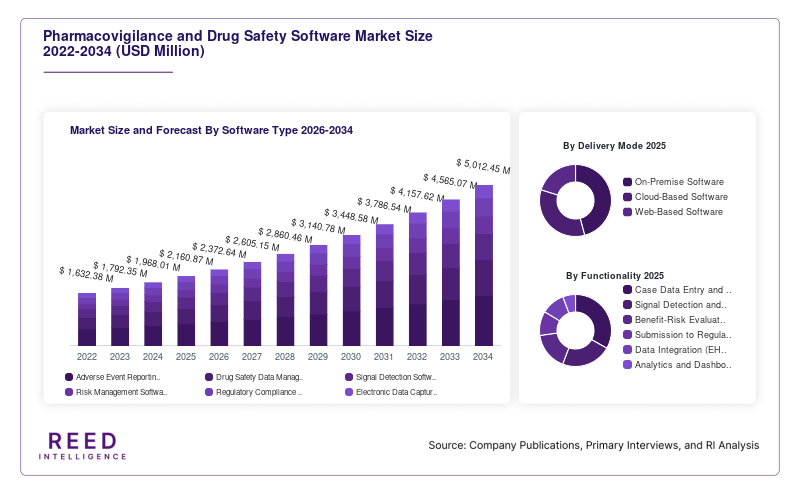
The industry is segmented by software type, delivery mode, functionality, and end user. Software-type data show Adverse Event Reporting Software commanding approximately 33.14% of 2026 revenue, followed by Drug Safety Data Management Software at 20.44%. Regulatory Compliance Software is the fastest-expanding identified software category with a 10.01% CAGR.
By Software Type
Adverse Event Reporting Software is the largest subsegment, increasing from USD 717.09 million in 2025 to USD 786.07 million in 2026 and USD 1,639.01 million by 2034 at a 9.62% CAGR. Drug Safety Data Management Software reaches USD 484.72 million in 2026, while Signal Detection Software and Risk Management Software account for USD 360.71 million and USD 350.25 million, respectively.
Regulatory Compliance Software records the fastest CAGR at 10.01%, expanding from USD 258.13 million in 2026 to USD 553.72 million in 2034. EDC and Analytics Integration Tools rise from USD 132.09 million to USD 274.20 million at 9.56%, while Signal Detection Software reaches USD 768.18 million at a 9.91% CAGR.
By Delivery Mode
The delivery-mode structure comprises on-premise, cloud-based, and web-based software. Cloud deployment is increasingly central to safety modernization because multi-tenant architectures support geographically distributed operations, upgrades, scalability, and integration. A documented 2025 LifeSphere implementation covers 3 major regions and approximately 20,000 safety cases annually, demonstrating the operational scale being migrated toward cloud infrastructure.
No delivery-mode revenue or CAGR figures were supplied in the mandatory dataset; consequently, numerical subsegment values are not fabricated. Industry evidence nevertheless indicates increasing SaaS orientation, with IQVIA describing its Vigilance Platform as a secure SaaS environment supporting high-volume case processing, multilingual requirements, AI, ML and NLP workflows.
By Functionality
Functionality spans case data entry and processing, signal detection and management, benefit-risk evaluation, regulatory submission, EHR/EDC/CRO integration, and analytics dashboards. Automation is particularly significant in signal assessment, where an advanced deployment has demonstrated up to 80% faster assessment compared with traditional approaches.
No functionality-level revenue or CAGR figures were included in the supplied tables, so values are not estimated. Operational indicators nonetheless show substantial automation potential: emerging AI platforms report efficiency improvements reaching 70% and regulatory-report preparation time reductions of 90%, while automated safety-label extraction research achieved 0.983 recall.
By End User
Pharmaceutical and biotechnology companies, CROs, regulatory agencies, BPO firms, and healthcare providers represent the principal end-user categories. Large pharmaceutical organizations generate particularly demanding workloads because safety activities span clinical development, marketed products, multiple countries, medical literature, digital channels, and regulatory submissions; one documented enterprise implementation handles around 20,000 cases per year across 3 regions.
The supplied dataset does not provide end-user revenue or CAGR values, preventing defensible numerical ranking. Nevertheless, consolidation between technology and outsourced services is increasing: Parexel's 2026 acquisition of Vitrana combines AI-enabled technology with pharmacovigilance services, including EDC and serious-adverse-event reconciliation, reflecting growing demand for integrated technology-service models.
Pharmacovigilance and Drug Safety Software Market Regional Outlook
North America
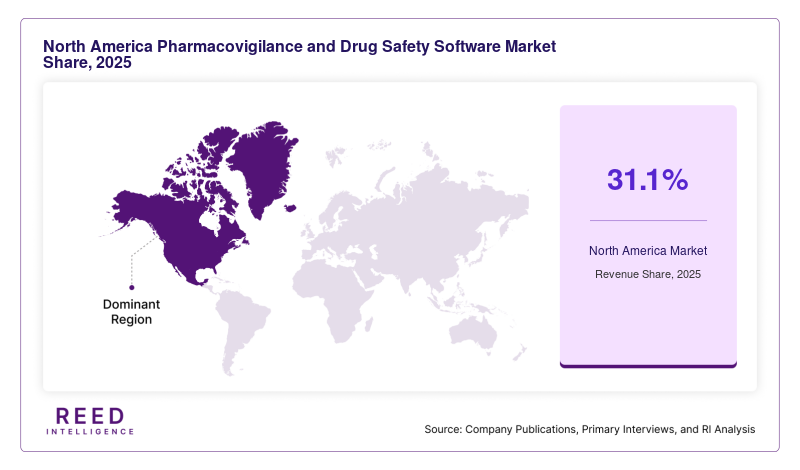
North America accounts for approximately 31.11% of global 2026 revenue, increasing from USD 671.07 million in 2025 to USD 738.18 million in 2026 and USD 1,582.35 million by 2034 at the fastest regional CAGR of 10.00%. The United States represents the region's principal technology and pharmaceutical ecosystem, supported by FDA reporting requirements, large biopharmaceutical pipelines, CRO activity and adoption of cloud-based safety systems.
Europe
Europe represents approximately 20.13% of 2026 revenue at USD 477.59 million, compared with USD 434.49 million in 2025. Revenue is projected to reach USD 1,017.82 million by 2034 at 9.92% CAGR. Germany, the United Kingdom, France, Italy and other pharmaceutical centers underpin regional activity, while EudraVigilance requirements support continuing investment in case management, signal detection, risk evaluation and regulatory submission infrastructure.
APAC
Asia Pacific leads with approximately 35.63% of 2026 revenue, equivalent to USD 845.51 million versus USD 771.10 million in 2025. The region is projected to reach USD 1,766.80 million by 2034 at 9.65% CAGR. China, Japan, India and South Korea contribute through pharmaceutical manufacturing, clinical research, outsourcing, biotechnology investment and digital transformation, with large case-processing operations supporting demand for scalable platforms.
Middle East and Africa
Middle East and Africa accounts for approximately 7.99% in 2026, with revenue rising from USD 173.06 million in 2025 to USD 189.55 million in 2026 and USD 392.64 million by 2034 at 9.53% CAGR. Gulf markets, South Africa and expanding healthcare systems support adoption as pharmacovigilance frameworks mature and multinational pharmaceutical companies strengthen regional compliance infrastructure.
Latin America
Latin America contributes approximately 5.13% in 2026, valued at USD 121.81 million compared with USD 110.84 million in 2025. Revenue is forecast to reach USD 259.22 million by 2034 at 9.90% CAGR. Brazil and Mexico form major regional pharmaceutical centers, while expanding clinical research, post-market monitoring and regulatory digitization reinforce requirements for adverse-event reporting and compliance platforms.
Top players in Global Pharmacovigilance and Drug Safety Software Market
- Oracle Corporation
- ArisGlobal LLC
- Veeva Systems Inc.
- IQVIA Holdings Inc.
- Parexel International
- Ennov
- Extedo GmbH
- ClinChoice
- Deloitte
- Accenture
- Cognizant
- Tata Consultancy Services
- Wipro
- ICON plc
- Laboratory Corporation of America Holdings
Top Two Companies
-
Oracle Corporation: Oracle is positioned prominently in enterprise pharmacovigilance through Argus Safety and related life-sciences technology infrastructure. Its competitive positioning centers on validated enterprise workflows, adverse-event case processing, regulatory reporting, integration, and suitability for complex multinational environments. The broader industry is moving toward automation as individual safety files expand from roughly 2 MB historically to as much as 20 MB, making scalable data architectures increasingly important. While a defensible company-specific percentage of this software market is not available from the supplied dataset, Oracle competes within a global opportunity valued at USD 2,372.64 million in 2026 and forecast to exceed USD 5 billion by 2034.
-
ArisGlobal LLC: ArisGlobal is strongly positioned through LifeSphere Safety, Advanced Signals, MultiVigilance and its NavaX AI capabilities. In April 2025, the company reported that Advanced Signals could enable up to 80% faster signal assessment, while an August 2025 deployment involved approximately 20,000 annual safety cases across Japan, the United States and Europe. These deployments reinforce its positioning around cloud-native, AI-supported safety transformation. A verified vendor-specific percentage cannot be calculated from the mandatory dataset and is therefore not fabricated.
Recent Developments in Global Pharmacovigilance and Drug Safety Software Market
- 2026: Parexel acquired Vitrana, adding an AI-enabled, system-agnostic pharmacovigilance technology platform supporting automated patient-safety processes, safety-database integration, EDC workflows and SAE reconciliation.
- 2025: ArisGlobal announced deployment of LifeSphere Safety by a Japan-based pharmaceutical organization processing approximately 20,000 safety cases annually across Japan, the United States and Europe.
- 2025: ArisGlobal reported its largest LifeSphere Advanced Signals deployment, with AI-supported capabilities designed to deliver up to 80% faster signal assessment than traditional manual processes.
- 2025: ArisGlobal introduced LifeSphere Unify, NavaX Insights and Advanced Compliance Docs, expanding integrated AI, safety, regulatory, quality and compliance capabilities.
- 2025: Graph AI raised USD 3 million in seed financing for its AI-driven pharmacovigilance platform, which reported efficiency improvements of up to 70%, regulatory-report preparation reductions of 90%, and support for more than 7,000 marketed drugs.
Pharmacovigilance and Drug Safety Software Market Segments
By Software Type
- Adverse Event Reporting Software
- Drug Safety Data Management Software
- Signal Detection Software
- Risk Management Software
- Regulatory Compliance Software
- Electronic Data Capture (EDC) and Analytics Integration Tools
By Delivery Mode
- On-Premise Software
- Cloud-Based Software
- Web-Based Software
By Functionality
- Case Data Entry and Processing
- Signal Detection and Management
- Benefit-Risk Evaluation
- Submission to Regulatory Authorities
- Data Integration (EHR, EDC, CRO)
- Analytics and Dashboards
By End User
- Pharmaceutical and Biotechnology Companies
- Contract Research Organizations (CROs)
- Regulatory Agencies
- Business Process Outsourcing (BPO) Firms
- Hospitals and Healthcare Providers
By Region
- North America
- Europe
- APAC
- Middle East and Africa
- LATAM