Phase Change Thermal Interface Material Market Size, Share & Demand Report By Material Type (Paraffin-Based Materials, Silicone-Based Materials, Non-Silicone Materials, Wax-Based Materials), By Application (Consumer Electronics, Automotive Electronics, Electric Vehicle Battery Systems, Telecommunications Equipment, Industrial Equipment, Medical Devices, Aerospace and Defense Electronics), By End-Use Industry (Electronics and Semiconductor Manufacturing, Automotive Manufacturing, Telecommunicatio
USD 3950
Market Overview
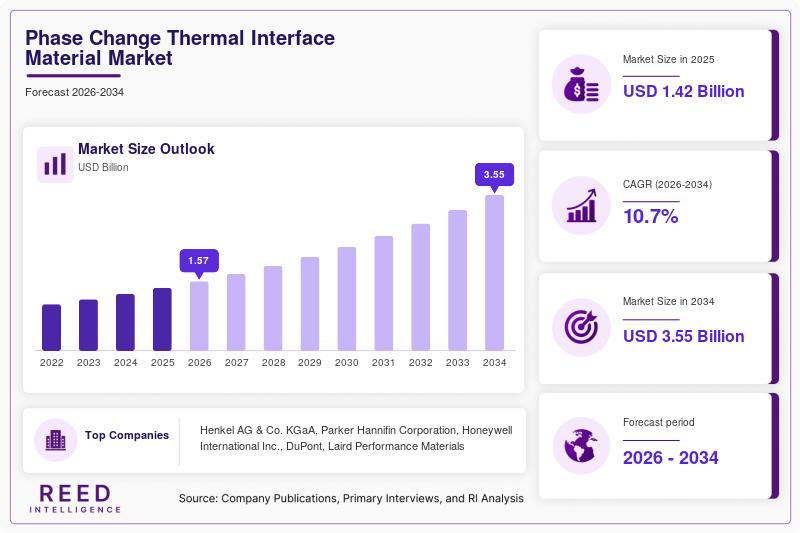
The global Phase Change Thermal Interface Material Market size was valued at USD 1.42 billion in 2026 and is projected to reach USD 3.21 billion by 2034, expanding at a CAGR of 10.7% during the forecast period. The market is witnessing stable expansion due to increasing demand for efficient heat dissipation solutions across consumer electronics, automotive electronics, telecommunications equipment, and industrial systems. Phase change thermal interface materials are widely used to improve thermal conductivity between heat-generating components and heat sinks. These materials offer enhanced reliability, reduced thermal resistance, and improved long-term performance in high-density electronic assemblies.
The growing adoption of artificial intelligence infrastructure, data centers, electric vehicles, and compact semiconductor devices has increased the need for advanced thermal management solutions. Manufacturers are investing in phase change materials that support low operating temperatures and higher durability in demanding environments. Demand is also rising from the aerospace and medical electronics sectors, where thermal stability is essential for operational performance. The increasing miniaturization of electronic devices and the rapid expansion of 5G infrastructure are further contributing to market growth.
Key Highlights
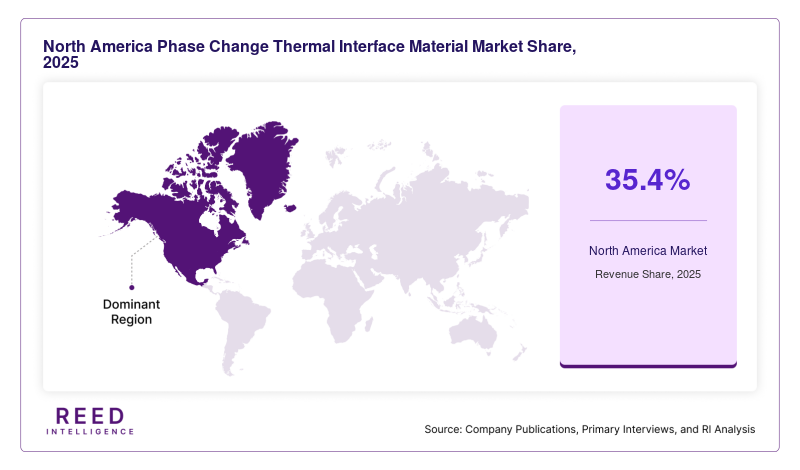
- North America dominated the market with a 35.4% share in 2025, while Asia Pacific is expected to grow at the fastest CAGR of 11.9% during 2026–2034.
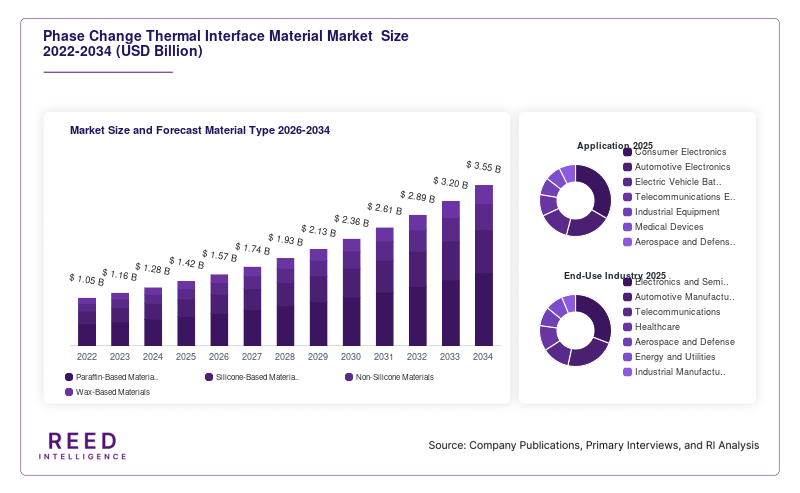
- By material type, paraffin-based materials accounted for the largest share of 39.1%, while non-silicone phase change materials are projected to grow at a CAGR of 12.3%.
- By application, consumer electronics led with a 36.8% share, whereas electric vehicle battery systems are expected to expand at a CAGR of 13.1%.
- By end-use industry, electronics and semiconductor manufacturing accounted for the highest share of 42.7%, while automotive manufacturing is anticipated to witness a CAGR of 12.6%.
- The United States remained the dominant country, with market values of USD 392 million in 2024 and USD 431 million in 2025.
Market Trends
Rising Integration of Thermal Management Solutions in AI and High-Performance Computing
The increasing deployment of artificial intelligence servers and high-performance computing systems is shaping the demand pattern within the Phase Change Thermal Interface Material Market. Data centers and advanced computing facilities generate substantial heat due to dense processor configurations and continuous computational workloads. As a result, manufacturers are integrating phase change thermal materials to maintain stable thermal performance and prevent overheating in processors, GPUs, and memory modules. The transition toward advanced packaging technologies in semiconductors is also creating demand for materials capable of supporting thinner interfaces with improved conductivity. Many technology companies are prioritizing thermal efficiency to reduce system downtime and improve energy utilization across server environments.
The trend is further supported by investments in hyperscale data centers across North America and Asia Pacific. Phase change thermal interface materials are becoming preferred solutions due to their ability to fill microscopic gaps between surfaces while maintaining long-term reliability. Product development efforts are increasingly focused on low-bleed formulations and enhanced thermal cycling resistance, which are important for high-performance applications. Growing demand for cloud computing and edge processing infrastructure is expected to sustain this trend throughout the forecast period.
Expanding Use of Advanced Thermal Materials in Electric Vehicles
The rapid growth of electric mobility is increasing the use of advanced thermal interface materials in automotive systems. Electric vehicles require effective heat dissipation solutions for battery packs, onboard chargers, power control units, and infotainment systems. Phase change thermal interface materials are gaining adoption because they help maintain stable operating temperatures and improve component reliability during long operating cycles. Automotive manufacturers are also emphasizing lightweight and compact thermal management solutions that align with evolving battery architectures and vehicle performance requirements.
The expansion of fast-charging infrastructure and high-capacity battery systems is creating additional opportunities for thermal material suppliers. Companies are developing products with higher thermal conductivity and better vibration resistance to meet automotive durability standards. The transition toward autonomous driving technologies and connected vehicle platforms is also contributing to increased electronic content in vehicles, which strengthens the requirement for efficient thermal solutions. This trend is expected to accelerate as governments continue to support electric vehicle production and charging infrastructure development across major automotive markets.
Market Drivers
Growing Demand for Miniaturized Consumer Electronics
The continuous reduction in the size of electronic devices is one of the primary growth drivers for the Phase Change Thermal Interface Material Market. Smartphones, tablets, wearable devices, gaming consoles, and compact laptops require advanced thermal management systems to maintain performance within limited internal space. Miniaturized components often generate concentrated heat, increasing the need for reliable thermal interface materials capable of reducing thermal resistance and supporting efficient heat transfer.
Manufacturers are increasingly adopting phase change materials because they provide consistent thermal contact between electronic components and heat sinks without excessive mechanical stress. The rise in consumer demand for multifunctional devices with higher processing speeds is further strengthening the requirement for advanced cooling materials. Product manufacturers are also focusing on thermal reliability to extend device lifespan and reduce maintenance costs. This driver remains significant as semiconductor technologies continue evolving toward higher power densities and more compact system architectures.
Expansion of 5G Infrastructure and Telecommunications Equipment
The global expansion of 5G communication networks is contributing substantially to market growth. Telecommunications equipment such as base stations, network routers, radio units, and edge computing systems generate high levels of heat due to continuous data transmission and increased processing requirements. Phase change thermal interface materials are increasingly used in these systems to maintain stable operating temperatures and prevent performance degradation.
Telecom infrastructure providers are investing in advanced thermal management solutions to improve network reliability and reduce energy consumption. The deployment of small cell infrastructure and high-frequency communication equipment is further increasing demand for thermally conductive materials with superior stability. In addition, telecom operators are modernizing legacy infrastructure with energy-efficient systems that require advanced cooling technologies. The expansion of connected devices, industrial automation, and smart city projects is expected to support long-term growth in the telecommunications segment of the Phase Change Thermal Interface Material Market.
Market Restraint
Volatility in Raw Material Pricing and Manufacturing Complexity
Fluctuations in raw material prices remain a major challenge for manufacturers operating in the Phase Change Thermal Interface Material Market. Many phase change materials rely on specialty compounds, engineered waxes, polymers, and conductive fillers that are vulnerable to supply chain disruptions and changes in petrochemical pricing. Variability in raw material costs can affect production margins and create pricing pressure for manufacturers supplying large-scale electronics and automotive industries.
The manufacturing process for high-performance thermal interface materials also requires precise formulation control and advanced testing procedures. Maintaining consistent thermal conductivity, phase transition behavior, and long-term reliability increases production complexity and operational costs. Smaller manufacturers often face challenges related to technology investment and compliance with environmental regulations governing material composition. In some cases, end users continue using conventional thermal greases due to lower initial costs, which can limit adoption of advanced phase change products in price-sensitive markets. These factors may slow market penetration in developing economies where cost optimization remains a key purchasing criterion.
Market Opportunities
Development of Thermal Solutions for Renewable Energy Systems
The increasing deployment of renewable energy infrastructure is creating favorable opportunities for the Phase Change Thermal Interface Material Market. Solar inverters, wind turbine control systems, battery energy storage units, and power conversion devices generate considerable heat during operation. Efficient thermal management is essential to maintain system reliability and reduce operational downtime in renewable energy installations. Phase change thermal interface materials are emerging as suitable solutions due to their ability to provide stable thermal conductivity across varying environmental conditions.
Energy storage systems used in grid stabilization and commercial backup applications are also increasing the need for advanced thermal materials. Manufacturers are developing products designed specifically for high-voltage power electronics and outdoor operating environments. Government investments in renewable energy projects across Asia Pacific, Europe, and North America are expected to support long-term demand. The transition toward sustainable power generation and decentralized energy networks is likely to create new application areas for thermal interface materials over the coming years.
Increasing Adoption in Medical and Aerospace Electronics
Medical electronics and aerospace systems represent expanding opportunities for market participants. Medical imaging systems, portable diagnostic devices, and surgical electronics require precise temperature management to maintain operational accuracy and equipment reliability. Phase change thermal interface materials help improve thermal stability while supporting compact equipment designs. Demand is increasing for materials that can operate consistently under strict performance standards and continuous usage conditions.
In the aerospace industry, avionics systems, radar modules, satellite communication devices, and defense electronics generate significant thermal loads during operation. Manufacturers are emphasizing lightweight and durable thermal management materials capable of performing in extreme environmental conditions. The increasing use of electronic systems in aircraft modernization programs and satellite deployments is expected to support demand growth. Suppliers are also focusing on low-outgassing and high-reliability formulations suitable for aerospace standards, creating new commercial opportunities for specialized material producers.
Segmental Analysis
By Material Type
Paraffin-based phase change thermal interface materials accounted for the largest share of 39.1% in 2024 due to their cost efficiency, stable thermal performance, and wide commercial availability. These materials are extensively used in consumer electronics, telecommunications systems, and industrial equipment where moderate thermal conductivity and reliable phase transition properties are required. Manufacturers prefer paraffin-based solutions because they provide consistent thermal contact between components while reducing interface resistance during operation. The segment also benefits from ease of processing and compatibility with multiple electronic assemblies. Increasing use in notebook computers, graphics processors, and networking equipment continues to strengthen demand for paraffin-based thermal materials across developed and emerging economies.
Non-silicone phase change thermal interface materials are projected to witness the fastest CAGR of 12.3% during the forecast period. Growth is primarily driven by rising demand for low-contamination thermal materials in semiconductor manufacturing and advanced electronics applications. Non-silicone products reduce the risk of silicone migration, making them suitable for sensitive optical and electronic components. Manufacturers are investing in research focused on environmentally compliant formulations with improved conductivity and long-term reliability. Increasing use in electric vehicle systems, medical devices, and high-performance industrial electronics is further supporting segment expansion. Demand for clean and residue-free thermal management solutions is expected to accelerate adoption across advanced technology industries.
By Application
Consumer electronics represented the leading application segment with a market share of 36.8% in 2024. Smartphones, tablets, gaming systems, wearable devices, and laptops continue to generate strong demand for thermal interface materials capable of managing heat in compact assemblies. Electronic manufacturers increasingly rely on phase change materials to improve device performance and prevent overheating during continuous usage. The growing popularity of high-speed processors and graphics-intensive applications is also contributing to increased thermal requirements. In addition, rapid product replacement cycles and expanding consumer demand for portable electronics are strengthening market growth within this segment. Manufacturers are focusing on thinner and more thermally efficient materials to support next-generation device architectures.
Electric vehicle battery systems are anticipated to record the fastest CAGR of 13.1% during the forecast period. The growing adoption of electric mobility is increasing the need for efficient thermal management technologies capable of maintaining battery performance and operational safety. Phase change thermal interface materials help regulate temperature variations in battery modules, power electronics, and charging systems. Automotive manufacturers are prioritizing advanced cooling solutions to extend battery lifespan and support fast-charging capabilities. Increasing government incentives for electric vehicle adoption and rising investments in battery manufacturing facilities are creating favorable growth conditions for this segment. Product innovations focused on lightweight and high-conductivity materials are expected to further accelerate market demand.
By End-Use Industry
Electronics and semiconductor manufacturing held the largest share of 42.7% in 2024 due to the widespread use of thermal interface materials in processors, integrated circuits, and communication devices. Semiconductor manufacturers are increasingly adopting advanced thermal management solutions to support higher processing speeds and compact chip architectures. The growth of artificial intelligence systems, cloud computing infrastructure, and advanced memory technologies is contributing to increasing thermal loads in semiconductor devices. Phase change materials are preferred because they provide efficient heat transfer and reliable long-term performance in demanding operating environments. Investments in semiconductor fabrication facilities across North America and Asia Pacific are also supporting sustained segment growth.
Automotive manufacturing is expected to expand at the fastest CAGR of 12.6% during the forecast period. Modern vehicles incorporate advanced electronic systems including infotainment modules, driver assistance technologies, battery management systems, and electric propulsion components. These systems generate significant heat and require effective thermal management solutions to maintain performance and reliability. The transition toward electric and hybrid vehicles is substantially increasing thermal management requirements across automotive applications. Manufacturers are developing specialized phase change materials capable of operating under high vibration and varying temperature conditions. Increasing adoption of connected vehicle technologies and autonomous driving systems is also expected to support long-term growth in the automotive segment.
Regional Analysis
North America
North America accounted for 35.4% of the global Phase Change Thermal Interface Material Market in 2025 and is projected to expand at a CAGR of 9.8% during the forecast period. The region maintains a strong position due to extensive investments in data centers, semiconductor manufacturing, and electric vehicle technologies. Demand for advanced thermal management materials continues to increase across consumer electronics and industrial automation sectors. The presence of established technology companies and strong research capabilities further supports regional market expansion.
The United States remained the dominant country within the region due to strong demand from high-performance computing, aerospace electronics, and defense systems. Increasing investments in domestic semiconductor fabrication facilities are creating additional demand for thermal interface materials used in advanced packaging and chip manufacturing processes. Growth in cloud computing infrastructure and artificial intelligence applications is also contributing to the adoption of phase change thermal materials across multiple industrial sectors.
Europe
Europe represented 24.1% of the global market in 2025 and is anticipated to grow at a CAGR of 9.4% from 2026 to 2034. The region is benefiting from increasing adoption of electric mobility and energy-efficient electronics across industrial and automotive applications. European manufacturers are emphasizing sustainable thermal management materials that comply with regional environmental standards. Demand for reliable thermal interface solutions is also increasing in telecommunications equipment and renewable energy systems.
Germany emerged as the dominant country within Europe due to its strong automotive manufacturing base and expanding industrial electronics sector. Automotive manufacturers are integrating advanced thermal materials into electric vehicle battery systems and power electronics to improve operational efficiency. The country is also witnessing rising investments in industrial automation and smart manufacturing technologies, which are strengthening the need for efficient thermal management solutions across production facilities.
Asia Pacific
Asia Pacific held 28.6% of the global Phase Change Thermal Interface Material Market in 2025 and is projected to register the fastest CAGR of 11.9% during the forecast period. Rapid industrialization, expanding electronics manufacturing, and increasing electric vehicle production are supporting market growth throughout the region. Countries across Asia Pacific continue to invest heavily in semiconductor fabrication, telecommunications infrastructure, and consumer electronics manufacturing, creating strong demand for advanced thermal interface materials.
China dominated the regional market due to its extensive electronics manufacturing ecosystem and growing electric vehicle industry. The country is also investing significantly in 5G infrastructure, renewable energy systems, and battery manufacturing facilities. These developments are increasing the requirement for thermally conductive materials capable of supporting high-performance electronic systems. In addition, local manufacturers are expanding production capacities to address growing domestic and international demand.
Middle East & Africa
The Middle East & Africa accounted for 6.2% of the global market in 2025 and is expected to grow at a CAGR of 8.1% during the forecast period. The region is gradually increasing investments in telecommunications infrastructure, industrial automation, and renewable energy projects. Demand for thermal interface materials is rising as governments prioritize digital transformation and smart infrastructure development. Expanding adoption of electronic control systems in industrial operations is also supporting market growth.
Saudi Arabia remained the leading country in the region due to increasing investments in smart city projects and data center development. The government is actively promoting technology-driven infrastructure under long-term economic diversification programs. Growth in renewable energy installations and industrial modernization initiatives is creating additional demand for efficient thermal management materials. Regional market participants are also benefiting from rising investments in telecom network expansion and automation technologies.
Latin America
Latin America captured 5.7% of the global Phase Change Thermal Interface Material Market in 2025 and is forecast to grow at a CAGR of 8.5% during 2026–2034. Market expansion is supported by increasing demand for consumer electronics, industrial equipment, and automotive electronics across emerging economies. The region is witnessing steady improvements in manufacturing capabilities and digital infrastructure development. Rising investments in telecommunications networks are further contributing to market demand.
Brazil dominated the regional market due to growing automotive production and increasing adoption of electronic systems in industrial manufacturing. The country is also experiencing higher demand for thermal management solutions within renewable energy and telecommunications sectors. Government support for industrial modernization and expansion of local electronics assembly operations are contributing to the growing use of phase change thermal interface materials across multiple applications.
Competitive Landscape
The Phase Change Thermal Interface Material Market is moderately consolidated, with leading companies focusing on product innovation, strategic partnerships, and capacity expansion to strengthen their market positions. Major participants are investing in research and development activities aimed at improving thermal conductivity, reducing material contamination, and enhancing reliability for high-performance electronics applications. Competition is intensifying as demand rises from electric vehicles, data centers, and semiconductor manufacturing industries.
Henkel AG & Co. KGaA remained one of the leading companies in the market due to its extensive portfolio of thermal management materials and strong global distribution network. The company continues to invest in advanced thermal solutions designed for automotive electronics and high-performance computing applications. Parker Hannifin Corporation, Honeywell International Inc., Laird Performance Materials, and DuPont are also focusing on expanding their thermal material offerings for industrial and consumer electronics applications.
Recent developments within the industry include the launch of high-conductivity phase change materials designed for artificial intelligence processors and advanced semiconductor packaging. Several manufacturers are also entering partnerships with electric vehicle battery producers to develop customized thermal solutions. Capacity expansion projects in Asia Pacific and North America are expected to intensify competition during the forecast period.
Key Players
- Henkel AG & Co. KGaA
- Parker Hannifin Corporation
- Honeywell International Inc.
- DuPont
- Laird Performance Materials
- Shin-Etsu Chemical Co., Ltd.
- 3M Company
- Indium Corporation
- Dow Inc.
- Fujipoly America Corporation
- AI Technology, Inc.
- Zalman Tech Co., Ltd.
- Aavid Thermalloy LLC
- MG Chemicals
- Boyd Corporation
Recent Developments
- In February 2026, Henkel AG & Co. KGaA introduced a new phase change thermal material designed for high-density artificial intelligence processors with improved thermal cycling performance.
- In July 2025, Parker Hannifin Corporation expanded its thermal materials manufacturing capacity in Asia Pacific to address increasing demand from electric vehicle and semiconductor customers.
- In November 2025, Honeywell International Inc. launched a silicone-free phase change thermal interface material for advanced automotive battery applications.
- In March 2026, DuPont announced a collaboration with a semiconductor packaging company to develop advanced thermal management materials for next-generation computing systems.
Phase Change Thermal Interface Material Market Segments
Material Type
- Paraffin-Based Materials
- Silicone-Based Materials
- Non-Silicone Materials
- Wax-Based Materials
Application
- Consumer Electronics
- Automotive Electronics
- Electric Vehicle Battery Systems
- Telecommunications Equipment
- Industrial Equipment
- Medical Devices
- Aerospace and Defense Electronics
End-Use Industry
- Electronics and Semiconductor Manufacturing
- Automotive Manufacturing
- Telecommunications
- Healthcare
- Aerospace and Defense
- Energy and Utilities
- Industrial Manufacturing
By Region
- North America
- Europe
- APAC
- Middle East and Africa
- LATAM