Phenoxyethanol Preservative Market Size, Share & Demand Report By Grade (Cosmetic Grade, Pharmaceutical Grade), By Application (Cosmetics & Personal Care, Pharmaceuticals, Industrial Applications), By Form (Liquid, Powder), By End-Use Industry (Personal Care, Healthcare, Industrial), By Distribution Channel (Direct Sales, Distributors, Online) & Segment Forecasts, 2026–2034
USD 3950
Market Overview
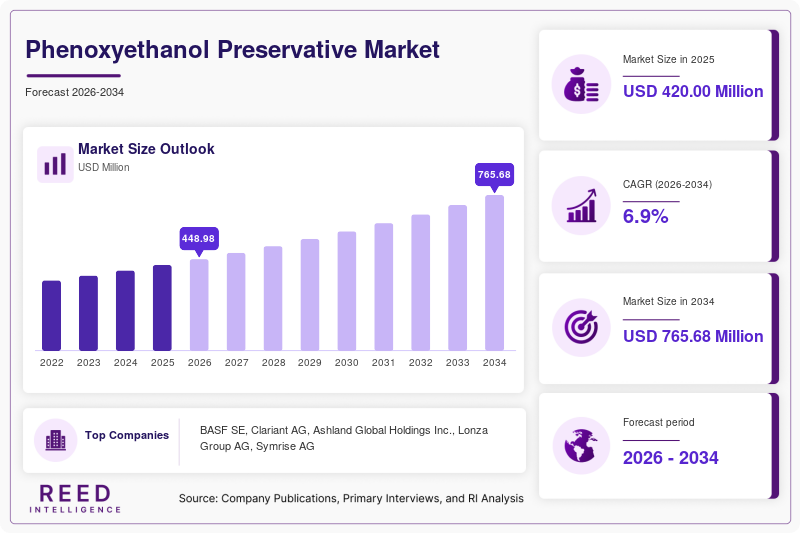
The global Phenoxyethanol Preservative Market was valued at approximately USD 420 million in 2026 and is projected to reach USD 720 million by 2034, expanding at a CAGR of 6.9% during the forecast period (2026–2034). Phenoxyethanol, widely used as a preservative in cosmetics, personal care, pharmaceuticals, and industrial formulations, has gained significant traction due to its effectiveness against a broad spectrum of microorganisms and compatibility with diverse formulations.
A key global factor supporting market growth has been the increasing demand for paraben-free and safer preservative alternatives. As regulatory scrutiny around traditional preservatives intensifies, manufacturers are increasingly adopting phenoxyethanol due to its favorable safety profile and regulatory acceptance across major markets.
Key Highlights:
- Europe dominated the market with a 34% share in 2025, while Asia Pacific is expected to register the fastest growth at a CAGR of 8.1%.
- In segmentation, Cosmetics & Personal Care led the application segment with a 48% share, while pharmaceutical applications are projected to grow fastest at a 7.8% CAGR.
- By grade, Cosmetic Grade Phenoxyethanol dominated with a 52% share, while pharmaceutical grade is expected to expand at a 7.5% CAGR.
- Germany remained the dominant country, with market values of USD 58 million in 2024 and USD 61 million in 2025.
Market Trends
Shift Toward Clean-Label and Transparent Formulations
The global shift toward clean-label products is significantly shaping the Phenoxyethanol Preservative Market. Consumers are increasingly scrutinizing ingredient lists and demanding transparency from brands. Phenoxyethanol is often positioned as a safer alternative to parabens, aligning well with evolving consumer expectations. Manufacturers are reformulating existing products to replace traditional preservatives with phenoxyethanol, especially in skincare and baby care categories. This trend has driven product innovation and increased investment in research for optimized preservative blends incorporating phenoxyethanol.
Rising Demand from Emerging Economies
Emerging economies, particularly in Asia Pacific and Latin America, are witnessing rapid growth in personal care and pharmaceutical consumption. Urbanization, rising disposable incomes, and expanding middle-class populations are boosting demand for high-quality cosmetic and healthcare products. As multinational brands expand their presence in these regions, the demand for effective preservatives like phenoxyethanol is increasing. Local manufacturers are also adopting advanced formulation practices, further accelerating market growth. This trend is expected to create sustained demand momentum over the forecast period.
Market Drivers
Increasing Demand for Paraben-Free Preservatives
The growing concerns over the potential health risks associated with parabens have significantly influenced the adoption of alternative preservatives. Phenoxyethanol has emerged as a preferred substitute due to its broad-spectrum antimicrobial efficacy and regulatory acceptance. This shift has been particularly prominent in skincare, haircare, and baby care products, where safety is a critical consideration. As regulatory bodies continue to impose restrictions on certain preservatives, the demand for phenoxyethanol is expected to increase steadily.
Expansion of the Global Cosmetics Industry
The global cosmetics and personal care industry continues to expand, driven by changing lifestyles, social media influence, and increased consumer awareness. Phenoxyethanol plays a crucial role in maintaining product stability and extending shelf life, making it an essential component in formulations. The proliferation of product categories such as anti-aging creams, serums, and organic cosmetics has further driven the need for effective preservatives. This growth trajectory directly supports the expansion of the Phenoxyethanol Preservative Market.
Market Restraint
Regulatory Limitations and Safety Concerns
Despite its widespread use, phenoxyethanol faces certain regulatory limitations, particularly regarding permissible concentration levels in cosmetic and pharmaceutical products. Regulatory bodies in various regions have established strict guidelines to ensure consumer safety, which can limit formulation flexibility for manufacturers. Additionally, some consumers express concerns about potential skin irritation and long-term exposure effects, especially in sensitive applications such as baby products. These factors may hinder market growth to some extent, as companies must invest in compliance and testing to meet evolving standards. The need for continuous monitoring and adherence to regulatory frameworks can also increase operational costs for manufacturers.
Market Opportunities
Growth in Natural and Hybrid Formulations
The increasing popularity of natural and organic products has created opportunities for hybrid formulations that combine natural ingredients with safe synthetic preservatives like phenoxyethanol. Manufacturers are developing innovative preservative systems that balance efficacy with consumer preferences for natural products. Phenoxyethanol’s compatibility with plant-based ingredients makes it a valuable component in such formulations, opening new avenues for growth.
Expansion in Pharmaceutical and Healthcare Applications
The expanding pharmaceutical sector presents significant opportunities for the Phenoxyethanol Preservative Market. Its use in vaccines, ointments, and liquid medications is increasing due to its antimicrobial properties and stability. As global healthcare infrastructure improves and demand for medicines rises, the need for reliable preservatives is expected to grow. This trend is particularly strong in developing regions, where healthcare access is expanding rapidly.
Segmental Analysis
By Grade
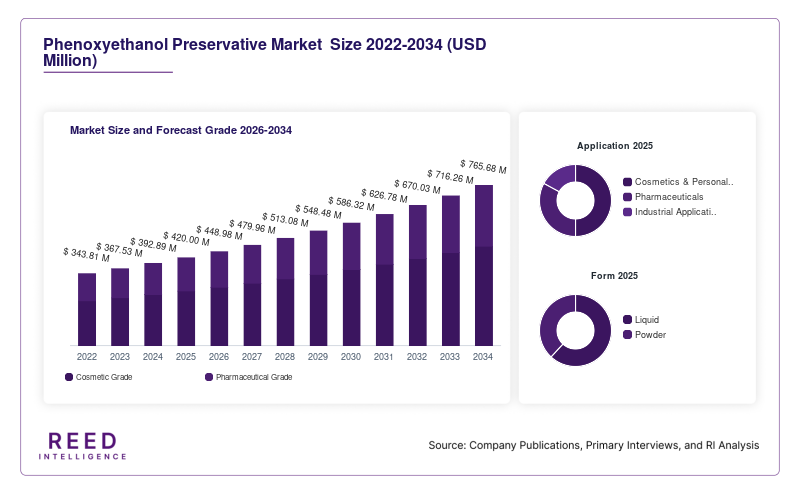
The Cosmetic Grade Phenoxyethanol segment dominated the market, accounting for approximately 52% of the share in 2025. This dominance was attributed to its extensive use in skincare, haircare, and makeup products, where product stability and safety are critical.
The Pharmaceutical Grade segment is expected to grow at the fastest rate, with a projected CAGR of 7.5%. This growth will be driven by increasing demand for stable and contamination-free formulations in medicines, particularly in liquid and topical applications.
By Application
The Cosmetics & Personal Care segment led the market with a 48% share in 2025. The widespread use of phenoxyethanol in creams, lotions, and serums contributed significantly to this dominance.
The Pharmaceutical Applications segment is projected to grow at a CAGR of 7.8%. This growth will be supported by rising healthcare needs and increasing production of medicines requiring effective preservation.
By Form
The Liquid Form segment dominated, holding a 67% share in 2025. Its ease of incorporation into formulations and compatibility with various products made it the preferred choice.
The Powder Form segment is expected to grow at a CAGR of 6.4%, driven by its use in specialized applications requiring controlled release and stability.
By End-Use Industry
The Personal Care Industry accounted for the largest share at 46% in 2025, driven by high consumption of cosmetics and grooming products globally.
The Healthcare Industry is projected to grow at a CAGR of 7.6%, supported by increasing demand for pharmaceutical formulations and medical products.
By Distribution Channel
The Direct Sales segment dominated with a 55% share in 2025, as manufacturers preferred direct procurement for bulk quantities.
The Online Distribution Channel is expected to grow at a CAGR of 8.3%, driven by digital transformation and increased accessibility for small and medium enterprises.
Regional Analysis
North America
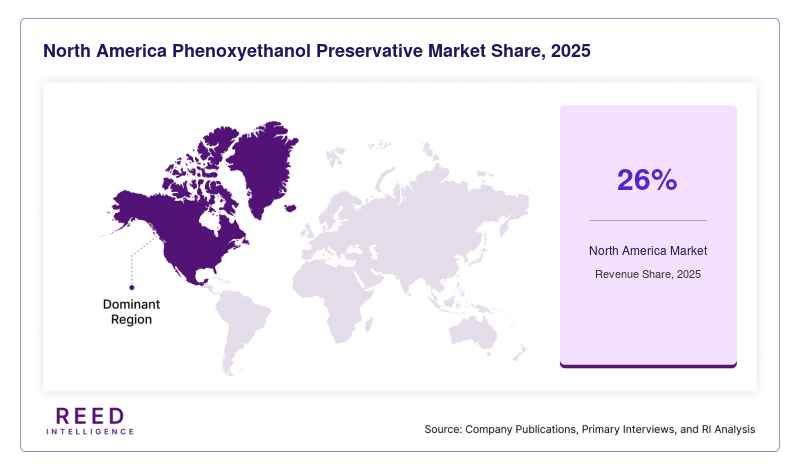
North America accounted for approximately 26% of the Phenoxyethanol Preservative Market share in 2025 and is projected to grow at a CAGR of 6.2% from 2026 to 2034. The region’s growth has been supported by advanced manufacturing capabilities and high consumer awareness regarding product safety.
The United States dominated the regional market due to strong demand for premium skincare and pharmaceutical products. The presence of established cosmetic brands and continuous product innovation contributed to steady demand for phenoxyethanol-based preservatives.
Europe
Europe held the largest share, contributing 34% of the market in 2025, and is expected to grow at a CAGR of 6.5% during the forecast period. The region’s stringent regulatory framework has encouraged the adoption of safe and approved preservatives.
Germany emerged as the dominant country, driven by its strong chemical manufacturing base and emphasis on high-quality cosmetic formulations. The country’s focus on sustainability and compliance has reinforced the use of phenoxyethanol in various applications.
Asia Pacific
Asia Pacific represented 22% of the market share in 2025 and is anticipated to register the fastest growth at a CAGR of 8.1%. Rapid urbanization and increasing disposable incomes have driven demand for personal care products in the region.
China led the market due to its expanding cosmetics industry and growing domestic consumption. The rise of local brands and increasing adoption of global standards in product formulation have further fueled demand for phenoxyethanol.
Middle East & Africa
The Middle East & Africa accounted for 9% of the market in 2025 and is expected to grow at a CAGR of 6.8%. Growth in this region has been supported by increasing investments in healthcare and personal care industries.
The United Arab Emirates dominated due to its strong retail sector and high demand for imported cosmetic products. The country’s role as a regional trade hub has also contributed to market expansion.
Latin America
Latin America held a 9% share in 2025 and is projected to grow at a CAGR of 6.7%. The region has seen increasing demand for affordable personal care products and expanding pharmaceutical access.
Brazil emerged as the leading country, driven by its large population and growing beauty and personal care industry. The country’s evolving consumer preferences have supported the adoption of phenoxyethanol in various formulations.
Competitive Landscape
The Phenoxyethanol Preservative Market is moderately consolidated, with key players focusing on product innovation, regulatory compliance, and global expansion. Leading companies are investing in research and development to enhance product performance and meet evolving consumer demands.
A major market leader, BASF SE, has strengthened its position through continuous innovation and the development of high-purity phenoxyethanol solutions. The company recently expanded its production capacity to meet rising global demand.
Other prominent players are emphasizing strategic partnerships and regional expansion to increase market penetration. The competitive environment remains dynamic, with companies striving to balance cost efficiency and product quality.
Key Players List
- BASF SE
- Clariant AG
- Ashland Global Holdings Inc.
- Lonza Group AG
- Symrise AG
- Galaxy Surfactants Ltd.
- Solvay S.A.
- Dow Inc.
- Akzo Nobel N.V.
- Eastman Chemical Company
- Evonik Industries AG
- Lanxess AG
- Arkema S.A.
- Croda International Plc
- Kao Corporation
Recent Developments
- In 2025, BASF SE expanded its phenoxyethanol production capacity in Europe to meet rising demand.
- Clariant AG introduced a new high-purity phenoxyethanol grade for sensitive skin applications.
- Lonza Group AG invested in advanced formulation technologies to enhance preservative efficiency.
- Ashland Global launched a sustainable preservative blend incorporating phenoxyethanol.
- Evonik Industries developed innovative solutions targeting pharmaceutical-grade applications.
Phenoxyethanol Preservative Market Segments
Grade
- Cosmetic Grade
- Pharmaceutical Grade
Application
- Cosmetics & Personal Care
- Pharmaceuticals
- Industrial Applications
Form
- Liquid
- Powder
End-Use Industry
- Personal Care
- Healthcare
- Industrial
Distribution Channel
- Direct Sales
- Distributors
- Online
By Region
- North America
- Europe
- APAC
- Middle East and Africa
- LATAM