Phenylacetonitrile Market Size, Share & Demand Report By Application (Pharmaceutical Intermediates, Agrochemicals, Specialty Chemicals, Fragrances), By Purity Level (≥99%, <99%, Ultra-High Purity), By End-Use Industry (Pharmaceuticals, Agriculture, Chemical Manufacturing, Research & Development), By Form (Liquid, Solid), By Region & Segment Forecasts, 2025–2034
USD 3950
Market Overview
The global Phenylacetonitrile Market size was valued at USD 312.4 million in 2025 and is projected to reach USD 498.7 million by 2034, expanding at a CAGR of 5.4% during the forecast period (2025–2034). The market growth is being supported by the increasing demand for specialty intermediates in pharmaceutical synthesis and fine chemical production. Phenylacetonitrile, a versatile organic compound, is widely used in the manufacture of active pharmaceutical ingredients (APIs), agrochemicals, and fragrances, making it a critical raw material across multiple downstream industries.
One of the key global factors contributing to the growth of the Phenylacetonitrile Market is the steady expansion of the pharmaceutical sector. As drug development pipelines continue to grow, demand for high-purity intermediates has surged, particularly in emerging economies where healthcare infrastructure is improving.
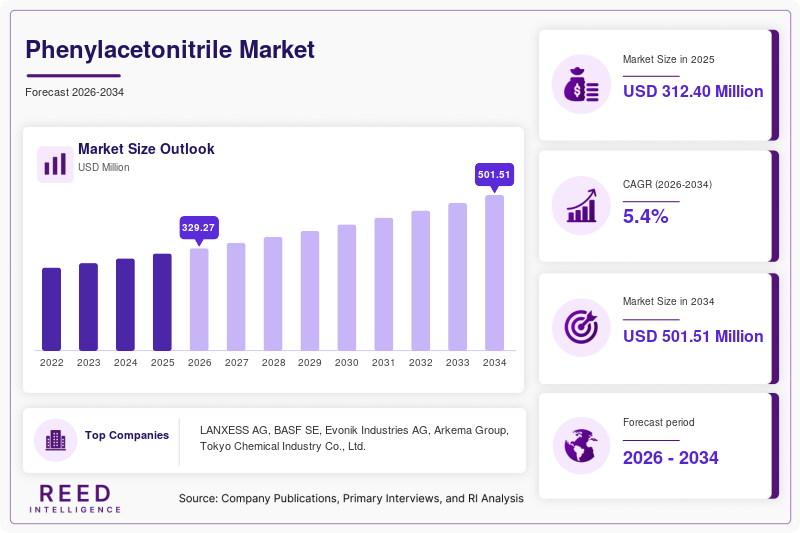
Key Highlights:
- Asia Pacific dominated the market with a 42.6% share in 2025, while the region is expected to grow at the fastest CAGR of 6.3% through 2034.
- By application, pharmaceutical intermediates accounted for the largest share, whereas specialty chemicals is projected to be the fastest-growing subsegment with a CAGR of 6.1%.
- By purity level, ≥99% purity grade led the market, while ultra-high purity grades are expected to grow rapidly at a CAGR of 5.9%.
- China remained the dominant country, with a market size of USD 82.1 million in 2024 rising to USD 86.3 million in 2025.
Market Trends
Increasing Shift Toward High-Purity Chemical Intermediates
The Phenylacetonitrile Market is experiencing a notable shift toward high-purity and ultra-high-purity grades. This trend is primarily driven by stringent quality standards in pharmaceutical manufacturing and specialty chemical applications. Manufacturers are investing in advanced purification technologies to meet regulatory requirements and ensure consistency in product performance. The demand for impurity-free intermediates has increased as pharmaceutical formulations become more complex and sensitive.
Expansion of Custom Chemical Manufacturing
Another important trend shaping the Phenylacetonitrile Market is the rise of custom synthesis and contract manufacturing services. Chemical companies are increasingly offering tailored solutions to pharmaceutical and agrochemical firms, allowing them to outsource intermediate production. This trend is improving supply chain efficiency and reducing operational costs for end users. It is also enabling smaller companies to access high-quality intermediates without investing in large-scale infrastructure, thereby widening the market base.
Market Drivers
Growing Demand from Pharmaceutical Synthesis
The expansion of pharmaceutical manufacturing has significantly driven the Phenylacetonitrile Market. The compound is widely used as an intermediate in the synthesis of APIs and other medicinal compounds. As global healthcare needs increase, particularly in developing regions, pharmaceutical companies are scaling up production capacities, leading to higher demand for reliable chemical intermediates.
Rising Use in Agrochemical Formulations
The increasing global focus on agricultural productivity has also fueled the demand for phenylacetonitrile. It is used in the synthesis of various agrochemical products, including pesticides and herbicides. As food demand rises due to population growth, the need for efficient crop protection solutions is increasing. This, in turn, is supporting steady consumption of phenylacetonitrile in agrochemical production processes.
Market Restraint
Stringent Regulatory Compliance and Handling Risks
A major restraint in the Phenylacetonitrile Market is the strict regulatory framework governing the production, storage, and transportation of chemical intermediates. Phenylacetonitrile is classified as a controlled substance in several regions due to its potential misuse in illicit synthesis. Regulatory authorities impose stringent monitoring and compliance requirements, which increase operational complexity for manufacturers.
Additionally, the compound requires careful handling due to its toxic and hazardous nature. Companies must invest in specialized storage facilities, safety systems, and trained personnel to ensure compliance with environmental and occupational safety standards. These additional costs can limit market entry for smaller players and reduce overall profit margins.
Market Opportunities
Growth in Emerging Pharmaceutical Markets
Emerging economies present a significant opportunity for the Phenylacetonitrile Market. Countries in Asia, Latin America, and parts of Africa are investing in local pharmaceutical manufacturing capabilities. This shift is reducing dependency on imports and creating demand for domestically produced chemical intermediates. As these regions strengthen their healthcare systems, the consumption of phenylacetonitrile is expected to rise steadily.
Development of Green and Sustainable Production Methods
Sustainability is becoming a key focus area in the chemical industry. Manufacturers in the Phenylacetonitrile Market are exploring environmentally friendly production processes that minimize waste and reduce emissions. The adoption of green chemistry practices not only aligns with regulatory requirements but also enhances brand reputation. Companies that invest in sustainable production technologies are likely to gain a competitive advantage in the long term.
Segmental Analysis
By Application
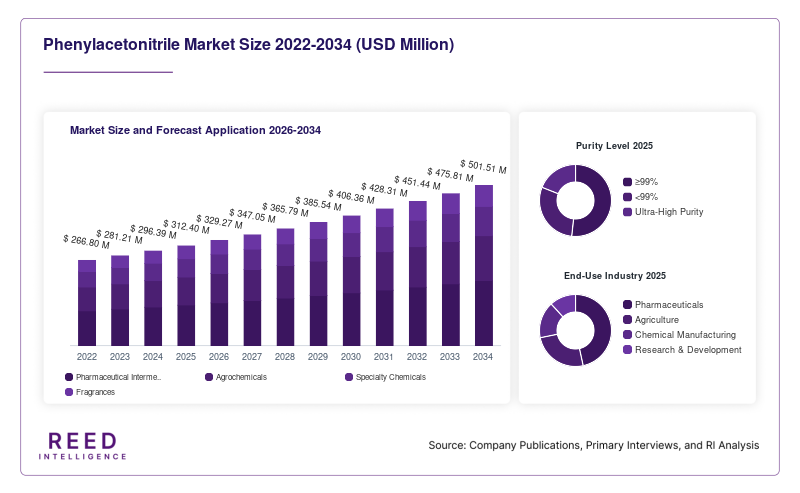
The pharmaceutical intermediates segment dominated the Phenylacetonitrile Market, accounting for 48.2% of the market share in 2024. This dominance was attributed to the compound’s widespread use in API synthesis and drug formulation processes. The demand for reliable and consistent intermediates supported strong growth in this segment.
The specialty chemicals segment is expected to grow at the fastest CAGR of 6.1% during the forecast period. This growth will be driven by increasing demand for customized chemical solutions across various industries. The rising use of phenylacetonitrile in advanced material synthesis and niche applications will further support segment expansion.
By Purity Level
The ≥99% purity segment held the largest share, accounting for 55.7% of the Phenylacetonitrile Market in 2024. High-purity grades were preferred due to their suitability for pharmaceutical and high-value applications. Manufacturers focused on maintaining consistent quality standards to meet industry requirements.
The ultra-high purity segment is projected to grow at a CAGR of 5.9%. This growth will be driven by increasing demand for precision-grade chemicals in research and development activities. The need for minimal impurities in complex formulations will support the adoption of ultra-high purity phenylacetonitrile.
By End-Use Industry
The pharmaceutical industry dominated the market with a 46.5% share in 2024. The sector’s reliance on chemical intermediates for drug development and manufacturing contributed to its leading position. Continuous innovation in pharmaceuticals supported sustained demand.
The agrochemical industry is expected to grow at the fastest CAGR of 5.8%. The increasing need for efficient crop protection solutions will drive the use of phenylacetonitrile in pesticide and herbicide synthesis. Advancements in agricultural practices will further support segment growth.
By Form
The liquid form segment accounted for 63.4% of the Phenylacetonitrile Market share in 2024. Liquid phenylacetonitrile was widely used due to its ease of handling and compatibility with various chemical processes. Its versatility made it suitable for multiple applications.
The solid form segment is expected to grow at a CAGR of 5.2%. This growth will be supported by increasing demand for stable and easily transportable chemical forms. Solid phenylacetonitrile offers advantages in storage and shelf life, making it attractive for certain applications.
Regional Analysis
North America
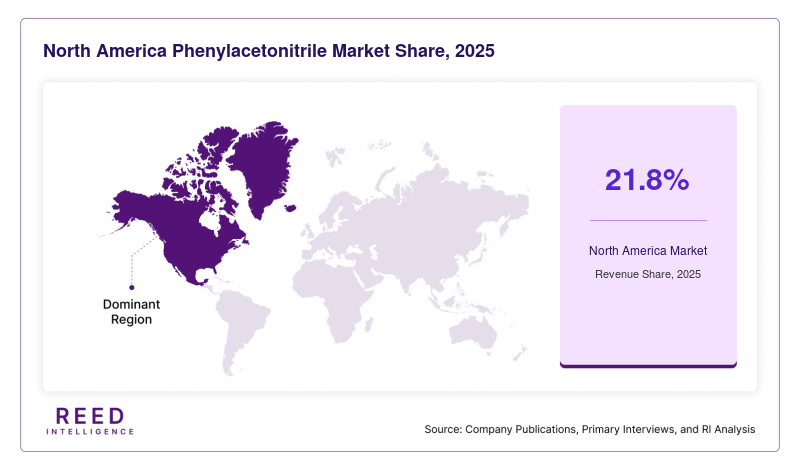
North America accounted for 21.8% of the Phenylacetonitrile Market share in 2025 and is expected to grow at a CAGR of 4.8% during the forecast period. The region’s mature pharmaceutical industry and strong regulatory framework supported steady demand for high-quality intermediates.
The United States dominated the regional market due to its advanced drug development ecosystem. The presence of large pharmaceutical manufacturers and continuous investment in R&D contributed to stable consumption levels. The country’s emphasis on innovation and stringent quality standards further supported demand for high-purity phenylacetonitrile.
Europe
Europe held a 19.6% share of the Phenylacetonitrile Market in 2025 and is projected to expand at a CAGR of 4.9% through 2034. The region’s focus on specialty chemicals and sustainable manufacturing practices supported consistent market growth.
Germany emerged as the dominant country, driven by its strong chemical manufacturing base. The country’s emphasis on precision engineering and high-quality production processes enabled efficient manufacturing of phenylacetonitrile. Additionally, increasing demand for specialty intermediates in fine chemical applications contributed to market expansion.
Asia Pacific
Asia Pacific led the Phenylacetonitrile Market with a 42.6% share in 2025 and is anticipated to grow at the fastest CAGR of 6.3%. Rapid industrialization and expanding pharmaceutical production capacity played a key role in driving demand.
China dominated the region due to its large-scale chemical manufacturing infrastructure. The country’s cost-effective production capabilities and strong export network enabled it to supply phenylacetonitrile to global markets. Government support for chemical and pharmaceutical industries further accelerated growth.
Middle East & Africa
The Middle East & Africa accounted for 8.4% of the Phenylacetonitrile Market in 2025 and is expected to grow at a CAGR of 5.1%. The region’s gradual industrial development and increasing investments in chemical production supported moderate growth.
Saudi Arabia led the regional market, supported by its focus on diversifying the economy beyond oil. Investments in petrochemical and downstream chemical industries created opportunities for phenylacetonitrile production and consumption. The development of industrial zones further contributed to market expansion.
Latin America
Latin America held a 7.6% share of the Phenylacetonitrile Market in 2025 and is projected to grow at a CAGR of 5.3%. The region’s growing agrochemical industry played a significant role in driving demand.
Brazil emerged as the dominant country due to its large agricultural sector. The need for crop protection chemicals supported the consumption of phenylacetonitrile in agrochemical synthesis. Increasing investments in local chemical manufacturing also contributed to steady market growth.
Competitive Landscape
The Phenylacetonitrile Market is moderately fragmented, with several global and regional players competing based on product quality, pricing, and distribution capabilities. Leading companies focus on expanding production capacity and enhancing product purity to meet evolving industry standards.
The market leader, LANXESS AG, has strengthened its position through continuous investment in specialty chemical production and innovation. The company recently expanded its intermediate chemicals portfolio to support pharmaceutical and agrochemical applications.
Other key players are focusing on strategic partnerships, mergers, and acquisitions to enhance their market presence. Companies are also investing in sustainable production technologies to align with environmental regulations and improve operational efficiency.
Key Players List
- LANXESS AG
- BASF SE
- Evonik Industries AG
- Arkema Group
- Tokyo Chemical Industry Co., Ltd.
- Alfa Aesar
- Merck KGaA
- Thermo Fisher Scientific Inc.
- Jubilant Ingrevia Limited
- Loba Chemie Pvt. Ltd.
- Sigma-Aldrich Corporation
- TCI Chemicals India Pvt. Ltd.
- Anhui Bayi Chemical Industry Co., Ltd.
- Wuhan Golden Wing Industry & Trade Co., Ltd.
- Toronto Research Chemicals
Recent Developments
- In 2025, leading manufacturers increased investment in high-purity phenylacetonitrile production facilities to meet pharmaceutical demand.
- A major chemical company announced expansion of its specialty intermediates portfolio to include advanced derivatives of phenylacetonitrile.
- Several regional players in Asia Pacific adopted green chemistry practices to reduce environmental impact.
- Strategic collaborations between chemical manufacturers and pharmaceutical firms increased to ensure supply chain stability.
- New regulatory frameworks in Europe encouraged the adoption of safer handling and production methods.
Phenylacetonitrile Market Segments
Application
- Pharmaceutical Intermediates
- Agrochemicals
- Specialty Chemicals
- Fragrances
Purity Level
- ≥99%
- <99%
- Ultra-High Purity
End-Use Industry
- Pharmaceuticals
- Agriculture
- Chemical Manufacturing
- Research & Development
Form
- Liquid
- Solid
Distribution Channel
- Direct Sales (B2B Contracts)
- Chemical Distributors
- Online Chemical Marketplaces
- Specialty Chemical Suppliers
By Region
- North America
- Europe
- APAC
- Middle East and Africa
- LATAM