Phocomelia Market Size, Share & Demand Report By Type (Prosthetic Devices, Surgical Treatment, Assistive Devices), By Application (Pediatric Care, Adult Care, Rehabilitation & Therapy), By End-Use (Hospitals & Clinics, Rehabilitation Centers, Home Care Settings), By Region & Segment Forecasts, 2025–2034
USD 3950
Market Overview
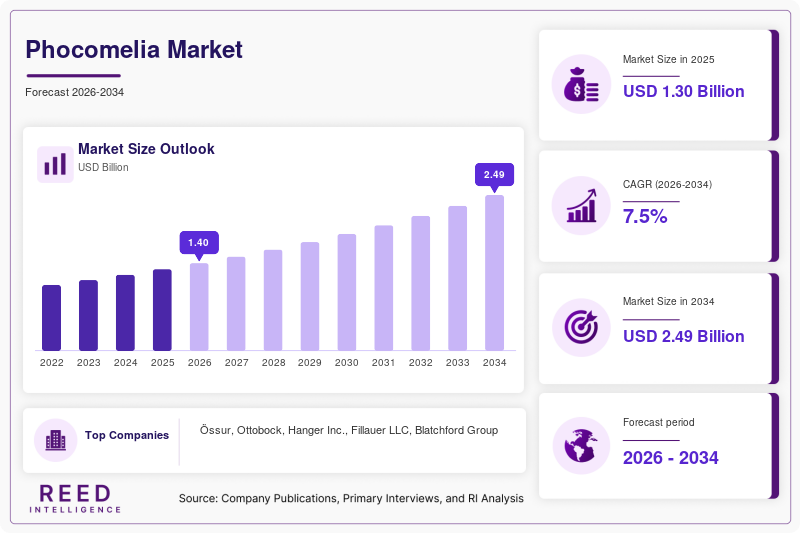
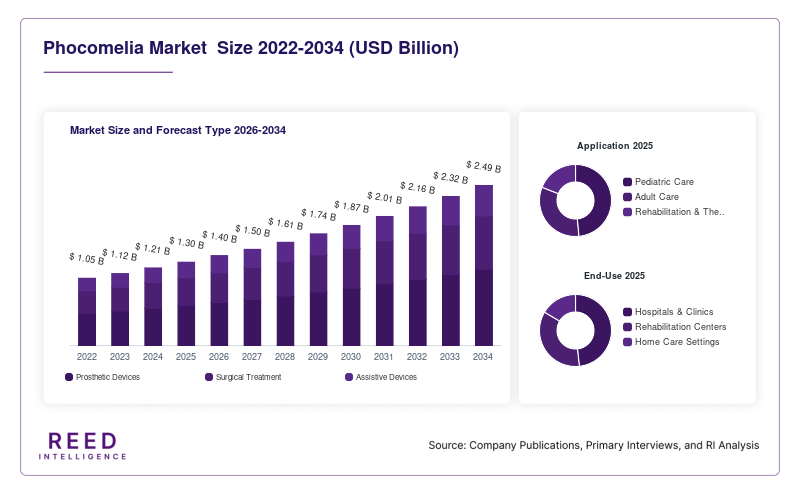
The Phocomelia Market size is estimated at USD 1.3 billion and is projected to reach USD 1.4 billion in 2026. The market is forecasted to expand to approximately USD 2.5 billion by 2034, registering a compound annual growth rate (CAGR) of 7.5% during the forecast period (2025–2034).
One of the primary growth factors is the rising investment in rare disease research, which has led to improved diagnostic capabilities and early detection. Governments and healthcare organizations are increasingly supporting rare disease registries and funding research initiatives, which has improved patient identification and treatment access. Another important factor is the growing adoption of advanced prosthetics and assistive devices. Technological developments in robotics, 3D printing, and bioengineering have enabled customized prosthetic solutions, improving patient mobility and quality of life.
Key Highlights
- Market size is estimated at USD 1.3 billion in 2025 and is expected to reach USD 1.4 billion in 2026.
This steady increase reflects consistent demand for treatment solutions and assistive technologies. - The market is forecasted to reach USD 2.5 billion by 2034, growing at a CAGR of 7.5%.
Long-term expansion is supported by continuous innovation and improved healthcare access globally. - Growth is driven by advancements in prosthetics and genetic diagnostics technologies.
These innovations are improving early detection and enhancing mobility outcomes for patients. - Increasing awareness and government support for rare disease management are boosting market growth.
Public health initiatives and funding programs are improving access to specialized care services.
Market Trends
Integration of Advanced Prosthetic Technologies
The integration of advanced prosthetic technologies is a significant trend shaping the Phocomelia Market. Innovations such as myoelectric prosthetics, AI-enabled limb control systems, and 3D-printed customized devices are improving functionality and patient comfort. These solutions enable individuals with limb deformities to achieve greater independence and mobility. Manufacturers are focusing on lightweight materials and adaptive designs, which enhance usability across different age groups. Furthermore, digital modeling and scanning technologies are allowing precise customization, reducing production time and improving fit. This trend is expected to strengthen as research institutions and medical device companies collaborate to enhance prosthetic capabilities and affordability.
Expansion of Genetic Screening and Prenatal Diagnostics
The expansion of genetic screening and prenatal diagnostic technologies is another key trend influencing market growth. Advanced imaging techniques and genetic testing methods are enabling early detection of congenital anomalies, including phocomelia. This early identification allows healthcare providers to plan interventions and counseling strategies before birth. The growing adoption of non-invasive prenatal testing (NIPT) and high-resolution ultrasound technologies is contributing to increased diagnostic accuracy. Additionally, awareness campaigns and improved access to prenatal care services are encouraging more expectant parents to undergo screening. This trend is expected to drive demand for diagnostic services and support long-term market development.
Market Drivers
Increasing Investment in Rare Disease Research
The growing investment in rare disease research is a major driver of the Phocomelia Market. Governments, private organizations, and pharmaceutical companies are allocating funds to study congenital disorders and develop targeted treatment approaches. These investments are supporting the establishment of research centers and rare disease registries, which improve data collection and patient tracking. Enhanced research capabilities are also leading to the development of innovative therapies and assistive technologies. As awareness about rare diseases increases, funding initiatives are expected to expand further, contributing to improved healthcare outcomes and sustained market growth.
Rising Demand for Rehabilitation and Assistive Care
The rising demand for rehabilitation services and assistive care solutions is another important driver. Individuals with phocomelia often require long-term physical therapy, occupational therapy, and psychological support. Healthcare providers are increasingly offering integrated rehabilitation programs that address mobility, functionality, and emotional well-being. The growing availability of specialized rehabilitation centers and trained professionals is supporting this demand. Additionally, advancements in assistive devices, including adaptive tools and mobility aids, are enhancing patient independence. This increasing focus on comprehensive care is expected to drive the expansion of the market over the forecast period.
Market Restraint
Limited Patient Population and High Treatment Costs
One of the primary restraints in the Phocomelia Market is the limited patient population combined with high treatment costs. As a rare congenital disorder, the number of diagnosed cases remains relatively low, which restricts large-scale commercialization opportunities for medical device manufacturers and healthcare providers. This limited demand can lead to higher costs for research, development, and production of specialized treatments and prosthetic devices. Additionally, advanced prosthetics and long-term rehabilitation programs can be expensive, making them less accessible in low- and middle-income regions. The lack of widespread insurance coverage for rare disease treatments further exacerbates this issue. For example, customized prosthetic limbs can cost significantly more than standard devices due to their complexity and personalization requirements. This cost barrier can limit adoption rates and slow market growth, particularly in emerging economies where healthcare budgets are constrained.
Market Opportunities
Growth in Emerging Healthcare Markets
Emerging healthcare markets present significant opportunities for the Phocomelia Market. Countries in Asia Pacific, Latin America, and parts of the Middle East are investing in healthcare infrastructure and expanding access to specialized care services. Governments in these regions are focusing on improving maternal and child healthcare, which includes early diagnosis and treatment of congenital disorders. Increasing healthcare spending and the development of public-private partnerships are enabling the introduction of advanced diagnostic tools and rehabilitation facilities. As awareness about rare diseases grows in these regions, demand for treatment and support services is expected to increase, creating new growth avenues for market players.
Advancements in Personalized Medicine and Prosthetics
Advancements in personalized medicine and prosthetics are creating new opportunities in the market. The use of genetic data and digital technologies is enabling the development of tailored treatment plans and customized assistive devices. 3D printing and bioengineering are playing a key role in producing prosthetics that meet individual patient needs with greater precision. These innovations are improving patient outcomes and expanding the scope of treatment options. Additionally, collaborations between healthcare providers, research institutions, and technology companies are accelerating innovation in this field. As personalized approaches become more widely adopted, they are expected to drive long-term growth in the Phocomelia Market.
Segmental Analysis
By Type
The prosthetic devices segment dominated the Phocomelia Market in 2024, accounting for approximately 45% of the total market share. This dominance is attributed to the increasing demand for mobility solutions and the growing adoption of advanced prosthetic technologies. Patients with phocomelia often require customized prosthetics to improve functionality and independence. Technological advancements, such as lightweight materials and digital design tools, are enhancing the performance and comfort of these devices. Additionally, the availability of a wide range of prosthetic options is supporting market growth.
The diagnostic solutions segment is expected to be the fastest-growing subsegment, with a projected CAGR of 8.2% during the forecast period. This growth is driven by the increasing adoption of advanced imaging and genetic testing technologies. Early diagnosis plays a critical role in treatment planning and patient management. The expansion of prenatal screening programs and the availability of non-invasive testing methods are contributing to the growth of this segment. As awareness about early detection increases, demand for diagnostic solutions is expected to rise.
By Application
The rehabilitation segment held the largest share of the market in 2024, accounting for approximately 40%. This segment includes physical therapy, occupational therapy, and psychological support services. The growing emphasis on comprehensive care is driving demand for rehabilitation services. Healthcare providers are focusing on improving patient outcomes through integrated treatment approaches. The increasing availability of specialized rehabilitation centers and trained professionals is supporting the growth of this segment.
The surgical interventions segment is projected to be the fastest-growing, with a CAGR of 7.9%. Advances in surgical techniques and improved access to specialized healthcare facilities are contributing to this growth. Surgical procedures are often required to correct deformities and improve functionality. The development of minimally invasive techniques and improved post-operative care is enhancing patient outcomes. As healthcare infrastructure continues to improve, demand for surgical interventions is expected to increase.
By End-Use
Hospitals dominated the market in 2024, accounting for approximately 50% of the total share. Hospitals serve as primary centers for diagnosis, treatment, and rehabilitation services. The availability of advanced medical equipment and multidisciplinary teams enables comprehensive care for patients with phocomelia. The increasing number of hospital-based rehabilitation programs is further supporting market growth.
Rehabilitation centers are expected to be the fastest-growing end-use segment, with a CAGR of 8.0%. The growing focus on long-term care and patient recovery is driving demand for specialized rehabilitation facilities. These centers provide tailored therapy programs that address individual patient needs. The expansion of rehabilitation infrastructure and increasing investment in training professionals are contributing to the growth of this segment. As awareness about the benefits of rehabilitation increases, this segment is expected to witness significant expansion.
Regional Analysis
North America
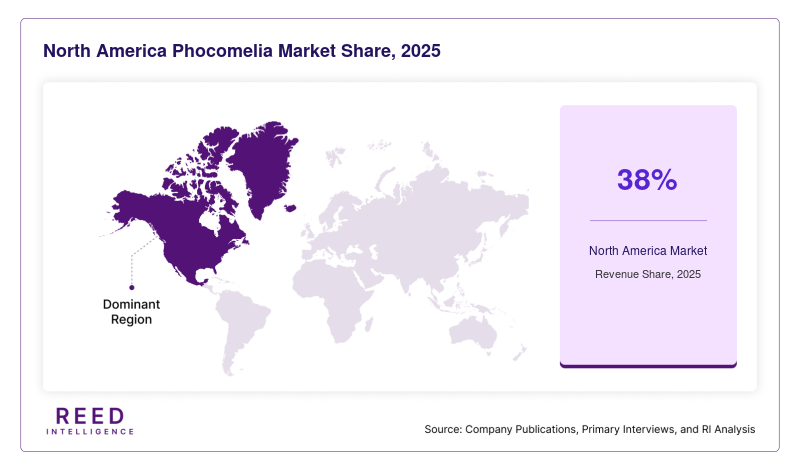
North America accounted for the largest share of the Phocomelia Market in 2025, contributing approximately 38% of the global market. The region is expected to maintain its dominance, with a projected CAGR of 7.2% during the forecast period. The presence of advanced healthcare infrastructure, strong research capabilities, and high awareness about rare diseases supports market growth. Additionally, favorable reimbursement policies and government funding for rare disease research are contributing to the expansion of diagnostic and treatment services.
The United States dominates the North American market due to its extensive healthcare network and investment in medical research. A key growth factor in the country is the widespread adoption of advanced prosthetic technologies, including AI-enabled devices. These innovations are improving patient outcomes and increasing the adoption of assistive solutions. The availability of specialized rehabilitation centers further supports market growth in the region.
Europe
Europe holds a significant share of the global market, accounting for approximately 27% in 2025, and is expected to grow at a CAGR of 7.0%. The region benefits from strong regulatory frameworks and government support for rare disease initiatives. Countries across Europe are implementing policies to improve diagnosis and treatment access, which is driving demand for healthcare services related to phocomelia.
Germany is a leading country in the European market, supported by its advanced healthcare system and focus on medical innovation. A unique growth factor in the region is the presence of well-established rare disease networks and registries. These systems facilitate data sharing and improve patient identification, contributing to better treatment outcomes and market growth.
Asia Pacific
Asia Pacific is emerging as a high-growth region, with a market share of around 20% in 2025 and a projected CAGR of 8.5%. The region is witnessing rapid improvements in healthcare infrastructure and increasing awareness about congenital disorders. Governments are investing in maternal and child healthcare programs, which support early diagnosis and intervention.
China is the dominant country in the Asia Pacific market, driven by its large population and expanding healthcare sector. A key growth factor is the increasing adoption of prenatal diagnostic technologies, which enable early detection of congenital anomalies. The rising availability of affordable healthcare services is also supporting market expansion in the region.
Middle East & Africa
The Middle East & Africa region accounted for approximately 8% of the market in 2025 and is expected to grow at a CAGR of 6.8%. The market is gradually developing due to improving healthcare infrastructure and increasing awareness about rare diseases. Governments are focusing on enhancing healthcare access and investing in specialized medical services.
The United Arab Emirates leads the regional market due to its advanced healthcare facilities and focus on medical innovation. A unique growth factor is the increasing investment in medical tourism, which is driving demand for specialized treatments. The presence of modern hospitals and rehabilitation centers is supporting market growth in the region.
Latin America
Latin America held a market share of around 7% in 2025 and is projected to grow at a CAGR of 7.3%. The region is experiencing steady growth due to improving healthcare systems and increasing awareness about congenital disorders. Government initiatives aimed at enhancing healthcare access are contributing to market development.
Brazil dominates the Latin American market, supported by its large population and expanding healthcare infrastructure. A key growth factor is the increasing focus on public healthcare programs that address maternal and child health. These initiatives are improving early diagnosis rates and driving demand for treatment and rehabilitation services.
Competitive Landscape
The Phocomelia Market is moderately fragmented, with a mix of global medical device manufacturers and specialized healthcare providers. Key companies are focusing on innovation, partnerships, and product development to strengthen their market position. The market leader is Össur, known for its advanced prosthetic solutions and strong global presence. The company continues to invest in research and development to enhance product performance and expand its portfolio.
Other major players are adopting strategies such as mergers, acquisitions, and collaborations to expand their reach. Recent developments include the introduction of AI-enabled prosthetic devices and the expansion of rehabilitation services. Companies are also focusing on emerging markets to tap into new growth opportunities. The competitive landscape is expected to evolve as technological advancements and increasing demand drive innovation.
Key Players List
- Össur
- Ottobock SE & Co. KGaA
- Fillauer LLC
- Blatchford Group
- WillowWood Global LLC
- Steeper Group
- Proteor SAS
- Mobius Bionics
- Open Bionics
- Endolite India Ltd.
- College Park Industries
- Hanger Inc.
- Becker Orthopedic
- Ability Prosthetics & Orthotics
- BioDapt Inc.
Recent Developments
- A leading prosthetics manufacturer introduced a next-generation AI-enabled prosthetic limb designed to improve mobility and adaptability.
- A healthcare provider expanded its rehabilitation network by opening new centers focused on rare congenital disorders.
- A research collaboration launched a project to develop advanced genetic screening tools for early detection of limb abnormalities.
Phocomelia Market Segments
Type
- Prosthetic Devices
- Surgical Treatment
- Assistive Devices
Application
- Pediatric Care
- Adult Care
- Rehabilitation & Therapy
End-Use
- Hospitals & Clinics
- Rehabilitation Centers
- Home Care Settings
By Region
- North America
- Europe
- APAC
- Middle East and Africa
- LATAM