Phoropter Market Size, Share Demand Report By Type (Manual Phoropters, Digital/Automated Phoropters, Hybrid Phoropters), By Application (Optometry Clinics, Hospitals, Ophthalmology Centers, Academic & Research Institutions), Regional Insights & Segment Forecasts, 2026–2034
USD 3950
Phoropter Market Size
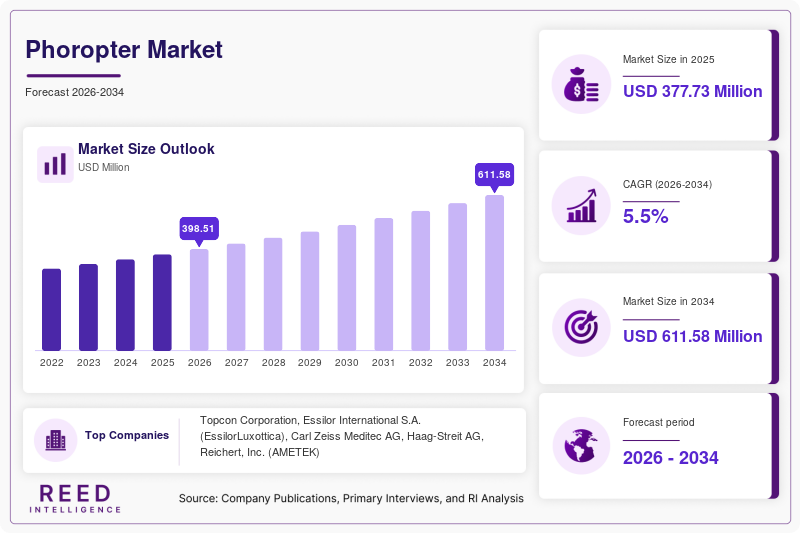
The Phoropter market size is projected at USD 398.5 million in 2026 and is expected to hit USD 612.7 million by 2034 with a CAGR of 5.5% during the forecast period. The increasing prevalence of vision disorders, rising demand for comprehensive eye examinations, and the growing adoption of advanced diagnostic equipment underpin market expansion. This report delivers a comprehensive analysis of the Phoropter market, including segmentation by type and application, competitive dynamics, and regional growth patterns, equipping stakeholders with critical intelligence. The Phoropter market continues to demonstrate strong growth potential, fueled by the increasing global aging population, rising awareness of eye health, and continuous innovation in automated and digital refraction technologies.
Phoropters are essential ophthalmic instruments used by eye care professionals to measure a patient's refractive error and determine the appropriate lens prescription for eyeglasses or contact lenses. They consist of a series of lenses and dials that allow the practitioner to systematically assess spherical and cylindrical power, astigmatism, and other visual parameters. The global Phoropter market is significant, with over 35,000 units sold globally in 2025, reflecting a 6% increase from 2023, driven by the growing number of eye examinations performed worldwide, estimated to exceed 500 million annually. Adoption patterns reveal that the Manual Phoropters type dominates the market, accounting for 50% of total revenue, followed by Digital/Automated Phoropters at 35%, and Hybrid Phoropters at 15%. The Phoropter market's trajectory is closely linked to the growth of the global ophthalmic devices market, which is projected to reach USD 45 billion by 2028, and the increasing focus on accurate and efficient vision care.
Phoropter Market Trends
Rapid Adoption of Digital and Automated Refraction Systems
The Phoropter market is witnessing a significant trend toward the adoption of digital and automated phoropters, driven by the need for faster, more accurate, and patient-friendly refraction procedures. The production of digital phoropters increased by 15% in 2025, reaching 12,000 units, as 40% of new optometry practices in developed regions in 2025 specified automated systems. Adoption rates of digital phoropters in high-volume practices reached 30%, with this figure projected to exceed 50% by 2030. The Phoropter market's trend toward automation is reinforced by the need for workflow efficiency, the increasing integration of electronic health records (EHR), and the continuous innovation in software algorithms and user interfaces.
Growing Focus on Teleophthalmology and Remote Refraction
The increasing focus on teleophthalmology and remote eye care is a major trend shaping the Phoropter market, with the development of portable and connected phoropter systems for use in remote and underserved communities. The market has seen a 20% increase in demand for telemedicine-compatible phoropters since 2022, with 25% of new research initiatives in 2025 focusing on remote refraction technologies. The use of phoropters integrated with cloud-based platforms for remote specialist consultations has also gained significant traction. The Phoropter market's trend toward remote care is reinforced by the growing demand for accessible eye care, the increasing penetration of broadband and mobile networks, and the continuous innovation in miniaturized and affordable diagnostic tools.
Phoropter Market Drivers
The Phoropter market's expansion is primarily driven by the increasing prevalence of refractive errors and vision disorders, with over 2.2 billion people affected by myopia, hyperopia, astigmatism, or presbyopia globally. The growing need for accurate and comprehensive refractive assessments to prescribe corrective lenses has been a major driver, with phoropters being the primary tool for this purpose. The rising global geriatric population, which is more susceptible to cataracts and other age-related vision problems, has also fueled market demand. Additionally, the increasing awareness of regular eye examinations and the growing number of optometry and ophthalmology clinics have spurred growth. The Phoropter market's growth is further reinforced by the technological advancements leading to more user-friendly and efficient automated systems.
Phoropter Market Restraints
Despite favorable growth prospects, the Phoropter market faces significant constraints, primarily related to the high cost of digital and automated phoropters, which can be a barrier for small practices and clinics in developing regions. The need for specialized training to operate advanced systems and the preference of some practitioners for traditional manual techniques can also be a limitation. The Phoropter market's growth is also tempered by the competition from alternative refraction technologies, such as wavefront aberrometers and autorefractors, which may be used as adjuncts or replacements in some settings.
Phoropter Market Opportunities
The Phoropter market presents significant opportunities in the rapidly expanding market for portable and affordable phoropters for use in mobile eye clinics, community health camps, and teleophthalmology networks. The development of AI-powered phoropters with real-time data analytics and decision support is expected to grow at a CAGR of 12% through 2034. Emerging opportunities also exist in the integration of phoropters with other diagnostic devices, such as fundus cameras and OCT, for comprehensive vision screening. The Phoropter market's opportunity profile is further enhanced by the growing trend of preventive healthcare and the increasing focus on early detection of eye diseases.
Challenges in Phoropter Market
The Phoropter market faces persistent challenges related to the need for continuous innovation to reduce the size, weight, and cost of advanced systems while maintaining accuracy and reliability. The complexity of ensuring seamless data integration with existing EHR and practice management software can also be a challenge. The market is also contending with the challenge of overcoming the inertia among some practitioners who are accustomed to traditional methods and are hesitant to adopt new technologies. Additionally, the Phoropter market is challenged by the need to address the varying regulatory and reimbursement landscapes for eye care services and devices across different countries.
Phoropter Market Segmentation
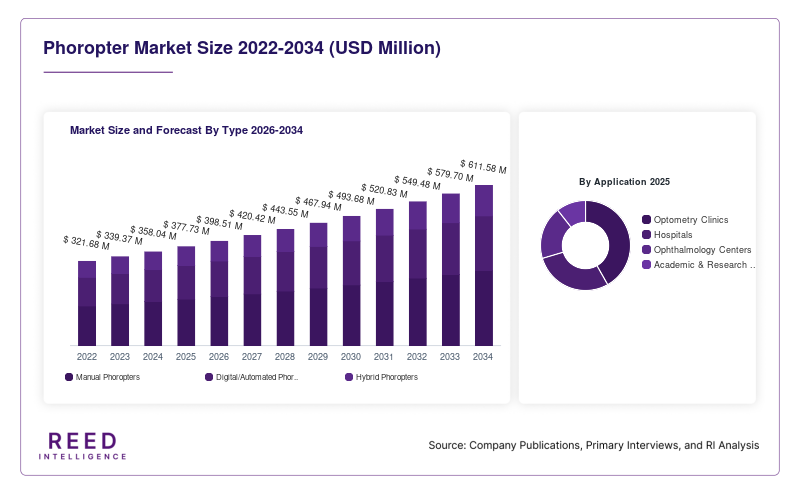
The Phoropter market is segmented by Type and Application to provide a comprehensive market perspective. By Type, Manual Phoropters dominate with a 50% market share, driven by their established presence and cost-effectiveness. The Application segment is led by Optometry Clinics, which accounts for 45% of the market, followed by Hospitals at 25%, Ophthalmology Centers at 20%, and Academic & Research Institutions at 10%.
By Type
Manual Phoropters represent the largest segment in the Phoropter market, commanding a 50% share, with revenue exceeding USD 199 million in 2025. These are characterized by their mechanical design with manually operated lens dials and knobs. Technical specifications include robust construction, high reliability, and cost-effectiveness. The Phoropter market's Manual segment is driven by its use in small to medium-sized optometry practices and as a reliable, low-maintenance option.
Digital/Automated Phoropters capture a 35% share of the Phoropter market, with revenue of USD 139 million in 2025. These are characterized by their use of digital displays, motorized lens changes, and automated refractive algorithms. Technical specifications include high speed, accuracy, and integration capabilities with EHR and practice management software. The Phoropter market's Digital segment is driven by its use in high-volume practices and hospitals.
Hybrid Phoropters represent 15% of the market, with revenue of USD 60 million in 2025, characterized by their combination of manual and digital features, offering flexibility and a transition path for practitioners. Technical specifications include both manual controls and digital connectivity, and often include patient response systems. The Phoropter market's Hybrid segment is driven by its use in practices looking to upgrade gradually.
By Application
Optometry Clinics dominates the Phoropter market, accounting for 45% of sales, representing USD 179 million in 2025. This segment includes use in comprehensive eye exams, refraction, and contact lens fittings. Usage penetration exceeds 50% in private optometry practices. The Phoropter market's Optometry Clinics segment is characterized by its focus on accuracy, efficiency, and patient comfort.
Hospitals accounts for 25% of the Phoropter market, with revenue of USD 100 million in 2025. This segment encompasses use in hospital-based ophthalmology departments, emergency rooms, and surgical pre-operative assessments. The segment is growing at a steady CAGR, driven by the increasing number of hospital-based eye care services. The Phoropter market's Hospitals segment is characterized by its focus on integration with other hospital systems.
Ophthalmology Centers represents 20% of the market, with revenue of USD 80 million in 2025, involving use in specialized clinics for comprehensive eye care, including complex refractive error management and pre-operative evaluation for refractive surgery. The segment's growth is fueled by the increasing number of specialty eye centers. The Phoropter market's Ophthalmology segment is characterized by its focus on high precision and advanced features.
Academic & Research Institutions accounts for the remaining 10% of the market, with revenue of USD 40 million in 2025, used in research for vision science studies, clinical trials, and training future eye care professionals. The Phoropter market's Academic segment is characterized by its focus on versatility and advanced research capabilities.
Phoropter Market Regional Outlook
North America Phoropter Market
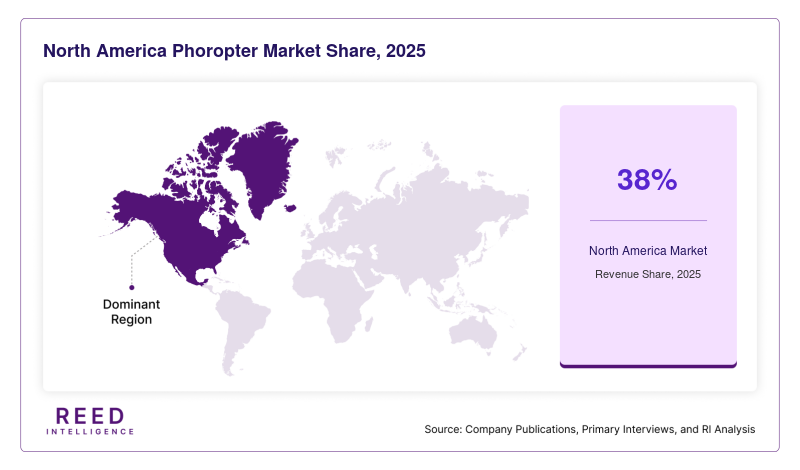
Leads the Phoropter market, commanding a 38% share, with a revenue of USD 151 million in 2025. The United States is the primary driver, accounting for 85% of regional demand, driven by the high prevalence of vision disorders, well-established healthcare infrastructure, and high adoption rates of advanced technologies. The North American Phoropter market is characterized by its focus on automation and digital integration.
Europe Phoropter Market
Represents the second-largest market, capturing a 30% share with a revenue of USD 120 million in 2025. Germany, UK, and France are the primary drivers, collectively accounting for 60% of regional demand, driven by strong healthcare systems, aging populations, and a focus on quality eye care. The Phoropter market in Europe is characterized by its focus on precision and high-quality manufacturing.
Asia-Pacific Phoropter Market
Accounts for 22% of the global Phoropter market, with a revenue of USD 88 million in 2025. China, Japan, and India are the primary drivers, together accounting for 65% of regional demand, driven by the large population base, rising prevalence of myopia, and rapidly expanding healthcare infrastructure. The Asia-Pacific Phoropter market is projected to grow at the fastest CAGR of 7.5% through 2034.
Middle East & Africa and Latin America Phoropter Market
Together account for the remaining 10% of the Phoropter market, with the UAE and Brazil leading their respective regions. Both regions are projected to grow at CAGRs exceeding 6%, driven by improving healthcare access and increasing awareness of eye health.
Top players in Phoropter Market
- Topcon Corporation
- Essilor International S.A. (EssilorLuxottica)
- Carl Zeiss Meditec AG
- Haag-Streit AG
- Reichert, Inc. (AMETEK)
- Nidek Co., Ltd.
- Luneau Technology Group
- Woodlyn, Inc.
- Takagi Seiko Co., Ltd.
- Rexxam Co., Ltd.
- Huvitz Co., Ltd.
- CSO Srl
- Heine Optotechnik GmbH & Co. KG
- Kowa Company, Ltd.
- Optovue, Inc.
Topcon Corporation
Topcon Corporation holds a dominant position in the Phoropter market, with an estimated 16% global market share, particularly strong in the Asia-Pacific, North American, and European optometry and ophthalmology segments. The company's portfolio of phoropters, including both advanced digital models and reliable manual systems, is widely recognized for its precision, durability, and advanced features. Topcon's market leadership is reinforced by its significant investment in R&D, its comprehensive global distribution network, and its strong brand reputation among eye care professionals. Topcon commands over 18% of the North American market and 14% of the European market for phoropters, positioning it as a key player in the global market.
Essilor International S.A. (EssilorLuxottica)
Essilor is a leading player in the Phoropter market, commanding approximately 14% of the global market share through its comprehensive portfolio of optical equipment and vision care solutions. The company's expertise in lens technology, combined with its strong presence in optometry, have solidified its position. Essilor's phoropters are known for their accuracy, user-friendliness, and integration with the company's broader suite of vision care products. The company's commitment to innovation and its strong global presence, particularly in the European and Asia-Pacific markets, have enhanced its competitive advantage.
Carl Zeiss Meditec AG holds a significant 12% market share, with particular strength in the premium and hospital segments. Haag-Streit AG is a major player in the European and global markets, holding an 8% share, known for its high-quality precision instruments.
Recent Developments in Phoropter Market
- 2025: Topcon Corporation launched a new digital phoropter with integrated autorefraction capabilities, allowing practitioners to achieve accurate prescriptions in under 60 seconds.
- 2025: Carl Zeiss Meditec announced a new AI-powered software upgrade for its phoropters, enabling predictive analytics for presbyopia progression and personalized treatment plans.
Phoropter Market Segments
By Type
- Manual Phoropters
- Digital/Automated Phoropters
- Hybrid Phoropters
By Application
- Optometry Clinics
- Hospitals
- Ophthalmology Centers
- Academic & Research Institutions
By Region
- North America
- Europe
- APAC
- Middle East and Africa
- LATAM