Phosphine Fumigation Market Size, Share & Demand Report By Form (Tablet, Pellet, Powder, Granule), By Application (Grain Storage, Warehouse Fumigation, Shipping Containers, Food Processing Facilities, Others), By End Use (Agriculture, Food Processing, Logistics and Shipping, Commercial Warehousing, Others), By Region & Segment Forecasts, 2026–2034
USD 3950
Market Overview
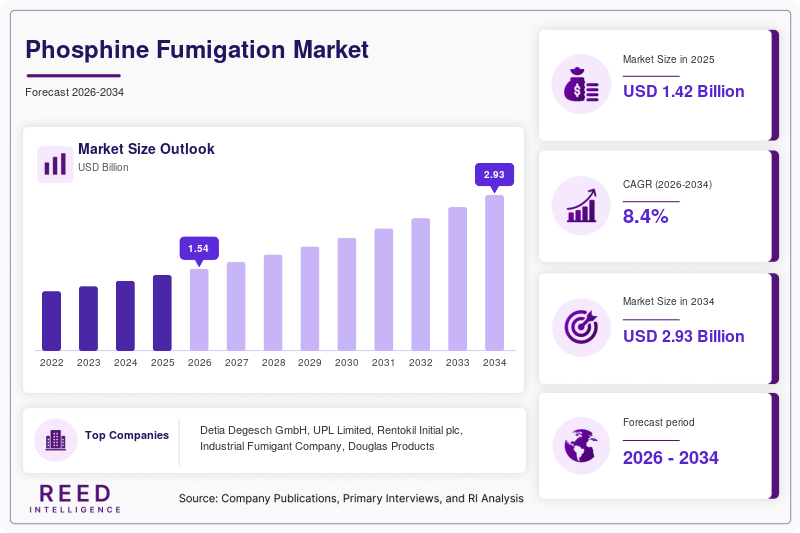
The global Phosphine Fumigation Market size was valued at USD 1.42 billion in 2026 and is projected to reach USD 2.71 billion by 2034, expanding at a CAGR of 8.4% during the forecast period from 2026 to 2034. The market continues to expand due to the growing need for effective grain preservation, pest management, and food storage protection across agricultural and industrial supply chains. Phosphine fumigation remains widely used in warehouses, shipping containers, grain silos, and food processing facilities because it offers broad-spectrum pest control and comparatively lower residue levels than several conventional chemical treatments.
A major global factor supporting market growth is the increasing pressure on agricultural producers to reduce post-harvest losses. According to industry estimates, grain losses caused by insects and storage pests continue to affect food security and export quality standards in several economies. Governments and food safety agencies are promoting modern fumigation systems to protect stored commodities during transportation and long-term storage. The expansion of international grain trade and rising demand for high-quality stored food products are also increasing the adoption of phosphine-based fumigation solutions in logistics hubs and commercial storage facilities.
Key Highlights
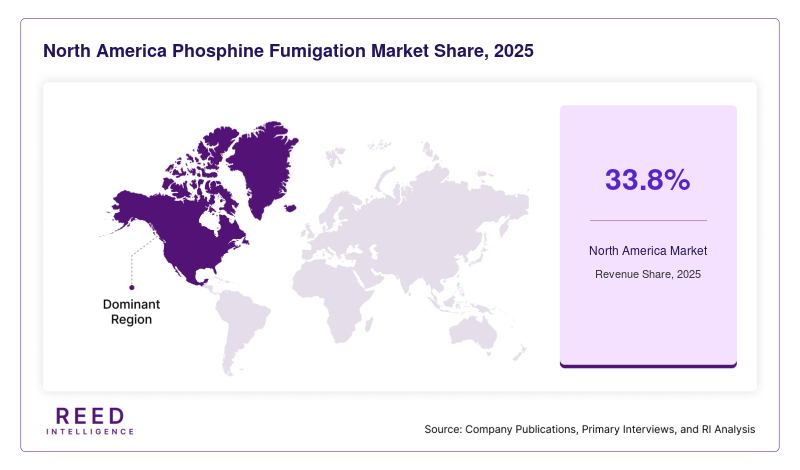
- North America dominated the market with a 33.8% share in 2025.
- Asia Pacific is expected to grow at the fastest CAGR of 10.9% during 2026–2034.
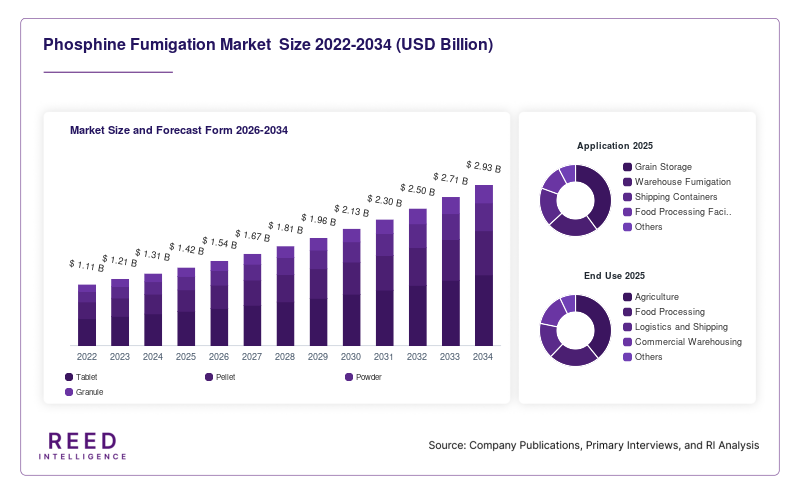
- By form, tablet formulations accounted for the largest share of 44.1%.
- while pellet formulations are projected to grow at a CAGR of 9.8%.
- By application, grain storage led with a 47.5% share.
- whereas warehouse fumigation is expected to expand at a CAGR of 10.1%.
- By end use, agriculture accounted for the highest share of 51.3%.
- while logistics and shipping are anticipated to grow at a CAGR of 9.7%.
- The United States remained the dominant country, with market values of USD 392 million in 2024 and USD 427 million in 2025.
Market Trends
Rising Adoption of Automated Fumigation Monitoring Systems
The Phosphine Fumigation Market is witnessing increased adoption of automated monitoring systems across commercial grain storage and industrial warehousing operations. Storage operators are increasingly using digital sensors, remote monitoring tools, and automated dosing technologies to improve treatment precision and reduce operational risks. These systems help maintain accurate phosphine concentration levels throughout fumigation cycles, which improves pest control efficiency while supporting worker safety compliance. Automated monitoring also reduces manual intervention and limits exposure risks in enclosed treatment areas.
The integration of Internet of Things platforms in fumigation management is creating opportunities for real-time tracking and predictive maintenance. Companies are investing in cloud-connected monitoring systems that provide concentration alerts and treatment analytics. Large agricultural exporters are adopting these technologies to meet international quality standards and reduce shipment rejection rates. As grain storage infrastructure modernizes in developing economies, demand for intelligent fumigation management systems is expected to support steady market growth throughout the forecast period.
Expansion of International Grain Trade and Storage Infrastructure
The steady expansion of global grain trade is contributing to increased demand for phosphine fumigation services and products. Several countries are investing in large-scale grain storage facilities, export terminals, and logistics hubs to improve food supply chain efficiency. International food trade regulations require exporters to maintain pest-free storage conditions, which continues to increase the use of phosphine fumigation in shipping containers, silos, and warehouses. Agricultural commodity exporters are particularly focused on reducing storage-related losses to preserve product quality during long transportation cycles.
Emerging economies in Asia Pacific, Latin America, and Africa are expanding public and private grain storage capacity to improve food security and export competitiveness. This infrastructure expansion is increasing demand for fumigation tablets, pellets, gas monitoring systems, and related safety equipment. Growth in processed food exports and rising cereal consumption are also supporting investments in advanced storage systems. As governments strengthen food preservation policies and agricultural trade programs, phosphine fumigation adoption is expected to remain strong across global agricultural supply chains.
Market Drivers
Increasing Focus on Reducing Post-Harvest Food Losses
The growing global focus on reducing post-harvest food losses is a major factor driving the Phosphine Fumigation Market. Insects, mites, and storage pests continue to damage large quantities of grains and stored food products every year, particularly in regions with limited storage infrastructure. Governments, agricultural cooperatives, and food processing companies are investing in fumigation solutions to maintain crop quality and improve food security. Phosphine fumigation is widely preferred because it penetrates deep into stored commodities and effectively controls multiple pest species.
The demand for efficient grain preservation technologies is also increasing due to rising global population and food consumption levels. Agricultural exporters are under pressure to comply with international phytosanitary standards, which require pest-free cargo before shipment. As a result, grain handlers and warehouse operators are adopting routine fumigation practices to reduce contamination risks and maintain product value. The expansion of commercial grain storage capacity across developing countries is expected to further support market growth during the forecast period.
Growing Demand from Logistics and Export Industries
The rapid growth of international logistics and agricultural exports is contributing significantly to market expansion. Exporters of cereals, pulses, processed food products, and animal feed increasingly rely on phosphine fumigation to prevent pest infestation during transportation and storage. Shipping companies and logistics providers are adopting fumigation protocols to meet import regulations in destination markets. The growing movement of bulk agricultural commodities through ports and distribution centers is creating sustained demand for fumigation services and products.
In addition, containerized shipping has increased the need for compact and efficient fumigation treatments that can be applied during cargo transit. Logistics operators are investing in specialized fumigation systems that minimize treatment time while maintaining effectiveness. Rising trade volumes across Asia Pacific and Latin America are further accelerating demand for phosphine-based pest management solutions. The continued expansion of global agricultural supply chains and cross-border food trade is expected to strengthen the market outlook over the coming years.
Market Restraint
Regulatory Challenges and Safety Concerns Associated with Phosphine Exposure
Stringent safety regulations and concerns related to phosphine exposure continue to restrain the growth of the Phosphine Fumigation Market. Phosphine gas is highly toxic when inhaled in concentrated quantities, creating risks for workers involved in storage operations, cargo handling, and fumigation activities. Regulatory agencies in several countries have introduced strict guidelines regarding gas concentration monitoring, worker training, equipment handling, and disposal procedures. Compliance with these regulations often increases operational costs for fumigation service providers and warehouse operators.
Smaller agricultural businesses and storage operators may face difficulties in adopting advanced monitoring systems due to budget limitations. Inadequate training or improper application can result in accidental exposure incidents, product contamination, or environmental concerns. Some regions are also tightening restrictions on chemical fumigants due to increasing emphasis on sustainable agricultural practices and occupational safety standards. These challenges are encouraging some storage operators to evaluate alternative pest control methods such as controlled atmosphere storage and biological pest management systems.
The presence of resistant insect species in certain grain-producing regions is another concern affecting treatment effectiveness. Repeated phosphine use without proper resistance management strategies can reduce fumigation efficiency over time. As regulatory oversight continues to increase, companies operating in the market are required to invest in safer application technologies, employee training programs, and advanced monitoring equipment to maintain compliance and operational reliability.
Market Opportunities
Increasing Investments in Smart Storage Infrastructure
The expansion of smart storage infrastructure presents a strong growth opportunity for the Phosphine Fumigation Market. Governments and private agricultural companies are investing in advanced grain silos, temperature-controlled warehouses, and digital storage management systems to improve food preservation and reduce commodity losses. These modern facilities require integrated pest management solutions that can maintain long-term storage quality without disrupting operational efficiency. Phosphine fumigation systems are increasingly being combined with automated monitoring technologies to support precision-based storage management.
Emerging economies with rising agricultural production are accelerating investments in modern storage infrastructure to strengthen export competitiveness. Large grain handling companies are adopting centralized monitoring systems that integrate fumigation control, gas concentration tracking, and inventory management. This shift toward technologically advanced storage operations is expected to increase demand for high-performance phosphine fumigation products and safety systems. Companies offering integrated fumigation solutions with digital capabilities are likely to benefit from expanding infrastructure modernization programs.
Expansion of Food Processing and Packaged Food Industries
The rapid growth of food processing and packaged food industries is creating additional opportunities for market participants. Processed grains, cereals, dry fruits, spices, and packaged food ingredients require effective pest management throughout storage and transportation stages. Food manufacturers are increasingly implementing fumigation procedures to maintain hygiene standards and reduce contamination risks in production supply chains. Rising consumer demand for packaged food products is driving investments in large-scale storage and warehousing infrastructure, particularly in urban markets.
Food exporters are also focusing on maintaining consistent product quality to meet international trade standards and retailer requirements. Phosphine fumigation is widely used because it can be applied efficiently across large storage volumes while preserving commodity quality. Growth in food retail chains, e-commerce grocery distribution, and global food trade is further increasing the need for reliable fumigation solutions. Companies developing safer application technologies and residue management solutions are expected to gain growth opportunities as food safety regulations continue to evolve.
Segmental Analysis
By Form
Tablet formulations dominated the Phosphine Fumigation Market and accounted for 44.1% of the global share in 2024. Tablets are widely preferred because they are easy to transport, store, and apply in large-scale grain storage operations. Agricultural warehouses, food processing facilities, and commercial storage operators commonly use tablet formulations due to their controlled gas release properties and cost efficiency. The ability of tablets to penetrate deeply into stored commodities makes them suitable for treating bulk grain shipments and enclosed storage structures.
In addition, tablet formulations remain highly popular among grain exporters because they can be applied effectively during transportation and long-term storage. Their compatibility with multiple storage environments and relatively low equipment requirements support widespread adoption across developed and developing economies. Increasing grain production and rising international food trade are expected to maintain strong demand for tablet-based fumigation solutions over the coming years.
By Application
Grain storage represented the dominant application segment and accounted for 47.5% of the global market share in 2024. The increasing need to protect cereals, pulses, and oilseeds from insect infestation continues to drive demand for phosphine fumigation across grain storage facilities. Commercial silos, agricultural cooperatives, and export warehouses rely heavily on fumigation treatments to maintain commodity quality and reduce post-harvest losses. The growing volume of global grain trade has also increased the importance of reliable pest management practices.
Governments and agricultural organizations are investing in advanced storage infrastructure to strengthen food security and improve supply chain efficiency. This has created sustained demand for phosphine fumigation products in both developed and emerging economies. The expansion of strategic grain reserve programs and bulk commodity storage facilities is further supporting segment growth. Increasing regulatory emphasis on maintaining pest-free storage environments is expected to preserve the leading position of grain storage applications during the forecast period.
By End Use
Agriculture accounted for the largest share of the Phosphine Fumigation Market in 2024, representing 51.3% of total revenue. Agricultural producers and grain storage operators continue to rely heavily on phosphine fumigation to prevent insect damage and preserve crop quality after harvest. Rising food demand and increasing pressure to minimize storage losses are supporting adoption across large farming cooperatives and commodity storage facilities. The agriculture sector benefits from the effectiveness of phosphine gas in controlling a broad range of storage pests.
The expansion of commercial farming and export-oriented agriculture is further strengthening demand for fumigation products and services. Governments in several countries are promoting improved storage practices to enhance food security and reduce economic losses associated with pest infestation. Investments in modern silos, grain reserves, and rural storage infrastructure are also contributing to segment growth. As agricultural supply chains continue to expand globally, the agriculture segment is expected to maintain its leading market position.
Regional Analysis
North America
North America accounted for 33.8% of the global Phosphine Fumigation Market share in 2025 and is expected to maintain steady growth during the forecast period at a CAGR of 7.4%. The region benefits from advanced grain storage infrastructure, strong agricultural exports, and strict food quality regulations. Large-scale grain handling facilities across the United States and Canada continue to use phosphine fumigation extensively to protect stored commodities from infestation. The presence of established logistics networks and commercial warehousing operations also contributes to market demand.
The United States remained the dominant country in the regional market due to its extensive grain production and export activities. The country continues to invest in modern grain silos and automated storage management systems to reduce post-harvest losses. Increasing exports of wheat, corn, and soybeans are creating demand for efficient fumigation practices across shipping terminals and storage facilities. The adoption of digital gas monitoring systems and worker safety technologies is further supporting long-term market expansion in the country.
Europe
Europe represented 24.6% of the global Phosphine Fumigation Market in 2025 and is projected to expand at a CAGR of 7.8% through 2034. Demand across the region is supported by strict food safety standards and increasing investments in agricultural storage modernization. European grain processors and exporters are adopting advanced fumigation protocols to maintain product quality and comply with import and export regulations. Warehousing operators are also implementing integrated pest management systems to improve operational efficiency and reduce contamination risks.
Germany emerged as the leading market within Europe due to its strong food processing industry and well-developed logistics infrastructure. The country has experienced growing demand for phosphine fumigation solutions in cereal storage and packaged food manufacturing operations. Expansion in agricultural trade activities and investments in sustainable storage technologies are supporting market growth. Increasing focus on regulatory compliance and worker safety has also accelerated adoption of automated fumigation monitoring equipment across industrial storage facilities.
Asia Pacific
Asia Pacific held 27.9% of the global market share in 2025 and is expected to register the fastest CAGR of 10.9% during the forecast period. The region is experiencing strong growth due to increasing agricultural production, rising food demand, and expanding grain storage infrastructure. Countries across Asia Pacific are investing heavily in warehouse modernization and pest management technologies to reduce food losses. Growing exports of rice, wheat, pulses, and processed agricultural commodities are increasing the need for effective fumigation solutions.
China dominated the regional market because of its large agricultural production base and expanding food storage infrastructure. Government initiatives aimed at improving food security and reducing post-harvest losses are driving investments in modern fumigation technologies. Rapid urbanization and increasing packaged food consumption are further supporting demand for safe storage systems. The expansion of international trade and logistics operations across major ports is also increasing phosphine fumigation usage in shipping containers and export facilities.
Middle East & Africa
The Middle East & Africa region accounted for 7.1% of the global Phosphine Fumigation Market in 2025 and is projected to grow at a CAGR of 8.3% through 2034. Growth in the region is linked to increasing investments in food security programs and grain storage infrastructure. Several countries rely heavily on imported grains and food commodities, creating strong demand for fumigation systems that maintain storage quality during transportation and warehousing. Expanding commercial storage operations and port logistics facilities are also contributing to market development.
Saudi Arabia remained the dominant country within the region due to its strategic investments in food storage and agricultural logistics infrastructure. The country continues to strengthen grain reserve management systems to improve long-term food supply stability. Rising imports of wheat and other staple commodities are increasing the use of phosphine fumigation across ports and storage facilities. Government support for warehouse modernization and advanced pest control practices is expected to support additional market growth over the forecast period.
Latin America
Latin America captured 6.6% of the global market share in 2025 and is expected to grow at a CAGR of 8.7% during the forecast period. The region benefits from expanding agricultural exports and increasing investments in grain handling infrastructure. Countries across Latin America are improving storage capacity to support rising exports of soybeans, corn, coffee, and other agricultural commodities. Demand for phosphine fumigation products is increasing among exporters seeking to maintain product quality during long-distance transportation.
Brazil emerged as the dominant country in the regional market due to its position as a major agricultural exporter. The country continues to invest in modern silos, logistics corridors, and storage facilities to reduce commodity losses and improve export efficiency. Increasing pressure to comply with international food quality standards is encouraging widespread use of fumigation systems across warehouses and transport containers. Growth in agricultural production and trade partnerships is expected to support continued market expansion in Brazil.
Competitive Landscape
The Phosphine Fumigation Market is moderately consolidated, with several international and regional companies competing through product innovation, distribution expansion, and strategic partnerships. Leading market participants are investing in advanced fumigation technologies, automated monitoring systems, and safety-focused product development to strengthen their competitive positions. Companies are also focusing on expanding service capabilities across agricultural storage, logistics, and food processing industries.
Detia Degesch GmbH remains one of the leading companies in the market due to its broad fumigation product portfolio and strong presence across grain storage and industrial applications. The company continues to invest in digital monitoring solutions and worker safety technologies to support regulatory compliance. Several competitors are expanding manufacturing capacity and strengthening regional distribution networks to address growing demand from emerging agricultural economies.
Industrial Fumigant Company, UPL Limited, Rentokil Initial plc, and Douglas Products are also actively expanding their market presence through acquisitions, partnerships, and product launches. In 2025, UPL Limited introduced an upgraded phosphine monitoring platform designed for large-scale grain storage facilities, improving treatment tracking and operational efficiency. Companies are expected to continue focusing on sustainable fumigation practices, residue management technologies, and integrated pest control systems to strengthen market competitiveness.
Key Players
- Detia Degesch GmbH
- UPL Limited
- Rentokil Initial plc
- Industrial Fumigant Company
- Douglas Products
- Solvay S.A.
- Cytec Solvay Group
- Royal Agro Organic Pvt. Ltd.
- Ikeda Kogyo Co., Ltd.
- Agrosynth Chemicals Ltd.
- Shenyang Fengshou Chemical Co., Ltd.
- Nippon Chemical Industrial Co., Ltd.
- Sandhya Group
- Pestcon Systems Inc.
- Jining Shengcheng Chemical Co., Ltd.
Recent Developments
- In February 2025, Detia Degesch GmbH expanded its fumigation monitoring product line with advanced wireless gas concentration sensors designed for large grain silos and export terminals.
- In July 2025, Rentokil Initial plc strengthened its agricultural pest management business through a regional partnership focused on warehouse fumigation services across Southeast Asia.
- In November 2024, Industrial Fumigant Company introduced upgraded phosphine application systems with improved dosage control and digital treatment tracking capabilities for logistics operators.
- In March 2025, Douglas Products increased production capacity for phosphine fumigation formulations to address rising demand from agricultural exporters in Latin America.
- In September 2024, UPL Limited launched a safety-focused fumigation training initiative for grain storage operators and warehouse managers across India and Australia.
Phosphine Fumigation Market Segments
Form
- Tablet
- Pellet
- Powder
- Granule
Application
- Grain Storage
- Warehouse Fumigation
- Shipping Containers
- Food Processing Facilities
- Others
End Use
- Agriculture
- Food Processing
- Logistics and Shipping
- Commercial Warehousing
- Others
By Region
- North America
- Europe
- APAC
- Middle East and Africa
- LATAM