Phosphonium Salt Market Size, Share & Demand Report By Type (Tetraalkylphosphonium Salts, Ionic Liquid-Based Phosphonium Salts, Others), By Application (Catalysts, Electrochemical Applications, Coatings, Water Treatment), By End-Use Industry (Chemical Industry, Electronics & Semiconductor, Pharmaceuticals, Energy & Power), By Form (Solid, Liquid), By Region & Segment Forecasts, 2025–2034
USD 3950
Market Overview
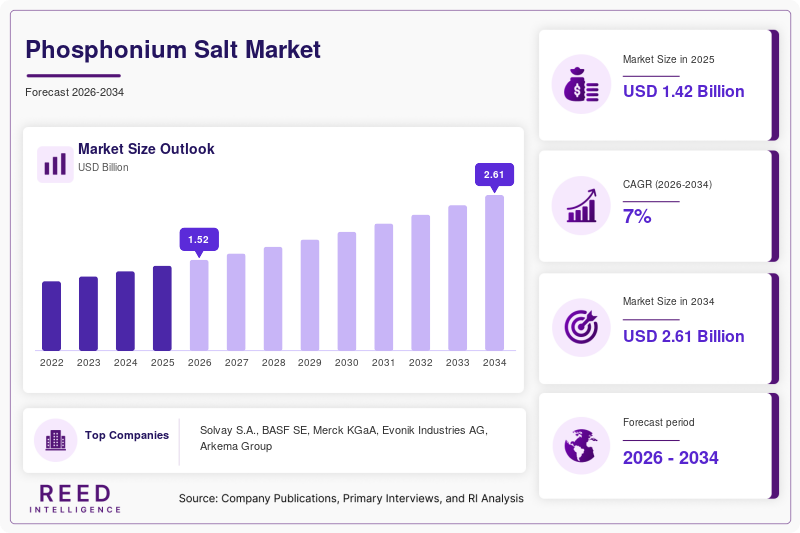
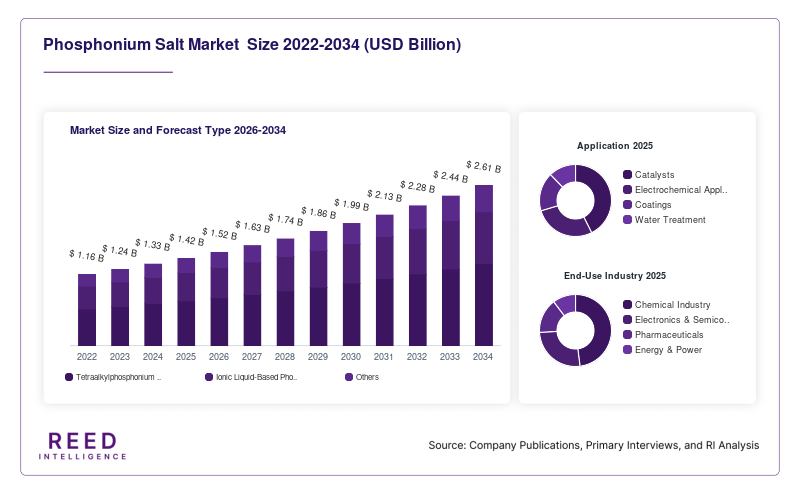
The global Phosphonium Salt Market size was valued at approximately USD 1.42 billion in 2025 and is projected to reach USD 2.61 billion by 2034, growing at a compound annual growth rate (CAGR) of 7.0% during the forecast period from 2025 to 2034. The market growth is being driven by increasing demand for high-performance catalysts, ionic liquids, and specialty chemicals across diverse industrial applications including pharmaceuticals, electronics, and polymer processing.
One of the key global factors supporting the expansion of the Phosphonium Salt Market is the rising adoption of green chemistry practices. Phosphonium salts are increasingly utilized in environmentally friendly catalytic systems due to their thermal stability, recyclability, and low volatility. These characteristics make them suitable alternatives to traditional solvents and catalysts, aligning with global sustainability initiatives and stricter environmental regulations.
Key Highlights
- Asia Pacific dominated the market with a share of 41.2% in 2025, while it is projected to be the fastest-growing region with a CAGR of 7.8%.
- By type, tetraalkylphosphonium salts led with a 46.5% share, while ionic liquid-based phosphonium salts are expected to grow at a CAGR of 8.3%.
- By application, catalysts accounted for the largest share of 38.7%, whereas electrochemical applications are projected to grow at a CAGR of 8.6%.
- China remained the dominant country with a market value of USD 412 million in 2025, expected to reach USD 438 million in 2026.
Market Trends
Rising Adoption of Ionic Liquids
The increasing utilization of phosphonium-based ionic liquids is a major trend shaping the Phosphonium Salt Market. These compounds are gaining traction due to their low volatility, high thermal stability, and tunable properties. Industries such as energy storage, electrochemistry, and advanced manufacturing are incorporating these materials to improve efficiency and reduce environmental impact. The trend is particularly evident in battery technologies and carbon capture systems, where ionic liquids are used for enhanced performance and sustainability.
Expansion in High-Performance Coatings
Another notable trend is the growing use of phosphonium salts in high-performance coatings and surface treatments. These salts enhance corrosion resistance, thermal durability, and antimicrobial properties, making them suitable for industrial, marine, and healthcare applications. With increasing infrastructure development and demand for durable materials, the coatings segment is witnessing consistent growth. Manufacturers are focusing on developing customized formulations to meet industry-specific requirements, further strengthening this trend.
Market Drivers
Increasing Demand in Pharmaceutical Synthesis
Phosphonium salts are widely used as phase-transfer catalysts and intermediates in pharmaceutical synthesis. The expanding pharmaceutical industry, driven by growing healthcare needs and drug development activities, is significantly contributing to the demand for these compounds. Their ability to improve reaction efficiency and selectivity makes them valuable in complex chemical processes.
Growth in Electronics and Semiconductor Industry
The rapid growth of the electronics and semiconductor industry is another key driver of the Phosphonium Salt Market. These salts are used in photoresists, etching processes, and electrochemical applications. As demand for advanced electronic devices increases globally, the need for high-purity and high-performance chemical materials is also rising, supporting market growth.
Market Restraint
High Production Costs and Limited Raw Material Availability
One of the primary challenges in the Phosphonium Salt Market is the high cost associated with production and raw materials. The synthesis of phosphonium salts often involves complex chemical processes and expensive phosphorus-based inputs. Additionally, fluctuations in the availability and pricing of raw materials can impact production efficiency and profitability. These factors may limit the adoption of phosphonium salts, especially in cost-sensitive applications. Smaller manufacturers may face difficulties in scaling operations, further restricting market expansion.
Market Opportunities
Emerging Applications in Energy Storage
The growing focus on renewable energy and energy storage systems presents significant opportunities for the Phosphonium Salt Market. These salts are increasingly used in electrolytes for batteries and supercapacitors due to their stability and conductivity. As demand for efficient energy storage solutions rises, manufacturers are expected to invest in research and development to enhance product performance.
Expansion in Water Treatment Applications
Phosphonium salts are gaining attention for their antimicrobial and biocidal properties, making them suitable for water treatment applications. With increasing concerns about water quality and industrial wastewater management, the demand for effective treatment solutions is rising. This creates new growth avenues for phosphonium salt manufacturers, particularly in developing regions.
Segmental Analysis
By Type
Tetraalkylphosphonium salts dominated the Phosphonium Salt Market in 2025, accounting for a share of 46.5%. Their widespread use in catalysts and phase-transfer applications has contributed to their leading position. These salts offer high stability and versatility, making them suitable for various industrial processes.
Ionic liquid-based phosphonium salts are expected to be the fastest-growing subsegment, with a projected CAGR of 8.3%. Their unique properties, such as low volatility and high thermal stability, will drive adoption in advanced applications like energy storage and green chemistry.
By Application
Catalysts represented the largest application segment, holding a share of 38.7% in 2025. Phosphonium salts are extensively used as catalysts in organic synthesis and industrial chemical processes, contributing to their dominance.
Electrochemical applications are anticipated to grow at the fastest CAGR of 8.6%. Increasing demand for batteries and energy storage systems will drive the use of phosphonium salts in electrolytes and related technologies.
By End-Use Industry
The chemical industry dominated the market with a share of 34.2% in 2025. The extensive use of phosphonium salts in chemical synthesis and processing has supported this segment’s growth.
The electronics industry is projected to grow at a CAGR of 8.1%, driven by increasing demand for advanced materials in semiconductor manufacturing and electronic devices.
By Form
Solid phosphonium salts accounted for the largest share of 52.8% in 2025 due to ease of handling and storage. Their stability and compatibility with various applications have contributed to their dominance.
Liquid forms are expected to grow at a CAGR of 7.9%, supported by their increasing use in ionic liquid applications and specialized chemical processes.
Regional Analysis
North America
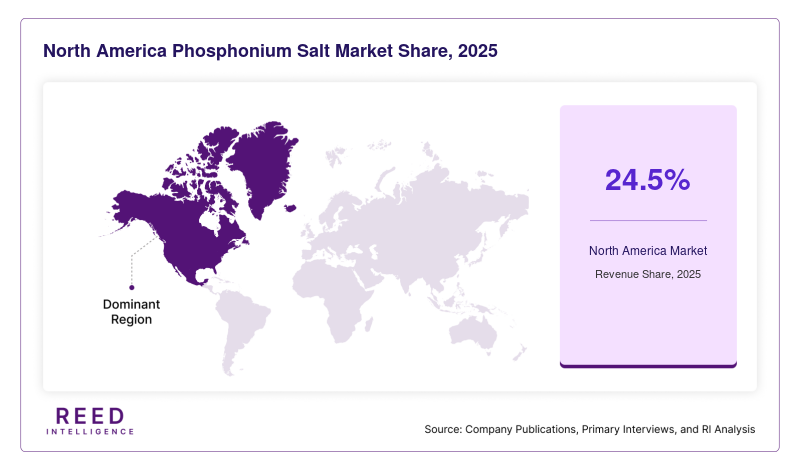
North America accounted for 24.5% of the Phosphonium Salt Market share in 2025 and is expected to grow at a CAGR of 6.5% during the forecast period. The region’s growth is supported by strong demand from the pharmaceutical and electronics sectors.
The United States dominated the regional market due to its advanced research infrastructure and significant investments in specialty chemicals. The presence of leading pharmaceutical companies and increasing adoption of green chemistry practices have contributed to sustained demand.
Europe
Europe held a market share of 21.3% in 2025 and is projected to grow at a CAGR of 6.2% through 2034. The region is characterized by stringent environmental regulations and a strong focus on sustainable chemical solutions.
Germany emerged as the leading country, driven by its robust chemical manufacturing industry and emphasis on innovation. The country’s focus on eco-friendly materials has encouraged the adoption of phosphonium salts in various applications.
Asia Pacific
Asia Pacific dominated the Phosphonium Salt Market with a share of 41.2% in 2025 and is anticipated to grow at the fastest CAGR of 7.8%. Rapid industrialization and expanding manufacturing activities are key factors supporting growth.
China led the region due to its large-scale chemical production and growing electronics industry. Government initiatives to support advanced materials and increased demand for specialty chemicals have further boosted market expansion.
Middle East & Africa
The Middle East & Africa accounted for 7.1% of the market in 2025 and is expected to grow at a CAGR of 6.8%. The region’s growth is driven by increasing investments in industrial and water treatment sectors.
Saudi Arabia dominated the market due to its expanding petrochemical industry and focus on industrial diversification. The adoption of advanced chemical solutions in oil and gas applications has contributed to demand.
Latin America
Latin America held a market share of 5.9% in 2025 and is projected to grow at a CAGR of 6.6%. The region is witnessing gradual growth due to increasing industrial activities and infrastructure development.
Brazil emerged as the leading country, supported by its growing chemical industry and demand for specialty materials. Investments in manufacturing and industrial expansion are expected to drive market growth.
Competitive Landscape
The Phosphonium Salt Market is moderately fragmented, with several global and regional players competing based on product innovation, quality, and pricing strategies. Key companies are focusing on expanding their product portfolios and investing in research and development to strengthen their market position.
A leading player in the market is Solvay S.A., which has maintained a strong presence through its advanced chemical solutions and continuous innovation. The company recently introduced new phosphonium-based ionic liquids aimed at enhancing performance in energy storage applications.
Other major players are also emphasizing strategic collaborations and capacity expansions to meet growing demand. The competitive landscape is characterized by ongoing technological advancements and efforts to develop sustainable and high-performance products.
Key Players
- Solvay S.A.
- BASF SE
- Merck KGaA
- Tokyo Chemical Industry Co., Ltd.
- Strem Chemicals, Inc.
- Alfa Aesar
- Sigma-Aldrich Corporation
- Lanxess AG
- Arkema Group
- Evonik Industries AG
- Chevron Phillips Chemical Company
- Clariant AG
- Huntsman Corporation
- Dow Inc.
- Nouryon
Recent Developments
- In 2024, Solvay S.A. launched a new range of phosphonium-based ionic liquids targeting energy storage applications.
- BASF SE expanded its specialty chemicals production capacity to include advanced phosphonium salt formulations.
- Merck KGaA invested in research to develop high-purity phosphonium salts for semiconductor applications.
- Evonik Industries AG introduced sustainable phosphonium compounds for green chemistry initiatives.
- Lanxess AG focused on expanding its product portfolio for industrial and water treatment applications.
Phosphonium Salt Market Segments
Type
- Tetraalkylphosphonium Salts
- Ionic Liquid-Based Phosphonium Salts
- Others
Application
- Catalysts
- Electrochemical Applications
- Coatings
- Water Treatment
End-Use Industry
- Chemical Industry
- Electronics & Semiconductor
- Pharmaceuticals
- Energy & Power
Form
- Solid
- Liquid
By Region
- North America
- Europe
- APAC
- Middle East and Africa
- LATAM