Phosphor Bronze Wire Market Size, Share & Demand Report By Type (Tin Phosphor Bronze Wire, High-Conductivity Phosphor Bronze Wire, Leaded Phosphor Bronze Wire, Specialty Alloy Phosphor Bronze Wire), By Application (Electrical Connectors, Springs and Contacts, Automotive Electronics, Industrial Equipment, Telecommunications Components, Aerospace Systems), By End Use (Electronics and Electrical Manufacturing, Automotive Industry, Aerospace and Defense, Industrial Manufacturing, Energy and Utilitie
USD 3950
Market Overview
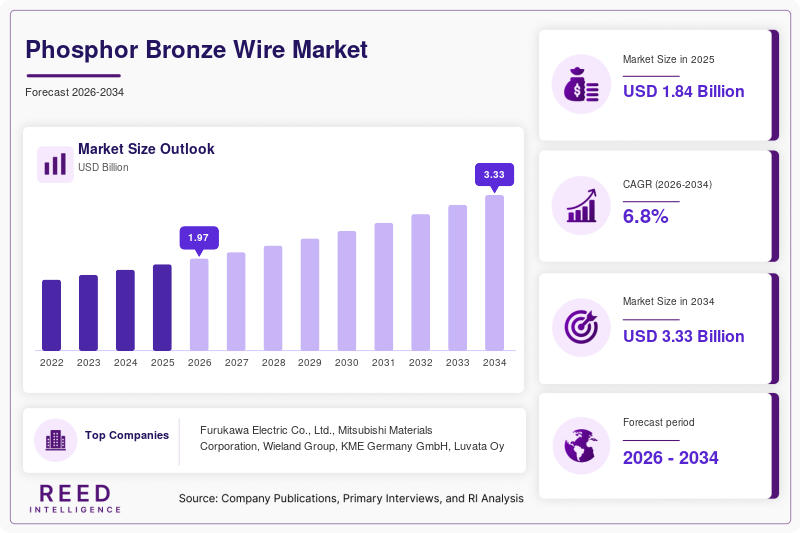
The global Phosphor Bronze Wire Market size was valued at USD 1.84 billion in 2026 and is projected to reach USD 3.12 billion by 2034, expanding at a CAGR of 6.8% during the forecast period from 2026 to 2034. Demand for phosphor bronze wire continues to rise across electrical, automotive, telecommunications, aerospace, and industrial manufacturing sectors due to its conductivity, corrosion resistance, durability, and fatigue strength. Manufacturers are increasingly adopting advanced copper alloy materials to improve product life cycles and operational efficiency in high-performance applications. The growing focus on miniaturized electronic devices and precision engineering components has also contributed to the steady expansion of the market.
One of the major global factors supporting market growth is the accelerating transition toward electrification across transportation and industrial systems. Electric vehicles, renewable energy infrastructure, smart grids, and automated industrial equipment require conductive materials that maintain performance under harsh operating conditions. Phosphor bronze wire offers high spring properties and mechanical reliability, making it suitable for connectors, terminals, relays, and electronic contacts. Expanding investments in industrial automation and next-generation communication systems have further strengthened market demand across developed and emerging economies.
Key Highlights
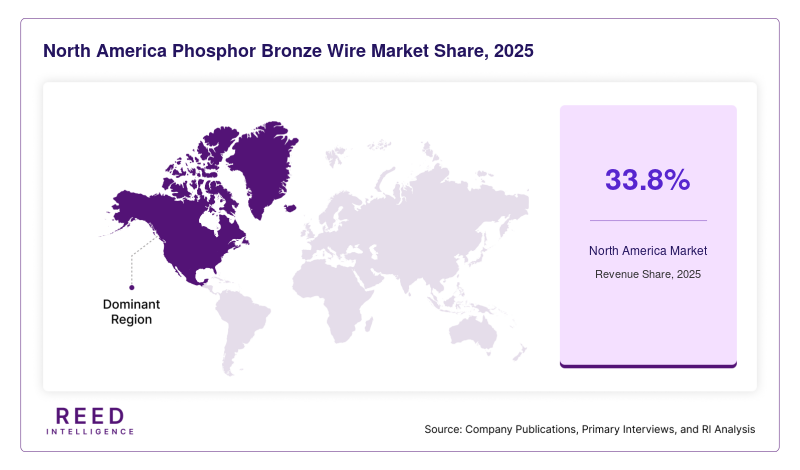
- North America dominated the market with a 33.8% share in 2025.
- Asia Pacific is expected to grow at the fastest CAGR of 8.1% during 2026–2034.
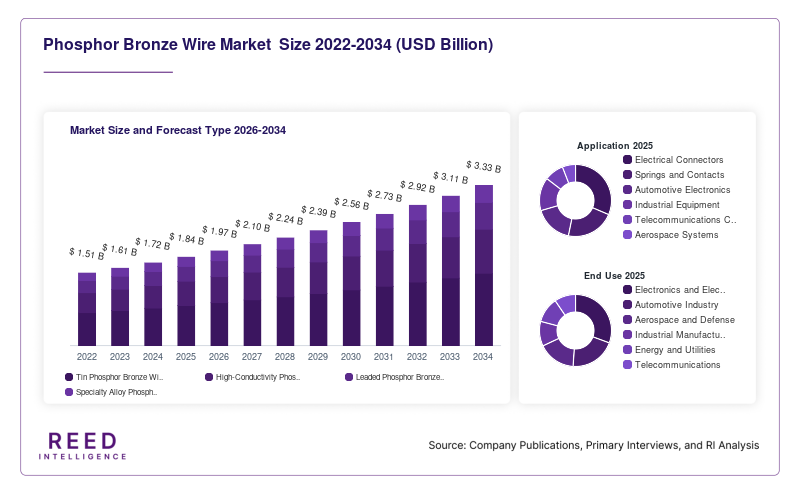
- By type, tin phosphor bronze wire accounted for the largest share of 42.6%, while high-conductivity phosphor bronze wire is projected to grow at a CAGR of 8.5%.
- By application, electrical connectors led with a 39.4% share, whereas automotive electronics are expected to expand at a CAGR of 8.8%.
- The United States remained the dominant country, with market values of USD 420 million in 2024 and USD 455 million in 2025.
Market Trends
Rising Integration of Phosphor Bronze Wire in Electric Mobility Systems
The growing penetration of electric vehicles and hybrid transportation systems is influencing product adoption across the Phosphor Bronze Wire Market. Automotive manufacturers increasingly rely on conductive alloys that deliver stable electrical performance, corrosion resistance, and high fatigue endurance. Phosphor bronze wire is being integrated into battery connectors, charging components, relay systems, and onboard electronics due to its balance between conductivity and mechanical strength. The expansion of electric mobility infrastructure across North America, Europe, and Asia Pacific is creating sustained demand for precision-engineered copper alloy wires. In addition, automotive suppliers are focusing on lightweight and durable materials to improve energy efficiency and reduce maintenance requirements. This trend is encouraging investments in advanced wire processing technologies and customized alloy compositions.
Growing Adoption of Precision Components in Consumer Electronics
The expansion of the global consumer electronics industry is creating favorable conditions for the use of phosphor bronze wire in compact and high-performance devices. Manufacturers of smartphones, wearable devices, laptops, and communication equipment are increasingly utilizing precision conductive materials to support miniaturization and long operating life. Phosphor bronze wire is widely used in springs, connectors, switches, and micro-electronic assemblies because of its elasticity and wear resistance. Rapid growth in data communication infrastructure and increasing semiconductor production are also supporting product demand. Electronics manufacturers are emphasizing component reliability and thermal stability, particularly for devices operating under continuous usage conditions. As electronic systems become more sophisticated, the demand for specialized wire grades and ultra-fine wire products is expected to rise steadily.
Market Drivers
Expansion of Industrial Automation and Smart Manufacturing
The increasing implementation of industrial automation systems is a major factor driving the Phosphor Bronze Wire Market. Manufacturing facilities across automotive, electronics, aerospace, and heavy engineering sectors are adopting automated production equipment that depends on stable electrical components and durable conductive materials. Phosphor bronze wire is commonly used in sensors, switches, relay systems, and robotic assemblies because it maintains performance under repetitive stress and vibration conditions. Smart factories also require reliable electrical connectivity for real-time monitoring and machine communication systems. The ongoing modernization of industrial infrastructure in developing economies is creating additional opportunities for alloy wire suppliers. Manufacturers are also improving product quality through automated wire drawing and heat treatment processes, which supports wider industrial acceptance.
Increasing Demand for High-Performance Electrical Connectors
The rising use of high-performance electrical connectors in telecommunications, energy systems, and transportation equipment is accelerating market growth. Phosphor bronze wire provides a combination of electrical conductivity, tensile strength, and resistance to environmental degradation, making it suitable for precision connectors and contact systems. The rapid deployment of renewable energy projects, smart power grids, and high-speed communication networks has increased the need for reliable conductive materials. Telecommunications infrastructure providers are also investing in durable connector systems to support uninterrupted data transmission. In the automotive sector, advanced driver assistance systems and electronic control units require stable connector performance in varying temperature environments. These applications are strengthening long-term demand for premium phosphor bronze wire products.
Market Restraint
Volatility in Copper and Alloy Raw Material Prices
Fluctuations in the prices of copper and alloying elements remain a significant challenge for the Phosphor Bronze Wire Market. Since phosphor bronze wire production depends heavily on copper-based raw materials, sudden shifts in commodity pricing can affect manufacturing costs and profit margins. Supply chain disruptions, trade regulations, geopolitical tensions, and mining output variations frequently influence global copper pricing patterns. Small and medium-sized manufacturers often face difficulty managing production costs during periods of price instability, which may reduce operational efficiency and limit expansion activities.
Price volatility also affects procurement planning for end-use industries such as automotive, electronics, and industrial manufacturing. Companies may delay large-scale purchasing decisions when raw material costs become unpredictable. In addition, competition from alternative conductive materials, including brass alloys and aluminum-based products, may increase during periods of elevated copper prices. Manufacturers are therefore focusing on recycling initiatives, long-term supplier agreements, and material optimization strategies to reduce exposure to market fluctuations. However, persistent uncertainty in raw material pricing continues to create pressure across the overall value chain.
Market Opportunities
Expansion of Renewable Energy Infrastructure Projects
The global expansion of renewable energy infrastructure presents significant opportunities for the Phosphor Bronze Wire Market. Solar power systems, wind energy installations, battery storage systems, and smart grid projects require durable conductive materials capable of operating under demanding environmental conditions. Phosphor bronze wire is increasingly used in electrical contacts, spring connectors, and control systems within renewable energy equipment. Governments across several regions are introducing clean energy policies and investment incentives that support large-scale deployment of sustainable energy technologies. These developments are expected to strengthen demand for high-performance copper alloy wires.
The growing integration of energy storage systems and advanced transmission networks is also contributing to market opportunities. Renewable energy equipment manufacturers are prioritizing component durability and electrical efficiency to improve operational reliability. Phosphor bronze wire suppliers are responding by developing corrosion-resistant and high-conductivity product variants tailored for outdoor and high-temperature applications. As renewable energy investments continue to expand, the market is likely to benefit from increased demand for specialized industrial wire products.
Increasing Use in Aerospace and Defense Applications
The aerospace and defense sectors are creating new growth avenues for phosphor bronze wire manufacturers due to rising demand for lightweight and high-reliability materials. Aircraft electrical systems, navigation equipment, communication devices, and defense electronics require conductive materials with strong fatigue resistance and long operational life. Phosphor bronze wire is suitable for these applications because it maintains electrical and mechanical stability under vibration and temperature fluctuations.
Governments are increasing defense modernization budgets, while commercial aerospace companies continue investing in advanced aircraft technologies and satellite communication systems. This environment is encouraging the use of precision-engineered alloy materials in critical electronic assemblies. Manufacturers are also exploring custom alloy formulations and ultra-fine wire solutions to meet evolving aerospace requirements. Growing investments in space technology and military communication infrastructure are expected to support long-term product adoption across specialized applications.
Segmental Analysis
By Type
Tin phosphor bronze wire accounted for the largest share of 42.6% in 2024 due to its strong combination of corrosion resistance, electrical conductivity, and mechanical durability. This wire type is widely used across electrical connectors, industrial springs, relay systems, and communication equipment. Manufacturers prefer tin phosphor bronze wire because it performs efficiently in demanding operating environments and maintains dimensional stability under repetitive stress conditions. Growing production of electronic devices and industrial automation equipment has contributed significantly to segment expansion. In addition, the material offers strong wear resistance and improved solderability, which enhances its suitability for precision electrical applications. Increasing investments in advanced manufacturing technologies have further supported demand for this product category across developed and emerging industrial markets.
High-conductivity phosphor bronze wire is projected to register the fastest CAGR of 8.5% during the forecast period due to increasing demand from advanced electronics and renewable energy industries. The segment is benefiting from rising adoption in electric vehicle battery systems, high-speed communication equipment, and energy-efficient electrical assemblies. Manufacturers are focusing on developing alloy compositions that improve conductivity while preserving tensile strength and corrosion resistance. Growing investments in semiconductor manufacturing and data communication infrastructure are also contributing to segment growth. In addition, expanding use of miniaturized electronic devices has increased demand for ultra-fine conductive wire products with consistent electrical performance. These factors are expected to support continued expansion of the high-conductivity segment.
By Application
Electrical connectors held the dominant market share of 39.4% in 2024 because phosphor bronze wire is widely used in connector systems requiring reliable conductivity and long operational life. The segment benefits from growing demand across automotive electronics, telecommunications infrastructure, industrial machinery, and consumer electronics manufacturing. Connector manufacturers prioritize materials capable of withstanding vibration, temperature changes, and corrosion exposure without losing electrical efficiency. Phosphor bronze wire meets these requirements through its strong fatigue resistance and elasticity properties. The rapid deployment of smart devices, industrial automation systems, and renewable energy equipment has further increased demand for advanced electrical connector components. Manufacturers are also introducing precision wire products to improve connector miniaturization and assembly performance in compact electronic systems.
Automotive electronics is anticipated to expand at the fastest CAGR of 8.8% during the forecast period due to increasing electrification in transportation systems. Modern vehicles incorporate advanced electronic systems including sensors, battery management systems, infotainment modules, and driver assistance technologies that rely on stable electrical connections. Phosphor bronze wire provides durability and electrical reliability in high-vibration automotive environments, making it suitable for critical electronic assemblies. The growing production of electric vehicles and hybrid vehicles across Asia Pacific, Europe, and North America is accelerating segment demand. Automotive manufacturers are also focusing on lightweight and energy-efficient materials to improve vehicle performance and reduce maintenance requirements. These trends are expected to support strong growth in automotive electronics applications.
By End Use
Electronics and electrical manufacturing accounted for the largest share of 44.1% in 2024 owing to the extensive use of phosphor bronze wire in switches, terminals, relays, springs, and precision connectors. The rapid growth of consumer electronics production and communication infrastructure development has significantly increased demand for reliable conductive materials. Manufacturers in this segment prioritize wire products that offer stable conductivity, dimensional precision, and resistance to environmental degradation. Phosphor bronze wire is also preferred for compact electronic assemblies because of its flexibility and long fatigue life. Increasing investments in semiconductor production facilities and industrial automation equipment have strengthened segment growth. The expansion of smart home technologies and advanced communication networks continues to create favorable demand conditions for electrical manufacturing applications.
The aerospace and defense segment is projected to witness the fastest CAGR of 7.9% during the forecast period due to increasing adoption of advanced electronic systems in aircraft and military equipment. Aerospace manufacturers require high-performance conductive materials capable of maintaining reliability under extreme operating conditions. Phosphor bronze wire is used in communication devices, avionics systems, navigation equipment, and electrical assemblies because of its durability and resistance to vibration. Rising defense modernization programs and investments in satellite communication technologies are also supporting segment expansion. Commercial aviation companies are focusing on lightweight and efficient materials to improve aircraft performance and operational safety. In addition, growing investments in space exploration and defense electronics are expected to create new opportunities for specialized alloy wire manufacturers.
Regional Analysis
North America
North America accounted for 33.8% of the global Phosphor Bronze Wire Market in 2025 and is expected to maintain a stable growth trajectory with a CAGR of 6.1% through 2034. The region benefits from advanced industrial infrastructure, strong electronics manufacturing capabilities, and growing investments in electric vehicle production. Demand for phosphor bronze wire remains high across telecommunications, aerospace, and automotive applications. Manufacturers are increasingly adopting high-precision conductive materials to support automated systems and advanced electronic assemblies. The region also benefits from ongoing technological innovation and strong demand for premium industrial components.
The United States remained the dominant country in North America due to its strong industrial manufacturing base and rising investments in transportation electrification. Expanding electric vehicle production and large-scale renewable energy projects are supporting demand for high-performance conductive alloys. Aerospace manufacturers are also increasing procurement of precision wire materials for avionics and communication systems. In addition, the country benefits from strong research and development capabilities that encourage innovation in copper alloy processing technologies and advanced wire manufacturing solutions.
Europe
Europe represented 27.4% of the global market in 2025 and is projected to grow at a CAGR of 6.4% during the forecast period. The region continues to witness rising demand for phosphor bronze wire in automotive electronics, industrial automation systems, and renewable energy equipment. European manufacturers are focusing on sustainable production practices and energy-efficient technologies, which is supporting the use of durable conductive materials. The increasing adoption of smart manufacturing technologies and expansion of electric mobility infrastructure are contributing to steady market growth across the region.
Germany emerged as the dominant country in Europe due to its strong automotive engineering industry and advanced manufacturing ecosystem. The country has experienced increasing demand for phosphor bronze wire in electric vehicle components, industrial machinery, and high-speed communication equipment. German manufacturers are also emphasizing precision engineering and high-quality alloy materials to improve product performance and operational reliability. Growing investments in Industry 4.0 initiatives and industrial robotics continue to strengthen market opportunities within the country.
Asia Pacific
Asia Pacific held 24.6% of the global Phosphor Bronze Wire Market in 2025 and is anticipated to register the fastest CAGR of 8.1% through 2034. Rapid industrialization, expanding electronics manufacturing, and increasing automotive production are major factors driving regional growth. Countries across the region are investing heavily in renewable energy systems, telecommunications infrastructure, and advanced industrial equipment. The strong presence of electronics component manufacturers and semiconductor production facilities continues to support demand for high-quality conductive alloy wires.
China remained the leading country in Asia Pacific due to its large-scale manufacturing sector and extensive electronics production capabilities. The country continues to expand electric vehicle manufacturing and communication infrastructure projects, creating substantial demand for phosphor bronze wire. Chinese manufacturers are also increasing investments in precision metal processing technologies and automated production systems. Government initiatives supporting industrial modernization and renewable energy deployment are further contributing to sustained market expansion across the domestic industry.
Middle East & Africa
The Middle East & Africa region accounted for 7.2% of the global market in 2025 and is expected to grow at a CAGR of 5.8% during the forecast period. Demand for phosphor bronze wire is increasing gradually due to infrastructure development, industrial diversification programs, and growing investments in energy and telecommunications projects. Several countries in the region are modernizing power transmission systems and expanding industrial manufacturing capabilities. The adoption of advanced electrical components in construction and industrial automation applications is also contributing to market growth.
Saudi Arabia emerged as the dominant country in the region because of its large-scale infrastructure investments and industrial development initiatives. The country is focusing on expanding renewable energy capacity and modernizing manufacturing operations under long-term economic diversification programs. Demand for durable conductive materials is increasing across electrical equipment, energy systems, and industrial facilities. In addition, rising investments in data centers and telecommunications infrastructure are supporting the use of precision alloy wire products in advanced electronic systems.
Latin America
Latin America captured 7.0% of the global Phosphor Bronze Wire Market in 2025 and is forecast to expand at a CAGR of 5.9% through 2034. The market is benefiting from increasing industrial activity, infrastructure upgrades, and expansion of automotive assembly operations across the region. Demand for phosphor bronze wire is rising in electrical equipment manufacturing, telecommunications systems, and industrial maintenance applications. Governments are also investing in renewable energy projects and modernization of power infrastructure, creating opportunities for conductive alloy suppliers.
Brazil remained the dominant country in Latin America due to its expanding industrial manufacturing sector and growing automotive production activities. The country has experienced increasing demand for electrical connectors, industrial machinery components, and communication equipment. Investments in energy transmission projects and manufacturing modernization initiatives are also supporting market expansion. In addition, the growing use of automation technologies in industrial operations is encouraging adoption of high-performance conductive wire materials across multiple sectors.
Competitive Landscape
The Phosphor Bronze Wire Market remains moderately fragmented, with global and regional manufacturers competing on product quality, alloy performance, manufacturing precision, and distribution capabilities. Leading companies are investing in advanced wire drawing technologies, automated processing systems, and customized alloy formulations to strengthen their market presence. Strategic partnerships with automotive, electronics, and industrial equipment manufacturers are becoming increasingly common as companies seek long-term supply agreements and stable revenue streams.
Furukawa Electric Co., Ltd. continues to maintain a leading position in the market due to its broad product portfolio, strong manufacturing capabilities, and extensive global distribution network. The company recently expanded its precision alloy production capacity to meet growing demand from electric vehicle and communication equipment manufacturers. Other major participants are also focusing on research and development activities to improve conductivity, corrosion resistance, and product durability.
Key Players
- Furukawa Electric Co., Ltd.
- Mitsubishi Materials Corporation
- Wieland Group
- KME Germany GmbH
- Luvata Oy
- Ningbo Boway Alloy Material Co., Ltd.
- Shanghai Metal Corporation
- Aviva Metals
- Aurubis AG
- Kobe Steel, Ltd.
- NGK Insulators Ltd.
- Hitachi Metals, Ltd.
- AMETEK Inc.
- Little Falls Alloys
- PMX Industries Inc.
Recent Developments
- In February 2026, Furukawa Electric Co., Ltd. expanded its precision alloy wire production facility in Japan to support rising demand from electric vehicle battery connector manufacturers.
- In September 2025, Wieland Group introduced a new high-conductivity phosphor bronze wire series designed for renewable energy equipment and advanced communication systems.
- In April 2026, Ningbo Boway Alloy Material Co., Ltd. announced investments in automated wire drawing technology to improve production efficiency and support growing export demand across Asia Pacific and Europe.
- In November 2025, Aurubis AG partnered with industrial electronics manufacturers to develop recyclable phosphor bronze wire solutions for sustainable electrical component production.
Phosphor Bronze Wire Market Segments
Type
- Tin Phosphor Bronze Wire
- High-Conductivity Phosphor Bronze Wire
- Leaded Phosphor Bronze Wire
- Specialty Alloy Phosphor Bronze Wire
Application
- Electrical Connectors
- Springs and Contacts
- Automotive Electronics
- Industrial Equipment
- Telecommunications Components
- Aerospace Systems
End Use
- Electronics and Electrical Manufacturing
- Automotive Industry
- Aerospace and Defense
- Industrial Manufacturing
- Energy and Utilities
- Telecommunications
By Region
- North America
- Europe
- APAC
- Middle East and Africa
- LATAM