Phosphor Plate Scanner Market Size, Share & Demand Report By Type (Tabletop Phosphor Plate Scanners, Portable Phosphor Plate Scanners), By Application (Dental Imaging, Medical Radiography, Veterinary Imaging, Industrial Radiography), By End Use (Hospitals & Diagnostic Centers, Dental Clinics, Veterinary Clinics, Industrial Inspection Facilities), By Region & Segment Forecasts, 2025–2034
USD 3950
Market Overview
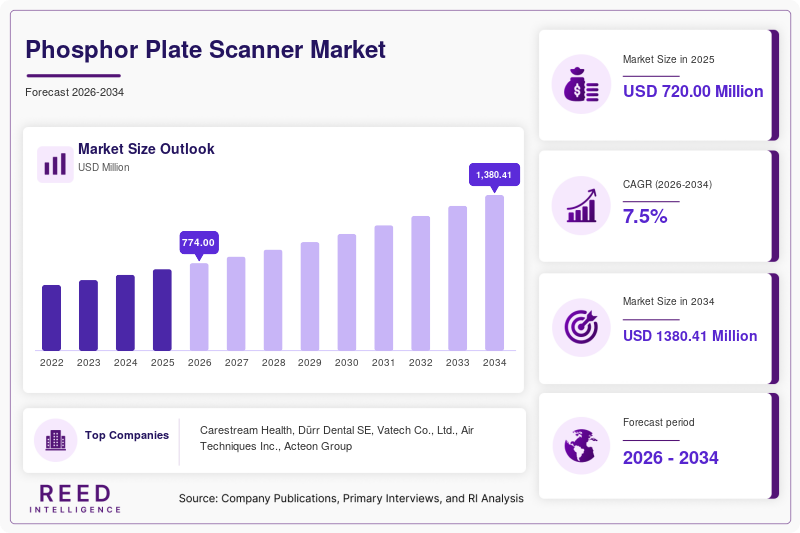
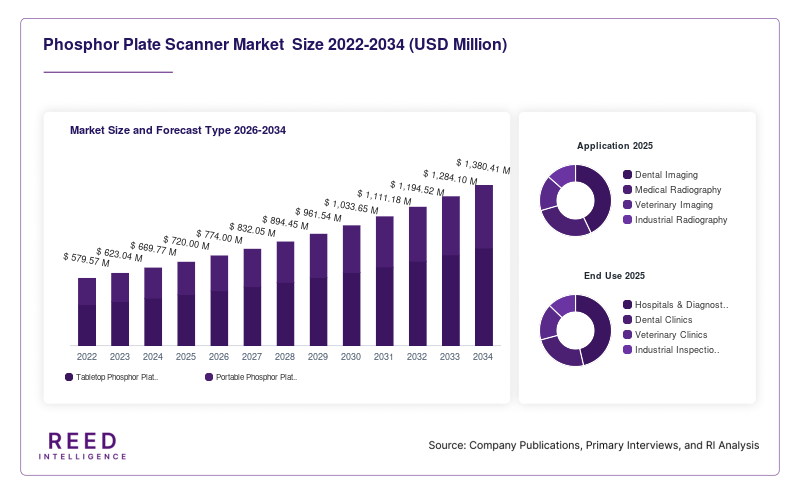
The global Phosphor Plate Scanner Market size was estimated at USD 720 million in 2025 and is projected to reach approximately USD 1.38 billion by 2034, registering a compound annual growth rate (CAGR) of 7.5% from 2025 to 2034. Phosphor plate scanners are widely used in digital radiography workflows where reusable photostimulable phosphor plates capture X-ray images and scanners convert them into digital formats. The increasing shift from traditional film-based radiography to digital imaging solutions across dental clinics, hospitals, and industrial inspection environments has supported steady market expansion.
One major global factor contributing to market growth has been the ongoing digital transformation of diagnostic imaging systems. Healthcare providers are increasingly investing in compact, efficient imaging technologies that improve workflow efficiency and reduce operational costs. Phosphor plate scanners have gained attention because they offer flexibility, high image quality, and compatibility with existing radiography systems. The technology also enables easier integration with picture archiving and communication systems (PACS), making it suitable for modern diagnostic environments.
Key Highlights
- North America accounted for approximately 36% of the global market share in 2025, while Asia Pacific is expected to register the fastest growth at a CAGR of 8.6% during the forecast period.
- The dental application segment represented the largest share in 2025, while veterinary imaging applications are expected to grow at a CAGR of 8.9% through 2034.
- By scanner type, tabletop phosphor plate scanners dominated the market, whereas portable scanners are projected to expand at a CAGR of 8.4%.
- The United States remained the dominant country market with an estimated USD 210 million in 2025, expected to reach USD 226 million in 2026.
Market Trends
Integration of Advanced Imaging Software and AI Tools
A key trend shaping the Phosphor Plate Scanner Market is the integration of advanced imaging software and artificial intelligence tools into scanning systems. Modern scanners are increasingly equipped with automated image enhancement algorithms that improve contrast, noise reduction, and diagnostic clarity. These software upgrades are enabling faster image processing and improved workflow efficiency in dental clinics and radiology departments. Artificial intelligence is also being introduced to assist in anomaly detection and image analysis, helping clinicians identify potential abnormalities more quickly. As digital imaging platforms evolve, scanner manufacturers are focusing on compatibility with cloud-based storage and integrated diagnostic platforms, strengthening the role of phosphor plate scanners in digital healthcare ecosystems.
Growing Adoption in Veterinary Diagnostics
Another notable trend is the increasing use of phosphor plate scanning systems in veterinary imaging. Veterinary hospitals and diagnostic centers are adopting digital radiography technologies to enhance diagnostic accuracy for companion animals and livestock. Phosphor plate scanners offer a practical solution because they allow flexible imaging in clinics with limited space and budgets. Additionally, reusable phosphor plates reduce long-term imaging costs compared to single-use film systems. As veterinary care standards improve globally and pet ownership continues to rise, demand for digital imaging technologies such as phosphor plate scanners is expected to expand steadily.
Market Drivers
Increasing Adoption of Digital Radiography Systems
The widespread adoption of digital radiography technologies has emerged as a primary growth driver for the Phosphor Plate Scanner Market. Healthcare providers are transitioning from analog film-based imaging systems to digital solutions that improve workflow efficiency, reduce chemical processing requirements, and enable rapid image sharing. Phosphor plate scanners play an essential role in this transition because they allow healthcare facilities to upgrade to digital imaging without replacing existing X-ray systems entirely. This compatibility has made them particularly attractive for small clinics and mid-sized hospitals seeking cost-effective digital imaging upgrades.
Rising Demand for Dental Diagnostic Imaging
Dental imaging procedures have increased globally due to greater awareness of oral health, expanding dental care services, and the growing number of dental clinics. Phosphor plate scanners are widely used in dental radiography because they provide high-resolution imaging with reusable plates that are comfortable for patients. The compact design of many scanners also makes them suitable for dental practices with limited workspace. As dental professionals continue to adopt digital imaging systems to enhance diagnostic accuracy and patient experience, demand for phosphor plate scanners is expected to rise steadily.
Market Restraint
Competition from Direct Digital Radiography Systems
A major restraint affecting the Phosphor Plate Scanner Market is the increasing adoption of direct digital radiography (DDR) systems. These technologies capture digital images directly through electronic sensors, eliminating the need for intermediate phosphor plates and scanning processes. DDR systems provide faster imaging results and streamlined workflows, which can reduce the operational advantages traditionally associated with phosphor plate scanners.
While phosphor plate systems remain cost-effective for many clinics, especially smaller facilities, some healthcare organizations are opting for direct digital systems during major equipment upgrades. This shift can limit the growth potential of phosphor plate scanners in markets where healthcare infrastructure investments favor fully digital imaging solutions.
Market Opportunities
Expansion in Emerging Healthcare Markets
Emerging economies present significant opportunities for the Phosphor Plate Scanner Market. Many healthcare systems in developing regions are gradually transitioning from analog imaging to digital solutions but face budget constraints when adopting advanced digital radiography equipment. Phosphor plate scanners provide a cost-effective entry point into digital imaging because they can integrate with existing X-ray systems. As governments and private healthcare providers invest in improving diagnostic capabilities, demand for flexible imaging technologies is expected to increase.
Growth in Industrial Radiography Applications
Beyond healthcare, industrial radiography represents a growing opportunity for phosphor plate scanner manufacturers. Industries such as aerospace, automotive manufacturing, oil and gas, and infrastructure inspection rely on non-destructive testing (NDT) methods to evaluate structural integrity. Phosphor plate scanners enable high-resolution imaging of welds, materials, and mechanical components without damaging them. As safety standards become stricter and infrastructure inspection requirements expand globally, industrial imaging applications could generate additional growth avenues for the market.
Segmental Analysis
By Type
Tabletop phosphor plate scanners dominated the Phosphor Plate Scanner Market, accounting for approximately 63% of the market share in 2025. These systems were widely used in hospitals, dental clinics, and diagnostic centers because of their higher scanning capacity and reliable performance. Tabletop scanners typically offer faster processing speeds and support multiple plate sizes, making them suitable for facilities handling high imaging volumes.
The portable phosphor plate scanner segment is expected to grow at the fastest CAGR of 8.4% through 2034. Growth will be driven by increasing demand for compact imaging solutions in mobile healthcare settings and field applications. Portable scanners enable clinicians to perform diagnostic imaging in remote or temporary medical environments, improving access to diagnostic services in underserved areas.
By Application
The dental imaging segment represented the largest share of the Phosphor Plate Scanner Market, accounting for around 48% of the market in 2025. Dental clinics widely used phosphor plate scanners for intraoral radiography due to their ability to produce high-resolution images with reusable imaging plates. The technology also enhances patient comfort compared to some sensor-based systems.
The veterinary imaging segment is projected to grow at the fastest CAGR of approximately 8.9%. Growth will be supported by expanding veterinary clinics, increasing pet ownership, and improved animal healthcare services. Veterinary professionals are adopting digital imaging technologies to improve diagnostic capabilities for companion animals and livestock.
By End Use
Hospitals and diagnostic imaging centers accounted for the largest share of the Phosphor Plate Scanner Market, representing about 52% of the market in 2025. These facilities used phosphor plate scanners for a wide range of diagnostic imaging procedures due to their compatibility with existing radiography equipment and digital workflow systems.
The dental clinics segment is expected to grow at the fastest CAGR of 8.1% through 2034. Dental practices will increasingly adopt digital imaging technologies to improve diagnostic accuracy and enhance patient care. Compact scanner designs and simplified imaging workflows will contribute to increasing adoption in dental clinics globally.
Regional Analysis
North America
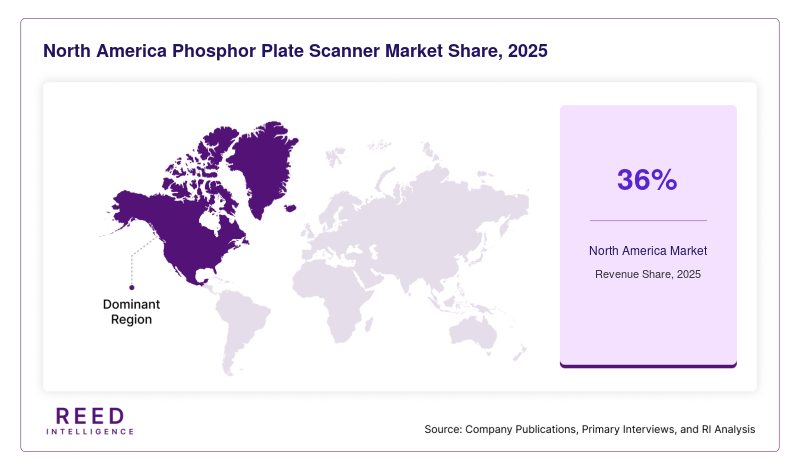
North America accounted for approximately 36% of the global Phosphor Plate Scanner Market share in 2025. The region benefited from widespread digital imaging adoption, well-established healthcare infrastructure, and strong investments in diagnostic technologies. The market in North America will expand at a projected CAGR of 6.9% between 2025 and 2034. Continued modernization of radiology departments and growing demand for efficient imaging workflows will support market growth across the region.
The United States represented the dominant country market. A key growth factor in the country has been the strong network of dental clinics and imaging centers that increasingly rely on digital radiography solutions. Many dental practices prefer phosphor plate scanners because they allow seamless upgrades from film-based systems while maintaining familiar imaging workflows. In addition, technological innovation among domestic imaging equipment manufacturers continues to support product development and adoption.
Europe
Europe held around 27% share of the global Phosphor Plate Scanner Market in 2025. The region has maintained strong adoption of diagnostic imaging technologies supported by universal healthcare systems and growing investments in medical imaging equipment. The European market is expected to grow at a CAGR of 7.1% during the forecast period.
Germany dominated the regional market due to its strong medical technology industry and large number of diagnostic laboratories. The country has maintained steady demand for imaging systems used in hospitals and dental clinics. German healthcare providers have also emphasized high-quality imaging standards and digital data integration, encouraging the use of efficient imaging technologies such as phosphor plate scanners.
Asia Pacific
Asia Pacific accounted for approximately 22% of the global market in 2025. The region’s large patient population, expanding healthcare infrastructure, and increasing investment in diagnostic technologies have supported market development. The Phosphor Plate Scanner Market in Asia Pacific will grow at the fastest CAGR of about 8.6% through 2034.
China emerged as the dominant country market due to rapid expansion of healthcare facilities and diagnostic centers. The country has experienced significant growth in dental clinics and imaging centers, creating demand for digital imaging systems. Healthcare providers in China have also emphasized improving diagnostic efficiency, which has encouraged the adoption of cost-effective digital radiography solutions such as phosphor plate scanners.
Middle East & Africa
The Middle East & Africa represented approximately 8% of the global Phosphor Plate Scanner Market share in 2025. Although the region currently holds a smaller share compared to other markets, ongoing healthcare infrastructure development is expected to support expansion. The regional market is projected to grow at a CAGR of 7.3% from 2025 to 2034.
The United Arab Emirates remained the leading country market. The growth factor driving adoption has been the modernization of healthcare facilities and the establishment of advanced diagnostic centers. Hospitals and specialty clinics in the country are increasingly incorporating digital imaging technologies to improve patient care and diagnostic accuracy.
Latin America
Latin America captured around 7% of the global Phosphor Plate Scanner Market in 2025. The region has gradually expanded its diagnostic imaging capabilities as healthcare systems modernize and private healthcare providers invest in new technologies. The regional market will expand at a CAGR of 7.0% during the forecast period.
Brazil held the largest share within the region. A key growth factor has been the expansion of private dental clinics and diagnostic imaging facilities. These healthcare providers have increasingly adopted digital imaging systems to improve diagnostic workflows and reduce long-term imaging costs, creating steady demand for phosphor plate scanners.
Competitive Landscape
The Phosphor Plate Scanner Market remains moderately competitive, with several established imaging technology companies offering advanced scanning solutions. Market participants focus on product innovation, imaging software improvements, and strategic partnerships to expand their market presence.
Carestream Health is widely recognized as a leading player in the market due to its extensive portfolio of digital radiography systems and phosphor plate scanners. The company recently introduced upgraded imaging software designed to improve image clarity and workflow efficiency across dental and medical applications.
Other companies such as Dürr Dental, Vatech, Acteon Group, and Air Techniques continue to develop compact scanners and advanced imaging technologies to strengthen their market positions.
Key Players List
- Carestream Health
- Dürr Dental SE
- Vatech Co., Ltd.
- Air Techniques Inc.
- Acteon Group
- Digiray Corporation
- Midmark Corporation
- KaVo Dental
- CRUXELL Corp.
- Soredex (part of KaVo Kerr)
- Trident S.r.l.
- Owandy Radiology
- FONA Dental
- Ray Co., Ltd.
- Nical S.p.A.
Recent Developments
- Carestream Health introduced an upgraded digital phosphor plate scanning system with improved image processing capabilities.
- Dürr Dental expanded its imaging product portfolio with enhanced scanning speed and plate durability features.
- Vatech launched a compact dental imaging scanner designed for small clinic environments.
- Air Techniques introduced software enhancements to improve digital radiography workflow integration.
- Acteon Group expanded its dental imaging equipment distribution network in Asia Pacific.
Phosphor Plate Scanner Market Segments
Type
- Tabletop Phosphor Plate Scanners
- Portable Phosphor Plate Scanners
Application
- Dental Imaging
- Medical Radiography
- Veterinary Imaging
- Industrial Radiography
End Use
- Hospitals & Diagnostic Centers
- Dental Clinics
- Veterinary Clinics
- Industrial Inspection Facilities
Region
- North America
- Europe
- Asia Pacific
- Middle East & Africa
- Latin America
By Region
- North America
- Europe
- APAC
- Middle East and Africa
- LATAM