Photo Emulsion Market Size, Share & Demand Report By Product Type (Diazo Photo Emulsion, SBQ-Based Photo Emulsion, Dual-Cure Photo Emulsion), By Application (Textile Printing, Graphic Printing, Electronics Printing, Glass Printing), By End User (Commercial Printing Companies, Textile Manufacturers, Electronics Manufacturers, Packaging Industry) By Region & Segment Forecasts, 2026–2034
USD 3950
Market Overview
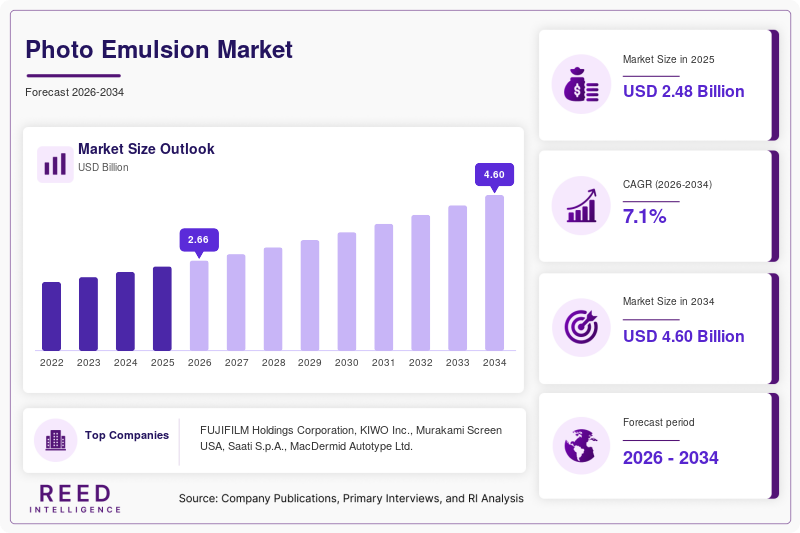
The Photo Emulsion Market was valued at approximately USD 2.48 billion in 2026 and is projected to reach nearly USD 4.31 billion by 2034, expanding at a CAGR of 7.1% during the forecast period from 2026 to 2034. The global Photo Emulsion Market is witnessing stable growth due to increasing demand from textile printing, packaging, electronics manufacturing, and graphic imaging industries. Photo emulsions are light-sensitive coatings widely used in screen printing and stencil preparation processes, where precision image transfer and durable print quality are essential. Rising industrialization, expansion of digital textile printing, and increasing use of advanced printing technologies are supporting long-term market development across both developed and emerging economies.
A major global factor supporting the growth of the Photo Emulsion Market is the expansion of the global packaging and textile industries. The increasing use of customized packaging solutions, promotional graphics, and branded textile products is creating strong demand for screen printing materials and high-performance photo emulsions. Growth in consumer goods manufacturing and rising investments in industrial printing technologies are also encouraging wider adoption of advanced emulsion formulations. Furthermore, improvements in UV-curable emulsions, water-resistant coatings, and eco-friendly chemical compositions are positively influencing the overall market outlook.
Key Highlights
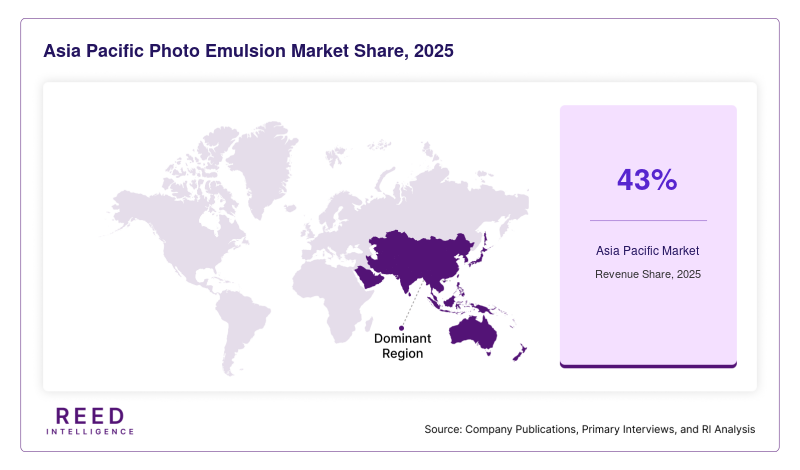
- Asia Pacific dominated the market with 43% share in 2025, while Latin America is projected to witness the fastest growth at a 7.8% CAGR during 2026–2034.
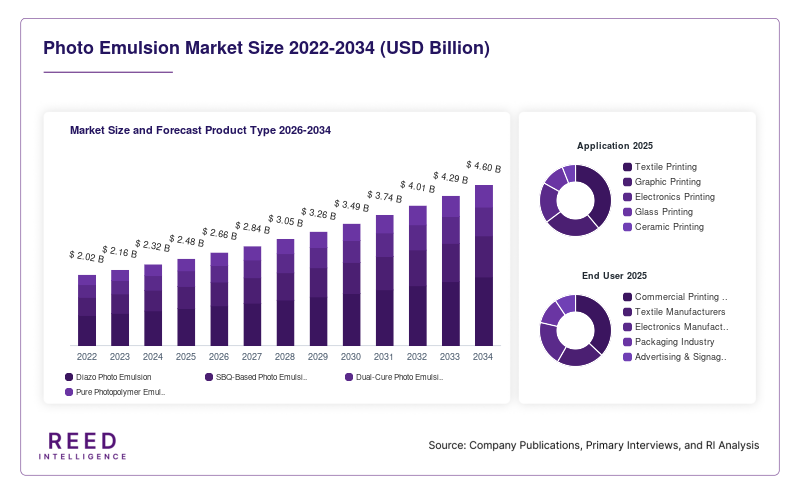
- By type, diazo photo emulsions accounted for the largest market share of 45% in 2025, while dual-cure photo emulsions are expected to grow at a CAGR of 7.9% during the forecast period.
- By application, textile printing remained the dominant segment with 39% market share in 2025, whereas electronics printing is projected to expand at a CAGR of 8.1% through 2034.
- China remained the leading country market and was valued at approximately USD 412 million in 2024 and USD 445 million in 2025.
Market Trends
Rising Demand for High-Resolution Screen Printing Applications
One of the major trends shaping the Photo Emulsion Market is the increasing demand for high-resolution and precision-based screen printing applications. Industries such as electronics, packaging, and promotional printing are adopting advanced printing technologies capable of producing detailed and durable image transfers. Photo emulsions with enhanced exposure stability and improved stencil durability are becoming increasingly important in these applications.
Manufacturers are focusing on developing emulsions that support finer mesh counts and better print consistency across different substrates. The growing use of printed electronics, decorative graphics, and specialty labels is encouraging innovation in high-performance emulsion chemistry. This trend is expected to strengthen demand for premium photo emulsion products over the forecast period.
Increasing Shift Toward Environmentally Safer Formulations
Another important trend in the Photo Emulsion Market is the growing shift toward environmentally safer and low-VOC formulations. Regulatory agencies and industrial users are increasingly emphasizing sustainable chemical usage in printing operations. Traditional solvent-heavy emulsions are gradually being replaced with water-based and eco-friendly alternatives that reduce hazardous emissions and improve workplace safety.
Manufacturers are investing in bio-based ingredients and recyclable chemical systems to comply with evolving environmental standards. The demand for sustainable screen printing materials is particularly increasing in textile and packaging applications where environmental compliance has become a critical purchasing factor. This transition is expected to create new growth opportunities for advanced eco-friendly emulsions.
Market Drivers
Expansion of Textile and Apparel Printing Industry
The rapid expansion of the textile and apparel printing industry is a major driver supporting the growth of the Photo Emulsion Market. Screen printing continues to be widely used in garment decoration, sportswear branding, and promotional textile production because of its cost efficiency and high print durability. Rising consumer demand for customized apparel and branded merchandise is increasing the need for reliable photo emulsion systems.
Textile manufacturers are also adopting advanced screen printing technologies to improve productivity and print quality. The growth of fashion retail and e-commerce apparel businesses is further contributing to increased printing activity across global textile production centers. These factors are collectively driving sustained demand for photo emulsions.
Growth in Electronics and Industrial Printing Applications
Another key growth driver for the Photo Emulsion Market is the increasing use of screen printing processes in electronics and industrial manufacturing. Printed circuit boards, membrane switches, solar panels, and touch-sensitive devices require precision printing solutions capable of producing consistent conductive patterns and high-quality imaging.
The expansion of consumer electronics manufacturing and renewable energy infrastructure is increasing the demand for advanced industrial printing materials. High-performance photo emulsions are becoming essential for achieving precise pattern transfer and improved production efficiency in electronics manufacturing facilities.
Market Restraint
Competition from Digital Printing Technologies
One of the primary restraints affecting the Photo Emulsion Market is the growing adoption of digital printing technologies. Digital printing systems offer faster setup, reduced material waste, and simplified customization capabilities compared to conventional screen printing methods. In some commercial printing applications, digital alternatives are reducing the dependence on traditional photo emulsion-based screen printing processes.
Market Opportunities
Increasing Adoption in Printed Electronics Manufacturing
The rising adoption of printed electronics is creating significant opportunities for the Photo Emulsion Market. Flexible electronics, wearable devices, and smart sensors require precision stencil and conductive printing processes that rely heavily on high-quality photo emulsions. As electronics manufacturers continue to expand production capacity, demand for advanced emulsion formulations is expected to increase steadily.
Manufacturers are developing specialized emulsions capable of supporting ultra-fine printing applications and enhanced conductive ink compatibility. This opportunity is likely to strengthen the role of photo emulsions in next-generation electronics manufacturing.
Growth of Specialty Packaging and Branding Solutions
The increasing demand for specialty packaging and premium branding solutions presents another strong opportunity for the market. Packaging manufacturers are adopting advanced screen printing methods for decorative finishes, customized labels, and promotional graphics. High-quality photo emulsions help improve print clarity, durability, and color consistency across packaging materials.
The expansion of consumer goods industries and rising emphasis on visual brand differentiation are expected to encourage greater use of screen printing technologies in packaging applications. This trend is anticipated to support long-term market growth.
Segmental Analysis
By Type
Based on type, the Photo Emulsion Market is segmented into diazo photo emulsions, dual-cure photo emulsions, pure photopolymer emulsions, and capillary film emulsions. Diazo photo emulsions dominated the market with approximately 45% share in 2025 due to their affordability, broad application compatibility, and ease of use in textile and graphic printing operations. Dual-cure photo emulsions are expected to witness the fastest growth at a CAGR of 7.9% during the forecast period because they offer improved exposure speed, stencil durability, and high-resolution imaging performance.
By Application
By application, the market is segmented into textile printing, graphic printing, electronics printing, and packaging printing. Textile printing accounted for the largest market share of 39% in 2025 because screen printing remains widely used in garment manufacturing and promotional textile production. Electronics printing is expected to grow at a CAGR of 8.1% through 2034 due to increasing production of printed circuit boards, membrane switches, and flexible electronic devices.
By Chemistry Type
Based on chemistry type, the market includes water-resistant emulsions, solvent-resistant emulsions, and hybrid emulsions. Water-resistant emulsions held the dominant share of approximately 42% in 2025 due to their extensive use in textile printing and water-based ink applications. Hybrid emulsions are projected to grow at a CAGR of 7.7% during the forecast period because manufacturers are increasingly demanding versatile emulsions compatible with multiple printing environments and ink systems.
By End User
The market is segmented into textile manufacturers, commercial printing companies, electronics manufacturers, and packaging companies. Textile manufacturers accounted for approximately 40% share in 2025 because they represent the largest consumers of screen printing emulsions for apparel decoration and branding applications. Electronics manufacturers are expected to witness a CAGR of 8.0% during the forecast period owing to increasing printed electronics production and expanding demand for precision imaging technologies.
Regional Analysis
Asia Pacific
Asia Pacific accounted for approximately 43% share of the Photo Emulsion Market in 2025 and is projected to grow at a CAGR of 7.5% during the forecast period. The region benefits from strong textile manufacturing activity, expanding electronics production, and rapid industrialization. China remained the dominant regional market due to the presence of large-scale textile printing operations and increasing investments in industrial printing technologies.
North America
North America held around 24% share in 2025 and is expected to expand at a CAGR of 6.6% through 2034. Rising demand for specialty packaging, promotional graphics, and printed electronics applications is supporting regional market growth. The United States dominated the regional market because of advanced industrial printing infrastructure and increasing adoption of eco-friendly screen printing materials.
Europe
Europe represented nearly 21% market share in 2025 and is projected to witness a CAGR of 6.4% during the forecast period. The region is benefiting from strong environmental regulations and increasing adoption of sustainable printing technologies. Germany remained the leading regional contributor due to expanding industrial manufacturing and increasing investments in specialty packaging production.
Middle East & Africa
The Middle East & Africa accounted for approximately 6% share in 2025 and is expected to grow at a CAGR of 6.1% during the forecast period. Increasing textile production activities and expanding commercial printing operations are supporting market growth across the region. The United Arab Emirates dominated the regional market because of growing packaging and advertising industries.
Latin America
Latin America held around 6% market share in 2025 and is projected to expand at the fastest CAGR of 7.8% through 2034. Brazil remained the dominant country market due to increasing textile exports and rising demand for customized apparel printing. Expanding consumer goods manufacturing and growth in local branding activities are also supporting market development.
Competitive Landscape
The Photo Emulsion Market is moderately competitive with the presence of several international and regional manufacturers focusing on product innovation, sustainable chemistry development, and expansion of industrial printing solutions. Companies are investing in advanced emulsion technologies that improve exposure efficiency, stencil durability, and environmental compatibility.
KIWO Inc. remained one of the leading participants in the market due to its broad portfolio of screen printing emulsions and industrial imaging solutions. The company recently expanded its environmentally safer emulsion product line for textile and electronics applications.
Fujifilm Holdings Corporation continues to strengthen its specialty imaging business through advanced screen printing chemistry and industrial graphics solutions. Ulano Corporation is focusing on high-performance stencil systems, while MacDermid Graphics Solutions and Murakami Screen USA are expanding their precision printing technologies through continuous product development initiatives.
Key Players List
- KIWO Inc.
- Fujifilm Holdings Corporation
- Ulano Corporation
- MacDermid Graphics Solutions
- Murakami Screen USA
- Chromaline Screen Print Products
- Saati S.p.A.
- Autotype International Ltd.
- PRODECRAN S.L.
- SPGPrints B.V.
- Sericol International
- Asahi Kasei Corporation
- Tiflex Ltd.
- TechNova Imaging Systems Pvt. Ltd.
- Nazdar Ink Technologies
Photo Emulsion Market Segments
Product Type
- Diazo Photo Emulsion
- SBQ-Based Photo Emulsion
- Dual-Cure Photo Emulsion
- Pure Photopolymer Emulsion
Application
- Textile Printing
- Graphic Printing
- Electronics Printing
- Glass Printing
- Ceramic Printing
End User
- Commercial Printing Companies
- Textile Manufacturers
- Electronics Manufacturers
- Packaging Industry
- Advertising & Signage Industry
By Region
- North America
- Europe
- APAC
- Middle East and Africa
- LATAM