Photovoltaic Thermal (PVT) System Market Size, Share & Demand Report By Collector Type (Water-Based PVT Collectors, Air-Based PVT Collectors, Concentrating PVT Collectors), By Application (Residential, Commercial, Industrial), By End-Use (Commercial Buildings, District Energy Systems, Healthcare Facilities, Educational Institutions, Manufacturing Facilities) By Region & Segment Forecasts, 2026–2034
USD 3950
Market Overview
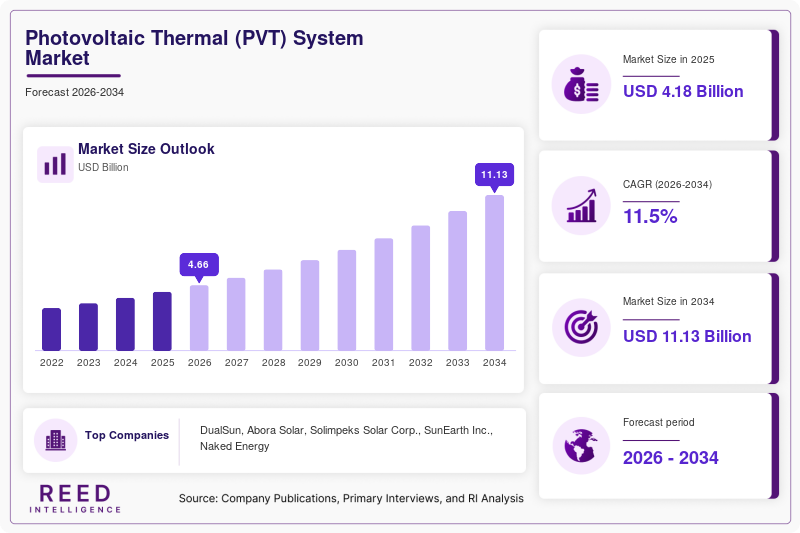
The global Photovoltaic Thermal (PVT) System Market size was valued at USD 4.18 billion in 2026 and is projected to reach USD 9.96 billion by 2034, expanding at a CAGR of 11.5% during the forecast period from 2026 to 2034. The market is gaining momentum due to the increasing integration of renewable energy technologies in commercial, industrial, and residential infrastructure projects. Photovoltaic thermal systems combine solar photovoltaic electricity generation with thermal energy collection in a single solution, enabling improved energy efficiency and optimized rooftop utilization. Governments and private organizations across multiple economies are increasingly prioritizing decarbonization goals, which has accelerated investments in hybrid solar technologies.
One major global factor supporting the growth of the Photovoltaic Thermal (PVT) System Market is the rising demand for energy-efficient building infrastructure. Urbanization, combined with growing electricity consumption and stricter environmental regulations, has encouraged developers to adopt integrated renewable systems that reduce long-term operating costs. PVT systems provide dual benefits by generating electricity while simultaneously capturing thermal energy for heating applications. This combined functionality has made the technology attractive for hospitals, hotels, manufacturing facilities, district heating systems, and smart residential complexes. In addition, advancements in heat exchanger materials, panel efficiency, and thermal storage technologies are improving system performance and reducing maintenance requirements.
Key Highlights
- North America dominated the market with a 35.1% share in 2025, while Asia Pacific is expected to grow at the fastest CAGR of 12.8% during 2026–2034.
- By collector type, water-based PVT collectors accounted for the largest share of 44.3%, while air-based collectors are projected to grow at a CAGR of 13.1%.
- By application, residential installations led with a 39.6% share, whereas industrial applications are expected to expand at a CAGR of 12.7%.
- By end-use, commercial buildings held the dominant share of 36.9%, while district energy systems are projected to grow at a CAGR of 13.4%.
- The United States remained the dominant country, with market values of USD 780 million in 2024 and USD 860 million in 2025.
Market Trends
Integration of Smart Energy Management Systems
The integration of smart energy management platforms with photovoltaic thermal systems is becoming an important trend across the global market. Building operators and industrial facilities are increasingly using digital monitoring software, predictive analytics, and IoT-enabled controllers to improve the efficiency of solar energy utilization. Smart systems allow real-time monitoring of electricity generation, heat recovery, and energy consumption patterns, helping organizations optimize overall operational performance. The increasing adoption of smart buildings and connected infrastructure is creating favorable conditions for intelligent PVT deployments. Many manufacturers are now offering cloud-based monitoring solutions that enable users to remotely analyze thermal output, panel performance, and storage efficiency.
This trend is particularly strong in developed economies where energy optimization standards are becoming more stringent. Commercial properties, hospitals, and educational campuses are deploying smart PVT systems to reduce grid dependence and achieve sustainability objectives. Furthermore, digital twins and artificial intelligence-based predictive maintenance tools are helping operators identify system inefficiencies before failures occur. The inclusion of battery storage and thermal storage integration is also improving system flexibility. These advancements are expected to enhance customer confidence and encourage broader adoption of hybrid solar technologies across residential and commercial sectors.
Expansion of Hybrid Renewable Energy Infrastructure
The increasing development of hybrid renewable energy infrastructure is another significant trend shaping the Photovoltaic Thermal (PVT) System Market. Governments and utility providers are moving beyond standalone solar systems and focusing on integrated renewable platforms that combine electricity generation, heating, cooling, and energy storage capabilities. PVT systems are gaining attention because they maximize solar energy conversion efficiency and support multiple energy applications simultaneously. This multifunctional capability is becoming important for regions facing land constraints and rising energy costs.
Industrial facilities and urban infrastructure projects are increasingly adopting hybrid systems that integrate photovoltaic thermal collectors with heat pumps, geothermal units, and centralized heating networks. In Europe and parts of Asia Pacific, district heating projects are incorporating PVT technologies to improve renewable energy penetration in urban areas. The trend is also supported by increasing investments in net-zero buildings and carbon-neutral industrial operations. Manufacturers are responding by introducing modular and scalable PVT solutions suitable for large-scale installations. As hybrid energy ecosystems continue to expand globally, demand for advanced photovoltaic thermal systems is expected to increase steadily throughout the forecast period.
Market Drivers
Rising Demand for Energy-Efficient Building Solutions
The increasing demand for energy-efficient buildings is a major factor driving the growth of the Photovoltaic Thermal (PVT) System Market. Governments and regulatory agencies across several countries are implementing stricter building efficiency standards to reduce carbon emissions and lower overall energy consumption. PVT systems support these objectives by generating both electricity and thermal energy through a single installation. This dual functionality improves energy efficiency and reduces reliance on conventional power sources. Commercial buildings, hotels, healthcare facilities, and educational institutions are increasingly integrating PVT systems into new construction and renovation projects.
The growing focus on green certifications and sustainable urban planning is also supporting market growth. Developers are seeking renewable technologies that can improve building energy ratings while reducing operating expenses. PVT systems help lower electricity bills and heating costs simultaneously, making them financially attractive over the long term. In addition, increasing electricity prices in many regions are encouraging businesses and homeowners to invest in integrated renewable systems. Technological improvements in panel durability, thermal absorption efficiency, and compact design are further enhancing the commercial viability of photovoltaic thermal solutions.
Government Incentives Supporting Renewable Energy Deployment
Government policies and financial incentives promoting renewable energy adoption are contributing significantly to the expansion of the Photovoltaic Thermal (PVT) System Market. Many countries are introducing tax credits, capital subsidies, feed-in tariffs, and low-interest financing programs to accelerate investments in clean energy infrastructure. These initiatives are encouraging residential, commercial, and industrial consumers to adopt hybrid solar technologies that can reduce greenhouse gas emissions and improve energy independence.
Public investments in renewable infrastructure are particularly strong across North America, Europe, and parts of Asia Pacific. National energy transition programs are increasingly emphasizing distributed energy systems and decentralized heating solutions. PVT systems align well with these policy frameworks because they provide both electrical and thermal output with higher land-use efficiency compared to conventional solar technologies. In addition, international climate commitments and net-zero targets are motivating governments to increase renewable energy deployment across urban and industrial sectors. The combination of regulatory support and declining installation costs is expected to strengthen market expansion over the coming years.
Market Restraint
High Initial Installation and Integration Costs
The high initial investment associated with photovoltaic thermal systems remains a major challenge for market expansion. Although PVT systems provide long-term energy savings, their upfront costs are generally higher than traditional photovoltaic systems due to the integration of thermal collectors, heat exchangers, storage systems, and advanced control technologies. Installation complexity also increases project costs, particularly in retrofitting applications where existing building infrastructure may require modifications. Small and medium-sized businesses, along with residential consumers in developing economies, often face budget limitations that restrict adoption.
The lack of standardized installation practices and limited availability of skilled technicians in some regions further complicate deployment. In emerging markets, financing access and limited awareness regarding long-term operational benefits continue to hinder broader commercialization. Industrial customers may also delay investments because of uncertainty regarding payback periods and maintenance requirements. For example, large-scale industrial facilities considering integrated heating and cooling solutions often require customized engineering designs, which increases implementation expenses. These financial and operational barriers may slow market penetration in cost-sensitive regions despite growing interest in renewable energy technologies.
Market Opportunities
Growing Adoption of Net-Zero Energy Buildings
The increasing development of net-zero energy buildings presents a major opportunity for the Photovoltaic Thermal (PVT) System Market. Governments, construction firms, and real estate developers are investing heavily in sustainable infrastructure that minimizes environmental impact and reduces dependence on conventional energy sources. PVT systems are well suited for net-zero projects because they combine electricity production and thermal energy generation in a compact design. This capability allows building owners to maximize rooftop efficiency while meeting stringent energy performance standards.
Commercial complexes, educational institutions, and healthcare facilities are emerging as important application areas for integrated renewable technologies. Many new urban development projects are incorporating advanced energy management systems, thermal storage units, and smart grids that complement photovoltaic thermal installations. In addition, increasing consumer awareness regarding carbon reduction and long-term energy savings is creating favorable market conditions. The demand for eco-friendly construction materials and renewable heating solutions is expected to increase further as sustainability certifications become more important in global real estate markets.
Expansion of Industrial Decarbonization Initiatives
Industrial decarbonization programs are creating strong growth opportunities for photovoltaic thermal system providers. Manufacturing industries are under increasing pressure to reduce carbon emissions and improve operational sustainability. PVT systems can support industrial facilities by supplying renewable electricity alongside process heating applications. Industries such as food processing, textiles, pharmaceuticals, and chemicals are particularly suitable for hybrid solar technologies because they require continuous thermal energy for production activities.
Many industrial operators are now exploring integrated renewable energy systems to reduce fuel dependency and stabilize long-term energy costs. The growing use of industrial heat pumps and thermal storage technologies is increasing compatibility with advanced PVT systems. Governments and environmental agencies are also encouraging industrial sustainability through carbon reduction mandates and energy efficiency regulations. Furthermore, large corporations are establishing renewable energy procurement targets to strengthen environmental performance and investor confidence. These developments are expected to generate substantial demand for high-capacity photovoltaic thermal systems across industrial sectors during the forecast period.
Segmental Analysis
By Collector Type
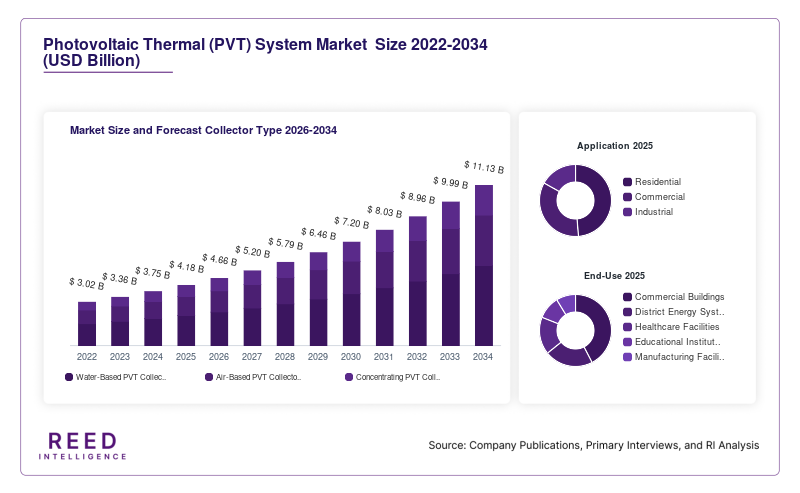
Water-based PVT collectors accounted for the largest share of the global Photovoltaic Thermal (PVT) System Market in 2024, contributing approximately 44.3% of total revenue. These systems are widely used because of their high thermal transfer efficiency and suitability for residential, commercial, and industrial heating applications. Water-based collectors are commonly integrated with hot water systems, district heating infrastructure, and industrial process heating operations. Their ability to deliver stable thermal performance while simultaneously generating electricity makes them highly attractive for energy-efficient buildings and smart infrastructure projects. The increasing adoption of sustainable heating technologies across Europe and North America has further strengthened the demand for water-based photovoltaic thermal systems.
Air-based PVT collectors are projected to register the fastest CAGR of 13.1% during the forecast period due to their lower maintenance requirements and simplified installation processes. These systems are increasingly used in commercial buildings, agricultural facilities, and industrial drying applications where air heating is essential. Air-based collectors reduce the risk of fluid leakage and freezing issues, making them suitable for regions with challenging climatic conditions. Technological improvements in airflow management, thermal insulation, and modular collector designs are enhancing overall system performance. In addition, rising investments in low-cost renewable heating solutions are expected to accelerate the deployment of air-based photovoltaic thermal systems across emerging economies.
By Application
Residential applications held the dominant position in the Photovoltaic Thermal (PVT) System Market in 2024, accounting for 39.6% of global revenue. Growing consumer awareness regarding renewable energy adoption and rising residential electricity costs are encouraging homeowners to invest in hybrid solar technologies. PVT systems are increasingly integrated into smart homes and sustainable residential complexes because they provide both electricity generation and water heating capabilities. Government subsidies, tax benefits, and low-interest financing programs in several countries are also supporting residential adoption. The demand for rooftop renewable systems has increased significantly in urban areas where efficient space utilization is becoming an important factor.
Industrial applications are anticipated to expand at the fastest CAGR of 12.7% from 2026 to 2034 due to rising demand for renewable process heating solutions. Industries such as food processing, chemicals, pharmaceuticals, and textiles require substantial thermal energy for manufacturing operations, creating strong demand for advanced photovoltaic thermal systems. Companies are increasingly adopting integrated renewable energy technologies to reduce carbon emissions and comply with sustainability regulations. In addition, industrial facilities are seeking long-term energy cost stability amid fluctuating fuel prices. Improvements in large-scale thermal storage systems and industrial heat integration technologies are expected to support rapid growth in this segment.
By End-Use
Commercial buildings represented the largest end-use segment in the global Photovoltaic Thermal (PVT) System Market in 2024, accounting for 36.9% of total market revenue. Hotels, hospitals, educational institutions, office complexes, and retail centers are increasingly deploying photovoltaic thermal systems to reduce operational energy expenses and achieve sustainability objectives. Commercial facilities generally have high electricity and heating requirements, making hybrid solar technologies economically beneficial. The increasing development of green buildings and energy-efficient urban infrastructure has strengthened demand for integrated renewable energy systems. Furthermore, rising corporate commitments toward carbon reduction and environmental compliance are encouraging broader deployment across commercial sectors.
District energy systems are expected to witness the fastest CAGR of 13.4% during the forecast period due to growing investments in centralized renewable heating infrastructure. Urban areas are increasingly adopting district heating and cooling networks to improve energy efficiency and reduce greenhouse gas emissions. PVT systems can support these networks by supplying renewable electricity and thermal energy simultaneously. European and Asian cities are particularly active in expanding district energy projects as part of broader sustainability programs. Technological advancements in thermal storage, smart grid integration, and large-scale heat exchange systems are expected to create strong growth opportunities for photovoltaic thermal technologies within this segment.
Regional Analysis
North America
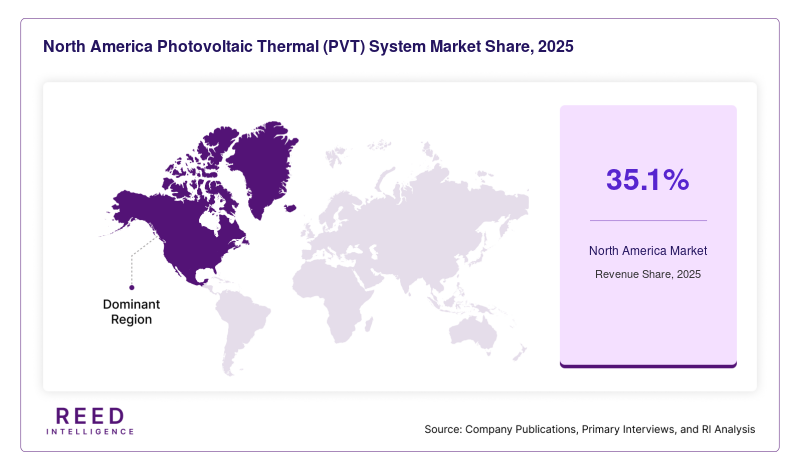
North America accounted for 35.1% of the global Photovoltaic Thermal (PVT) System Market share in 2025 and is expected to maintain a stable growth trajectory throughout the forecast period. The region is projected to expand at a CAGR of 10.9% between 2026 and 2034 due to increasing investments in renewable infrastructure and energy-efficient buildings. Growing electricity demand, coupled with federal support for clean energy projects, is encouraging commercial and residential adoption of hybrid solar technologies. Utilities and private developers are also increasing investments in distributed energy systems.
The United States remains the dominant country within the regional market due to strong policy support and rising adoption of sustainable building technologies. The country benefits from significant investments in smart city infrastructure, advanced energy storage systems, and net-zero construction projects. Large commercial facilities and industrial plants are increasingly integrating PVT systems to reduce operational energy costs. In addition, favorable tax incentives and renewable portfolio standards are encouraging wider deployment of photovoltaic thermal technologies across multiple states.
Europe
Europe represented 28.4% of the global Photovoltaic Thermal (PVT) System Market in 2025 and continues to experience consistent expansion supported by aggressive carbon reduction targets. The regional market is anticipated to grow at a CAGR of 11.3% during the forecast period as governments focus on reducing dependence on fossil fuels. District heating projects, green building initiatives, and energy transition programs are creating favorable conditions for photovoltaic thermal installations. Increasing concerns regarding energy security are also accelerating renewable energy investments across several European economies.
Germany remains the leading country in the European market because of its advanced renewable energy ecosystem and strong industrial base. The country has witnessed increasing adoption of hybrid solar systems in residential complexes, manufacturing facilities, and municipal infrastructure projects. Germany’s emphasis on energy-efficient construction and decentralized power generation continues to drive innovation in photovoltaic thermal technologies. In addition, partnerships between technology providers and research institutions are improving system efficiency and expanding commercial deployment opportunities.
Asia Pacific
Asia Pacific is emerging as the fastest-growing region in the Photovoltaic Thermal (PVT) System Market and is forecast to expand at a CAGR of 12.8% from 2026 to 2034. The region accounted for 23.6% of global market revenue in 2025 and is benefiting from rapid urbanization, industrialization, and rising electricity consumption. Governments across major economies are implementing renewable energy policies to address environmental concerns and strengthen energy security. Large-scale infrastructure development and increasing awareness regarding sustainable construction are also contributing to market growth.
China dominates the regional market due to extensive renewable energy investments and strong manufacturing capabilities. The country has become a major production hub for solar technologies, enabling cost-effective deployment of photovoltaic thermal systems. Rapid industrial expansion and government-backed clean energy programs are supporting installation growth across commercial and industrial sectors. In addition, China’s increasing focus on carbon neutrality and energy efficiency is driving demand for integrated renewable heating and power generation solutions.
Middle East & Africa
The Middle East & Africa region accounted for 7.2% of the global Photovoltaic Thermal (PVT) System Market share in 2025 and is expected to witness moderate growth during the forecast period. The regional market is projected to register a CAGR of 10.1% between 2026 and 2034. Rising solar irradiation levels and increasing investments in renewable energy diversification programs are supporting market development. Governments are gradually expanding renewable energy projects to reduce dependence on conventional oil and gas resources.
The United Arab Emirates remains the dominant country in the regional market because of its strong focus on sustainable urban development and clean energy deployment. The country is investing in smart cities, green buildings, and advanced district cooling infrastructure, all of which create demand for photovoltaic thermal systems. Large commercial developments and tourism projects are increasingly integrating renewable energy technologies to improve environmental performance. Furthermore, public-private partnerships are supporting innovation and renewable infrastructure expansion across the region.
Latin America
Latin America held 5.7% of the global Photovoltaic Thermal (PVT) System Market in 2025 and is expected to experience gradual expansion over the forecast period. The regional market is anticipated to grow at a CAGR of 9.7% between 2026 and 2034 due to increasing renewable energy adoption and modernization of energy infrastructure. Several countries are promoting distributed energy generation to improve electricity accessibility and reduce dependence on imported fuels. Rising energy costs are also encouraging businesses to invest in hybrid solar technologies.
Brazil remains the leading country within the Latin American market owing to its expanding renewable energy sector and favorable climatic conditions. Commercial establishments, agricultural operations, and industrial facilities are increasingly deploying photovoltaic thermal systems to reduce electricity expenses and improve energy efficiency. Government incentives supporting renewable energy investments are further strengthening market growth. Additionally, increasing awareness regarding sustainable development and carbon reduction objectives is encouraging broader adoption of integrated solar technologies.
Competitive Landscape
The global Photovoltaic Thermal (PVT) System Market is moderately fragmented, with several international and regional companies competing through technological innovation, strategic partnerships, and product portfolio expansion. Leading companies are focusing on improving thermal efficiency, reducing installation costs, and developing integrated renewable energy solutions tailored to residential, commercial, and industrial applications. Market participants are also investing in smart monitoring systems and advanced thermal storage technologies to enhance customer value and operational performance.
DualSun emerged as one of the leading companies in the market due to its strong product portfolio and expanding international distribution network. The company recently introduced an advanced hybrid solar module designed for high-efficiency residential and commercial installations, improving both electricity generation and thermal recovery performance. Other major players are increasingly engaging in partnerships with construction firms, renewable energy developers, and utility providers to strengthen market presence.
Key Players
- DualSun
- Abora Solar
- Solimpeks Solar Corp.
- SunEarth Inc.
- Naked Energy
- Solarus
- Heliodyne Inc.
- Solimpeks Energy
- Dimas Solar
- Absolicon Solar Collector AB
- Racell Technologies
- EnergySolaris
- Chromagen
- AWA SOLAR
- Mitsubishi Electric Corporation
Recent Developments
- In February 2026, DualSun expanded its manufacturing capacity in Europe to address increasing demand for hybrid solar modules across commercial construction projects.
- In August 2025, Naked Energy partnered with a regional infrastructure developer to deploy photovoltaic thermal systems in multiple district heating projects across Europe.
- In November 2025, Abora Solar introduced a next-generation high-efficiency PVT collector designed for industrial process heating applications.
- In March 2026, Solarus announced the integration of AI-enabled monitoring software into its photovoltaic thermal systems to improve energy optimization and predictive maintenance.
- In September 2025, Solimpeks Solar Corp. expanded its distribution network in Asia Pacific to strengthen regional market penetration and support industrial renewable energy projects.
Photovoltaic Thermal (PVT) System Market Segments
Collector Type
- Water-Based PVT Collectors
- Air-Based PVT Collectors
- Concentrating PVT Collectors
Application
- Residential
- Commercial
- Industrial
End-Use
- Commercial Buildings
- District Energy Systems
- Healthcare Facilities
- Educational Institutions
- Manufacturing Facilities
By Region
- North America
- Europe
- APAC
- Middle East and Africa
- LATAM