Phthalocyanine Pigment Market Size, Share & Demand Report By Type (Copper Phthalocyanine, Metal-Free Phthalocyanine), By Application (Coatings, Inks, Plastics, Textiles), By End-Use Industry (Construction, Automotive, Packaging, Consumer Goods), By Form (Powder, Liquid), By Region & Segment Forecasts, 2025–2034
USD 3950
Market Overview
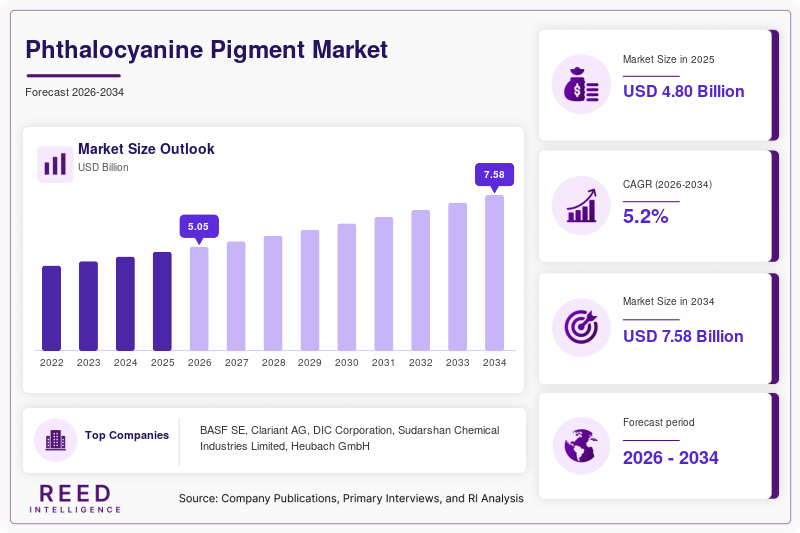
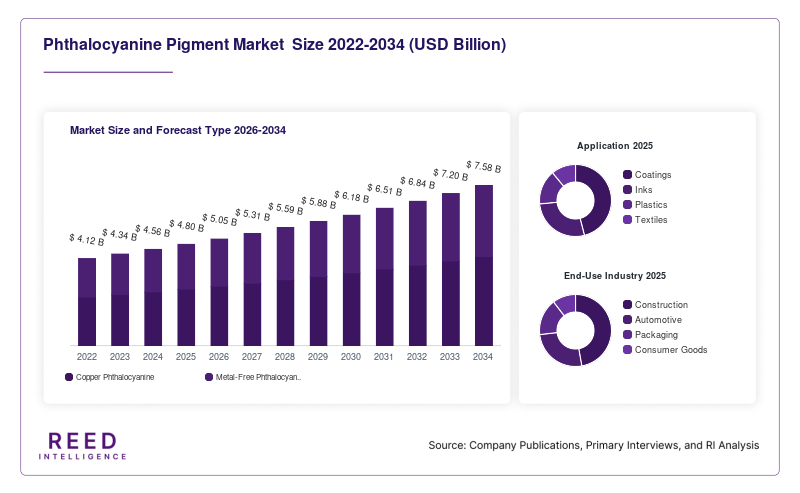
The global Phthalocyanine Pigment Market size was valued at approximately USD 4.8 billion in 2025 and is projected to reach USD 7.6 billion by 2034, expanding at a CAGR of 5.2% during the forecast period (2025–2034). Phthalocyanine pigments, known for their excellent color strength, chemical stability, and resistance to heat and light, are widely used across coatings, plastics, inks, and textiles. Their superior performance characteristics compared to conventional organic pigments have made them a preferred choice in industrial applications.
One of the primary global factors supporting the growth of the Phthalocyanine Pigment Market is the increasing demand for high-performance coatings in infrastructure and automotive industries. As construction activities rise globally and automotive production evolves toward durable and eco-efficient materials, the demand for long-lasting pigments continues to expand.
Key Highlights:
- Asia Pacific dominated the market with a share of 42% in 2025, while the region is also projected to grow at the fastest CAGR of 6.1% during the forecast period.
- By type, copper phthalocyanine pigments held the leading share of 68% in 2024, while metal-free variants are anticipated to grow at the fastest CAGR of 5.8%.
- By application, coatings emerged as the dominant segment with a 36% share, while inks are projected to grow at the fastest CAGR of 5.9%.
- China remained the dominant country, with a market size of USD 1.2 billion in 2024, rising to USD 1.28 billion in 2025.
Market Trends
Shift Toward Sustainable and Low-VOC Pigments
The Phthalocyanine Pigment Market is witnessing a gradual shift toward environmentally friendly formulations. Manufacturers are increasingly focusing on developing low-VOC (volatile organic compound) and heavy-metal-free pigments to comply with stringent environmental regulations. This trend is particularly evident in coatings and printing ink applications, where regulatory compliance is becoming a key purchasing factor. The adoption of green chemistry practices is also reshaping production processes, encouraging innovation in pigment synthesis.
Rising Adoption in Digital Printing Applications
Digital printing technologies are expanding rapidly across packaging, textiles, and advertising industries. Phthalocyanine pigments are being increasingly utilized in inkjet and toner-based printing due to their color consistency and durability. Their compatibility with advanced printing systems allows for high-resolution outputs and long-lasting prints. This trend is further supported by the growing demand for customized packaging and short-run printing, which favors digital solutions over traditional methods.
Market Drivers
Increasing Demand from Automotive Coatings Industry
The automotive sector continues to be a major consumer of phthalocyanine pigments, particularly for exterior coatings requiring high durability and UV resistance. As vehicle production rises in emerging economies and consumer preferences shift toward premium finishes, the demand for high-quality pigments is growing steadily. Phthalocyanine pigments provide enhanced gloss, color retention, and weather resistance, making them suitable for automotive coatings.
Growth in Packaging and Printing Industry
The expanding packaging sector, driven by e-commerce and consumer goods industries, is fueling demand for high-performance printing inks. Phthalocyanine pigments are widely used in packaging inks due to their brightness and stability. The increasing need for visually appealing and durable packaging is contributing significantly to market growth, especially in flexible packaging formats.
Market Restraint
Fluctuating Raw Material Prices and Production Costs
One of the key challenges in the Phthalocyanine Pigment Market is the volatility in raw material prices, particularly petrochemical derivatives used in pigment production. Price fluctuations can impact manufacturing costs and profit margins, making it difficult for producers to maintain consistent pricing strategies. Additionally, energy-intensive production processes and compliance with environmental regulations further increase operational costs. Small and medium-scale manufacturers may find it challenging to compete with larger players due to these cost pressures. As a result, the market may experience constrained growth in price-sensitive regions, especially where low-cost alternatives are available.
Market Opportunities
Expansion in Emerging Economies
Emerging markets in Asia Pacific, Latin America, and Africa present significant growth opportunities for the Phthalocyanine Pigment Market. Rapid industrialization, urbanization, and infrastructure development are increasing the demand for coatings, plastics, and construction materials. As these regions continue to develop manufacturing capabilities, the consumption of high-performance pigments is expected to rise.
Technological Advancements in Pigment Processing
Advancements in pigment dispersion technologies and nano-scale processing are opening new avenues for product innovation. Improved dispersion techniques enhance pigment performance in applications such as high-end coatings and digital inks. These technological developments enable manufacturers to offer customized solutions with improved efficiency and reduced environmental impact, thereby expanding their application scope.
Segmental Analysis
By Type
Copper phthalocyanine pigments dominated the market, accounting for 68% of the share in 2024. Their widespread use in coatings and inks due to superior stability and color intensity contributed to their dominance. These pigments are highly resistant to chemicals and environmental factors, making them suitable for industrial applications.
Metal-free phthalocyanine pigments are expected to grow at the fastest CAGR of 5.8% during the forecast period. Their improved environmental profile and suitability for specialized applications will drive growth. Increasing demand for eco-friendly pigments is likely to support this segment.
By Application
The coatings segment held the largest share of 36% in 2024, driven by extensive use in automotive and construction industries. Phthalocyanine pigments provide excellent durability and color retention in coatings applications.
The inks segment is projected to grow at the fastest CAGR of 5.9%. The expansion of digital printing and packaging industries will drive demand. High-quality color output and compatibility with modern printing technologies are key growth factors.
By End-Use Industry
The construction industry dominated the market with a share of 34% in 2024. The use of pigments in paints and coatings for buildings and infrastructure contributed significantly to this segment’s growth.
The packaging industry is expected to grow at the fastest CAGR of 6.0%. Increasing demand for visually appealing packaging and rising e-commerce activities will drive growth.
By Form
Powder form pigments held the largest share of 61% in 2024 due to their ease of handling and wide application range. They are commonly used in coatings and plastics manufacturing.
Liquid form pigments are projected to grow at a CAGR of 5.7%, driven by their use in inks and specialized coatings. Improved dispersion and ease of application will support growth.
Regional Analysis
North America
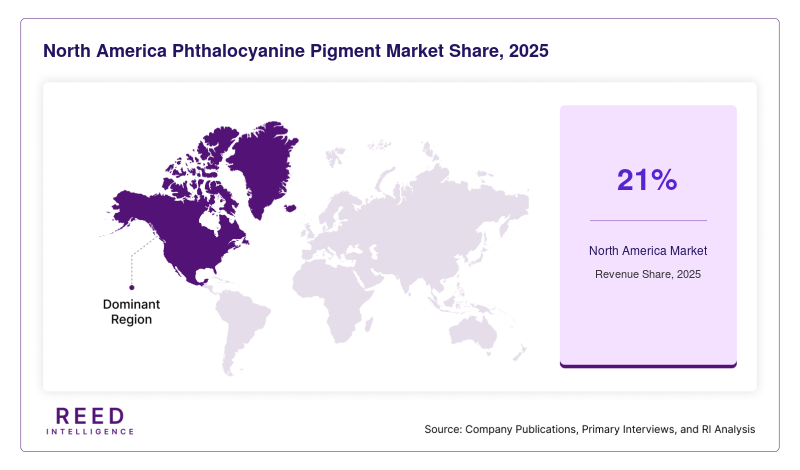
North America accounted for approximately 21% of the Phthalocyanine Pigment Market share in 2025 and is expected to grow at a CAGR of 4.6% during the forecast period. The region’s mature industrial base and steady demand from coatings and plastics industries contributed to its market position.
The United States dominated the regional market due to its well-established automotive and packaging industries. The demand for high-performance pigments in advanced coatings applications supported market growth. Additionally, the presence of major manufacturers and ongoing technological innovations strengthened the country’s position.
Europe
Europe held a market share of 24% in 2025 and is projected to expand at a CAGR of 4.8% through 2034. The region’s strong regulatory framework and focus on sustainability influenced market dynamics.
Germany emerged as the leading country, driven by its advanced manufacturing sector and emphasis on eco-friendly materials. The demand for sustainable pigments in industrial coatings and printing applications played a significant role in market expansion.
Asia Pacific
Asia Pacific dominated the Phthalocyanine Pigment Market with a share of 42% in 2025 and is anticipated to grow at a CAGR of 6.1% during the forecast period. Rapid industrialization and infrastructure development supported regional growth.
China led the market due to its large-scale manufacturing base and strong presence in the chemical industry. The country’s expanding construction and packaging sectors created substantial demand for phthalocyanine pigments.
Middle East & Africa
The Middle East & Africa region accounted for 7% of the market share in 2025 and is expected to grow at a CAGR of 5.0%. Increasing construction activities and industrial diversification contributed to growth.
Saudi Arabia dominated the region, supported by infrastructure development projects and investments in manufacturing industries. The demand for durable coatings in harsh climatic conditions further boosted pigment consumption.
Latin America
Latin America held a 6% share in 2025 and is projected to grow at a CAGR of 5.3% during the forecast period. The region’s growing industrial base and rising demand for consumer goods supported market expansion.
Brazil emerged as the leading country, driven by its expanding packaging and automotive sectors. The increasing use of pigments in printing inks and coatings contributed to steady market growth.
Competitive Landscape
The Phthalocyanine Pigment Market is characterized by the presence of several established players focusing on product innovation and strategic expansions. Leading companies are investing in research and development to enhance pigment performance and meet evolving regulatory requirements.
A key market leader is BASF SE, which continues to strengthen its position through advanced pigment technologies and sustainable product offerings. The company recently introduced a new range of eco-efficient phthalocyanine pigments designed for high-performance coatings applications.
Other major players are focusing on expanding their production capacities and entering emerging markets to gain a competitive edge. Strategic collaborations and acquisitions are also shaping the competitive landscape, enabling companies to broaden their product portfolios and geographic reach.
Key Players
- BASF SE
- Clariant AG
- DIC Corporation
- Sudarshan Chemical Industries Limited
- Heubach GmbH
- Lanxess AG
- Toyo Ink SC Holdings Co., Ltd.
- Sun Chemical Corporation
- Kronos Worldwide, Inc.
- Trust Chem Co., Ltd.
Recent Developments
- In 2024, BASF SE launched a new sustainable pigment line aimed at reducing environmental impact in coatings applications.
- Clariant AG expanded its pigment production capacity in Asia to meet rising regional demand.
- Sudarshan Chemical Industries Limited introduced advanced dispersion technologies for improved pigment performance.
- DIC Corporation invested in digital printing pigment solutions to support emerging applications.
- Heubach GmbH focused on strengthening its global supply chain through strategic partnerships.
Phthalocyanine Pigment Market Segments
Type
- Copper Phthalocyanine
- Metal-Free Phthalocyanine
Application
- Coatings
- Inks
- Plastics
- Textiles
End-Use Industry
- Construction
- Automotive
- Packaging
- Consumer Goods
Form
- Powder
- Liquid
By Region
- North America
- Europe
- APAC
- Middle East and Africa
- LATAM