Physician Dispensed Skin Care Product Market Size, Share & Trends Analysis Report By Product Type (Anti-Aging & Rejuvenation, Acne & Blemish Care, Hyperpigmentation & Brightening, Sun Protection, Hydration & Barrier Care), By Application (Aesthetic & Post-Procedure Care, Acne Management), By End User (Dermatology Clinics, Plastic Surgery & Aesthetic Clinics, Medical Spas), By Distribution Channel (Direct Physician Dispensing, Clinic-Based Retail, Authorized Online Channels) Forecasts, 2026–2034
USD 3950
Physician Dispensed Skin Care Product Market Size
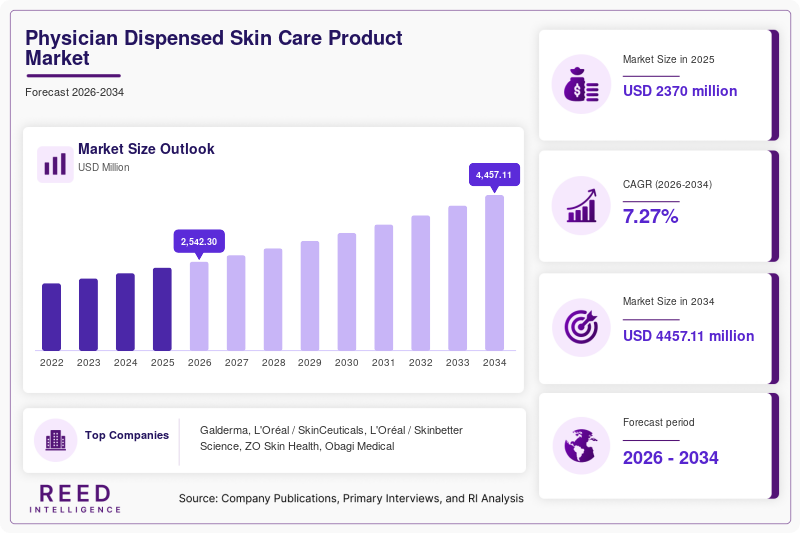
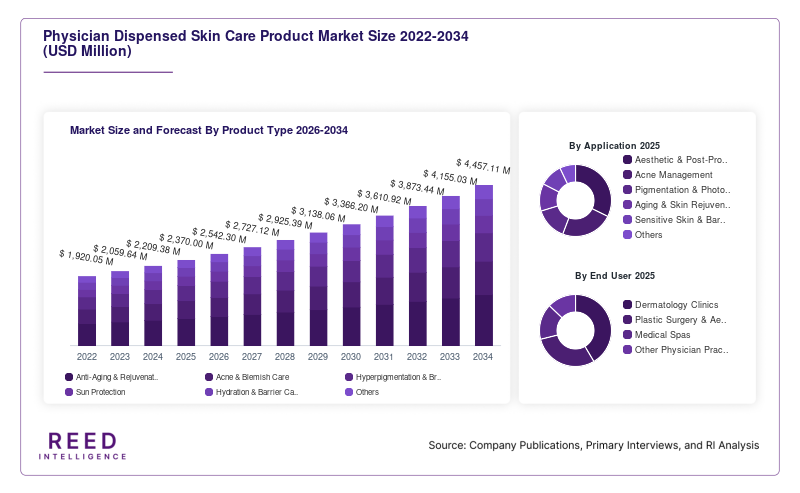
The global physician dispensed skin care product market size was valued at USD 2,370 million in 2025 and is projected to grow from USD 2,540 million in 2026 to USD 4,457.11 million by 2034, registering a CAGR of 7.27% during the forecast period from 2026 to 2034.
The physician-dispensed skin care market is moving toward clinically positioned, professional-grade products linked to dermatologist and aesthetic-practice recommendations, rather than competing only on conventional cosmetic branding. Physician-dispensed products are generally sold through dermatology practices, medical spas, plastic surgery practices, or other authorized professionals, with brands using professional education, customized regimens, and clinical evidence to differentiate products from mass-market skincare. Epionce, for example, describes professional-strength skincare as products sold through medical settings and incorporated into patient-specific regimens.
Demand is supported by the large underlying need for skin treatment and maintenance. The American Academy of Dermatology reports that acne affects up to 50 million Americans annually, while its guidance continues to emphasize dermatologist-directed skin protection and sunscreen use.
Physician Dispensed Skin Care Product Market Drivers
Greater physician involvement in personalized skincare regimens
Physician-dispensed skincare benefits from a business model in which product selection is connected to professional assessment. Brands such as Epionce, Revision Skincare and Obagi restrict or emphasize professional channels, allowing dermatologists, plastic surgeons and other trained professionals to recommend products based on individual skin concerns. This changes purchasing behavior because the transaction is linked to consultation, treatment planning and follow-up rather than a standalone retail purchase. Products targeting pigmentation, aging, acne, photodamage and sensitive skin can therefore be incorporated into longer-term regimens. The commercial effect is particularly relevant for premium products, where professional recommendation can support higher price points and repeat purchasing. It also creates a competitive barrier for brands that lack physician networks, clinical education programs or professional distribution infrastructure.
Expansion of aesthetic and post-procedure skincare
The connection between aesthetic procedures and topical skincare is becoming more important. L'Oréal's 2025 reporting identifies demand for products used before and after aesthetic treatments and describes skincare as complementary to procedures. Galderma has developed Alastin around peri-procedural and daily skincare, while its 2025 launch of Restorative Skin Complex with TriHex+ strengthened the regenerative skincare portfolio. This creates a direct commercial mechanism: clinics performing procedures can recommend products for preparation, recovery and maintenance, increasing the number of skincare touchpoints associated with each patient. Physician-dispensed brands therefore compete not only within skincare but also within the broader aesthetic-treatment journey.
Clinical positioning and demand for science-backed formulations
Professional skincare brands increasingly use clinical testing, active ingredients and dermatologist relationships as differentiation tools. Epionce highlights independent clinical studies and physician involvement, while ZO Skin Health positions its portfolio around physician-supervised professional skincare and treatment protocols. Large dermatology-focused companies are also investing in scientific positioning. L'Oréal reported more than 320,000 healthcare professionals reached by its Dermatological Beauty division in 2025, alongside 25.8% market share in dermocosmetics. This professional infrastructure gives manufacturers a way to communicate product evidence, educate providers and build recurring demand through treatment protocols rather than relying entirely on consumer advertising.
Physician Dispensed Skin Care Product Market Restraints
Higher product prices and professional-channel dependence
Physician-dispensed products typically occupy a premium position because their commercial model includes professional education, clinical support, specialized formulations and controlled distribution. Brands such as Revision Skincare explicitly restrict sales to authorized professionals and retailers, while Obagi maintains professional and prescription channels for selected products. This limits the addressable consumer base compared with mass-market skincare. Consumers who are unwilling to pay premium prices or who prefer unrestricted online shopping can shift toward dermatology-recommended products available through pharmacies, retailers or direct-to-consumer channels. The result is a structural trade-off between professional differentiation and distribution scale.
Regulatory and compliance complexity
The distinction between cosmetics, OTC products and prescription skincare creates additional compliance requirements. FDA states that cosmetic facility registration and product listing under MoCRA do not represent FDA approval, while certain products may instead be subject to drug or device requirements. Sunscreens provide a clear example because certain formulations are regulated as OTC drug products in the U.S. Manufacturers therefore need to manage product claims, labeling, ingredients, facility requirements and market-specific rules. For global physician-dispensed brands, differences between regulatory systems can increase launch costs and lengthen commercialization timelines.
Physician Dispensed Skin Care Product Market Opportunities
Post-procedure and regenerative skincare
The growing overlap between medical aesthetics and skincare creates room for products specifically designed around procedure preparation, recovery and ongoing maintenance. Galderma's Alastin portfolio is positioned around peri-procedural care, and the company launched ALASTIN Signature Practices in April 2026 to integrate its regenerative skincare portfolio into treatment planning and patient care across dermatology, plastic surgery and medical aesthetics practices. This creates an opportunity for manufacturers to develop procedure-specific protocols rather than selling isolated creams or serums. Products that can be incorporated into established clinical workflows can also increase repeat purchases and strengthen relationships between brands and physician practices.
Expansion across Asia-Pacific and emerging markets
International expansion is becoming an important growth mechanism for professional skincare companies. Galderma reported strong 2025 performance in China and India and expanded Alastin into China in September 2025, describing China as the second-largest physician-dispensed market globally. L'Oréal also reported strong momentum in emerging markets for its Dermatological Beauty division. The opportunity is therefore not simply geographic distribution; manufacturers can combine physician education, aesthetic clinics, premium skincare and localized product portfolios to establish professional channels in markets where medical aesthetics and dermatological care are expanding.
Segmental Analysis
By Product Type
Anti-Aging & Rejuvenation represents approximately 31% of the global market in 2025, making it the dominant product category. Demand is supported by the overlap between physician-dispensed skincare and aesthetic medicine, where consumers increasingly combine procedures with daily topical regimens. L'Oréal specifically identifies the complementary relationship between aesthetic procedures and highly efficient skincare products, while Obagi and SkinMedica maintain extensive portfolios targeting wrinkles, skin texture, photodamage and visible aging.
Sun Protection is the fastest-growing product category, with a projected CAGR of approximately 8.4%. Dermatologists continue to position sunscreen as a core part of skin-health management, with the AAD recommending broad-spectrum, SPF 30+ and water-resistant products. Physician-dispensed brands can differentiate through mineral formulations, pigmentation-focused protection and products designed for post-procedure or sensitive skin.
By Application
Aesthetic & Post-Procedure Care accounts for approximately 34% of the market in 2025, reflecting the increasingly connected economics of procedures and skincare. Alastin's portfolio is explicitly positioned around peri-procedural and daily regimens, while Galderma's Signature Practices initiative connects skincare products with treatment planning.
Aesthetic & Post-Procedure Care is also the fastest-growing application, with a projected CAGR of approximately 9.3%. Products used before and after aesthetic treatments can become part of a structured clinical pathway, giving practices recurring product revenue while providing manufacturers with a direct professional distribution route.
By End User
Dermatology Clinics hold approximately 42% market share in 2025, supported by their role in diagnosing skin conditions, managing pigmentation and acne, treating photodamage, and recommending long-term skincare regimens. The professional model is particularly suited to products that require patient-specific selection and follow-up. Epionce, for example, describes physician and professional involvement as a central component of its product model.
Medical Spas are the fastest-growing end-user category, with a projected CAGR of approximately 8.7%. Their position between conventional skincare retail and physician-led aesthetic treatment allows them to combine professional skincare with procedures, although the exact regulatory framework and permitted activities differ by market.
By Distribution Channel
Direct Physician Dispensing accounts for approximately 48% of the market in 2025. This channel remains central because physician-dispensed skincare is differentiated by professional recommendation, regimen customization and controlled product access. Revision Skincare, ZO Skin Health and Epionce all emphasize authorized professional channels or physician-supervised purchasing.
Authorized Online Channels are the fastest-growing distribution channel, with a projected CAGR of approximately 9.1%. Professional brands are increasingly combining physician authentication with digital ordering, allowing patients to reorder established regimens without eliminating professional oversight. The model can expand geographic reach while preserving restrictions against unauthorized online resellers.
Regional Analysis
North America Physician Dispensed Skin Care Product Market
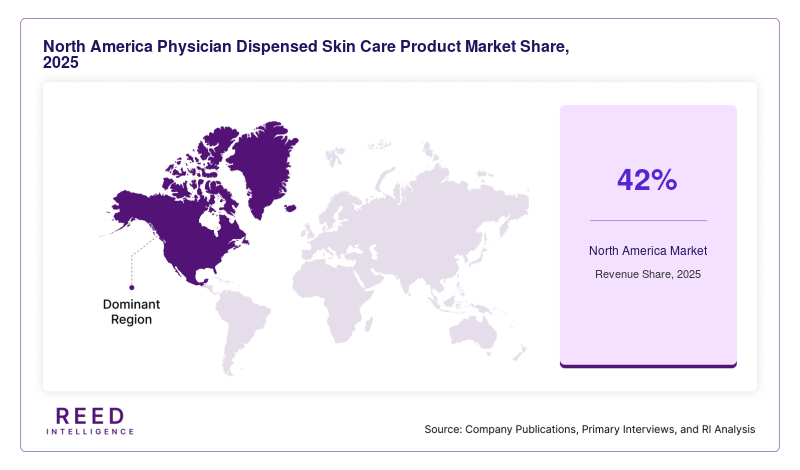
North America represents approximately 42% of the global market in 2025, supported by an established physician-dispensed skincare ecosystem, strong dermatology and aesthetic medicine infrastructure, and the presence of major professional skincare brands. The U.S. market includes physician-led portfolios from Obagi, ZO Skin Health, SkinMedica, Alastin and other professional brands. Obagi operates a physician locator and professional registration system, while ZO emphasizes authorized physician-supervised skincare.
The region's purchasing model is strongly connected to dermatology, plastic surgery and medical aesthetics. Galderma reported that Alastin continued to deliver double-digit growth in the U.S. in 2025 and remained the fastest-growing top physician-dispensed skincare brand.
North America is projected to register a CAGR of approximately 6.8% through 2034. The market benefits from premium product adoption and established professional networks, while competition from direct-to-consumer skincare and broader retail availability limits the pace of expansion.
Europe Physician Dispensed Skin Care Product Market
Europe accounts for approximately 25% of the global market in 2025, supported by strong dermatology networks, pharmacy-based skincare purchasing and established dermocosmetic brands. L'Oréal's Dermatological Beauty division maintains a substantial professional footprint across Europe and reported more than 320,000 healthcare professionals reached globally in 2025.
The European market is characterized by the convergence of dermatological care, pharmacy channels and premium skincare. Scientific positioning and product tolerability are important purchasing considerations, particularly for sensitive-skin and aging-skin categories. Regulatory requirements also create a relatively structured environment for product claims, ingredients and manufacturing.
Europe is projected to grow at approximately 6.3% CAGR. Growth will be supported by aging populations, continued adoption of aesthetic treatments and demand for dermatologist-recommended skincare, while regulatory compliance and mature market penetration constrain expansion compared with emerging markets.
Asia-Pacific Physician Dispensed Skin Care Product Market
APAC represents approximately 20% of the global market in 2025 and is the fastest-growing region, with a projected CAGR of approximately 9.4%. China, Japan, South Korea, India and Australia are key markets, with growth linked to professional aesthetics, dermatology, premium skincare and increasing consumer attention to pigmentation, aging and photoprotection.
Galderma reported particularly strong performance for dermatological skincare in China and India during 2025 and expanded Alastin into China in September 2025. The company described China as the second-largest physician-dispensed market globally. L'Oréal similarly reported strong momentum for its Dermatological Beauty portfolio in emerging markets and mainland China.
The commercial mechanism is increasingly based on physician education, aesthetic clinics and premium professional products. Localized formulations, digital ordering and clinic partnerships should broaden access, although differences in regulation, professional-channel structure and consumer purchasing behavior remain important constraints.
Middle East and Africa Physician Dispensed Skin Care Product Market
Middle East and Africa accounts for approximately 6% of the global market in 2025, with demand concentrated in major urban centers and higher-income consumer markets. Aesthetic dermatology, pigmentation management, sun protection and anti-aging products represent important applications.
The region's climatic conditions also support demand for products addressing UV exposure, pigmentation and skin-barrier concerns. However, physician-dispensed skincare penetration remains uneven because professional distribution networks and specialist dermatology capacity vary significantly between countries.
The region is projected to register a CAGR of approximately 7.2% through 2034. Growth will depend on expansion of medical-aesthetic clinics, premium healthcare services, professional education and authorized distribution infrastructure.
LATAM Physician Dispensed Skin Care Product Market
LATAM represents approximately 7% of the global market in 2025, with Brazil, Mexico, Argentina and Colombia serving as important markets for dermatology and aesthetic skincare. Demand is supported by strong consumer interest in pigmentation, sun protection, facial rejuvenation and aesthetic procedures.
Galderma's expansion of Alastin into Brazil in 2024 illustrates the increasing integration of physician-dispensed skincare with aesthetic medicine in the region. The company also identified Latin America as an important market for its broader dermatology and aesthetics portfolio.
LATAM is projected to grow at approximately 7.8% CAGR. Expansion of medical-aesthetic practices and professional distribution can increase access, although currency volatility, premium pricing and uneven healthcare infrastructure can affect purchasing capacity.
Competitive Landscape
The competitive landscape is characterized by professional-channel control, clinical positioning, physician relationships, product differentiation and integration with aesthetic procedures. Companies compete by developing specialized formulations, clinical evidence, practitioner education, treatment protocols and authorized distribution networks.
Galderma has strengthened its position through Alastin's physician-dispensed portfolio and its integration with the company's injectable aesthetics business. Its 2025 launch of Restorative Skin Complex with TriHex+ and 2026 launch of ALASTIN Signature Practices demonstrate a strategy centered on linking skincare with aesthetic treatment workflows.
L'Oréal competes through a broad dermatological portfolio including SkinCeuticals and Skinbetter Science, supported by healthcare-professional relationships and clinical research. Its Dermatological Beauty division reported €7.2 billion in 2025 sales and 5.5% like-for-like growth.
Key Market Players
- Galderma
- L'Oréal / SkinCeuticals
- L'Oréal / Skinbetter Science
- ZO Skin Health
- Obagi Medical
- SkinMedica
- Revision Skincare
- Epionce
- Colorescience
- iS Clinical
- PCA Skin
- Jan Marini Skin Research
- EltaMD
- Alastin Skincare
Recent Market Developments
- April 2026 – Galderma: ALASTIN launched its first ALASTIN Signature Practice in the U.S., with additional practices planned across 2026. The program connects the brand's Procedure, Treatment and Daily Care portfolios with dermatology, plastic surgery and medical-aesthetics practices.
- February 2026 – U.S. FDA: FDA updated its Cosmetics Direct portal to support biennial facility registration renewal, adding registration-status and renewal-date fields and automated reminders for registered facilities.
Physician Dispensed Skin Care Product Market Segments
By Product Type
- Anti-Aging & Rejuvenation
- Acne & Blemish Care
- Hyperpigmentation & Brightening
- Sun Protection
- Hydration & Barrier Care
- Others
By Application
- Aesthetic & Post-Procedure Care
- Acne Management
- Pigmentation & Photodamage
- Aging & Skin Rejuvenation
- Sensitive Skin & Barrier Repair
- Others
By End User
- Dermatology Clinics
- Plastic Surgery & Aesthetic Clinics
- Medical Spas
- Other Physician Practices
By Distribution Channel
- Direct Physician Dispensing
- Clinic-Based Retail
- Authorized Online Channels
By Region
- North America
- Europe
- APAC
- Middle East and Africa
- LATAM