Pianos Market Size, Share & Demand Report By Type (Grand Pianos, Upright Pianos, Digital Pianos, Hybrid Pianos), By Distribution Channel (Offline Retail, Online Retail), By End User (Residential Consumers, Educational Institutions, Professional Musicians, Commercial Venues), By Region & Segment Forecasts, 2026–2034
USD 3950
Market Overview
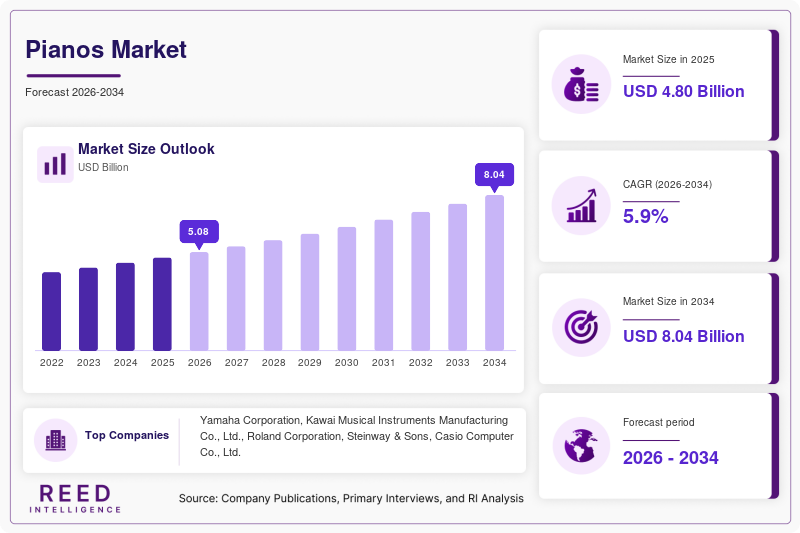
The global Pianos Market size was valued at approximately USD 4.8 billion in 2026 and is projected to reach nearly USD 7.6 billion by 2034, expanding at a compound annual growth rate (CAGR) of 5.9% during the forecast period from 2026 to 2034. The market continues to evolve as consumers increasingly seek premium musical instruments for home entertainment, music education, live performances, and professional studio applications. Rising interest in music learning among younger populations, coupled with the growing adoption of digital instruments, has created favorable conditions for long-term market expansion across developed and emerging economies.
One of the major global factors supporting the growth of the market is the increasing integration of music education into school curricula and online learning platforms. Educational institutions and private music academies are investing in acoustic and digital pianos to support structured learning programs. In addition, online music tutorials and virtual learning applications have improved accessibility to piano education, encouraging first-time buyers to invest in beginner and mid-range instruments. Manufacturers are also introducing hybrid pianos with advanced sound technology, Bluetooth connectivity, and compact designs to attract modern consumers living in urban areas.
Key Highlights
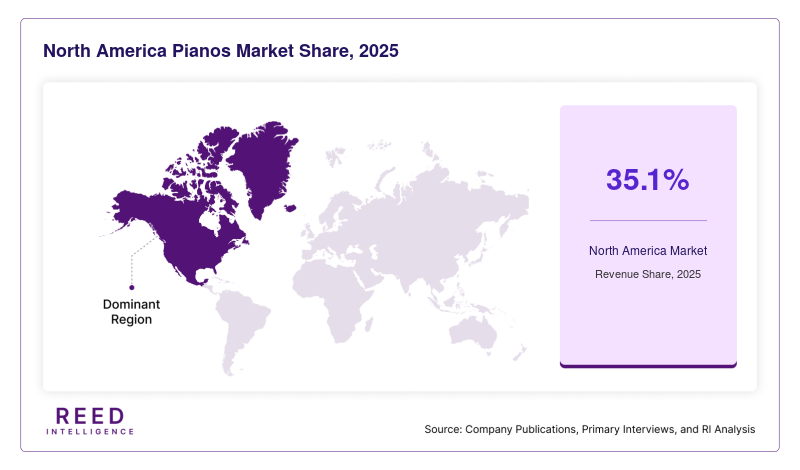
- North America dominated the market with a 35.1% share in 2025, while Asia Pacific is expected to grow at the fastest CAGR of 7.4% during 2026–2034.
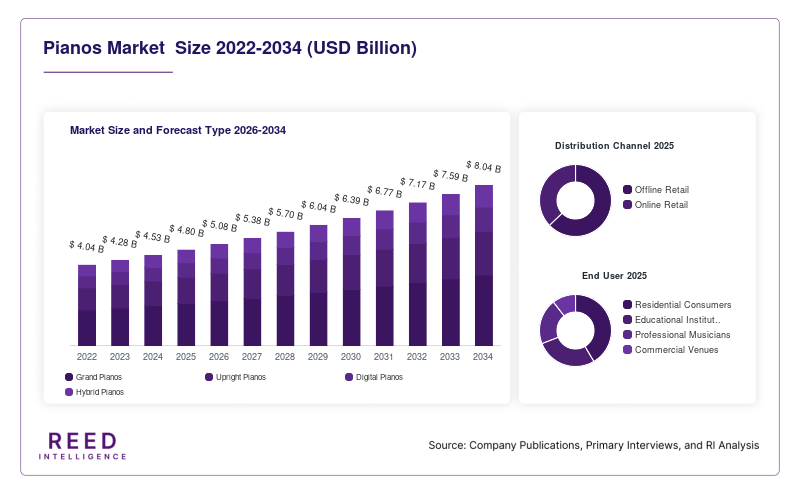
- By type, digital pianos accounted for the largest share of 46.8%, while hybrid pianos are projected to grow at a CAGR of 8.1%.
- By distribution channel, offline retail led with a 62.3% share, whereas online retail is expected to expand at a CAGR of 8.5%.
- By end user, residential consumers held a 57.9% share, while educational institutions are projected to grow at a CAGR of 7.8%.
- The United States remained the dominant country, with market values of USD 1.14 billion in 2024 and USD 1.22 billion in 2025.
Market Trends
Rising Preference for Digital and Hybrid Pianos
Consumer preference is steadily shifting toward digital and hybrid pianos due to their convenience, portability, and advanced technological features. Modern digital pianos now offer weighted keys, authentic acoustic sound reproduction, and integrated learning systems that appeal to beginners and professional musicians alike. Hybrid models combining traditional acoustic mechanisms with digital enhancements are gaining attention among urban consumers seeking premium performance without the maintenance requirements associated with traditional grand pianos. Manufacturers are increasingly focusing on compact product designs suitable for apartments and smaller residential spaces.
The growing integration of Bluetooth connectivity, recording functions, smart learning applications, and headphone compatibility has transformed digital pianos into versatile entertainment devices. These features support silent practice sessions and online music collaboration, which became particularly popular among younger users and remote learners. Music schools are also incorporating digital instruments into their classrooms due to lower maintenance costs and flexible functionality. As technological innovation continues to improve sound realism and key sensitivity, digital and hybrid pianos are expected to maintain strong demand throughout the forecast period.
Expansion of E-Commerce and Direct-to-Consumer Sales Channels
The rapid growth of e-commerce platforms has significantly transformed purchasing behavior in the global Pianos Market. Consumers are increasingly comparing product specifications, customer reviews, and pricing across online platforms before making purchasing decisions. Piano manufacturers and distributors are investing heavily in direct-to-consumer sales models to improve customer engagement and expand market reach. Online platforms provide access to a wider product range, including entry-level, professional, and customized instruments.
Virtual product demonstrations, online consultation services, and flexible financing options are improving buyer confidence and simplifying the purchasing process. Several leading brands have also adopted augmented reality tools and digital showrooms that allow customers to visualize piano placement in residential spaces. The expansion of logistics networks and secure delivery systems has further improved online sales of large musical instruments. As internet penetration and smartphone usage continue to increase globally, online retail channels are likely to become a critical growth contributor for piano manufacturers and retailers.
Market Drivers
Increasing Demand for Music Education and Skill Development
Growing awareness regarding the cognitive and emotional benefits of music education is driving global demand for pianos. Parents and educational institutions increasingly recognize piano learning as an important activity that supports creativity, concentration, and emotional development among children. As a result, music schools, private academies, and universities are expanding investments in piano-based training programs. Several governments and nonprofit organizations are also supporting arts education initiatives, creating favorable conditions for market growth.
The emergence of online learning platforms and digital tutoring services has made piano education more accessible to consumers across various income groups. Beginner-friendly digital pianos with integrated lessons and learning applications are becoming popular among first-time learners. Additionally, adult consumers are increasingly pursuing music as a recreational activity, supporting sustained demand for home-use instruments. The continuous rise in global enrollment in music education programs is expected to strengthen the demand for upright, digital, and hybrid pianos over the coming years.
Growth in Home Entertainment and Lifestyle Spending
Changing lifestyle patterns and increasing spending on home entertainment products are contributing significantly to the expansion of the Pianos Market. Consumers are investing in premium recreational products that improve indoor entertainment experiences and support creative hobbies. Pianos are increasingly viewed as lifestyle products that enhance home aesthetics while also serving functional musical purposes. The popularity of social media content creation and home music recording has also encouraged amateur musicians to purchase digital instruments with advanced connectivity features.
Urban households with rising disposable income are showing growing interest in compact upright and digital pianos designed for modern living environments. Manufacturers are responding by introducing aesthetically appealing products with customizable finishes and space-efficient structures. In addition, professional musicians and independent content creators are investing in high-performance digital pianos equipped with recording and editing capabilities. The continued rise of home studios and digital music production is expected to support steady market expansion across developed and developing regions.
Market Restraint
High Initial Cost and Maintenance Requirements of Acoustic Pianos
The relatively high cost associated with acoustic and grand pianos remains a major restraint affecting overall market penetration. Premium acoustic instruments often require substantial financial investment, making them less accessible for middle-income households and beginner musicians. In addition to purchase costs, consumers must also consider ongoing maintenance expenses such as tuning, humidity control, transportation, and repairs. These factors can discourage first-time buyers from investing in traditional acoustic models.
The challenge is particularly noticeable in emerging markets where consumers prioritize affordable and multifunctional entertainment products. Digital pianos often serve as lower-cost alternatives due to their portability and reduced maintenance requirements. Furthermore, limited availability of professional piano technicians in smaller cities and rural regions can negatively affect ownership experiences for acoustic piano users. Rising raw material costs associated with wood, metal components, and craftsmanship are also increasing manufacturing expenses for premium models. These pricing pressures may limit broader adoption of high-end acoustic pianos, especially during periods of economic uncertainty and fluctuating consumer spending patterns.
Market Opportunities
Emerging Demand Across Developing Economies
Developing economies across Asia Pacific, Latin America, and parts of the Middle East are creating substantial growth opportunities for piano manufacturers. Expanding middle-class populations, rising urbanization, and improving disposable income levels are encouraging greater spending on music education and recreational products. Families are increasingly enrolling children in extracurricular music programs, creating demand for entry-level and mid-range digital pianos. Educational institutions in developing nations are also modernizing music departments and investing in technologically advanced instruments.
Manufacturers are responding by introducing region-specific product lines with competitive pricing and localized marketing strategies. Partnerships with music schools, retail chains, and online learning platforms are helping brands strengthen consumer awareness in untapped markets. In addition, government initiatives promoting cultural activities and creative arts education are improving the long-term outlook for piano sales. As internet access and digital learning adoption continue to rise in emerging regions, demand for connected and affordable piano solutions is expected to accelerate.
Product Innovation Through Smart and Connected Technologies
Continuous innovation in sound technology, artificial intelligence, and smart connectivity is opening new growth avenues for the global Pianos Market. Manufacturers are increasingly developing instruments equipped with app integration, automated learning assistance, cloud recording, and wireless connectivity features. These innovations appeal to younger consumers who prefer interactive and digitally enhanced learning experiences. Smart pianos capable of tracking performance accuracy and offering real-time feedback are gaining popularity among beginners and educational institutions.
Hybrid piano systems that combine acoustic soundboards with digital control systems are also creating premium market opportunities. Professional musicians are seeking instruments that provide traditional tonal quality while supporting digital production capabilities. Additionally, the integration of subscription-based learning platforms and virtual music communities is encouraging recurring consumer engagement. Companies investing in research and development to improve sound realism, portability, and user customization are likely to gain competitive advantages in the evolving market landscape.
Segmental Analysis
By Type
Digital pianos represented the dominant subsegment within the market and accounted for nearly 46.8% of global revenue in 2024. The widespread popularity of digital models is primarily linked to their affordability, compact size, and advanced technological capabilities. Consumers increasingly prefer digital pianos because they offer realistic sound simulation, headphone functionality, and integrated learning applications suitable for modern lifestyles. Educational institutions and beginner musicians also favor digital instruments due to lower maintenance requirements compared to acoustic alternatives. Manufacturers are continuously introducing upgraded sound engines, weighted keyboards, and Bluetooth connectivity to improve user experience and strengthen product adoption.
Hybrid pianos are projected to witness the fastest growth during the forecast period, expanding at a CAGR of 8.1% from 2026 to 2034. The segment is gaining traction among professional musicians and affluent consumers seeking a combination of traditional acoustic sound and digital convenience. Hybrid models support silent practice, digital recording, and enhanced sound customization while maintaining authentic key action and tonal quality. Rising urbanization and space limitations in residential environments are encouraging adoption of compact hybrid instruments. In addition, premium music studios and educational institutions are investing in hybrid pianos to provide versatile learning and performance experiences.
By Distribution Channel
Offline retail remained the leading distribution channel in the global Pianos Market and accounted for approximately 62.3% of total revenue in 2024. Consumers continue to prefer physical retail stores because piano purchases often require hands-on evaluation of key sensitivity, sound quality, and build design before making a final decision. Specialized musical instrument stores and branded showrooms provide expert guidance, after-sales services, and customization options that improve customer confidence. High-value acoustic and grand piano purchases are particularly dependent on offline retail environments where buyers can compare multiple models directly.
Online retail is expected to register the fastest CAGR of 8.5% throughout the forecast period due to the rapid expansion of e-commerce platforms and digital purchasing behavior. Consumers increasingly rely on online reviews, video demonstrations, and virtual consultations when selecting musical instruments. Piano manufacturers are strengthening direct-to-consumer sales strategies through official websites and digital marketplaces. Flexible financing options, improved logistics systems, and home delivery services are further supporting online adoption. The availability of detailed product comparisons and personalized recommendations is encouraging more first-time buyers to purchase digital and entry-level pianos through online channels.
By End User
Residential consumers accounted for the largest share of the market in 2024, contributing approximately 57.9% of global revenue. The segment benefits from growing consumer interest in home entertainment, creative hobbies, and online music learning activities. Families are increasingly investing in pianos for children’s music education and recreational use. Digital pianos and compact upright models are particularly popular among urban households due to their space-efficient designs and user-friendly features. Rising disposable income and growing interest in aesthetic home interiors have also contributed to demand for stylish and premium piano models.
Educational institutions are expected to emerge as the fastest-growing end-user segment, registering a CAGR of 7.8% during the forecast period. Schools, universities, conservatories, and private music academies are expanding investments in music education infrastructure to support increasing student enrollment. Digital learning tools and remote music training programs are also driving demand for technologically advanced instruments. Governments and nonprofit organizations promoting arts education initiatives are encouraging institutions to modernize classroom equipment and music laboratories. The rising popularity of structured music certification programs is expected to create long-term opportunities for piano manufacturers serving the education sector.
Regional Analysis
North America
North America accounted for approximately 35.1% of the global Pianos Market share in 2025, making it the leading regional market. The region is projected to expand at a CAGR of 5.2% during the forecast period due to stable consumer spending on premium musical instruments and entertainment products. Strong demand from residential consumers, educational institutions, and professional musicians continues to support regional growth. Digital pianos and hybrid models are particularly popular among urban consumers seeking compact and technologically advanced instruments.
The United States remains the dominant country within the region due to its established music education ecosystem and strong presence of premium piano brands. Growing investments in home entertainment systems and rising participation in online music learning programs are contributing to sustained market expansion. Music schools, churches, and performance venues also continue to invest in high-quality acoustic pianos for training and live performances. The country benefits from a well-developed retail network and growing e-commerce penetration for musical instruments.
Europe
Europe represented nearly 27.4% of the global market share in 2025 and is expected to register a CAGR of 4.9% between 2026 and 2034. The region has a long-standing cultural connection with classical music and piano performance traditions, supporting stable demand for acoustic grand and upright pianos. Consumers across European countries continue to value craftsmanship, tonal quality, and premium design features. Educational institutions and conservatories also contribute significantly to market demand.
Germany remains the leading country in the European Pianos Market due to its strong heritage in musical instrument manufacturing and established music education infrastructure. The country is home to several internationally recognized piano manufacturers focused on premium craftsmanship and innovation. Rising consumer preference for hybrid pianos and sustainable wood sourcing practices has encouraged manufacturers to adopt environmentally responsible production methods. Expanding demand for digital music production tools among younger musicians is also supporting regional product diversification.
Asia Pacific
Asia Pacific is expected to emerge as the fastest-growing region in the global Pianos Market, with a forecast CAGR of 7.4% during the study period. The region accounted for approximately 24.8% of global revenue in 2025, supported by expanding middle-class populations and increasing participation in music education programs. Countries across the region are witnessing strong demand for beginner-friendly digital pianos and affordable upright models. Rapid urbanization and rising disposable income are also improving consumer purchasing power.
China dominates the Asia Pacific market due to its large student population and rapidly expanding music education sector. Parents increasingly view piano learning as an important extracurricular activity that supports academic and personal development. Domestic and international manufacturers are expanding production facilities and retail distribution networks across major Chinese cities. In addition, online music learning platforms and digital content creators are driving demand for technologically advanced instruments equipped with recording and connectivity features.
Middle East & Africa
The Middle East & Africa region accounted for around 6.1% of the global market share in 2025 and is projected to grow at a CAGR of 5.7% through 2034. Increasing investments in cultural infrastructure, educational development, and entertainment industries are supporting regional market expansion. Luxury hotels, event venues, and premium residential projects are contributing to demand for grand pianos and decorative acoustic instruments. Digital pianos are also gaining popularity among younger consumers in urban centers.
The United Arab Emirates remains the dominant market within the region due to its expanding luxury hospitality sector and rising investments in arts and entertainment initiatives. Music academies and cultural festivals are encouraging wider adoption of pianos among students and professional performers. The country’s strong tourism industry also supports demand for premium instruments in hotels and event spaces. Growing availability of international piano brands through retail showrooms and online channels is improving market accessibility.
Latin America
Latin America held approximately 6.6% of the global Pianos Market share in 2025 and is anticipated to grow at a CAGR of 5.5% during the forecast period. Demand for pianos in the region is supported by expanding music education programs, growing urban populations, and increasing exposure to international music culture. Consumers are showing greater interest in digital pianos due to affordability and ease of maintenance. Rising internet penetration has also improved awareness regarding online music learning resources.
Brazil remains the leading country in the regional market due to its large population base and strong cultural interest in music and performance arts. Educational institutions and churches continue to represent important customer segments for piano manufacturers and distributors. The growing popularity of live music events and home recording activities is encouraging demand for digital and portable instruments. Regional retailers are also partnering with international brands to expand product availability across major metropolitan areas.
Competitive Landscape
The global Pianos Market is characterized by the presence of established international manufacturers and regional players competing through product innovation, craftsmanship, distribution expansion, and technological integration. Leading companies are focusing on digital transformation strategies to meet evolving consumer expectations regarding connectivity, portability, and sound quality. The competitive environment is also influenced by rising investments in hybrid piano development and smart learning technologies.
Yamaha Corporation continues to maintain a leading position in the market due to its extensive product portfolio, strong distribution network, and focus on advanced digital piano technologies. The company has expanded its premium hybrid piano lineup and strengthened online music learning partnerships to improve customer engagement. Other major players are investing in sustainable manufacturing practices, customizable product designs, and AI-supported learning systems to differentiate their offerings.
Key Players
- Yamaha Corporation
- Kawai Musical Instruments Manufacturing Co., Ltd.
- Roland Corporation
- Steinway & Sons
- Casio Computer Co., Ltd.
- Samick Musical Instruments Co., Ltd.
- Young Chang Co., Ltd.
- Korg Inc.
- Pearl River Piano Group
- Fazioli Pianoforti
- Mason & Hamlin Piano Company
- Bluthner Piano Factory
- Bosendorfer GmbH
- Dexibell
- Kurzweil Music Systems
Recent Developments
- Yamaha Corporation introduced an upgraded hybrid piano series in 2025 featuring enhanced Bluetooth integration and AI-assisted learning capabilities for beginner musicians.
- Roland Corporation expanded its digital piano manufacturing capacity in Asia Pacific during 2024 to address increasing regional demand for compact and portable instruments.
- Steinway & Sons launched a premium limited-edition grand piano collection in 2025 targeting luxury hospitality projects and high-net-worth residential consumers.
- Kawai Musical Instruments partnered with online music education platforms in 2024 to promote integrated digital learning experiences for students and teachers.
- Casio Computer Co., Ltd. released a new range of entry-level digital pianos in 2025 designed for first-time learners and home-based music education programs.
Pianos Market Segments
Type
- Grand Pianos
- Upright Pianos
- Digital Pianos
- Hybrid Pianos
Distribution Channel
- Offline Retail
- Online Retail
End User
- Residential Consumers
- Educational Institutions
- Professional Musicians
- Commercial Venues
By Region
- North America
- Europe
- APAC
- Middle East and Africa
- LATAM