Picric Acid Market Size, Share & Demand Report By Application (Explosives, Dyes, Pharmaceutical Intermediates, Laboratory Reagents), By End-Use Industry (Defense, Chemical Manufacturing, Pharmaceuticals, Research & Academia), By Form (Crystalline, Powder), By Distribution Channel (Direct Sales, Distributors, Online Platforms), By Region & Segment Forecasts, 2025–2034
USD 3950
Market Overview
The Picric Acid Market size was valued at approximately USD 62.4 million in 2025 and is projected to reach USD 94.7 million by 2034, expanding at a CAGR of 4.8% during the forecast period (2025–2034). Picric acid, also known as 2,4,6-trinitrophenol, is widely used in explosives, dyes, antiseptics, and laboratory reagents. Its stable chemical properties and versatility continue to support demand across defense, chemical manufacturing, and research industries.
A key global factor supporting market growth is the steady demand from the defense sector, where picric acid is used in explosives and ammunition formulations. Rising geopolitical tensions and modernization of military infrastructure have contributed to consistent procurement of energetic materials, thereby supporting the overall market expansion.
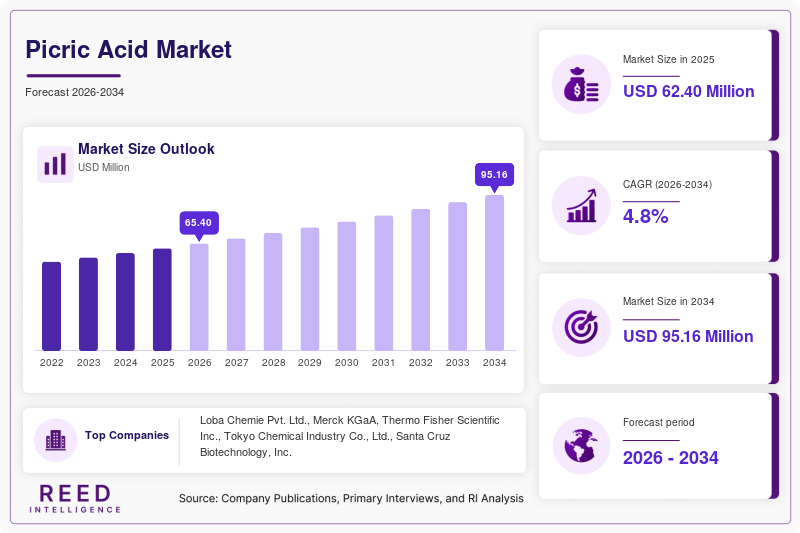
Key Highlights:
- Asia Pacific dominated the market with a 38.6% share in 2025, while Latin America is projected to be the fastest-growing region with a CAGR of 5.6%.
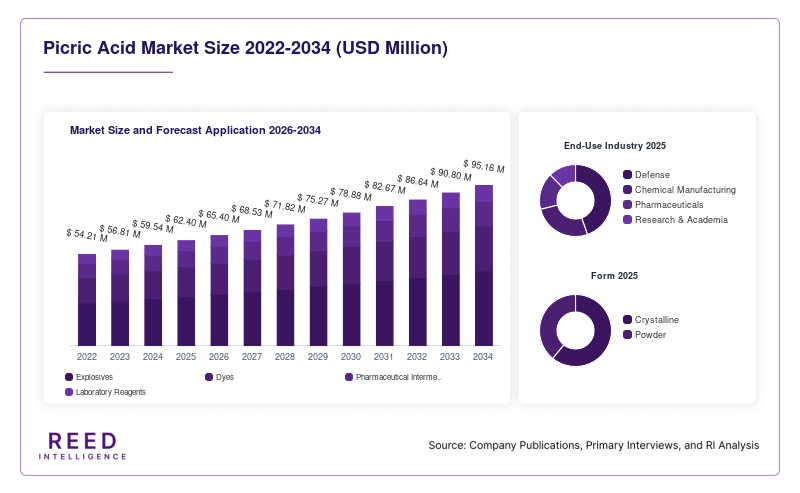
- By application, explosives accounted for the largest share (34.2%) in 2024, whereas pharmaceutical intermediates are expected to grow at the fastest CAGR of 5.9%.
- By end-use, defense remained the dominant segment, while chemical manufacturing is projected to grow at a CAGR of 5.4%.
- China led the market with USD 14.8 million in 2024 and USD 15.6 million in 2025.
Market Trends
Increasing Adoption in Analytical and Laboratory Applications
The growing emphasis on research and development in pharmaceuticals and chemical sciences has increased the use of picric acid as a reagent in analytical laboratories. It is widely used for creatinine testing and histological staining, making it essential in clinical diagnostics and academic research. Expansion of laboratory infrastructure globally has further reinforced this trend.
Shift Toward Controlled and Safe Chemical Handling
With stricter regulations surrounding hazardous chemicals, manufacturers are adopting improved storage, packaging, and transport mechanisms for picric acid. Innovations in stabilization techniques and safety protocols are being implemented to reduce risks associated with its explosive nature. This trend is influencing product design and compliance strategies, particularly in developed regions.
Market Drivers
Rising Demand from Defense and Explosives Industry
The increasing need for advanced explosives in defense applications is a major growth driver for the Picric Acid Market. Picric acid serves as a key component in the formulation of military-grade explosives due to its high energy output and stability under controlled conditions. Expanding defense budgets across major economies continue to sustain this demand.
Growth in Chemical and Pharmaceutical Manufacturing
The expanding chemical and pharmaceutical sectors have significantly contributed to the demand for picric acid. It is used as an intermediate in the synthesis of dyes and certain pharmaceutical compounds. As global healthcare and industrial output grow, the requirement for specialty chemicals like picric acid continues to increase.
Market Restraint
Stringent Regulatory Framework for Hazardous Chemicals
The Picric Acid Market faces challenges due to strict regulations governing the production, storage, and transportation of hazardous substances. Picric acid is classified as an explosive compound under certain conditions, requiring adherence to complex safety standards. Compliance with these regulations increases operational costs and limits entry for smaller manufacturers. Additionally, improper handling risks have led to restrictions in several regions, affecting supply chain efficiency and overall market growth.
Market Opportunities
Expansion in Emerging Economies
Emerging markets in Asia, Latin America, and Africa present significant opportunities for the Picric Acid Market. Rapid industrialization, growth in defense infrastructure, and increasing investment in chemical manufacturing are expected to drive demand. Local production capabilities are also improving, reducing reliance on imports and supporting market expansion.
Development of Safer Chemical Formulations
Advancements in chemical engineering have opened opportunities for developing stabilized forms of picric acid with reduced hazard potential. These innovations can expand its application scope in laboratories and industrial processes while ensuring compliance with safety regulations. Manufacturers focusing on safer formulations are likely to gain a competitive advantage.
Segmental Analysis
By Application
The explosives segment dominated the Picric Acid Market, accounting for 34.2% of the share in 2024. The widespread use of picric acid in military and industrial explosives has contributed to its dominance. Its effectiveness as a high-energy compound has made it a preferred choice in defense applications.
The pharmaceutical intermediates segment is expected to grow at the fastest CAGR of 5.9% during the forecast period. Increasing research activities and the need for specialized chemical compounds in drug development will drive this growth.
By End-Use Industry
The defense sector held the largest share of the Picric Acid Market in 2024. The consistent demand for explosives and ammunition has supported the dominance of this segment. Defense agencies rely on stable and efficient energetic materials, sustaining market demand.
The chemical manufacturing segment is projected to grow at a CAGR of 5.4%. Expansion of chemical production facilities and increased demand for specialty chemicals will support this growth.
By Form
The crystalline form dominated the market in 2024 due to its stability and ease of handling in industrial applications. Its widespread use in explosives and laboratory reagents has contributed to its leading position.
The powder form is expected to grow at a CAGR of 5.1%. Its versatility in various applications, including pharmaceuticals and dyes, will drive its adoption.
By Distribution Channel
Direct sales accounted for the largest share in 2024, as manufacturers prefer direct engagement with industrial buyers to ensure compliance and quality standards.
Online distribution is projected to grow at a CAGR of 5.7%, driven by the increasing adoption of digital procurement platforms in the chemical industry.
Regional Analysis
North America
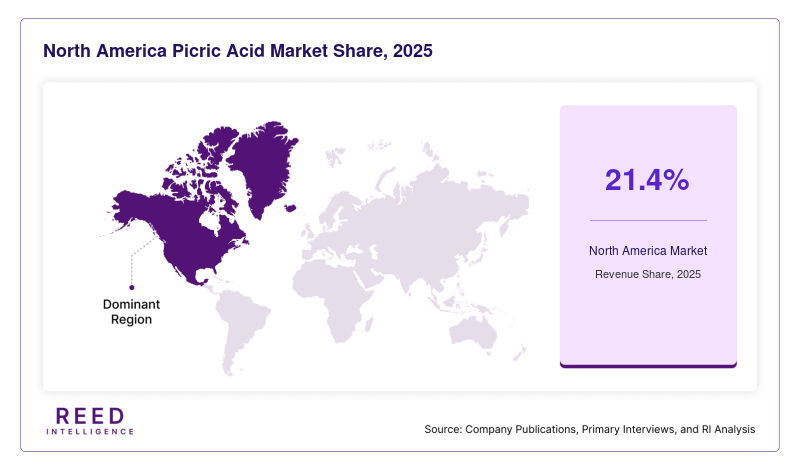
North America accounted for 21.4% of the Picric Acid Market share in 2025 and is projected to grow at a CAGR of 4.3% through 2034. The region has a well-established defense and chemical manufacturing sector, which has historically supported demand. Regulatory oversight has influenced production practices, ensuring safety and compliance across industries.
The United States dominated the regional market due to its strong defense infrastructure and advanced research facilities. Increased investment in laboratory research and defense modernization programs has supported the consistent use of picric acid in specialized applications.
Europe
Europe held a 19.8% share of the Picric Acid Market in 2025 and will expand at a CAGR of 4.1% during the forecast period. The region’s focus on chemical safety and sustainability has shaped the production and usage patterns of picric acid. Stringent environmental regulations have led to the adoption of controlled manufacturing processes.
Germany emerged as the leading country, supported by its strong chemical industry and advanced manufacturing capabilities. The presence of established chemical companies has enabled consistent demand for picric acid in industrial applications.
Asia Pacific
Asia Pacific dominated the Picric Acid Market with a 38.6% share in 2025 and is expected to grow at a CAGR of 5.2% through 2034. Rapid industrialization, expanding defense budgets, and increasing chemical production have driven regional demand.
China led the market due to its large-scale chemical manufacturing base and growing defense sector. The country’s focus on domestic production and export capabilities has strengthened its position in the global market.
Middle East & Africa
The Middle East & Africa accounted for 10.7% of the Picric Acid Market share in 2025 and is projected to grow at a CAGR of 4.9%. Growth in this region has been supported by increasing investments in industrial development and defense infrastructure.
Saudi Arabia dominated the regional market due to its expanding industrial base and investments in chemical manufacturing. Government initiatives to diversify the economy have contributed to the adoption of specialty chemicals.
Latin America
Latin America held a 9.5% share of the Picric Acid Market in 2025 and is anticipated to grow at the fastest CAGR of 5.6% during the forecast period. Industrial growth and increasing defense spending have supported market expansion in the region.
Brazil led the market, driven by its growing chemical industry and rising investments in industrial production. The country’s expanding manufacturing sector has contributed to increased demand for picric acid.
Competitive Landscape
The Picric Acid Market is moderately fragmented, with several regional and global players competing based on product quality, safety standards, and distribution capabilities. Key companies are focusing on expanding production capacity and enhancing compliance with safety regulations.
One leading player, Loba Chemie Pvt. Ltd., has strengthened its position through continuous product innovation and expansion of its specialty chemical portfolio. The company recently introduced improved packaging solutions for hazardous chemicals, enhancing safety and logistics efficiency.
Other companies are investing in research and development to develop safer formulations and expand application areas. Strategic collaborations and regional expansions remain common strategies among market participants.
Key Players
- Loba Chemie Pvt. Ltd.
- Merck KGaA
- Thermo Fisher Scientific Inc.
- Tokyo Chemical Industry Co., Ltd.
- Santa Cruz Biotechnology, Inc.
- Spectrum Chemical Manufacturing Corp.
- Central Drug House (P) Ltd.
- SRL Pvt. Ltd.
- Otto Chemie Pvt. Ltd.
- HiMedia Laboratories
Recent Developments
- In 2024, Loba Chemie Pvt. Ltd. expanded its specialty chemical production facility to enhance output capacity.
- In 2023, Merck KGaA introduced advanced safety packaging solutions for hazardous chemicals.
- In 2024, Thermo Fisher Scientific Inc. expanded its laboratory reagent portfolio, including picric acid derivatives.
- In 2023, Tokyo Chemical Industry Co., Ltd. increased its distribution network across Asia Pacific.
- In 2024, Avantor, Inc. focused on strengthening its supply chain for specialty chemicals globally.
Picric Acid Market Segments
Application
- Explosives
- Dyes
- Pharmaceutical Intermediates
- Laboratory Reagents
End-Use Industry
- Defense
- Chemical Manufacturing
- Pharmaceuticals
- Research & Academia
Form
- Crystalline
- Powder
Distribution Channel
- Direct Sales
- Distributors
- Online Platforms
By Region
- North America
- Europe
- APAC
- Middle East and Africa
- LATAM