Pierre Robin Syndrome Market Size, Share & Demand Report By Treatment Type (Surgical Interventions, Non-Invasive Airway Management), By Diagnosis Type (Clinical Examination, Genetic Testing), By End-Use (Hospitals, Specialty Clinics), By Age Group (Infants, Pediatric Patients), By Region & Segment Forecasts, 2025–2034
USD 3950
Market Overview
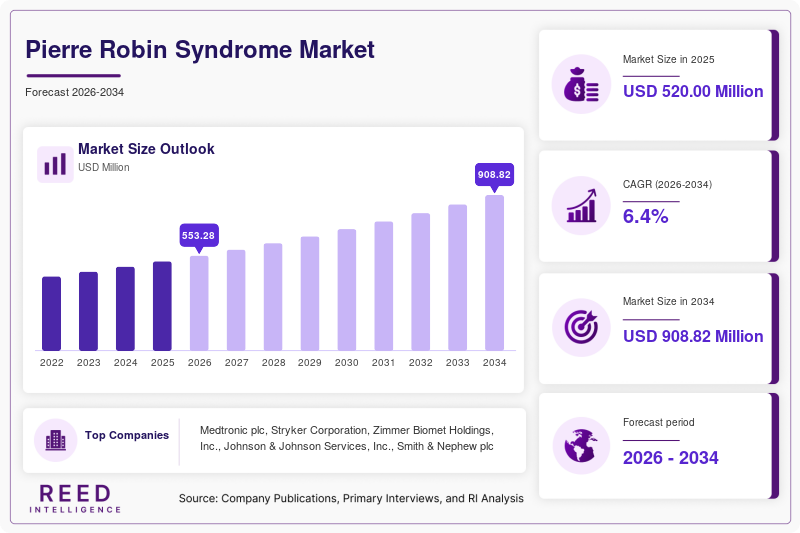
The Pierre Robin Syndrome Market was valued at approximately USD 520 million in 2025 and is projected to reach USD 910 million by 2034, expanding at a CAGR of 6.4% during the forecast period (2025–2034). The market is driven by the increasing clinical focus on rare congenital disorders and the growing integration of multidisciplinary treatment approaches, including surgical, orthodontic, and respiratory management.
A key global factor supporting market growth is the advancement in neonatal care infrastructure, particularly in developed and emerging economies. Improved diagnostic protocols, early intervention programs, and enhanced access to specialized pediatric care have significantly increased the detection and treatment rates of Pierre Robin Syndrome (PRS), thereby driving demand for therapeutic solutions.
Key Highlights:
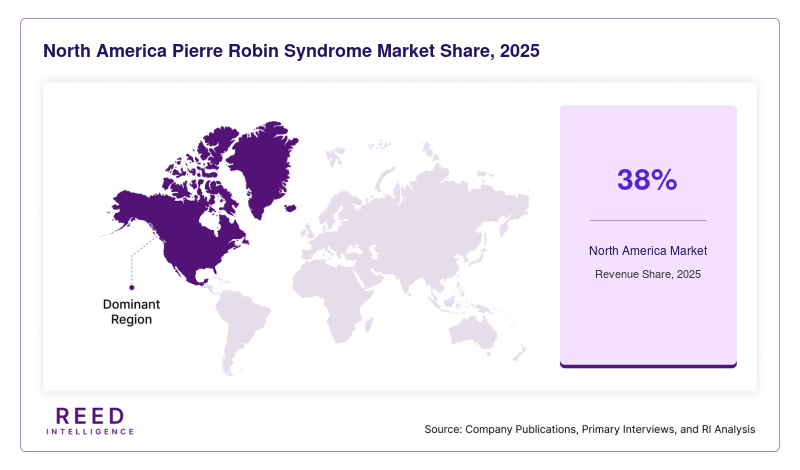
- North America dominated the market with 38% share in 2025, while Asia Pacific is expected to register the fastest CAGR of 7.8% through 2034.
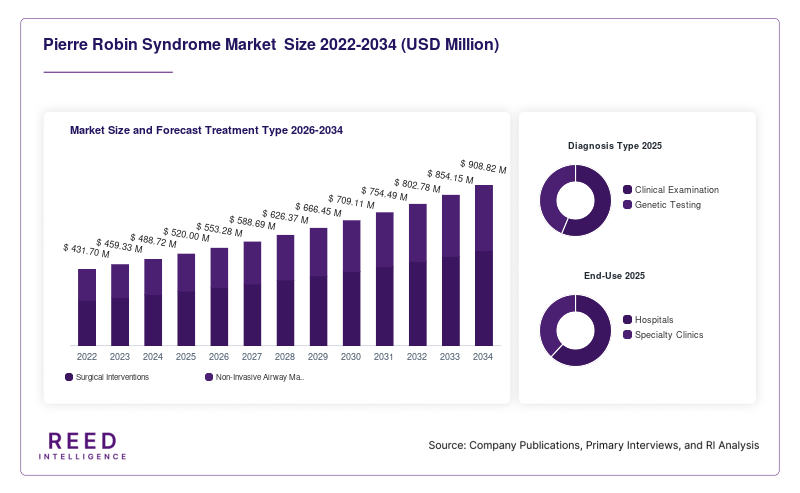
- Surgical interventions emerged as the leading treatment segment with 42% share in 2024, while non-invasive airway management is projected to grow at a CAGR of 7.2%.
- Hospitals led end-use with 55% share, whereas specialty clinics are expected to grow at a CAGR of 6.9%.
- The United States remained the dominant country, with market values of USD 180 million in 2024 and USD 190 million in 2025.
Market Trends
Rising Adoption of Minimally Invasive Surgical Techniques
The Pierre Robin Syndrome Market is witnessing a gradual shift toward minimally invasive procedures such as mandibular distraction osteogenesis. These techniques reduce recovery time, minimize complications, and improve airway function in infants. Surgeons are increasingly adopting image-guided and precision-based surgical tools, enhancing treatment success rates. This trend is particularly prominent in advanced healthcare systems, where early surgical intervention is prioritized.
Integration of Multidisciplinary Care Models
Another notable trend shaping the Pierre Robin Syndrome Market is the integration of multidisciplinary care frameworks involving pediatricians, ENT specialists, orthodontists, and speech therapists. This collaborative approach ensures comprehensive management of feeding difficulties, respiratory challenges, and craniofacial abnormalities. Healthcare institutions are increasingly establishing dedicated craniofacial centers to streamline patient care, improve clinical outcomes, and reduce long-term complications.
Market Drivers
Increasing Incidence of Congenital Craniofacial Disorders
The rising prevalence of congenital anomalies, including Pierre Robin Syndrome, is a major driver of market growth. Improved prenatal and postnatal screening technologies have led to higher diagnosis rates, increasing the demand for effective treatment options. The growing awareness of genetic and environmental factors contributing to craniofacial abnormalities is further supporting early detection and intervention.
Advancements in Pediatric Surgical Technologies
Technological advancements in pediatric surgical tools and techniques are significantly driving the Pierre Robin Syndrome Market. Innovations such as 3D-printed implants, advanced imaging systems, and precision surgical instruments have improved treatment outcomes. These advancements enable clinicians to perform complex procedures with higher accuracy, thereby increasing adoption rates across healthcare facilities.
Market Restraint
High Cost of Treatment and Limited Accessibility
One of the major challenges in the Pierre Robin Syndrome Market is the high cost associated with diagnosis, surgical procedures, and long-term care. Advanced treatments such as mandibular distraction and neonatal intensive care require specialized infrastructure and skilled professionals, making them expensive and less accessible in low-income regions. Additionally, the limited availability of trained specialists in rural and underdeveloped areas restricts market penetration. These factors collectively hinder the widespread adoption of advanced treatment solutions, particularly in emerging economies.
Market Opportunities
Expansion of Telemedicine and Remote Monitoring
The increasing adoption of telemedicine presents a significant opportunity for the Pierre Robin Syndrome Market. Remote consultations and monitoring systems enable early diagnosis and follow-up care, especially in underserved regions. This approach improves patient access to specialized care and reduces the burden on healthcare facilities.
Development of Personalized Treatment Solutions
The growing focus on personalized medicine is creating new opportunities in the Pierre Robin Syndrome Market. Customized treatment plans based on patient-specific anatomical and genetic factors are gaining traction. Advances in digital health technologies and data analytics are enabling healthcare providers to design tailored interventions, improving patient outcomes and driving market growth.
Segmental Analysis
By Treatment Type
Surgical interventions dominated the Pierre Robin Syndrome Market, accounting for 42% share in 2024. Procedures such as mandibular distraction osteogenesis and tracheostomy were widely adopted due to their effectiveness in addressing airway obstruction and improving patient outcomes. The growing preference for definitive surgical solutions contributed to the segment’s dominance.
Non-invasive airway management is expected to be the fastest-growing subsegment, with a projected CAGR of 7.2%. The increasing use of devices such as CPAP and positioning techniques will drive growth. These methods offer safer alternatives for infants and reduce the need for invasive procedures.
By Diagnosis Type
Clinical examination remained the dominant diagnostic method, holding 48% share in 2024. Physicians relied on physical assessment of craniofacial abnormalities and respiratory symptoms for initial diagnosis. The simplicity and cost-effectiveness of clinical evaluation contributed to its widespread use.
Genetic testing is anticipated to grow at the fastest rate, with a CAGR of 7.5%. Advances in genomic technologies will enable more accurate diagnosis and identification of associated syndromes, improving treatment planning and outcomes.
By End-Use
Hospitals led the market with 55% share in 2024, driven by the availability of advanced medical infrastructure and specialized healthcare professionals. The presence of neonatal intensive care units and surgical facilities made hospitals the primary treatment centers.
Specialty clinics are projected to grow at a CAGR of 6.9%, supported by the increasing establishment of dedicated craniofacial and pediatric care centers. These facilities offer focused treatment and personalized care, attracting a growing number of patients.
By Age Group
Infants represented the largest segment, accounting for 60% share in 2024, as PRS is typically diagnosed at birth or during early infancy. Early intervention is critical for managing airway and feeding challenges, driving demand within this segment.
Pediatric patients (beyond infancy) are expected to grow at a CAGR of 6.7%. Ongoing treatment needs such as orthodontic care and speech therapy will contribute to sustained demand in this group.
Regional Analysis
North America
North America accounted for 38% of the Pierre Robin Syndrome Market share in 2025 and is expected to grow at a CAGR of 5.9% through 2034. The region’s established healthcare infrastructure and high awareness levels contributed to its dominant position. The presence of advanced neonatal care units and specialized craniofacial centers supported early diagnosis and treatment adoption.
The United States dominated the regional market due to strong healthcare spending and the availability of specialized pediatric surgeons. A key growth factor is the widespread use of advanced diagnostic imaging technologies, which enables early identification of PRS cases and improves clinical outcomes.
Europe
Europe held approximately 27% share in 2025 and is projected to grow at a CAGR of 6.1% during the forecast period. The region benefited from robust healthcare policies and government support for rare disease management. Increasing investments in pediatric healthcare infrastructure further strengthened market growth.
Germany emerged as the leading country, driven by its well-developed healthcare system and strong focus on research and innovation. The availability of multidisciplinary care centers and favorable reimbursement policies has enhanced patient access to treatment.
Asia Pacific
Asia Pacific captured 20% of the market share in 2025 and is anticipated to grow at the fastest CAGR of 7.8%. Rapid urbanization, improving healthcare infrastructure, and rising awareness of congenital disorders have contributed to market expansion. The increasing number of pediatric hospitals and specialized clinics is further supporting growth.
China dominated the region due to its large population base and expanding healthcare sector. Government initiatives aimed at improving maternal and child healthcare services have significantly boosted early diagnosis and treatment rates.
Middle East & Africa
The Middle East & Africa accounted for 8% of the market share in 2025 and is expected to grow at a CAGR of 6.5%. The region is gradually improving its healthcare infrastructure, particularly in urban areas. Increasing investments in medical facilities and growing awareness of rare diseases are contributing to market growth.
Saudi Arabia led the regional market due to government initiatives to enhance healthcare services. The establishment of specialized medical centers and increased funding for pediatric care have improved treatment accessibility.
Latin America
Latin America held 7% of the market share in 2025 and is projected to grow at a CAGR of 6.3%. The region is witnessing gradual improvements in healthcare infrastructure and increasing awareness of congenital disorders. Expanding healthcare coverage is also supporting market growth.
Brazil dominated the market due to its large population and growing healthcare sector. The increasing number of pediatric specialists and improved access to healthcare services have contributed to higher diagnosis and treatment rates.
Competitive Landscape
The Pierre Robin Syndrome Market is moderately fragmented, with several global and regional players focusing on innovation and strategic collaborations. Companies are investing in advanced treatment technologies and expanding their product portfolios to strengthen their market position.
A leading player in the market is Medtronic plc, which has demonstrated strong capabilities in medical device innovation. The company recently introduced advanced airway management solutions designed for neonatal care, enhancing treatment outcomes for PRS patients.
Other key players are focusing on partnerships with healthcare institutions and research organizations to develop new treatment approaches. The competitive environment is characterized by continuous product development, technological advancements, and efforts to improve accessibility to treatment solutions.
Key Players List
- Medtronic plc
- Stryker Corporation
- Zimmer Biomet Holdings, Inc.
- Johnson & Johnson Services, Inc.
- Smith & Nephew plc
- Boston Scientific Corporation
- GE HealthCare Technologies Inc.
- Koninklijke Philips N.V.
- Siemens Healthineers AG
- Baxter International Inc.
- Becton, Dickinson and Company
- 3M Company
- Teleflex Incorporated
- Fisher & Paykel Healthcare Corporation Limited
- Getinge AB
Recent Developments
- In 2025, Medtronic plc launched a new neonatal airway management system designed to improve respiratory support in infants with craniofacial abnormalities.
- In 2024, Stryker Corporation expanded its pediatric surgical portfolio with advanced craniofacial reconstruction tools.
- In 2025, GE HealthCare introduced enhanced imaging solutions for early diagnosis of congenital disorders.
- In 2024, Philips Healthcare partnered with pediatric hospitals to develop integrated care solutions for rare diseases.
- In 2025, Fisher & Paykel Healthcare expanded its respiratory care product line targeting neonatal applications.
Pierre Robin Syndrome Market Segments
Treatment Type
- Surgical Interventions
- Non-Invasive Airway Management
Diagnosis Type
- Clinical Examination
- Genetic Testing
End-Use
- Hospitals
- Specialty Clinics
Age Group
- Infants
- Pediatric Patients
By Region
- North America
- Europe
- APAC
- Middle East and Africa
- LATAM