Piezoelectric Pump Market Size, Share, Demand & Industry Analysis Report By Type (Diaphragm Piezoelectric Pumps, Micro Piezoelectric Pumps), By Flow Rate (Ultra-Low, Low, Medium, High), By Application (Medical Devices, Laboratory & Analytical Instruments, Electronics Cooling), By End User (Healthcare & Life Sciences, Electronics & Semiconductor, Industrial Manufacturing), By Region Forecast 2026–2034
USD 3950
Market Overview
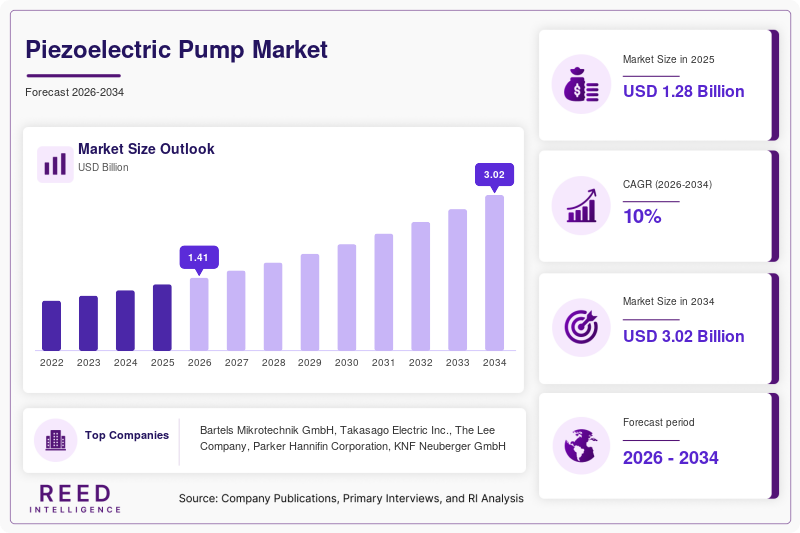
The Piezoelectric Pump Market size was valued at USD 1.28 billion in 2026 and is projected to reach USD 2.74 billion by 2034, registering a CAGR of 10.0% during the forecast period (2026–2034). A major factor supporting market growth globally has been the increasing demand for compact and energy-efficient microfluidic solutions. Piezoelectric pumps offer precise flow control, low power consumption, minimal maintenance requirements, and compact form factors, making them suitable for advanced healthcare devices, portable analytical equipment, and next-generation cooling technologies.
As industries continue to prioritize miniaturization and operational efficiency, demand for piezoelectric pumping systems has increased across both developed and emerging economies. Technological advancements in piezoelectric materials, enhanced diaphragm designs, and integrated control systems have further improved pump reliability and performance. Manufacturers are introducing high-frequency piezoelectric pumps capable of delivering precise dosing and fluid circulation in applications where conventional pumping technologies face limitations. Growing investments in biotechnology, semiconductor manufacturing, and wearable medical technologies continue to create favorable conditions for long-term market expansion.
Key Highlights
- North America accounted for the largest market share of 34.8% in 2025, while Asia Pacific is projected to register the fastest CAGR of 11.8% during 2026–2034.
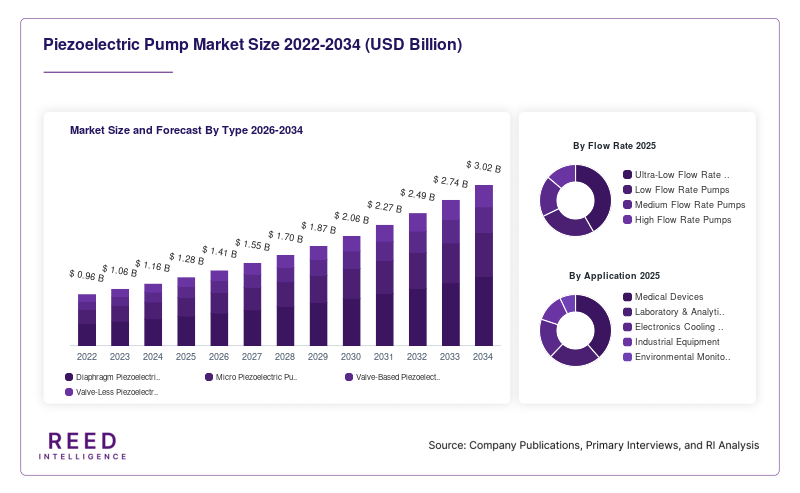
- By Type, Diaphragm Piezoelectric Pumps held the dominant share of 61.5% in 2025, whereas Micro Piezoelectric Pumps are expected to expand at a CAGR of 12.4% through 2034.
- By Flow Rate, Low Flow Rate Pumps represented 47.6% market share in 2025, while Ultra-Low Flow Rate Pumps are forecast to grow at 12.9% CAGR.
- By Application, Medical Devices captured 38.7% of the market in 2025, while Electronics Cooling Systems are anticipated to record a CAGR of 13.1%.
- By End User, Healthcare & Life Sciences remained the leading segment with 35.2% share in 2025, whereas Semiconductor Manufacturing is forecast to grow at 12.7% CAGR.
- The United States remained the dominant country, with market values of USD 292 million in 2024 and USD 319 million in 2025.
Market Trends
Integration of Piezoelectric Pumps in Wearable and Portable Medical Devices
Healthcare equipment manufacturers are increasingly incorporating piezoelectric pumps into wearable drug delivery systems, portable infusion devices, diagnostic platforms, and patient monitoring technologies. The compact size and accurate fluid control capabilities of piezoelectric pumps enable the development of lightweight medical devices that improve patient mobility and treatment efficiency. This trend continues to influence product innovation and supports broader adoption across modern healthcare ecosystems.
Growing Adoption in Advanced Electronics Thermal Management
The increasing complexity of electronic systems has intensified demand for efficient thermal management solutions. Piezoelectric pumps are being integrated into liquid cooling systems for data centers, high-performance computing equipment, power electronics, and telecommunications infrastructure. Their ability to operate quietly while maintaining precise coolant circulation is encouraging adoption across advanced electronics applications, contributing significantly to market development.
Market Drivers
Expansion of Microfluidics and Precision Fluid Handling Applications
The growing utilization of microfluidic technologies across biotechnology, diagnostics, pharmaceutical research, and analytical laboratories has accelerated demand for highly precise pumping systems. Piezoelectric pumps provide controlled fluid movement at micro and ultra-low flow rates, making them essential components in sophisticated analytical instruments and laboratory automation platforms. Increasing investments in life science research continue to strengthen demand worldwide.
Rising Demand for Energy-Efficient Pumping Technologies
Industries are increasingly seeking solutions that reduce power consumption while maintaining operational accuracy. Piezoelectric pumps consume significantly less energy compared to many conventional pumping technologies and provide reliable performance under varying operating conditions. The focus on sustainable industrial operations and energy optimization has encouraged wider deployment across manufacturing, healthcare, and electronics sectors.
Market Restraint
High Manufacturing and Material Costs
The production of piezoelectric pumps requires specialized materials, precision engineering processes, and advanced manufacturing techniques. These factors contribute to relatively high product costs compared to traditional pumping systems. Cost sensitivity among small-scale users and budget-constrained industries may limit adoption in certain applications, particularly where high precision fluid control is not essential.
Market Opportunities
Emerging Demand in Semiconductor Fabrication Facilities
The semiconductor industry requires highly controlled fluid delivery systems for chemical processing, wafer cleaning, and advanced manufacturing operations. Increasing investments in semiconductor fabrication facilities globally are expected to create new growth opportunities for piezoelectric pump manufacturers. Their precision and contamination-control advantages align well with stringent semiconductor production requirements.
Growth of Portable Environmental Monitoring Equipment
Environmental monitoring devices are becoming more compact and mobile to support field-based testing and real-time data collection. Piezoelectric pumps enable precise sampling and fluid movement in portable analytical instruments used for air quality, water quality, and industrial emissions monitoring. Rising environmental compliance initiatives are expected to support adoption throughout the forecast period.
Segmental Analysis
By Type
The market is segmented into:
- Diaphragm Piezoelectric Pumps
- Micro Piezoelectric Pumps
- Valve-Based Piezoelectric Pumps
- Valve-Less Piezoelectric Pumps
Diaphragm Piezoelectric Pumps dominated the market with 61.5% share in 2025. Their widespread adoption was attributed to reliable flow control, high operational stability, and compatibility with diverse fluid types. These pumps are extensively used across healthcare, industrial instrumentation, and analytical equipment applications.
Micro Piezoelectric Pumps are projected to witness the fastest growth at a CAGR of 12.4% during the forecast period. Increasing demand for miniaturized systems in portable diagnostics, wearable devices, and compact analytical instruments will drive their expansion. Their ability to operate efficiently within limited installation spaces will support broader adoption.
By Flow Rate
The market is categorized into:
- Ultra-Low Flow Rate Pumps
- Low Flow Rate Pumps
- Medium Flow Rate Pumps
- High Flow Rate Pumps
Low Flow Rate Pumps accounted for 47.6% market share in 2025 due to extensive deployment in medical devices, laboratory equipment, and analytical systems requiring precise fluid delivery. Their operational accuracy and consistency contributed to widespread utilization.
Ultra-Low Flow Rate Pumps are expected to record the highest CAGR of 12.9% through 2034. Increasing requirements for microfluidic applications and advanced biological analysis systems will encourage demand. Enhanced precision capabilities make them suitable for highly sensitive laboratory environments.
By Application
The market includes:
- Medical Devices
- Laboratory & Analytical Instruments
- Electronics Cooling Systems
- Industrial Equipment
- Environmental Monitoring Systems
- Others
Medical Devices held the largest share of 38.7% in 2025. Demand remained strong due to widespread integration into infusion systems, drug delivery equipment, and diagnostic devices requiring accurate fluid control.
Electronics Cooling Systems are forecast to grow at a CAGR of 13.1% during the assessment period. Increasing thermal management requirements in advanced computing systems, communication infrastructure, and power electronics will accelerate adoption. Compact cooling architectures will continue supporting market growth.
By End User
The market is segmented into:
- Healthcare & Life Sciences
- Electronics & Semiconductor
- Industrial Manufacturing
- Research Institutions
- Environmental Testing Organizations
Healthcare & Life Sciences accounted for 35.2% share in 2025 due to growing utilization of precision fluid handling systems across diagnostics, pharmaceutical processing, and clinical applications.
Electronics & Semiconductor is anticipated to register a CAGR of 12.7% over the forecast period. Increasing complexity of semiconductor production processes and thermal management requirements will strengthen demand for advanced piezoelectric pump technologies.
Regional Analysis
North America
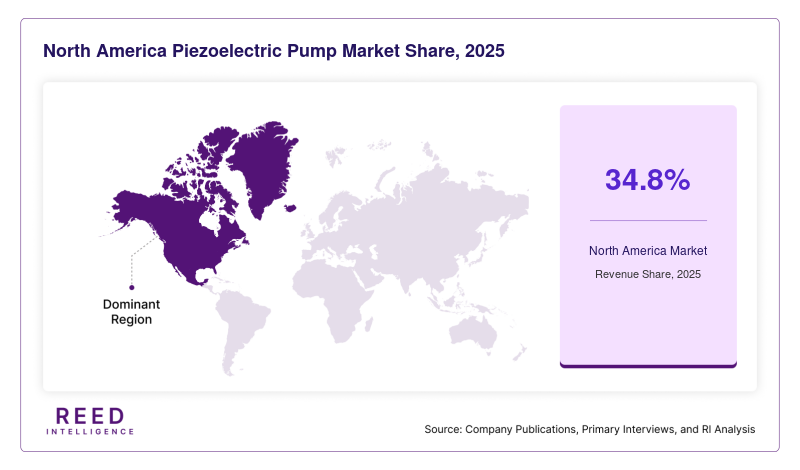
North America held 34.8% of the Piezoelectric Pump Market share in 2025 and will likely expand at a CAGR of 9.2% between 2026 and 2034. Market growth in the region is supported by extensive deployment of precision instrumentation across healthcare, biotechnology, and analytical laboratories. The region maintains a strong ecosystem of advanced equipment manufacturers and technology developers.
The United States remained the dominant country due to significant investments in medical device innovation and laboratory automation infrastructure. Continuous development of precision healthcare technologies has strengthened demand for advanced piezoelectric pumping systems.
Europe
Europe accounted for 27.4% market share in 2025 and is projected to grow at a CAGR of 8.8% through 2034. The region benefits from widespread adoption of industrial automation technologies and increasing utilization of precision fluid management systems across scientific research facilities. Demand remains particularly strong in engineering-intensive industries requiring reliable fluid control solutions.
Germany dominated the regional market owing to its extensive precision engineering sector and strong manufacturing base. Growing adoption of advanced industrial equipment has contributed to continued market expansion.
Asia Pacific
Asia Pacific represented 24.6% of the Piezoelectric Pump Market in 2025 and is forecast to register the fastest CAGR of 11.8% during 2026–2034. The region is witnessing substantial investments in electronics manufacturing, medical technology production, and laboratory infrastructure development. Rising industrial modernization initiatives continue to create favorable market conditions.
China emerged as the leading country due to rapid expansion of electronics manufacturing capabilities and increasing production of advanced medical equipment. Growing domestic technological capabilities have accelerated adoption of piezoelectric pump technologies.
Middle East & Africa
The Middle East & Africa captured 7.2% market share in 2025 and is expected to expand at a CAGR of 8.1% over the forecast period. Market growth is supported by increasing adoption of analytical instrumentation, industrial monitoring systems, and healthcare technologies. Investments in technology-driven industrial diversification are contributing to regional demand.
Saudi Arabia maintained regional leadership owing to investments in industrial modernization projects and development of advanced research infrastructure. Expanding technology-focused initiatives have encouraged deployment of precision fluid management systems.
Latin America
Latin America accounted for 6.0% of the global market share in 2025 and is anticipated to grow at a CAGR of 8.4% through 2034. The region is witnessing increasing adoption of laboratory automation equipment, environmental monitoring solutions, and healthcare technologies requiring precise fluid control.
Brazil remained the dominant market due to expanding healthcare infrastructure and increasing implementation of analytical testing technologies. Ongoing modernization of research and diagnostic facilities has supported demand for piezoelectric pumps.
Competitive Landscape
The Piezoelectric Pump Market remains moderately consolidated, with manufacturers focusing on technological innovation, product miniaturization, and expansion into high-growth applications. Companies continue investing in advanced piezoelectric materials, integrated control systems, and high-performance microfluidic solutions to strengthen competitive positioning.
Bartels Mikrotechnik GmbH remained a leading market participant due to its extensive portfolio of micro piezoelectric pumping solutions and strong presence in medical and analytical applications. The company recently introduced an enhanced microfluidic pump platform designed for portable diagnostic equipment, improving flow precision and energy efficiency.
Other leading participants continue emphasizing strategic partnerships, product development programs, and expansion of manufacturing capabilities to address growing demand across healthcare, industrial automation, and electronics sectors.
Key Players List
- Bartels Mikrotechnik GmbH
- Takasago Electric Inc.
- The Lee Company
- Parker Hannifin Corporation
- KNF Neuberger GmbH
- Xavitech AB
- Dolomite Microfluidics
- Fluigent SA
- Servoflo Corporation
- Bürkert Fluid Control Systems
- Harvard Apparatus
- Cole-Parmer Instrument Company
- IDEX Corporation
- Festo AG
- SMC Corporation
Recent Developments
- In 2025, several manufacturers introduced next-generation micro piezoelectric pumps featuring improved flow stability and reduced power consumption for portable healthcare applications.
- Multiple industry participants expanded production capabilities to address increasing demand from electronics cooling and semiconductor manufacturing sectors.
- New integrated control modules were launched to enhance pump precision and simplify system integration within laboratory automation platforms.
- Strategic collaborations between microfluidics technology developers and medical device manufacturers accelerated commercialization of compact diagnostic solutions.
- Research investments focused on advanced piezoelectric ceramic materials capable of improving durability, operational efficiency, and long-term performance in demanding industrial environments.
Piezoelectric Pump Market Segments
By Type
- Diaphragm Piezoelectric Pumps
- Micro Piezoelectric Pumps
- Valve-Based Piezoelectric Pumps
- Valve-Less Piezoelectric Pumps
By Flow Rate
- Ultra-Low Flow Rate Pumps
- Low Flow Rate Pumps
- Medium Flow Rate Pumps
- High Flow Rate Pumps
By Application
- Medical Devices
- Laboratory & Analytical Instruments
- Electronics Cooling Systems
- Industrial Equipment
- Environmental Monitoring Systems
By End User
- Healthcare & Life Sciences
- Electronics & Semiconductor
- Industrial Manufacturing
- Research Institutions
- Environmental Testing Organizations
By Region
- North America
- Europe
- APAC
- Middle East and Africa
- LATAM