Pigment Wetting Agent Market Size, Share & Demand Report By Type (Anionic Wetting Agents, Non-Ionic Wetting Agents, Cationic Wetting Agents, Amphoteric Wetting Agents), By Application (Paints and Coatings, Printing Inks, Plastics, Adhesives and Sealants, Textiles, Others), By End-Use Industry (Construction, Automotive, Packaging, Textile, Industrial Manufacturing, Consumer Goods), By Region & Segment Forecasts, 2026–2034
USD 3950
Market Overview
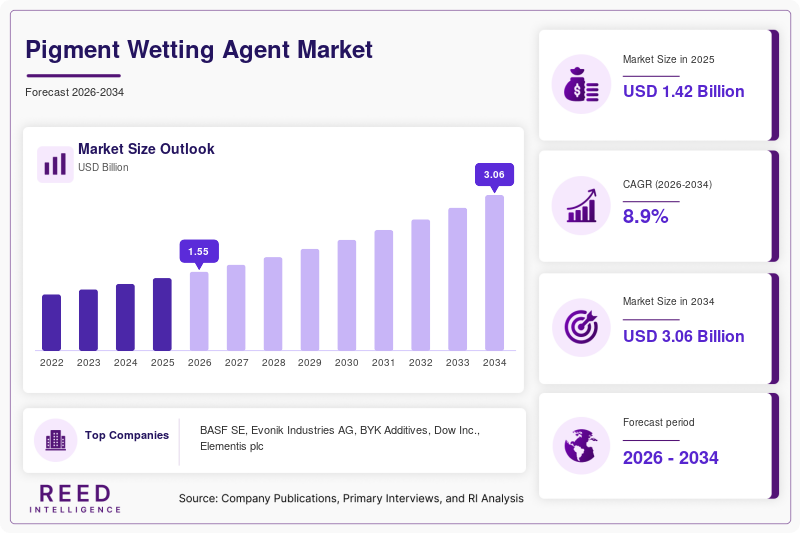
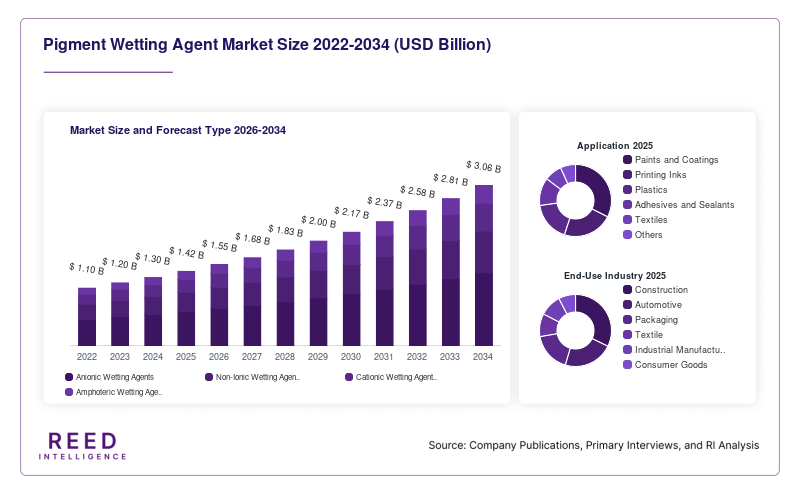
The global Pigment Wetting Agent Market size was valued at approximately USD 1.42 billion in 2026 and is projected to reach nearly USD 2.81 billion by 2034, expanding at a CAGR of 8.9% during the forecast period from 2026 to 2034. Pigment wetting agents play a critical role in coatings, inks, plastics, adhesives, and textile formulations by improving pigment dispersion, color consistency, and surface coverage. Manufacturers across multiple industrial sectors are increasingly focusing on high-performance formulations that reduce processing time and improve end-product durability. This shift has increased demand for advanced wetting technologies that can support both water-based and solvent-based systems.
One major global factor supporting market growth is the rising transition toward sustainable industrial coatings and low-VOC formulations. Environmental regulations in developed and emerging economies are encouraging manufacturers to adopt eco-friendly dispersing and wetting technologies that reduce hazardous emissions while maintaining product quality. Pigment wetting agents are becoming essential for improving pigment compatibility in waterborne systems, especially in automotive coatings, packaging inks, and decorative paints. Rapid industrialization in Asia Pacific, infrastructure development in emerging economies, and growing packaging consumption are also contributing to stable market expansion.
Key Highlights
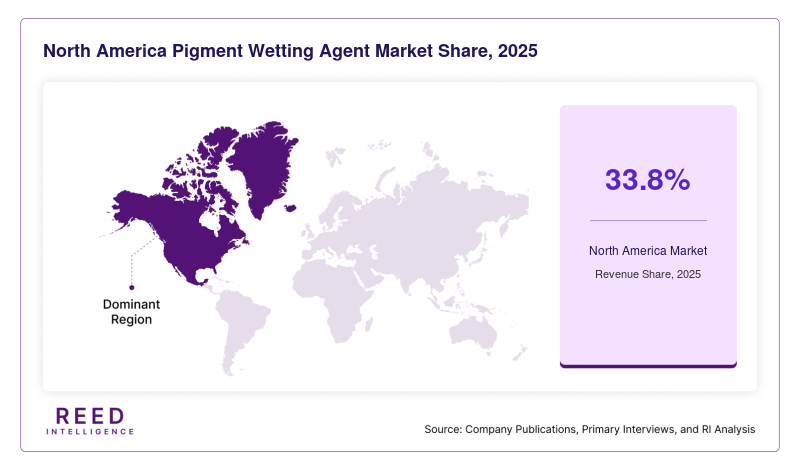
- North America dominated the market with a 33.8% share in 2025.
- Asia Pacific is expected to grow at the fastest CAGR of 10.8% during 2026–2034.
- By type, anionic wetting agents accounted for the largest share of 39.4%.
- while non-ionic wetting agents are projected to grow at a CAGR of 10.9%.
- By application, paints and coatings led with a 44.6% share, whereas printing inks are expected to expand at a CAGR of 10.7%.
- By end-use industry, construction held the dominant share of 36.1%, while packaging is forecast to grow at a CAGR of 11.1% during the assessment period.
- The United States remained the dominant country, with market values of USD 412 million in 2024 and USD 448 million in 2025.
Market Trends
Growing Adoption of Water-Based Formulations
The increasing adoption of water-based coatings and inks is shaping the Pigment Wetting Agent Market across developed and emerging economies. Industrial manufacturers are replacing solvent-heavy formulations with environmentally compliant alternatives that offer reduced emissions and improved workplace safety. Pigment wetting agents designed for waterborne systems are gaining demand because they enhance pigment stability, improve color development, and reduce foam generation during production. Automotive refinishing, architectural coatings, and industrial packaging applications are driving this transition. Producers are also investing in multifunctional additives that combine wetting, dispersing, and leveling capabilities in a single formulation. This trend is encouraging chemical manufacturers to develop bio-based and low-toxicity wetting agents that align with sustainability targets while supporting high-performance coating requirements.
Rising Demand from Digital Printing and Packaging Applications
The rapid expansion of flexible packaging and digital printing technologies is creating new growth opportunities for pigment wetting agent suppliers. Printing ink manufacturers require advanced wetting agents that can maintain pigment dispersion under high-speed printing conditions and deliver sharp image quality. Growth in e-commerce, food packaging, and label printing has significantly increased demand for specialty inks with strong adhesion and color consistency. Pigment wetting agents are becoming increasingly important in UV-curable inks and water-based digital printing systems because they help reduce viscosity fluctuations and improve substrate coverage. Companies are focusing on customized additive solutions for high-resolution printing applications, especially in packaging and textile printing industries. This trend is expected to strengthen demand for advanced surfactant technologies over the coming years.
Market Drivers
Expansion of Global Paints and Coatings Production
The steady expansion of the global paints and coatings industry continues to support growth in the Pigment Wetting Agent Market. Rising construction activity, infrastructure modernization, and automotive production are increasing demand for decorative and protective coatings. Pigment wetting agents are widely used to improve dispersion efficiency, reduce milling time, and achieve consistent surface appearance in coating formulations. Manufacturers are prioritizing additives that can improve scratch resistance, gloss retention, and long-term stability. Emerging economies in Asia Pacific and Latin America are experiencing strong demand for residential and commercial coatings, creating additional opportunities for additive suppliers. Industrial coating applications in marine, aerospace, and heavy equipment sectors are also contributing to market growth as companies seek high-performance pigment dispersion technologies.
Increasing Use in High-Performance Printing Inks
The growing use of high-performance printing inks across packaging, publishing, and textile sectors is driving demand for pigment wetting agents. Modern printing processes require stable pigment distribution to maintain color intensity and print precision across different substrates. Wetting agents help reduce agglomeration and improve pigment compatibility in both solvent-based and water-based inks. The packaging sector, especially flexible packaging, is expanding rapidly due to rising consumer demand for packaged food, beverages, and personal care products. Digital printing technologies are also increasing the need for specialized ink formulations with improved flow and drying properties. As print quality standards become more advanced, manufacturers are investing in innovative wetting solutions that improve production efficiency while reducing material waste and operational costs.
Market Restraint
Volatility in Raw Material Prices and Regulatory Compliance Costs
Fluctuating raw material prices remain a significant challenge for companies operating in the Pigment Wetting Agent Market. Many wetting agents are derived from petrochemical feedstocks and specialty surfactants, making production costs sensitive to crude oil price movements and supply chain disruptions. Price instability can reduce profit margins for manufacturers and create uncertainty in long-term procurement planning. In addition, environmental regulations related to volatile organic compounds, hazardous chemicals, and wastewater disposal are increasing compliance costs for chemical producers. Smaller manufacturers often face difficulties in upgrading production facilities or reformulating products to meet regional environmental standards. These challenges can delay product launches and reduce competitiveness in cost-sensitive markets. Regulatory pressure is particularly strong in Europe and North America, where strict chemical safety requirements continue to influence formulation strategies and investment decisions.
Market Opportunities
Rising Demand for Sustainable and Bio-Based Additives
The increasing preference for sustainable industrial chemicals is creating favorable opportunities for bio-based pigment wetting agents. Manufacturers are developing renewable and biodegradable additive solutions to align with environmental targets and consumer expectations. Bio-based wetting agents derived from plant oils and renewable feedstocks are attracting attention from coating and ink producers seeking low-emission formulations. Regulatory initiatives supporting green chemistry are encouraging investments in sustainable additive research and product development. Companies that can offer environmentally compliant wetting agents without compromising performance are expected to gain a competitive advantage. Demand is particularly strong in architectural coatings, food packaging inks, and textile applications where environmental compliance and product safety are becoming important purchasing factors.
Growth Potential in Emerging Industrial Economies
Emerging economies across Asia Pacific, the Middle East, and Latin America present strong growth opportunities for pigment wetting agent manufacturers. Rapid urbanization, industrial expansion, and infrastructure investment are increasing demand for paints, coatings, plastics, and printing inks. Governments in countries such as India, Vietnam, Brazil, and Saudi Arabia are investing heavily in manufacturing development and construction projects, supporting broader chemical industry growth. Local producers are also modernizing production technologies and adopting advanced additive systems to improve product quality. Expanding automotive assembly operations and packaging industries are further contributing to demand for high-performance pigment dispersion solutions. Market participants are increasingly establishing regional production facilities and distribution partnerships to strengthen their presence in these high-growth economies.
Segmental Analysis
By Type
Anionic wetting agents accounted for the largest share of the Pigment Wetting Agent Market in 2024, representing approximately 39.4% of total revenue. These wetting agents are widely used because of their strong dispersion capabilities, cost efficiency, and compatibility with various pigment systems. They are commonly utilized in paints, coatings, and industrial inks where stable pigment distribution is essential for product performance. Manufacturers prefer anionic formulations for high-volume industrial applications due to their ability to reduce surface tension and improve processing efficiency. Demand is particularly strong in decorative coatings and construction materials where cost-effective additive technologies are important. Increasing infrastructure development and rising demand for industrial coatings across emerging economies continue to support the dominance of anionic wetting agents in the global market.
By Application
Paints and coatings represented the dominant application segment in 2024, accounting for nearly 44.6% of the global Pigment Wetting Agent Market. Pigment wetting agents are essential in coating formulations because they improve pigment distribution, enhance color consistency, and reduce agglomeration during production. The construction and automotive industries remain major consumers of decorative and protective coatings, creating stable demand for advanced wetting technologies. Industrial manufacturers are also focusing on formulations that improve weather resistance, gloss retention, and surface appearance. Waterborne coating systems are gaining popularity because of environmental regulations, further increasing the need for specialized wetting agents that perform efficiently in low-VOC applications. Continuous growth in residential construction and infrastructure modernization is expected to sustain demand within this segment.
By End-Use Industry
The construction industry held the largest share of the Pigment Wetting Agent Market in 2024, contributing approximately 36.1% of total market revenue. Rapid urbanization, infrastructure expansion, and residential development projects are increasing consumption of paints, coatings, sealants, and construction materials that require effective pigment dispersion technologies. Pigment wetting agents help improve coating durability, surface smoothness, and color performance in architectural applications. Demand is particularly strong in Asia Pacific and the Middle East where governments continue to invest heavily in infrastructure modernization and commercial construction. The growing use of energy-efficient buildings and protective coating systems in industrial structures is also supporting broader adoption of advanced wetting additives in construction-related applications.
Regional Analysis
North America
North America accounted for approximately 33.8% of the global Pigment Wetting Agent Market in 2025 and is expected to maintain stable growth at a CAGR of 7.8% through 2034. The region benefits from advanced manufacturing infrastructure, strong demand for industrial coatings, and high adoption of specialty chemical additives across end-use industries. Paints, automotive coatings, and packaging inks remain major application sectors driving regional demand. Regulatory emphasis on low-VOC and environmentally compliant formulations is also encouraging the use of advanced water-based wetting technologies. The presence of major coating and additive manufacturers further strengthens market development across the United States and Canada.
Europe
Europe represented nearly 27.4% of the global Pigment Wetting Agent Market in 2025 and is projected to expand at a CAGR of 7.5% during the forecast period. The region has a mature chemical manufacturing industry supported by strict environmental standards and strong research capabilities. Demand for pigment wetting agents is growing steadily in automotive coatings, decorative paints, and high-quality printing applications. European manufacturers are focusing on low-emission additive technologies and recyclable packaging solutions, which has increased interest in sustainable wetting systems. The transition toward waterborne coatings and advanced digital printing technologies continues to influence regional product innovation.
Asia Pacific
Asia Pacific held approximately 24.6% of the global Pigment Wetting Agent Market in 2025 and is forecast to register the fastest CAGR of 10.8% between 2026 and 2034. Rapid industrialization, urban development, and expanding manufacturing activities are major drivers supporting regional market growth. Countries across the region are experiencing strong demand for decorative coatings, packaging inks, plastics, and textile chemicals. The growing middle-class population and increasing consumption of packaged products are further accelerating market expansion. Regional manufacturers are investing in production capacity expansion and advanced formulation technologies to meet rising industrial demand.
Middle East & Africa
The Middle East & Africa accounted for nearly 7.2% of the global Pigment Wetting Agent Market in 2025 and is expected to grow at a CAGR of 8.1% over the forecast period. Growth in the region is supported by expanding construction activity, industrial diversification initiatives, and increasing investments in manufacturing infrastructure. Demand for architectural coatings and industrial paints is rising steadily across Gulf countries due to large-scale infrastructure projects and commercial development. Printing and packaging industries are also gradually expanding, creating additional opportunities for pigment wetting agent suppliers. Regional chemical companies are forming partnerships with international manufacturers to strengthen product availability and technical expertise.
Latin America
Latin America captured around 7.0% of the global Pigment Wetting Agent Market in 2025 and is anticipated to grow at a CAGR of 8.4% through 2034. The regional market is benefiting from gradual industrial recovery, infrastructure investments, and growth in packaging production. Demand for paints and coatings is increasing in residential construction, transportation, and industrial maintenance applications. Packaging inks and plastic additives are also contributing to market development due to rising consumer goods demand. Regional manufacturers are focusing on cost-efficient additive technologies that improve production performance while meeting environmental standards.
Competitive Landscape
The Pigment Wetting Agent Market is moderately consolidated, with leading companies focusing on product innovation, sustainability, and regional expansion strategies to strengthen their market positions. Major manufacturers are investing in research and development activities aimed at improving dispersion efficiency, reducing volatile emissions, and enhancing compatibility with water-based systems. Strategic partnerships with coatings, ink, and packaging manufacturers are becoming increasingly common as companies seek to develop customized additive solutions for specialized industrial applications.
BASF SE continues to maintain a leading position in the market due to its broad specialty chemicals portfolio, strong global distribution network, and focus on sustainable additive technologies. The company recently expanded its development initiatives for waterborne dispersing and wetting additives aimed at industrial coatings and packaging applications. Other important participants include Evonik Industries AG, BYK Additives, Elementis plc, and Dow Inc., all of which are actively introducing advanced formulations designed for environmentally compliant applications. Competition in the market is expected to intensify as regional manufacturers increase production capabilities and invest in cost-efficient specialty chemical technologies.
Key Players
- BASF SE
- Evonik Industries AG
- BYK Additives
- Dow Inc.
- Elementis plc
- Clariant AG
- Arkema Group
- Ashland Inc.
- Solvay SA
- Croda International Plc
- Lubrizol Corporation
- Air Products and Chemicals Inc.
- Synthomer plc
- Munzing Corporation
- Kao Corporation
Recent Developments
- In February 2026, BASF SE introduced a new low-VOC pigment wetting additive series designed for waterborne industrial coatings and packaging ink applications.
- In August 2025, Evonik Industries AG expanded its specialty additives production facility in Asia Pacific to strengthen supply capacity for coatings and printing ink manufacturers.
- In November 2025, BYK Additives launched an advanced multifunctional wetting and dispersing agent aimed at improving pigment stability in high-speed digital printing systems.
- In March 2026, Elementis plc announced a strategic collaboration with regional coatings manufacturers to develop sustainable additive technologies for decorative paint applications.
Pigment Wetting Agent Market Segments
Type
- Anionic Wetting Agents
- Non-Ionic Wetting Agents
- Cationic Wetting Agents
- Amphoteric Wetting Agents
Application
- Paints and Coatings
- Printing Inks
- Plastics
- Adhesives and Sealants
- Textiles
- Others
End-Use Industry
- Construction
- Automotive
- Packaging
- Textile
- Industrial Manufacturing
- Consumer Goods
By Region
- North America
- Europe
- APAC
- Middle East and Africa
- LATAM