Piling Sheet Anchoring Equipment and Trench Shoring System Market Size, Share & Trends Analysis Report By Equipment Type (Trench Shoring Systems, Sheet Piling Equipment), By Application (Utility Trenching, Sewer & Water Infrastructure, Transportation Infrastructure, Building Foundations, Marine & Flood Protection, Industrial Construction), By System Type (Hydraulic, Mechanical), By End Use (Construction Contractors, Utility Contractors, Infrastructure Developers, Government & Municipalities, Ind
USD 3950
Piling Sheet Anchoring Equipment and Trench Shoring System Market Size
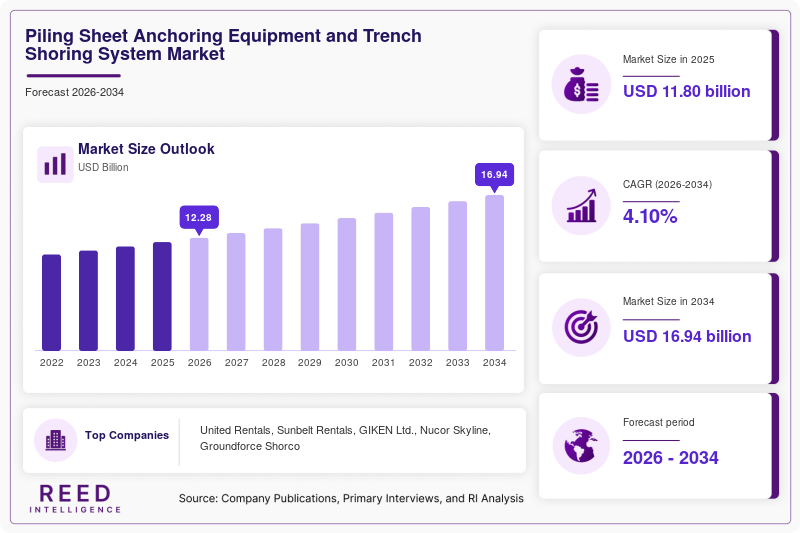
The global piling sheet anchoring equipment and trench shoring system market size was valued at USD 11.80 billion in 2025 and is projected to grow from USD 12.28 billion in 2026 to USD 17.10 billion by 2034, registering a CAGR of 4.10% during the forecast period from 2026 to 2034.
Demand is tied to the continued construction and rehabilitation of underground utilities, transportation infrastructure, water-management systems, foundations and flood-control structures. The equipment is also increasingly selected based on jobsite constraints: contractors need systems that can work close to existing utilities, roads, buildings and waterways while limiting ground movement, noise and vibration.
In the U.S., OSHA requires employees in excavations to be protected against cave-ins by an adequate protective system except in specified conditions, with requirements covering shoring, shielding and other protective methods. Infrastructure spending provides another demand channel: the U.S. Infrastructure Investment and Jobs Act provides approximately USD 350 billion for federal highway programs from FY2022 through FY2026, while FY2026 programs include substantial allocations for highway performance, bridge construction and other infrastructure activities.
The market is increasingly defined by the need to make deep and constrained excavations safer without creating excessive disruption to surrounding infrastructure. Traditional excavation methods can require large footprints, temporary access structures or extensive dewatering. Modern trench shields, hydraulic shores, sheet-pile systems, slide rails, walers and engineered bracing allow contractors to protect excavation walls while retaining usable working space.
OSHA's requirements make protective systems a fundamental part of many U.S. trenching projects. Excavations deeper than 5 feet generally require protection where employees are exposed to cave-in hazards, while excavations exceeding 20 feet require protective systems designed by a registered professional engineer.
Piling Sheet Anchoring Equipment and Trench Shoring System Market Drivers
Mandatory Excavation Protection and Worker-Safety Requirements
Safety regulations create a direct baseline for trench-shoring demand. OSHA's excavation standard requires employees to be protected from cave-ins using an adequate protective system unless the excavation meets specific exemptions. Acceptable systems include sloping, benching, shoring and shielding.
The commercial mechanism is particularly strong for contractors working on utility, sewer, drainage and foundation projects because protective systems become part of the project execution plan rather than an optional productivity accessory. OSHA also requires protective systems to withstand anticipated loads and requires manufacturer specifications and limitations to be followed when tabulated-data systems are used.
Recent enforcement activity reinforces the operational consequences. In April 2026, OSHA cited an Alabama home builder after a worker died when a sewage-pipe trench collapsed; investigators found the worker had been exposed to an unsupported section of trench.
This supports recurring demand for compliant trench boxes, hydraulic shores, sheeting and engineered systems.
Expansion of Transportation, Utility and Water Infrastructure
Underground infrastructure construction creates repeated requirements for temporary earth retention. FHWA's FY2026 highway programs include substantial funding for national highway performance, bridge replacement and rehabilitation, freight infrastructure and other transportation projects.
The relationship with shoring equipment is strongest where construction occurs below grade or adjacent to existing roads, utilities and structures. United Rentals' infrastructure applications include bridge excavations, road trenching and systems designed to prevent damage to existing utilities and surface infrastructure.
Water infrastructure is another important demand source. India's Jal Jeevan Mission reported that approximately 15.82 crore rural households had tap-water supply as of March 3, 2026, with remaining works continuing under implementation.
These projects require excavation for pipelines, drainage, treatment infrastructure and related structures, creating equipment demand throughout construction cycles.
Shift Toward Engineered and Low-Disruption Excavation Methods
Urban construction increasingly takes place where space is restricted and nearby structures, utilities, roads or waterways cannot be disturbed. This is increasing the value of engineered systems that provide excavation support while reducing the required footprint.
United Rentals' engineered systems include slide rails, sheet piling, hydraulic struts, beam-and-plate systems and custom-designed excavation support. Its slide-rail case study for Kansas City's sewer overhaul shows how modular shoring can be used near active roadways and utilities while maintaining excavation stability.
GIKEN's press-in technologies address a similar constraint for sheet piling. Its systems can install piles with low vibration and noise and, in certain configurations, without conventional temporary work platforms.
This creates a premium equipment segment around compact, engineered and environmentally compatible systems rather than only standard trench boxes.
Piling Sheet Anchoring Equipment and Trench Shoring System Market Restraints
High Equipment, Engineering and Mobilization Costs
Large sheet-pile systems, hydraulic bracing, specialized piling machines and engineered excavation systems require significant capital and technical expertise. Contractors must select equipment according to soil conditions, excavation depth, groundwater, adjacent loads and project geometry.
OSHA requires engineered designs in certain situations and manufacturer data must be followed when protective systems are based on tabulated specifications.
This increases the total project cost beyond the equipment itself because engineering, transportation, installation, inspection and removal can all contribute to the system cost.
Rental helps address the capital constraint. United Rentals maintains specialized trench-safety fleets and offers engineered design and on-site support, allowing contractors to use sophisticated equipment without owning every system.
Project-Specific Soil and Site Conditions
There is no single shoring system suitable for every excavation. Soil classification, groundwater, trench depth, adjacent structures, utility crossings and surcharge loads determine the appropriate protective system.
OSHA's excavation framework distinguishes soil types and requires competent-person assessment, while saturated or submerged conditions can require tight sheeting capable of resisting water pressure and preventing loss of backfill.
This variability increases engineering requirements and can slow equipment selection. It also means manufacturers and rental companies need broad fleets covering aluminum and steel shields, hydraulic shores, sheet piles, walers, slide rails and specialized bracing.
Piling Sheet Anchoring Equipment and Trench Shoring System Market Opportunities
Rental, Engineered Systems and Equipment-as-a-Service
Rental is becoming an important commercial route because trench-shoring requirements vary substantially from one project to another. Contractors can rent trench boxes, hydraulic shores, sheet piling and engineered systems based on project duration rather than owning equipment that may remain idle between projects.
United Rentals operates more than 100 trench-safety locations worldwide and combines equipment rental with engineering, installation guidance and site-specific designs.
Sunbelt Rentals similarly provides engineered sheet-and-frame systems with sheet piles, walers and hydraulic bracing designed for large, irregular and groundwater-affected excavations.
The opportunity therefore extends beyond equipment sales into rental, engineering, installation, inspection, training and maintenance.
Low-Vibration and Low-Noise Sheet-Pile Installation
Urban redevelopment and flood-protection projects create demand for piling methods that minimize disturbance to surrounding buildings, residents and infrastructure.
GIKEN's 2026 projects demonstrate this opportunity. In Ahmedabad, six SILENT PILER units are scheduled for a canal redevelopment involving approximately 50,000 U sheet piles; the project uses reusable steel sheet-pile retaining walls along approximately 20 km of both canal banks.
In Singapore, GIKEN reported growing adoption of its hat-sheet-pile press-in method for urban infrastructure, including road-tunnel, subway-renovation and sports-complex projects.
This creates room for equipment combining piling capability with reduced vibration, lower noise, compact footprints and digitally assisted operation.
Segmental Analysis
By Equipment Type
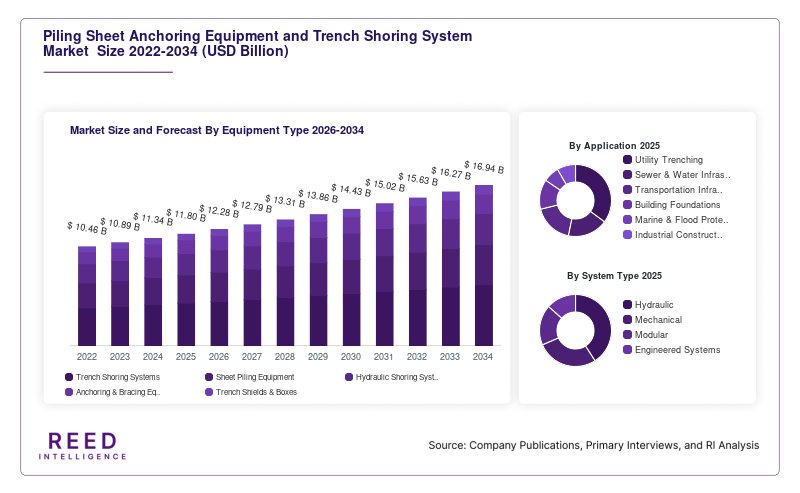
Trench Shoring Systems account for approximately 31% of the global market in 2025, making them the dominant equipment category. Their broad use across sewer, water, utility, road and foundation excavation gives them a larger application base than more specialized piling equipment. United Rentals' portfolio includes hydraulic shores, walers, end shores, manhole braces, trench shields and engineered systems.
Sheet Piling Equipment is the fastest-growing equipment category, registering approximately 5.2% CAGR. Sheet piling is particularly relevant for deeper excavations, saturated soils, retaining walls, flood-control projects and permanent earth-retention structures. OSHA recognizes steel sheet piling as a tight-sheathing option where water must be retained, while current GIKEN projects demonstrate growing use of press-in sheet-pile technology in urban infrastructure.
By Application
Utility Trenching represents approximately 30% of the market in 2025, supported by water, sewer, gas, electrical and telecommunications projects. The application requires equipment that protects workers while accommodating existing utilities and maintaining narrow excavation footprints.
Marine & Flood Protection is the fastest-growing application at approximately 5.8% CAGR. Flood-control projects increasingly use sheet piles, tubular piles and specialized press-in equipment. GIKEN's 2026 projects in the Netherlands, Italy and the U.K. demonstrate the use of sheet and tubular piling for levee reinforcement and flood defenses.
By System Type
Hydraulic Systems hold approximately 39% market share in 2025. Hydraulic shores and hydraulic bracing provide adjustable support and can be installed in changing excavation conditions.
Engineered Systems are the fastest-growing system category, with approximately 5.9% CAGR. They are increasingly relevant for deep, irregular or constrained excavations where standard trench boxes cannot provide the required working geometry. United Rentals provides engineered slide rails, hydraulic struts, sheet piling and beam-and-plate systems supported by professional engineers.
By End Use
Construction Contractors account for approximately 43% of the global market in 2025, reflecting their role across building foundations, utilities, roads, sewer projects and general excavation.
Infrastructure Developers are the fastest-growing end-user group, registering approximately 5.6% CAGR. Large infrastructure programs tend to involve longer excavation periods, complex site conditions and higher requirements for engineered earth retention.
FHWA's FY2026 infrastructure programs and India's continuing water-infrastructure investment illustrate the scale of public works that can generate demand for excavation support systems.
Regional Analysis
North America Piling Sheet Anchoring Equipment and Trench Shoring System Market
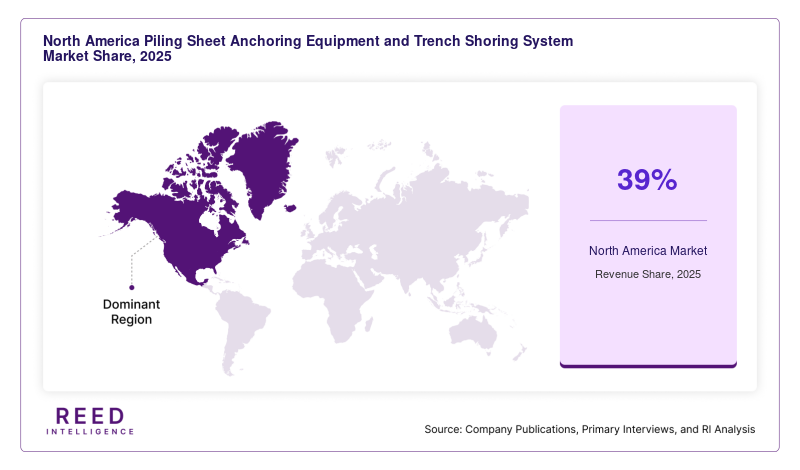
North America represents approximately 39% of the global market in 2025, making it the largest regional market. The region benefits from mature construction-safety regulation, extensive underground utility infrastructure, large rental fleets and continued transportation and water-infrastructure investment.
The U.S. regulatory environment provides a particularly strong structural demand mechanism. OSHA's excavation standard requires adequate protective systems where workers face cave-in hazards and specifies requirements for shoring, shielding, design, installation and removal.
Infrastructure spending adds another demand layer. The IIJA provides approximately USD 350 billion for federal highway programs through FY2026, and FY2026 allocations include substantial National Highway Performance Program and bridge-related funding.
The rental ecosystem is also highly developed. United Rentals operates a large trench-safety fleet spanning steel and aluminum shields, hydraulic shores, slide rails, sheet piling and engineered systems.
North America is projected to grow at approximately 3.8% CAGR. Demand will remain linked to utility replacement, transportation projects, sewer upgrades and commercial construction. The market's maturity and relatively high equipment penetration limit the growth rate compared with emerging infrastructure markets.
Europe Piling Sheet Anchoring Equipment and Trench Shoring System Market
Europe accounts for approximately 25% of the global market in 2025 and is projected to grow at approximately 3.7% CAGR. Demand is supported by urban redevelopment, rail and road construction, water infrastructure, flood defenses and increasingly constrained construction sites.
Flood protection is particularly relevant. GIKEN reported in April 2026 that its Implant Method was being used in the Netherlands' Delta Programme to reinforce river levees, with approximately 4,500 pairs of Z sheet piles and 2,500 tubular piles planned along approximately 10 km.
In Italy, approximately 1,900 Z sheet piles were scheduled for a levee-reinforcement project using GIKEN's SILENT PILER and GRB System, while in the U.K. its Gyropress method was adopted for the first time in a Derby flood-defense project.
These projects demonstrate a shift toward low-noise, low-vibration and low-footprint installation methods, particularly in dense urban and environmentally sensitive locations.
The region's main constraints include high engineering requirements, environmental permitting and complex urban working conditions. Nevertheless, flood resilience and aging infrastructure provide recurring demand for sheet piling and engineered shoring.
APAC Piling Sheet Anchoring Equipment and Trench Shoring System Market
APAC represents approximately 24% of the global market in 2025 and is the fastest-growing region at approximately 5.6% CAGR. The region combines rapid urbanization, transportation construction, water infrastructure expansion and major redevelopment projects.
India is an important growth market. GIKEN's June 2026 announcement described the adoption of six SILENT PILER machines for Ahmedabad's Kharicut Canal Redevelopment Project Phase 2. Approximately 50,000 U sheet piles are planned for retaining walls across approximately 20 km of canal banks, with construction planned through December 2028.
GIKEN also opened a strategic base in Ahmedabad in June 2026, supporting its efforts to expand press-in technology in the Indian market.
Singapore provides another signal. GIKEN reported rising demand for hat sheet-pile press-in methods in urban infrastructure, including subway renovation, road-tunnel and sports-complex projects.
India's continuing water infrastructure program provides an additional demand base. As of March 2026, the Jal Jeevan Mission reported tap-water connections for approximately 81.71% of rural households, with remaining infrastructure works continuing.
APAC's faster growth is therefore connected to urban infrastructure, water systems, flood management and constrained construction environments.
Middle East and Africa Piling Sheet Anchoring Equipment and Trench Shoring System Market
Middle East and Africa account for approximately 6% of the global market in 2025 and are projected to grow at approximately 4.8% CAGR. Demand is concentrated in Gulf infrastructure, large urban-development projects, transport infrastructure, utilities and water-management systems.
The region's construction environment favors equipment capable of handling difficult soil conditions, deep foundations and large-scale excavation. Infrastructure projects often require temporary earth retention around roads, underground utilities and major structures.
Water and wastewater projects are particularly relevant because many Middle Eastern markets must develop infrastructure under constrained water conditions. Excavation support is required for pipelines, treatment facilities, reservoirs and underground utility networks.
Africa presents a more fragmented market. Major infrastructure and urban-development projects can create demand for sheet piling and trench protection, but purchasing capacity and equipment availability vary significantly by country.
The region is projected to grow at approximately 4.8% CAGR. Rental and equipment-leasing models can reduce the capital barrier for contractors that require specialized shoring equipment only for individual projects.
LATAM Piling Sheet Anchoring Equipment and Trench Shoring System Market
LATAM represents approximately 6% of the global market in 2025 and is projected to grow at approximately 4.6% CAGR. Demand is connected to urban infrastructure, water and sanitation projects, transportation construction, industrial facilities and flood-control requirements.
Utility trenching remains a key application because expanding cities require water, sewer, electricity, telecommunications and gas infrastructure. These projects frequently occur in established urban corridors where excavation space is limited and existing utilities create additional loads.
Infrastructure modernization also supports sheet-piling applications in ports, bridges, drainage systems and flood-control projects. The commercial opportunity is strongest in Brazil, Mexico, Argentina, Chile and Colombia, where larger infrastructure programs provide more consistent demand.
The principal constraint is uneven construction investment and availability of specialized equipment. Contractors may favor rental or imported equipment rather than maintaining large dedicated fleets.
LATAM is projected to grow at approximately 4.6% CAGR, with water infrastructure, transportation and urban utility construction providing the main demand channels.
Competitive Landscape
The competitive landscape combines specialized shoring manufacturers, sheet-pile and piling-equipment companies, construction-equipment rental companies and engineering-service providers. Competition is increasingly based on system design rather than equipment alone.
United Rentals has built a broad trench-safety platform covering steel and aluminum shields, hydraulic shores, walers, slide rails, sheet piling, beam-and-plate systems and engineered excavation support. Its model combines equipment rental with engineering, site consultation and training, increasing customer retention around complex projects.
Sunbelt Rentals similarly combines equipment and engineered solutions, including sheet-and-frame systems designed for large, irregular and groundwater-affected excavations.
Key Market Players
- United Rentals
- Sunbelt Rentals
- GIKEN Ltd.
- Nucor Skyline
- Groundforce Shorco
- SBH Tiefbautechnik
- Efficiency Production
- Ischebeck
- MOVAX
- Junttan
- Pileco
- ABI Equipment
- ArcelorMittal Sheet Piling
- ESC Group
- Liebherr
- Bauer
- Soilmec
- Nippon Sharyo
- Hercules Machinery
- American Equipment & Fabricating
Recent Market Developments
- September 2026 – GIKEN: The company announced continued adoption of its Implant Method in Thailand for a riverbank protection and fender-system project, involving 527 hat sheet piles. The project extends press-in technology into marine and river infrastructure.
- April 2026 – United Rentals: The company published updated guidance distinguishing trench shoring from trench shielding and explaining how protective-system selection changes according to excavation conditions.
Piling Sheet Anchoring Equipment and Trench Shoring System Market Segments
By Equipment Type
- Trench Shoring Systems
- Sheet Piling Equipment
- Hydraulic Shoring Systems
- Anchoring & Bracing Equipment
- Trench Shields & Boxes
By Application
- Utility Trenching
- Sewer & Water Infrastructure
- Transportation Infrastructure
- Building Foundations
- Marine & Flood Protection
- Industrial Construction
By System Type
- Hydraulic
- Mechanical
- Modular
- Engineered Systems
By End Use
- Construction Contractors
- Utility Contractors
- Infrastructure Developers
- Government & Municipalities
- Industrial Operators
By Region
- North America
- Europe
- APAC
- Middle East and Africa
- LATAM