Pingueculum Drug Market Size, Share & Demand Report By Drug Type (Artificial Tears, Anti-inflammatory Drugs, Corticosteroids, Lubricants), By Treatment Type (Symptomatic Treatment, Curative Treatment), By Distribution Channel (Hospital Pharmacies, Retail Pharmacies, Online Pharmacies), By End-User (Hospitals, Clinics, Home Care Settings), By Region & Segment Forecasts, 2025–2034
USD 3950
Market Overview
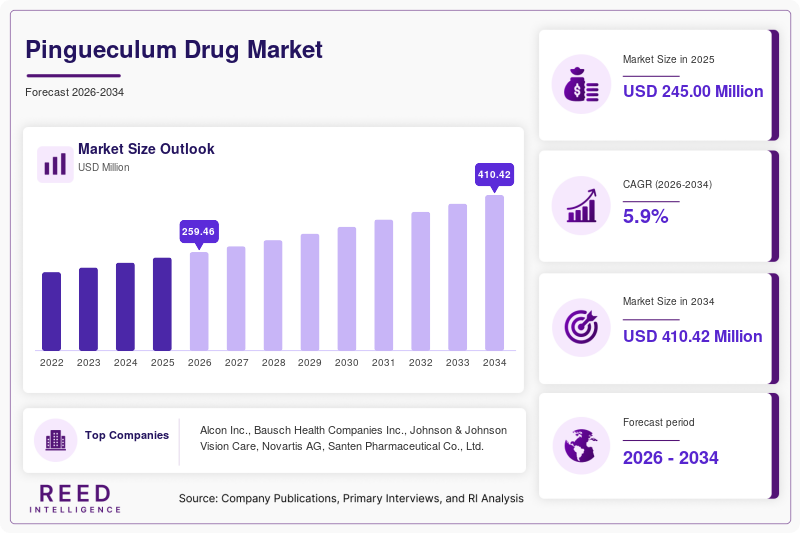
The global Pingueculum Drug Market size was valued at approximately USD 245 million in 2025 and is projected to reach USD 412 million by 2034, expanding at a CAGR of 5.9% during the forecast period (2025–2034). The market growth is primarily driven by the rising prevalence of ocular surface disorders associated with prolonged exposure to ultraviolet (UV) radiation, environmental pollutants, and increasing screen time across both developed and emerging economies.
A significant global factor supporting the expansion of the Pingueculum Drug Market is the growing awareness regarding preventive eye care and early diagnosis of benign conjunctival conditions. Healthcare systems worldwide are increasingly emphasizing routine ophthalmic screenings, which has led to a higher diagnosis rate of pingueculum and subsequent demand for therapeutic interventions such as lubricating eye drops, anti-inflammatory drugs, and corticosteroids.
Key Highlights
- North America dominated the market with a share of 38.2% in 2025, while Asia Pacific is expected to register the fastest CAGR of 7.1% during the forecast period.
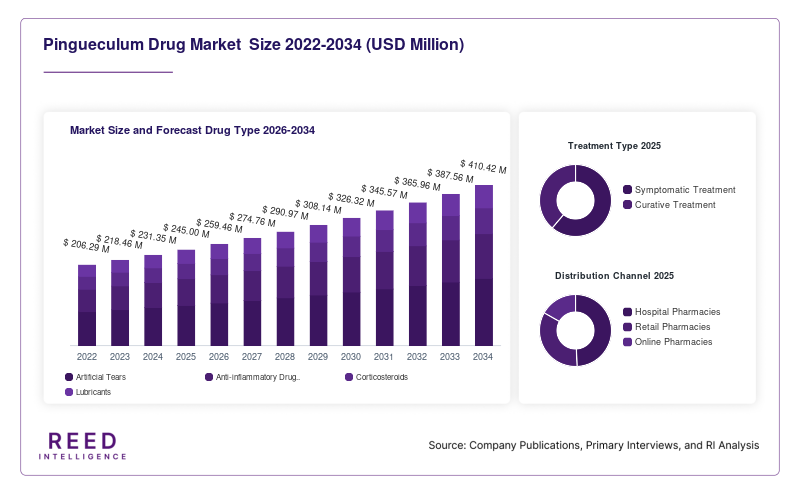
- Artificial tears led the drug type segment with a 46.5% share, whereas corticosteroids are projected to grow at the fastest CAGR of 6.8%.
- Hospital pharmacies accounted for the largest distribution share at 41.3%, while online pharmacies are expected to expand at a CAGR of 8.2%.
- The United States remained the dominant country, with market values of USD 78.5 million in 2025 and USD 82.3 million in 2026.
Market Trends
Rising Preference for Non-Invasive Therapeutics
A notable trend in the Pingueculum Drug Market is the increasing preference for non-invasive treatment approaches. Patients and healthcare providers are favoring lubricating eye drops and mild anti-inflammatory medications over surgical interventions due to lower risks, affordability, and ease of administration. This shift is encouraging pharmaceutical companies to develop advanced formulations with enhanced bioavailability and longer-lasting relief, which is reshaping treatment protocols globally.
Expansion of OTC Eye Care Products
Another key trend shaping the Pingueculum Drug Market is the rapid expansion of over-the-counter eye care solutions. Consumers are increasingly self-managing mild ocular conditions, supported by the availability of OTC artificial tears and lubricants. Retail pharmacies and e-commerce platforms are playing a critical role in improving product accessibility. This trend is particularly strong in urban regions, where awareness levels and disposable incomes are higher, leading to sustained demand growth.
Market Drivers
Increasing Exposure to Environmental Stressors
The rising exposure to environmental pollutants, dust, wind, and ultraviolet radiation is a primary driver of the Pingueculum Drug Market. Urbanization and industrialization have intensified environmental conditions that contribute to ocular surface irritation. Individuals working in outdoor environments or high-pollution areas are particularly susceptible, leading to increased diagnosis rates and higher demand for therapeutic drugs.
Growing Geriatric Population
The global increase in the aging population is another significant driver. Older individuals are more prone to degenerative eye conditions, including pingueculum, due to cumulative exposure to environmental factors and reduced ocular surface resilience. As life expectancy rises, the demand for long-term eye care solutions, including anti-inflammatory and lubricating drugs, is expected to grow steadily, supporting overall market expansion.
Market Restraint
Limited Awareness in Rural and Underserved Regions
A major restraint in the Pingueculum Drug Market is the limited awareness and underdiagnosis of the condition in rural and underserved areas. Many individuals perceive pingueculum as a minor cosmetic issue rather than a condition requiring medical attention. This lack of awareness leads to delayed treatment and reduced demand for pharmaceutical interventions.
Additionally, restricted access to ophthalmic healthcare services in low-income regions further hinders market penetration. The absence of specialized eye care professionals and limited availability of advanced treatment options contribute to slower adoption rates. While urban areas show strong growth, the disparity between urban and rural healthcare infrastructure remains a key challenge for market players aiming to achieve broader market coverage.
Market Opportunities
Development of Combination Therapies
The development of combination drug therapies presents a significant opportunity in the Pingueculum Drug Market. Pharmaceutical companies are increasingly focusing on formulations that combine lubricating agents with anti-inflammatory compounds to provide comprehensive symptom relief. These products offer enhanced patient convenience and improved treatment outcomes, which can drive higher adoption rates.
Growth in Emerging Markets
Emerging economies present substantial growth opportunities due to improving healthcare infrastructure and rising disposable incomes. Increasing investments in ophthalmology clinics and expanding distribution networks are enabling better access to eye care treatments. As awareness campaigns gain traction in these regions, the demand for pingueculum drugs is expected to rise, creating new revenue streams for market participants.
Segmental Analysis
By Drug Type
Artificial tears dominated the Pingueculum Drug Market in 2025, accounting for 46.5% of the total share. Their widespread use as a first-line treatment for mild symptoms such as dryness and irritation contributed to their leading position. These products are easily accessible and often available without prescription, which has supported high adoption rates across various demographics.
Corticosteroids are expected to register the fastest CAGR of 6.8% during the forecast period. Their effectiveness in reducing inflammation and redness will drive increased adoption, particularly in moderate to severe cases. Advancements in formulation technology are expected to enhance safety profiles, further supporting growth.
By Treatment Type
Symptomatic treatment dominated the market with a 58.2% share in 2025. This segment primarily includes lubricants and mild anti-inflammatory drugs aimed at relieving discomfort rather than eliminating the lesion. The preference for non-invasive treatment options contributed to its dominance.
Curative treatment is projected to grow at a CAGR of 6.5%. Increasing research into targeted therapies aimed at addressing the underlying pathology will drive growth. Innovations in drug delivery systems are expected to improve treatment efficacy.
By Distribution Channel
Hospital pharmacies held the largest share of 41.3% in 2025, supported by higher patient trust and access to prescription medications. Patients diagnosed in clinical settings often prefer purchasing drugs directly from hospital pharmacies.
Online pharmacies are anticipated to grow at the fastest CAGR of 8.2%. The convenience of home delivery and competitive pricing will drive adoption. Increasing internet penetration and digital healthcare platforms will further accelerate growth.
By End-User
Hospitals dominated the segment with a 49.1% share in 2025 due to the availability of specialized ophthalmic care and advanced diagnostic tools. Patients often seek treatment in hospital settings for accurate diagnosis and management.
Home care settings are expected to grow at a CAGR of 7.0%. The rising trend of self-medication and availability of OTC products will support this growth. Patients with mild symptoms increasingly prefer home-based treatment options.
Regional Analysis
North America
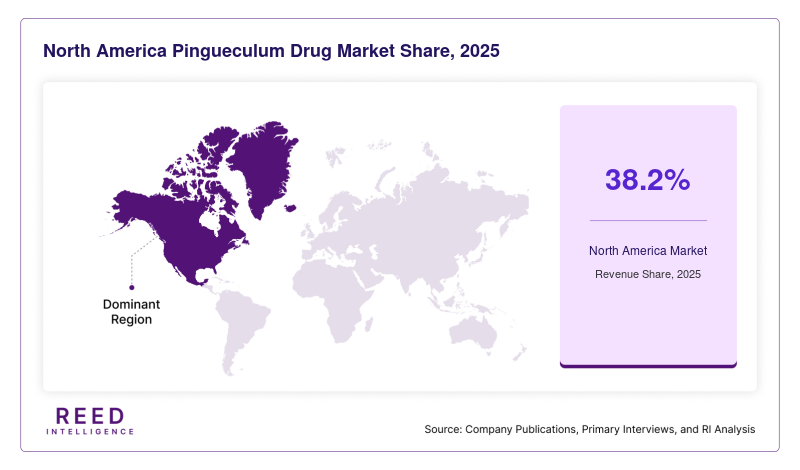
North America accounted for a 38.2% share of the Pingueculum Drug Market in 2025 and is expected to grow at a CAGR of 5.4% during the forecast period. The region benefited from a well-established healthcare system and high awareness regarding ocular health. The presence of advanced diagnostic facilities supported early detection and treatment adoption.
The United States dominated the regional market due to its strong healthcare infrastructure and widespread availability of ophthalmic drugs. A key growth factor in the country was the increasing prevalence of screen-related eye strain, which contributed to higher demand for lubricating and anti-inflammatory treatments.
Europe
Europe held a 27.6% share of the Pingueculum Drug Market in 2025 and is projected to expand at a CAGR of 5.2%. The region demonstrated steady growth supported by government initiatives promoting eye health and preventive care.
Germany emerged as the dominant country, driven by its advanced pharmaceutical industry and high healthcare expenditure. The growing adoption of OTC eye care products in the country played a significant role in supporting market growth.
Asia Pacific
Asia Pacific captured 21.4% of the Pingueculum Drug Market in 2025 and is anticipated to grow at the fastest CAGR of 7.1% during the forecast period. The region experienced rapid growth due to increasing urbanization and rising awareness about eye care.
China led the regional market, supported by a large population base and improving healthcare infrastructure. A distinct growth factor was the increasing exposure to environmental pollution, which heightened the incidence of ocular surface disorders and boosted demand for treatment solutions.
Middle East & Africa
The Middle East & Africa region held an 7.3% share of the Pingueculum Drug Market in 2025 and is expected to grow at a CAGR of 4.8%. Growth in this region was supported by gradual improvements in healthcare access and rising awareness.
Saudi Arabia dominated the market due to increasing investments in healthcare infrastructure. A key growth factor was the high exposure to sunlight and arid climatic conditions, which contributed to a higher prevalence of pingueculum.
Latin America
Latin America accounted for 5.5% of the Pingueculum Drug Market in 2025 and is projected to grow at a CAGR of 5.0%. The region showed moderate growth supported by expanding healthcare services.
Brazil emerged as the leading country, driven by increasing awareness and improving access to ophthalmic treatments. The expansion of retail pharmacy networks played a significant role in enhancing drug availability and supporting market growth.
Competitive Landscape
The Pingueculum Drug Market is moderately fragmented, with several global and regional players competing based on product innovation, pricing strategies, and distribution networks. Leading companies are focusing on expanding their ophthalmic portfolios and investing in research to develop advanced formulations.
A key market leader is Alcon Inc., which has strengthened its position through continuous product innovation and a strong global presence. The company recently introduced an advanced lubricating eye drop formulation designed to provide longer-lasting relief, enhancing its competitive edge.
Other players are adopting strategies such as partnerships, mergers, and geographic expansion to increase their market share. The competitive environment is expected to intensify as new entrants introduce cost-effective solutions and established companies enhance their product offerings.
Key Players
- Alcon Inc.
- Bausch Health Companies Inc.
- Johnson & Johnson Vision Care
- Novartis AG
- Santen Pharmaceutical Co., Ltd.
- Allergan (AbbVie Inc.)
- Sun Pharmaceutical Industries Ltd.
- Cipla Ltd.
- Rohto Pharmaceutical Co., Ltd.
- Otsuka Pharmaceutical Co., Ltd.
- Akorn, Inc.
- Prestige Consumer Healthcare Inc.
- Similasan Corporation
- URSAPHARM Arzneimittel GmbH
- Théa Pharmaceuticals
Recent Developments
- In 2024, Alcon Inc. launched a next-generation preservative-free artificial tear solution aimed at improving patient comfort.
- In 2024, Santen Pharmaceutical expanded its distribution network in Asia Pacific to enhance market penetration.
- In 2023, Bausch Health introduced a new anti-inflammatory ophthalmic formulation targeting mild ocular surface conditions.
- In 2023, Cipla Ltd. strengthened its OTC eye care portfolio with affordable lubricating eye drops in emerging markets.
- In 2024, Novartis AG invested in research for advanced ocular drug delivery systems to improve treatment efficacy.
Pingueculum Drug Market Segments
Drug Type
- Artificial Tears
- Anti-inflammatory Drugs
- Corticosteroids
- Lubricants
Treatment Type
- Symptomatic Treatment
- Curative Treatment
Distribution Channel
- Hospital Pharmacies
- Retail Pharmacies
- Online Pharmacies
End-User
- Hospitals
- Clinics
- Home Care Settings
By Region
- North America
- Europe
- APAC
- Middle East and Africa
- LATAM